SOLAR MELTDOWN......almost a FIRE!!!

   / SOLAR MELTDOWN......almost a FIRE!!! #21  
Some people are scared of math, but this stuff isn't too bad. Let's see how bad a teacher I am... Watts = Volts X Amps. AC, or DC voltage. So, your 1200W microwave at 120v uses 10 amps... 1200/120=10 That easy...

Now lets go a little deeper.. I(amps)=V/R, Current = volts /resistance Most simple chargers use a constant voltage to avoid overcharging the batteries, and the voltage is actually the difference between the panel voltage, and the batteries. The resistance is in the batteries, and is very small, almost non-existent.

Think of a teeter totter with a bucket of water in the center, the steeper the angle, the faster water flows. The greater the voltage difference between the panel and your batteries, the more current flows. As the battery voltage increases, the current drops off until it reaches "float" If the sun goes behind the clouds, the voltage of the panel drops, and the current drops as well. Your 12 volt battery needs 13.6 volts to be fully charged at 12.4 volts that little difference in voltage allows little current to still flow.

Does that make sense? or did I mess that up...

Glad to help, I would want someone to treat me the same if I had questions.
 
   / SOLAR MELTDOWN......almost a FIRE!!! #22  
if the controller fryed, you could have been reading battery voltage flowing back through the panels,
 
   / SOLAR MELTDOWN......almost a FIRE!!! #23  
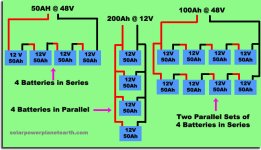
Here's an illustration I found that explains series connections, parallel connections, and series/parallel connections. It's pretty helpful...

B54D88B7-0ED4-4858-B8AA-02748D20F534.jpeg
 
   / SOLAR MELTDOWN......almost a FIRE!!!
  • Thread Starter
#24  
[quote from mbowhunter] "Now lets go a little deeper.. I(amps)=V/R, Current = volts /resistance Most simple chargers use a constant voltage to avoid overcharging the batteries, and the voltage is actually the difference between the panel voltage, and the batteries. The resistance is in the batteries, and is very small, almost non-existent."

Thank you,Bohunter. Can we go one step further.....do SOLAR controllers allow more current to pass if the batteries are low? That would be nice if they COULD. The solar panels produce X amount of current at 18 or so volts. The controller drops that to 14 +/- volts so as not to harm the batteries. So how would the amperage vary if the voltage is limited to 14V. Does a "low" battery add to the resistance? I'm sorta lost..... Sorry.
 
   / SOLAR MELTDOWN......almost a FIRE!!! #25  
[quote from mbowhunter] "Now lets go a little deeper.. I(amps)=V/R, Current = volts /resistance Most simple chargers use a constant voltage to avoid overcharging the batteries, and the voltage is actually the difference between the panel voltage, and the batteries. The resistance is in the batteries, and is very small, almost non-existent."Thank you,Bohunter. Can we go one step further.....do SOLAR controllers allow more current to pass if the batteries are low? That would be nice if they COULD. The solar panels produce X amount of current at 18 or so volts. The controller drops that to 14 +/- volts so as not to harm the batteries. So how would the amperage vary if the voltage is limited to 14V. Does a "low" battery add to the resistance? I'm sorta lost..... Sorry.

There are many different types of chargers out there. The current is limited first, by the watts of your panel(s), and second, by the charge controller. Lead acid batteries are recommended to charge at a certain rate maximum, to prevent boiling, and a minimum to limit sulfation.

What most people don't realize is that a battery that is low, is essentially a short circuit in that the internal resistance is measured in milli ohms. If you did the math, the amps that it COULD draw is very high However... in the real world, the charger won't let that happen because the panels and the charger would be damaged. The circuit internals are sized to only handle less than 20 amps.
It is the voltage difference that allows current... no voltage difference, no current.. current flow is limited by resistance. More resistance means less current.


your panels are 4(100watt) panels, and in a perfect world will produce 22 amps. 400/18 volts=22 amps. A pulse charger, if I understand them correctly use a square wave higher voltage pulse to protect against sulfation even during long periods of being on float.

Here is a link that you might like... BatteryStuff | Knowledge Base


If you take your 12v battery and put a 10 watt incandescent battery on it... 10watts/12volts = .83 amps, or nearly an amp per hour.. A incandescent light is nothing but a resistor, so take your battery internals.. say .020ohms, or 20 milli ohms...

now your potential difference is say 3 volts because you have 11 volts on your battery,14 volts on your unlimited power super whamadyne charger, and an UNLIMITED current supply, not your panels... 3volts/ .02 ohms = 150 amps!

Theoretically, your battery is a short... but only in the theoretical world, you should understand this before you charge.. always protect battery chargers and loads with fuses..

Keep asking any questions, We are all here to learn, and i'm certainly no expert....
 
Last edited:
   / SOLAR MELTDOWN......almost a FIRE!!! #26  
Looks like a loose connection at the voltmeter was the culprit. The "before" diagram shows the load being connected to run through the Stakons on the ends of the wires. Loose connection for a load = heat. What I don't understand is how that ammeter worked if it was connected as in the "before" diagram. It appears to have been connected in parallel with the batteries.

A voltmeter won't be damaged by connecting it in series with a voltage within its range. However, voltmeters are designed with a very high internal resistance, so the load won't get sufficient voltage to operate. An easy way to find a bad fuse is to connect a voltmeter across the fuse in a circuit that should be operating. If the meter reads source voltage, the fuse is blown.
 
   / SOLAR MELTDOWN......almost a FIRE!!!
  • Thread Starter
#27  
Looks like a loose connection at the voltmeter was the culprit. The "before" diagram shows the load being connected to run through the Stakons on the ends of the wires. Loose connection for a load = heat.
What I don't understand is how that ammeter worked if it was connected as in the "before" diagram. It appears to have been connected in parallel with the batteries.


Thank you, Chim. The AMPMETER did NOT work....my bad, I guess I had it wired wrong. I had never installed a shunt and had it wired incorrectly. Bowhunter sent a you tube link to correct that mistake.
I am concerned about those "loose" connections on the Voltmeter though. I wired that up 5 years ago and it has been fine. The little posts on the cheap V-meter are just that....small...a small post with a small nut. I torqued them down as much as I dared and was worried that I would twist the post out of the plastic meter. What would you do....maybe "recheck" them every 6 months or so?:confused:
 
   / SOLAR MELTDOWN......almost a FIRE!!! #28  
Make the connections on a terminal strip near by that is rated for the size of the wires, and run a pair of smaller jumper wires from there over to the meter, so that its connections are only for sensing the voltage.
 
   / SOLAR MELTDOWN......almost a FIRE!!!
  • Thread Starter
#29  
Make the connections on a terminal strip near by that is rated for the size of the wires, and run a pair of smaller jumper wires from there over to the meter, so that its connections are only for sensing the voltage.
Mr. Lyford, that is a great idea. Now, I'm always thinking of the "easiest" or least risk way of doing something sooo..... Instead of cutting the 10 GA red wire and putting it on a terminal strip with lugs etc.....What if I just ran a smaller 16GA wire back up to the fuse box where the HOT wire originates? Wouldn't that be the same result? If it's a bad idea please tell me, thanks:confused:
 
   / SOLAR MELTDOWN......almost a FIRE!!! #30  
I would suggest wiring it as glyford suggested and use something like this for a terminal block.

MPDB63162
 
   / SOLAR MELTDOWN......almost a FIRE!!! #31  
Mr. Lyford, that is a great idea. Now, I'm always thinking of the "easiest" or least risk way of doing something sooo..... Instead of cutting the 10 GA red wire and putting it on a terminal strip with lugs etc.....What if I just ran a smaller 16GA wire back up to the fuse box where the HOT wire originates? Wouldn't that be the same result? If it's a bad idea please tell me, thanks:confused:
If it were me, I would take the wires that are currently in two pieces to connect to the voltmeter and replace them with a single wire to go from point A to point B. Then add another pair of wires that is dedicated to the voltmeter.

Aaron Z
 
   / SOLAR MELTDOWN......almost a FIRE!!! #32  
If it were me, I would take the wires that are currently in two pieces to connect to the voltmeter and replace them with a single wire to go from point A to point B. Then add another pair of wires that is dedicated to the voltmeter.

Aaron Z

I would take this one step further. I would wire the panels directly to the batteries (unless you really want the ammeter telling you how much current your panels are sending to the batteries) and then have a separate wire with a small fuse on the positive line going to the voltmeter. The less connections the better when transmitting power. With a fuse going to the voltmeter you are protected in case something shorts across the two terminals. You have 4 batteries that will produce hundreds of amps of power if something is shorted. I would also use electrical contact grease, like No-OX, on each connector.
 
   / SOLAR MELTDOWN......almost a FIRE!!!
  • Thread Starter
#33  
I would wire the panels directly to the batteries (unless you really want the ammeter telling you how much current your panels are sending to the batteries) and then have a separate wire with a small fuse on the positive line going to the voltmeter.

Crazyal, sounds good BUT please clarify...panels directly to the CONTROLLER then the batteries.....right? And about this fuse....The big fuses I have off the panels are TWO, 20 ampers....should I use a 20A in line fuse to protect the Vmeter? I bought a 30V range V meter (and a 30 amp Amp meter) Thanks
 
   / SOLAR MELTDOWN......almost a FIRE!!!
  • Thread Starter
#34  
AaronZ, the single wires to the V meter can be lighter gauge, right? And another fellow recommended an "inline" fuse going to the meter....that sounds like a good idea. Would have prevented the issue that I had. Thanks
 
   / SOLAR MELTDOWN......almost a FIRE!!! #35  
Yes, the single wires to the meter can be a lighter gauge, and the size of the fuse in those wires should be whatever matches that size wire. It is there to protect those wires (and the meter)...unless the meter is rated for less, then it should be whatever matches the meter. I suspect something like 2A would be plenty...?
 

Tractor & Equipment Auctions

2020 Deere 750K LGP (A53317)
2020 Deere 750K...
ALLMAND NIGHT-LIGHT PRO 4 BULB LIGHT PLANT (A52706)
ALLMAND...
Land Pride RCR1260 (A53317)
Land Pride RCR1260...
2018 FREIGHTLINER CASCADIA TANDEM AXLE SLEEPER (A59904)
2018 FREIGHTLINER...
2016 FORD F-250 SUPER DUTY (A58214)
2016 FORD F-250...
2009 Ford Econoline Wagon Van, 101,671 Miles (A56438)
2009 Ford...
 
Top