Stabilizer Arm stuck

   / Stabilizer Arm stuck #1  

swigginton

New member
Joined
Jul 15, 2008
Messages
22
Location
Chesapeake, VA
Tractor
1939 Ford 9n, 2003 Branson 3510i
Hey everyone, my first post on TBN and unfortunately it is because my backhoe is out of commission.

I have a 2003 Branson 3510i with the 7620 backhoe purchased last summer with 800 hours on it. I was using the backhoe to breakup a tall pile of hardened dirt/clay that's about 8' tall and after dislodging a large chunk of concrete caused a large dirt slide that was high enough to accumulate at the base of the backhoe (the concrete did not make contact tho). After making several runs with the FEL to clear the loose dirt I came back to break it up again but then my left stabilizer arm refused to go down. All of my other hydraulics (FEL and BH) work just fine.

I took it back to the garage and cleaned out a bunch of greasy dirt/clay and small rocks around any and all of the hydraulic lines and it still would not budge. I tried putting some weight on it but didn't want to hit it with a sledge fearing I might do more damage.

I have no knowledge of hydraulics and would greatly appreciate any advice/suggestions.

Thanks ,

Scott
 
   / Stabilizer Arm stuck #2  
Scott,

Welcome to TBN. I'm pretty new here myself compared to some of the other posters. You'll find a wealth of information here. If my post doesn't help, some of those more experienced will probably chime in.

I don't think the work you did prior to this problem had anything to do with it.
I doubt that the cylinder is jammed. A cylinder is more likely go get jammed when retracting the stabilizer because of a bent cylinder rod (like if you tried to drive the tractor while the stabilizers were down). A rod is more vulnerable to bending when it's fully extended. And yes, those big thick shiny steel rods will bend like rubber under the right conditions.

I think it's more likely that the cylinder isn't getting pressurized fluid because of a faulty control valve or bad hydraulic line or connector.

Don't hit it with a sledge hammer, but have someone hold the control in the "let it down" position and apply as much pressure as possible to move the stabilizer down. You could even tap it with a sledge as long as the "let it down" control is open.

If it still won't go down, my next step would be to disconnect the hydraulic lines to the cylinder. If it still won't go down, you've got a frozen mechanical joint or a badly damaged cylinder.

If it does go down, you've got a problem with your control valve.

Let us know what you tried and what the results were.
 
   / Stabilizer Arm stuck #3  
i agree with ted on this but also check your lines that dirt that fell could have mashed a hard line flat or kinked a fitting. just make sure that your line are ok.
 
   / Stabilizer Arm stuck
  • Thread Starter
#4  
Had my uncle bounce slightly on the tip of the arm while trying to lower it to no avail. The hoses do not look damaged in the slightest, nor do the connections.

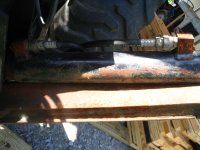
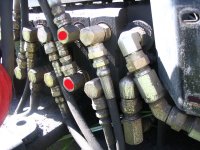
I am attaching pictures of the stabilizer arm hookups and the main backhoe hookups (the red dots indicate the lines coming from that stabilizer arm).

TedLaRue said:
If it still won't go down, my next step would be to disconnect the hydraulic lines to the cylinder. If it still won't go down, you've got a frozen mechanical joint or a badly damaged cylinder.

Could you point out on my picture which line you are referring to?

Also, since I've never messed with connecting/disconnecting any hydraulic lines, what procedures do I need to know about?

Thanks again,

Scott
 

Attachments

  • Main Hydraulic Connection.jpg
    Main Hydraulic Connection.jpg
    126.4 KB · Views: 533
  • Stabilizer Hydraulic Connection.jpg
    Stabilizer Hydraulic Connection.jpg
    101 KB · Views: 416
   / Stabilizer Arm stuck #5  
When your stabilizer arm is being forced down, the hose attached to the upper end of the cylinder (closest to the seat) will carry fluid under pressure, and the hose attached to the lower end of the cylinder (nearest the foot of the stabilizer) will carry unpressurized fluid back to the sump.

Before you remove any hoses, you might check the cylinder to see if it has any dents in it (possibly caused by a rock caught between it and the arm, for example).

Remove one end of the hose which is connected to the end of the cylinder closest to the foot of the stabilizer (I think it's the one on the right in your picture of the cylinder). Then (tractor off) move the lever to the position to lower the stabilizer.

If it still won't go down, then my next move would be to remove the pin from one end of the cylinder so it's not connected to the arm and see if the arm will go down then. If not, then it's definitely a frozen up joint.

You could also remove both hoses from the cylinder and see if you can move the rod in and out of the cylinder (to make sure the cylinder isn't stuck).
 
   / Stabilizer Arm stuck #6  
Did I read that when you do move the lever to lower that stabilizer, the tractor makes absolutely no change in sound or RPM ?
 
   / Stabilizer Arm stuck #7  
Willl (once again!) brings up a very good point.

Scott, I don't believe you said anything about the tractor engine sounding like it was or was not under load, nor anything about hearing a relief valve squealing. If there's no indication of the engine being under load nor any sound of a relief valve, then there's no point in removing hydraulic hoses.

However, I think the stabilizer arm should drift down on its own (esp. if your uncle is standing on it) even with the engine off as long as the lever is moved to the right position.

I read the initial post again, and the part about the dirt slide accumulating at the base of the backhoe makes me think you may have gotten rock or concrete between the cylinder and the arm of the stabilizer and either dented the cylinder or bent the rod. That could only have happened if you raised and then lowered the stabilizer while it was semi-buried. Raising the arm makes the gap between the cylinder and the arm get bigger which wouldn't cause a problem. But if you then lowered the arm when some obstruction was between the cylinder and the arm, you could have dented the cylinder wall or bent the rod.
 
   / Stabilizer Arm stuck #8  
Willl said:
Did I read
After rereading his posts, I don't know where I came up with the notion that he said such. So......


Swigginton, is there a change in the tractors RPM or sound when you try to move that stabilizer ?
 
   / Stabilizer Arm stuck #9  
Ted has given you some really excellent advice on how to determine the problem. It is either mechanical, such as the joint being stuck, dinged, bent, or obstructed by an object, or hydraulic.
He also explained a ding in the cylinder body or a bent rod could freeze up the cylinder. So you have a couple things to do. What I would do is basically what Ted already told you.

Remove the cylinder from the stabilizer leg without removing any hoses to it first. There are pins that hold the cylinder to the stabilizer leg. That isolates the two and you can check to see if it's a mechanical problem only. If it moves freely now you know it's not mechanical, or if it doesn't, you can concentrate on finding the damage/blockage of the mechanical pivot joint. You could even use a prybar or sledge to force it down to see where the bind could be. I say that because if it's damaged, you need to fix it anyway.

If it moves freely after removing the cylinder, then it's not mechanical but hydraulic related. With the cylinder off the stabilizer and hoses still connected, start the tractor and operate the lever to see if the cylinder retracts or extends just to see if perhaps the weight of the stabilizer might have an effect or something...just to check it. But chances are it won't move if you've determined it's not mechanical.
With it off the leg, you can inspect it thoroughly for dings, dents and crimped hose connections or even a cut in the line like Ted said.

Next, I would disconnect the hoses to it. You should be able to pull or push real hard to move the cylinder rod by hand in and out. Put on end in a vise to do this but don't clamp on the body itself. If not, then one of the things Ted mentioned could be the problem... ding, dent, bent rod etc.

To further check, I would first see if your BH valve is allowing fluid through the disconnected lines. This is a dangerous and messy operation, but will tell you whether it's really the cylinder of perhaps something to do with the valve itself. With the tractor running and bucket to catch the oil, hold firmly the disconnected lines. Then gently "feather" the valve control to get a small amount of fluid coming out of each line. You might want some help with this procedure. Whatever you do, be careful not to open the valve fully because hydraulics are under tremendous pressure and it could be very dangerous. So be careful. I have had my wife help me operate the levers (tenderly please:) ) while I hold the hoses.

Anyway, the point of that is to determine if your valve works and allows flow to your cylinder. And if you couldn't get your cylinder to move then it would point further to a damaged cylinder. Otherwise it could point to your valve or lines and fittings. When you get to that point, when you have determined what the problem is, you can get to how to correct it.
 
   / Stabilizer Arm stuck #10  
Troubleshooting is the art of removing a potential cause from the list, and not revisiting the same cause 10 times. Its like visiting the fridge 3 times to see if there is a slice of pie on the top shelf. =)

1. Test for mechanical vs. hydraulic. Mechanical will lug the engine since its opposing motion from the hydraulics. IF mechnical, should be fast to locate problem.

2. IF hydraulic, swap left and right cylinders. Does problem follow cylinder or stay on same side?

3. If it follows cylinder, time to bench the cylinder and diagnose or repair/replace.

4. If it stays on same side, (and if hoses are long enough) swap hoses at work section. If problem doesn't move, it is 99% certain that the issue resides in the flow control valve.

Troubleshooting is a science enhanced by art. Some people are better at it than others. Usually the ones who are skilled have enough experience to skip a few steps and reach the root cause faster.

For instance, a skilled service person might swap hoses at the valve first, to eliminate the valve from the equation.

The key is to design a test that eliminates a potential cause, cross it off the list, and don't test for that cause again. If you eliminate all potential causes both haven't solved the problem, it means at least one of your tests weren't robust enough to detect or isolate the issue.

Just some thoughts from someone who loves troubleshooting!

IowaAndy
 
   / Stabilizer Arm stuck #11  
I hope Scott (swigginton) gets back to us eventually. He's probably busy messing with his stabilizer cylinders, or wishing he could and anxious for the weekend. We're all wondering what the heck the problem was...
 
   / Stabilizer Arm stuck
  • Thread Starter
#12  
Finally got a night I could get out there and look at this thing!

I decided to go the route of isolating the joint from the cylinder, not as easy as I had expected! Some liquid wrench, a 24 oz hammer, and eventually my sledge hammer and me going muy loco got the bolt out and presto, free movement of the jiont and of the cylinder.

I guess I always assumed it had to be an issue with the hydraulics is because I knew it puts out 2800 psi which should overcome any minor frozen joints, what I forgot was basic dynamics. The cylinder is pushing up to go down, so gravity is the real force behind the schenes, the hydraulic was actually just holding it up.

Thanks again for all the suggestions and knowledge. I'll have a better understanding as I use my backhoe in the future.


-Scott
 
   / Stabilizer Arm stuck #13  
Scott,

I fear you may still have a problem.

If I'm reading your last post correctly, you freed one end of the cylinder and then the stabilizer arm moved freely up and down. You say the cylinder was free too. Do you mean it pivoted on the other end freely? or that the rod moved freely in and out of the cylinder?

It sounds like you think the arm goes up under hydraulic pressure, and down under the force of gravity (forgive me if I misread your post). In fact, it moves both ways under the force of hydraulics. Your cylinder is "double acting" meaning that when pressure is applied by the hose at one end of the cylinder, the rod moves away from that end, and when pressure is applied at the other end of the cylinder, the rod moves away from that end. The picture you posted earlier shows the two hoses attached to opposite ends of the cylinder.

So...if the arm moves freely with one end of the cylinder detached, then you have a hydraulic problem. If you can (with a little effort) move the rod in and out of the cylinder, then you probably have a crushed or blocked hose/pipe or a problem with your control valve.

3RRL had a good suggestion earlier when he said to try running the tractor with the at least one end of the cylinder free and moving the control lever back and forth to see if the cylinder will operate in both directions. This is a safe and easy thing to try.

3RRL and AndyinIowa posted a sequence of things to try.

Also, Willl's earlier question about whether the engine RPM dropped or you heard any squealing when you tried to lower the arm is important. You should have heard the engine RPM drop and possibly heard the hydraulic pressure relief valve squealing. If you didn't hear that, then your control valve isn't applying pressure to that cylinder. It could be as simple as the linkage from the lever to the valve came apart, but I think you'd have felt that in the way the lever worked.

Or maybe I misunderstood your last post and all's well now. For your sake, I do hope that's the case.
 
   / Stabilizer Arm stuck
  • Thread Starter
#14  
All is well and working. Here is a better explaination (I'm not watching a movie this time :rolleyes: )

First I fired up the tractor and tried to lower/raise the arm, I heard the same amount of engine strain as lowering the opposite arm and saw the cylinder move by perhaps 1/8".

Next step was to remove the bolt on the end of the arm to release the cylinder. This bolt was frozen and required a pretty good beating to force it free (I was careful not to bend the side supports). Once out the arm came down easily and I ran the tractor again. With the cylinder detached on one end it extended/retracted just fine.

I cleaned the bolt/holes and it was able to fit in properly without any sticking so I reattached the cylinder and this time the arm is moving up and down properly. I extended the arms enough to raise the rear tires and returned both sides to the up position, and the bolt does not appear in a stuck position.

My best guess is that with the dirt pushing against the arm as I lifted it up, the bolt got turned cockeyed and froze the joint. Now that it is back to perpendicular it is working fine. The great news is that now I know to keep those cylinders clear when retracting them.

Now I just have to pickup a toothbar and get my FEL level (the left side is about 3-4" low).

Thanks again everyone,


-Scott
 

Tractor & Equipment Auctions

Mini Jack Daniels Truck (A55853)
Mini Jack Daniels...
CASE IH MAXXUM 115 TRACTOR (A60430)
CASE IH MAXXUM 115...
Redirective Crash Cushion Guardrail (A59230)
Redirective Crash...
2020 PETERBILT 567 (A58214)
2020 PETERBILT 567...
2006 Chevrolet Express 3500 Cargo Van (A59230)
2006 Chevrolet...
2020 DRAGON 150BBL ALUMINUM (A58214)
2020 DRAGON 150BBL...
 
Top