Stupid Newbie question.

   / Stupid Newbie question. #1  

TSMART

Silver Member
Joined
Jul 11, 2005
Messages
203
Location
central florida
Tractor
jinma jm 224
My first tractor, a Jimna 224 brand new. Just got it last week. Heres the question and dont laugh cause I really dont know.

When driving the tractor on the road , I need a higher gear to go faster. If I try to start out in a high gear, it bogs the engine (as it would in any car). If I need to use a higher gear, do I just add RPMS (above the green RPM level) and let the clutch out gradually, or should start in a low gear and try to shift to a higher gear while moving as I would in a car? /forums/images/graemlins/confused.gif Thanks!
 
   / Stupid Newbie question. #2  
Not a stupid question -
The only stupid question is the one not asked......

Tractor transmissions are not synchronized. If you try to shift while the tractor is moving, the gears will clash like crazy, and is not good for the transmission.
The best way is to try to start out in the high gear, but that will not always work. Either the gear is just too high to get you started, or you might be on a hill.
Get your rpms up, and slip the clutch some to get going.

That's my theory - I'm sure others will have some thought on this too.
 
   / Stupid Newbie question. #3  
TSMART - Can't add anything concerning how to start in a high gear, but since I have to travel down Black top and Gravel State and County roads to get to some of my parcels, suggest just traveling in a lower gear. It takes a little while longer but it's safer (IMHO), and gives you a chance to look at the beautiful scenery as you go along.

What is critical, is that you have your Seat Belt On, Emergency Flashers on Head lights on and SMV in place.

Safest way would be on a trailer, but since mine is too short and you may not have one, that's not a viable option.

What ever you do have fun - penokee /forums/images/graemlins/smile.gif
 
   / Stupid Newbie question.
  • Thread Starter
#4  
I have two 5 acre properties and theres 2 miles between them. Very rural here, just a country road, but still I want to stay safe. Thanks for the advise. The life you save just may be mine!!!!!
 
   / Stupid Newbie question. #5  
I don't know anything about the Jinma 224, but I'm assuming it does not have sycronized transmission where you can shift on the go.
Maybe be aiming down hill to get going in the highest gear ..
 
   / Stupid Newbie question. #6  
</font><font color="blue" class="small">( Tractor transmissions are not synchronized. If you try to shift while the tractor is moving, the gears will clash like crazy, and is not good for the transmission. )</font>

Many tractor transmissions are not syncronized, but many are syncronized.
 
   / Stupid Newbie question. #7  
I would start in a lower gear and get your momentum going then push clutch in and shift to a higher gear this should get you going. I don't think this is the problem but just to ask. You don't maybe have the brake engaged. Just thought I would ask. Good Luck
 
   / Stupid Newbie question. #8  
Welcome aboard !!!There is no such thing as a dumb question here or these guy's would have thrown me out long ago. If this transmission has no sycron's and is like the old trucks I use to drive ,could a person "double clutch " as I use to do in order to mesh the gears ?
allen
 
   / Stupid Newbie question. #9  
In my many years of operating Ag tractors, TS, I always started in a lower gear and upshifted once everything got moving well. Yeah, the gears clashed, but it never bothered those things. Everybody else did it the same way. If you were forceful about jamming it into the next gear, there wasn't much clash. If you were pulling a loaded hay wagon or spreader with something like a Farmall H, you darn well couldn't start out in road gear without either killing the engine or doing a number on the clutch. Creeping along in a lower gear was a way to get a talkin'-to by the boss.

But I don't like hearing them clash either. When tachs, started showing up I experimented with double-clutching a little. The idea was to get rolling in a lower gear and run the RPMs up. When it was time to shift:
-depress clutch and shift to neutral
-drop the RPMs a fixed amount and let the clutch out momentarily (still in neutral---this slows the drive gears down to a rate that matches the driven gears)
-depress the clutch again and shift into the higher gear
-let the clutch out while still at the lower RPMs
-increase RPM for more speed
If the RPM was dropped to a value that corresponded with tractor speed in the higher gear, you could get it into the higher gear with very little clash....that was the secret.

But I gave up on this for a couple of reasons. Terrain and loading variations made it hard to hit the required RPM drop every time. Secondly, it took far too much concentration to do it right. A tractor with load traveling at road speed is a handful and its feel, direction of travel, and any traffic should receive your full attention. Double clutching took my attention away from all of these things.

With a foot throttle and more practice, it might've gone better though.
FWIW
Bob
 
   / Stupid Newbie question. #10  
Have been shifting tractors into high gear for years without slipping the clutch (learned not to slip a clutch when first beginning, as it would get a slap side the head from Pa if caught doing it /forums/images/graemlins/tongue.gif ). I think most high gears are either synchronized or not so sensitive to shifting, as are the lower gears. When shifting to a higher gear, a corresponding move to throttle down the engine rpm is very helpful, as the match with the transmission to the engine drive shaft speed is much closer than if the engine rpm is left high. Same as letting off the accelerator of a car. Double clutching is another trick to help get the gears to match and not grind. That is to clutch to shift out of gear, then clutch again to shift into the higher gear. We used to have to do that all the time with truck transmissions. Sometimes I do that just as an old habit. Shifting down is another skill to learn. Then the rpm is increased to match the tranny speed.

Can't tell what your experience covers, but mine covers 8N Fords, John Deere, Massy Harris, Farmalls, Olivers, Ferguson, etc through the 50's and 60's models. After that, transmissions have changed a lot, to allow moving through the gears with little clutch usage.
Not saying that there are not some tranny's out there that don't work well when shifting in high gear. But sure wouldn't recommend wearing on a clutch by slipping it. Too expensive to change, IMO. /forums/images/graemlins/wink.gif
 
   / Stupid Newbie question. #11  
Double clutching on the way up should be possible without throttle control. Going down it may be more difficult.

It also takes practice.

In some cases manuals can be shifted without the clutch with little problems. Again practice to coordinate throttle and the pressure required on the gearshift.

Egon /forums/images/graemlins/grin.gif
 
   / Stupid Newbie question. #12  
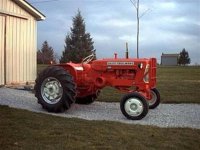
Most Allis Chalmers tractors made in the 50's & 60's had what they called a "Power Director". It was a long hand lever on the tractor's right side that had Low Range, Neutral, and High Range. It was like a wet clutch that you could slip to gently take off or slow down. You could also start off slow in low range and once you got rolling shift into high range on the go, no clashing gears. I will attach a picture of one of my AC's that have the Power Director.
 

Attachments

  • 699995-a4644 (Small).jpeg
    699995-a4644 (Small).jpeg
    39.9 KB · Views: 250
   / Stupid Newbie question. #13  
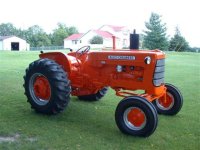
This is a 1959 D17 Allis Chalmers that also had the Power Director.
 

Attachments

  • 699997-D17 Right Side (Small).JPG
    699997-D17 Right Side (Small).JPG
    45.2 KB · Views: 316
   / Stupid Newbie question. #14  
Good looking AC in your pics.
I liked that 'hand' clutch that could be slipped. The AC's I drove were just prior to the two that you had pics of. They had the steel seats and the two-arm lift. Great tractors.

Great engines in the AC's. Could never figure out why they lost out in the competition wars. Bought up by Fiat, and not sure where they exist now.

Are parts for your AC's available through 'dealers' or mostly through other sources? I wondered that the other day when at an auction, and wild thoughts going through my head about bidding on three older AC's that looked in pretty good condition. Believe a couple were WD45's.
 
   / Stupid Newbie question. #15  
My first question would be...how fast would you expect your tractor to go?

I think my Deere 790 can do about 12 MPH.

I know nothing about Jimna's, but you must remember most of these machines are a bit top heavy. One does not want to turn too quickly at a high (for a tractor) rate of speed.

Tractors are pulling machines...that's what they are geared for.

My second question would be...are you pulling a load? Don't expect the same braking you would get with your car. If you're pulling a load, the tractor brakes may not be adequate at a higher rate of speed.

I don't know how good the Jimna owner manuals are. I would be surprised if they delve as deeply into safety as the Deere manual do.

I strongly suggest you learn more about your tractor before driving at it's maximum speed.

All that said...I'm assuming you have a manual transmission with two or three ranges. I'm also assuming your Jimna has a hand throttle to set the RPM. For road use, select the top gear in high range. Ensure your throttle is set at a fairly low RPM. Let the clutch out smoothly, then increase your RPM's using the hand throttle. Use a nice smooth increase rather then jerky.
If it's just the tractor with no load being towed, the above technique should work for you. If you're towing a load, perhaps you could use a lower gear (or range) until you're on a level stretch, then follow the above procedure.

If you're towing a load or transporting an implement, you really want to run a bit slower. Remember, that towed load may weigh as much as the tractor. Definitely slow down for going down hill or any turns. Never coast!! If you knock it out of gear going down a hill or slope, you won't get it back in gear until the tractor stops. By that time, you might be lying in a ditch with a tractor setting atop you.

If you do feel like you're going too fast for the situation, lower the RPM first. Frankly, those brakes aren't going to slow you down too much. Engine braking (by lowering the RPM) works better. If you have to go down a slope, select a lower gear before going down that slope.
 
   / Stupid Newbie question. #16  
</font><font color="blue" class="small">( Are parts for your AC's available through 'dealers' or mostly through other sources? )</font>

Engine parts you can get at a dealer or through aftermarket sources. Sheetmetal just through the aftermarket. For the WD45 they make reproduction sheet metal like: fenders, hoods, tool boxes, etc... For most AC tractors made from the 1930's on up you can buy engine parts, steering linkage, clutch, brakes, bearings, just about anything mechanical.
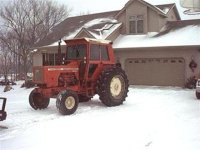
Here is a picture of a big Allis Chalmers 210 that I had a few years ago.
 

Attachments

  • 700167-a5417 (Small).jpeg
    700167-a5417 (Small).jpeg
    36.8 KB · Views: 211
   / Stupid Newbie question. #17  
Semi Tractors do not have syncronized gears. I, along with most drivers, do not use a clutch when shifting and we do not grind gears. (well, maybe sometimes.) You need to find the rpm split between gears, then you can let up on the throttle enough to break torque, pull into neutral, let the rpms fall to where they need be and then slide the shift lever into the next higher gear. When down shifting, you need to raise the rpms to the correct amount.
 

Tractor & Equipment Auctions

2024 CATERPILLAR 305 CR EXCAVATOR (A52709)
2024 CATERPILLAR...
Bulk Lot of over 600 NEW Motorcycle Sprockets - 1980s to Present (A56438)
Bulk Lot of over...
Lee Boy 250 Gal Tack Distributor (A53317)
Lee Boy 250 Gal...
John Deere 6110M (A60462)
John Deere 6110M...
2020 MACK GRANITE (A58214)
2020 MACK GRANITE...
SULLIVAN PATEK AIR COMPRESSOR (A55745)
SULLIVAN PATEK AIR...
 
Top