Torpedo/Salamander heater best practices?

   / Torpedo/Salamander heater best practices? #1  

jymbee

Platinum Member
Joined
Sep 20, 2011
Messages
622
Location
Upstate, NY
Tractor
Massey 1652, 1949 Farmall H
Need to do some assembly work in our unheated garage this winter. It's uninsulated and 28x30 feet with 10 foot ceilings. Open stairway in back going up to an enclosed, heated studio.

Given it will be an off/on situation it seems a forced air kero heater is the most practical way to go. Would appreciate any advice or precautions to take from others with a similar situation?
 
   / Torpedo/Salamander heater best practices? #2  
I use a propane torpedo heater in a 30 x 50 enclosed uninsulated barn. Works ok. Just keep it pointed in your general direction and use common sense.
 
   / Torpedo/Salamander heater best practices? #3  
We did a lot of work on our house in the dead of winter and before the central heat/air was installed. We used propane "red eye" heaters and torpedo heaters (we used diesel) in various conditions. The torpedo put out by far the most heat and in a larger area. Of course, you have to careful about CO AND moisture accumulation. There was some smell, but not objectionable. Almost no perceptible difference in smell or performance between kero and diesel, but kero was way more $.

We had a couple of red eyes; the main one was a dual mounted on a 20# tank that was best when working closer to it in a smaller space. No odor, but also had to be mindful of CO and moisture.

As soon as we had temporary electric, we bought a CO monitor/alarm.
 
   / Torpedo/Salamander heater best practices? #4  
I have a 70K btu kerosene/diesel torpedo. It would heat your space OK. As noted diesel is the cheaper option. I actually thought the smell was less with diesel. Almost nothing. Get a battery powered CO monitor. They are inexpensive. An old car running for a few minutes will set mine off. The heater has never set it off. Now I only use the torpedo to take the chill off while I fire up the wood stove.
 
   / Torpedo/Salamander heater best practices?
  • Thread Starter
#5  
I didn't realize these could burn diesl. Is that true with most all models of the torpedo type heaters? Certainly a bit price difference.

There was some smell, but not objectionable. Almost no perceptible difference in smell or performance between kero and diesel, but kero was way more $.
 
   / Torpedo/Salamander heater best practices? #6  
I didn't realize these could burn diesl. Is that true with most all models of the torpedo type heaters? Certainly a bit price difference.

It's not true of all but most are designed that way today. My understanding is that you could burn diesel in any of them but the older ones would smoke sometimes if you did. Mine is clearly labeled diesel/kerosene.
 
   / Torpedo/Salamander heater best practices? #7  
Unless they have changed, "kero" will give off a nasty "poof" on start-up and shut-down. Keep that in mind. Other than that, keep your shop vac hose a safe distance away (don't ask how I know that). I used a kero in my garage for years and loved it. Fast heat and lasted a long time. I now have a propane version and it sucks fuel.
 
   / Torpedo/Salamander heater best practices? #8  
What about the vertical convection kerosene heater that use a wick....diesel, will it smell or smoke? K1 is just to costly.
 
   / Torpedo/Salamander heater best practices? #9  
I've only ever used K1 in my wick type. Even with the kero, it's smellier than the torpedo, but maybe has more thorough combustion and fewer byproducts?
 
   / Torpedo/Salamander heater best practices? #10  
I use a 200K BTU torpedoe heater with diesel in my barn or in my shop as necessary. I have found a couple of useful things:

The heater has to be big enough to heat the area with doors open. I want to stay alive.

You don't have to heat the whole building, just an area to work in. I hang plastic tarps to 'wall-off' my work zone. Pay attention to the ceiling sealing. That's where the heat leaks out.

Its not the air temperature that's important, but the temp of the machine I'm working on. That means warming the tractor mass up if that's the job being done. Just point the heater at it and wait a few minutes. nice warm fenders or tires to lean on is much more comfy than stone cold ones.

Warming all the tools you will need is the last necessity. That means you don't need ski gloves to change out a starter or a battery or a belt or whatever. A freezing cold box wrench in my bare hands is a ticket to quit.

If you don't have a big fuel heater, a very high wattage light can help you almost the same, plus it helps you see better in a dark building. Just don't look at it.

Don't overdress. That insulated suit will keep the warm air out of you just as well as preventing cold from getting in. And by all means wear a warm hat, one without a visor. The visor is the first thing to bump into your work that results in your head getting cold when it gets knocked off.

Wear safety glasses, but wipe them with dish soap so they don't fog up when its time to breathe with your face right up against that thing you are working on.
 
   / Torpedo/Salamander heater best practices? #12  
Sometimes forced-air diesel/kero heaters need just a bit of adjustment to the fuel metering to make them burn clean and stay burning consistently. Instructions are usually in the manual. Clogged combustion air filters will also cause them to burn poorly or flameout.
 
   / Torpedo/Salamander heater best practices? #13  
Two winters ago I was using my dual red eye heater on a 20lb propane tank in my uninsulated 2 car garage. All doors closed but built in the '80s and definitely not air tight. No ceiling. Working CO alarm 3ft off the floor.

Towards the afternoon one of the red eyes went out. Went to relight it with my long-stalk butane lighter. Lighter wouldn't work no matter what I did. Tried another lighter which also didn't work.

Irritated about the cheap-***** lighters I went to the house to find another. Happened to have one of the non-functioning lighters in my hand and on the way to the house I pulled the trigger. To my surprise it light right up!

Went back into the garage and it wouldn't work. Outside- worked. Took the lit lighter from outside to inside the garage and it went out!

My guess is that I burned most of the oxygen out of the garage. I never thought it would be air-tight enough to do that. I did not feel light-headed or short of breath.

Now I leave a door cracked.
 
   / Torpedo/Salamander heater best practices? #14  
I have a 135,000 BTU torpedo heater that burns diesel or kerosene. It has a built in thermostat and works great to take the chill away. Just got a TSC ad yesterday and they have them on sale for $269. in my area. My garage and attached pole barn also has an 85,000 BTU mobile home furnace. I spend time each day out there so in winter I fire both of them up and set the stats for 60-65 deg F which is comfortable for me to work in. I do leave a door cracked open when running the salamander but once up to temp it is shut down and the furnace maintains the temp.
 
   / Torpedo/Salamander heater best practices? #15  
I just got a couple of KAL 6 radiant heaters at auction. I think they came off a film set. Borrowed one from a friend some time ago,and was impressed. Better for large areas then a fan forced heater. New, they are super expensive. I don't know why.
 
   / Torpedo/Salamander heater best practices? #16  
It's not true of all but most are designed that way today. My understanding is that you could burn diesel in any of them but the older ones would smoke sometimes if you did. Mine is clearly labeled diesel/kerosene.

Kerosene is the same as #1 diesel. #2 diesel/heating oil is a little heavier and won't work in all kerosene heaters. #1 diesel is low sulfur nowadays, and won't smell as bad as the kerosene.

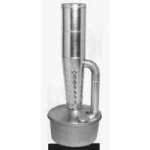
I haven't seen a salamander in 40 years. They need a tall building to keep from catching the ceiling on fire, and need a fan to force the heat back down, but have the advantage that they run with no electricity.

149The_Hy_Lo_Return_Stack_Heaters_Orchard_Heater_Smudge_Pot_Frost_Pot_HEALTH110__s.jpg
 
   / Torpedo/Salamander heater best practices? #17  
The smell from previous diesel was from the sulfur. The new low sulfur diesel has almost no smell in a torpedo.
 
   / Torpedo/Salamander heater best practices? #18  
When i use a torpedo heater i crack the bottom of the garage door and let the exhaust out. It still heated fine
 
   / Torpedo/Salamander heater best practices? #19  
Need to do some assembly work in our unheated garage this winter. It's uninsulated and 28x30 feet with 10 foot ceilings. Open stairway in back going up to an enclosed, heated studio.

Given it will be an off/on situation it seems a forced air kero heater is the most practical way to go. Would appreciate any advice or precautions to take from others with a similar situation?

Your garage has a ceiling and it sounds like it has plywood walls with a siding on and it is not that large. I would think a 110,000 BTU torpedo type heater would heat it just fine. I would suggest getting one along with a remote thermostat where you plug the stat in the other side of the room and run a power cord from that to the heater.

I have a torpedo heater that runs on kerosene but I put cheaper tractor diesel in it and all is good. I don't really smell it at all. Don't be shy about cracking the windows or a
 
   / Torpedo/Salamander heater best practices? #20  

Marketplace Items

2006 JLG E400AJPN ELECTRIC BOOM LIFT (A60429)
2006 JLG E400AJPN...
1969 VOLKSWAGEN BUG (A59905)
1969 VOLKSWAGEN...
WACKER NEUSON EZ26 EXCAVATOR (A60429)
WACKER NEUSON EZ26...
2021 CATERPILLAR 306CR EXCAVATOR (A60429)
2021 CATERPILLAR...
2008 V.E. ENTERPRISES 130BBL VAC TRAILER (A58214)
2008 V.E...
2017 Ford Explorer AWD SUV (A59231)
2017 Ford Explorer...
 
Top