Treated 2x4 or regular?

   / Treated 2x4 or regular? #1  

Richard

Super Member
Joined
Apr 6, 2000
Messages
5,057
Location
Knoxville, TN
Tractor
International 1066 Full sized JCB Loader/Backhoe and a John Deere 430 to mow with
Finishing basement bathroom (full bath when done), block walls, dirt on other side of block ALL the way up save for perhaps the last course of blocks.

Inside, the blocks have three coats of UGL drylock on them. On the outside, they have 2 coats of tar AND some form of plastic sheating.

In 6 years, have NEVER had the first drop/puddle of moisture but did have some small (1/2 diamater of dime) spots that I THINK were mold spots. I hit them (and entire wall) with strong bleach solution.

Ok, I've got a stack of good regular 2x4's. I've got several treated 2x4's to use as plates along floor/wall.

Can I use NON treated 2x4's on the block walls, or should I listen to my gut instinct and either do what's right, or what is overkill. I would be mounting them directly onto the block walls with nothing in between the block & stud (other than the UGL drylock)

/forums/images/graemlins/confused.gif
 
   / Treated 2x4 or regular? #2  
I would use the treated lumber. The reason being the studs may be exposed to humidity. Use the treated for anything that comes in contact with concrete. Top sill, studs, and bottom sill. For interior walls, use the treated for bottom sill. The treated material not only guards against moisture, but insects too. Remember todays ACQ treated lumber requires triple galvanized or stainless fasteners.
 
   / Treated 2x4 or regular? #3  
Richard; I suspect someone will most likely disagree, but I think the treated lumber is the way to go. Even though you have the UGL stuff on the wall, moisture will most likely will still migrate thru it to some extent. You just can't see it is all. Take a 12" square piece of visqueen, and use duct tape to tape it in the area you'll be working. Leave there about a week. Then see if you have any moisture on either side of it. If it's on the side against the wall, guess what, you,ve got moisture coming thru.
At any rate, any time wood is to be in contact with masonry, it should always be treated. I beleive the new Universal Building Code even states that. They must have a reason. /forums/images/graemlins/grin.gif
 
   / Treated 2x4 or regular?
  • Thread Starter
#4  
Well, a part of me that I wanted to ignore said treated would be the choice. Just wish I could use the 2x4's I already have instead of yet another trip to the store.

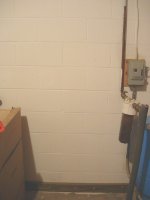
I've attached a pic of the wall (in spite of already having the answer I expected)

Thanks

/forums/images/graemlins/smile.gif
 

Attachments

  • 782691-DSCN1841.JPG
    782691-DSCN1841.JPG
    89.4 KB · Views: 418
   / Treated 2x4 or regular? #5  
That's the way it is here. If you use wood against concrete , it must be treated. In your case (if you'er not having it inspected ) you will be the only one to know. I used treated when I built my den.
 
   / Treated 2x4 or regular? #6  
Use either. All us Carpenters are taught to use PT on anything in contact with masonry. My experience tells me that isn't always best. If your area is markedly prone to termite infestation, then use the PT. If not, I'd go with the regular kiln dried. Most people don't know that the PT is more prone to support black mold. It doesn't breath as well. Can't tell you how many times I've gotten new PT material with mold working on it already. If your concerned, paint the masonry side with a mold resistant paint, the whole 2 x if you want but I prefer they breathe on 3 sides. Another trick is to not insulate tight to the block, if you intend to. I use 1" foam, not 1 1/2", in that application and hold it off the wall. If the air space can breath out the top plate, all the better. The idea is to make a slow breathing chimney space against the block. Stops allot of problems down the road.

HTH
 
   / Treated 2x4 or regular? #7  
Good info here: Building Science Corp One of their recommendations is to use metal studs...also, I've seen a new type of sheetrock at Home Depot that doesn't have the paper face; claim is that it's more mold resistant. Whatever you go with I would recommend that you let the space behind the finish wall 'breath'; and don't use batt insulation, go with the rigid foam panels - they don't hold moisture and critters dn't seem to like them (no nest!).

-Norm
 
   / Treated 2x4 or regular? #8  
Richard! Look at the plywood behind the disconnect box,What
shape is it in as it doesn't look treated?How long has it been there? If it's been there for sometime and is in good shape
then I'd go ahead and use the plain 2X4s that you already have but if thher's any signs of the ply seperating(swelling)
or dark color change in the ply against the wall,you may have
moisture issues! Good luck wich ever way you go.
 
   / Treated 2x4 or regular? #9  
When I did my basement I did have moisture problems with the block walls (old 1940's house), no protedection either inside or outside. My method was to use PT but first face the blocks with a heavy gauge plastic. No problems so far after about 15 years.

Harry K
 
   / Treated 2x4 or regular? #10  
I finish lots of basements. I usually use PT 2x4's against the floors and the rest regular white-wood.
Things to remeber with PT,
- the dimensions are not always the same as non-pt
- with the new ACQ lumber be sure to use only triple-hot-dipped nails or ACQ approved fastners. This will affect your drywall screws/nails as well.
- it warps more.

Some one else mentioned steel studs that may be the way to go.

-dave
 
   / Treated 2x4 or regular? #11  
Even if there is no moisture coming through the blocks, you may have moisture condensing on the surface of the blocks from the living space.

I would either space the studs away from the block wall slightly (it doesn't have to be much), or put some kind of moisture-proof insulating layer in there.

Dow makes some neat EPS insulating panels that are held on to basement walls with 1"x3" firring strips placed in slots.

Styrofoam Wallmate Slotted Insulation

The strips are placed on the inside surface of the panels after they are on the wall in recessed slots. The strips are then nailed through the insulating panels into the foundation wall to hold the insulation up. The firring strips also serve as anchors for the drywall. Less thickness than a 2x4 stud wall, no wood-to block contact, and a very nice insulated, moisture-resistant wall assembly.

- Rick
 
   / Treated 2x4 or regular? #12  
Turnkey,

That plastic was recommened and used by a number of people in years past. I can't say I'm a fan of that though. Never really was. If you have reasonably dry foundation or one with the few occasional damp spots, it probably doesn't hurt anything and could help. But I've seen people Drylok their walls and create another problem in one instance.

Virtually all CMU walls with parging on the exterior and applied waterproofing, get some dents and dings during backfill which damages the membrane in hopefully small areas. Additionally, most waterproofing applications are light IMO. Spray applications should be double coated. Hand applied once is enough when done right. What allot of people with perfectly dry walls in their basements don't realize is that some moisture will make it's way to the CMU (block). So long as it's limited in quantity and has a way to exit the block, your going to have apparently dry walls. Reason being, the limited moisture uptake of the CMU (they are nearly sponges) makes it's way to the interior and then is evaporated into the basement area. If it's limited it never appears wet. Have you ever noticed a seemingly perfectly dry basement in the summertime that seems to get a little extra close with humidity? More than the other areas of the house and often more than the outside humidity at any given time. That's because it doesn't have the nice dry winter inside air to transfer too and the air already starts out a little more humid. That moisture is coming from the slab and the walls, but predominately from the seemingly dry walls, assuming there is plastic under the slab.

Applying plastic or Drylok effectively puts a membrane there and traps the moisture in the wall cavity or behind the plastic. Not generally a problem with the Drylok as that moisture would have to collect over time, make it's way to the bottom of the wall (below the grade of the concrete slab), and not have an exit path, in order to create any problems. The plastic can actually trap the moisture behind the sheathing on wetter basements, where it collects and runs down the wall. It exists onto the basement floor lacking any other avenue of dispersal. Often you don't see this occur during construction, but I have. Seen it occur over time on a few occasions.

A friend of mine Dryloked their entire basement a year ago and then called me to trace a wet spot that appeared a few months later near one corner. I told them what I suspected was going on; the the moisture in the wall could not find it's way to the sub-slab CMU blockwork and was exiting the wall about one course up, running down the face of the wall and then onto the floor. It was trapped in one cell that somehow got filled during construction, getting saturated, then puddling in that cell, and even the Drylok couldn't hold it out.

I don't write this to make anyone who has used either of these methods wary. I generally have a favorable view of Drylok. Rather, it's to give an understanding or what occurs when you use interior side vapor or moisture barriers, of any type, on a foundation wall that is below outside grade. Knowing that, I always recommend the airspace along the wall. Drylok or not it's advisable. Moving air gets replenished and transports moisture. A little moisture can become allot over time if it can't exit.

HTH
 
   / Treated 2x4 or regular? #13  
I like that system, but I still want it airspaced off the wall. Hat channel or back side furring will accomplish that. Otherwise it's prone to the same issues the plastic sheathing is. Granted it will work problem free on 80-90% of basements. I like bulletproof, or nearly so, designs where moisture is concerned.

That said, the place to stop moisture is at the outer face of any wall. Above or below grade. Funny /forums/images/graemlins/laugh.gif how much energy is spent doing that above grade where it can usually just sluff off. Below grade, aside from mandatory drain tile, some are rather careless on the quality and application of wall waterproofing treatments.

I'll bore /forums/images/graemlins/crazy.gif you with this off-topic but moisture related story if your so inclined.....Built a bunch of dry ones because I fixed a bunch of wet ones back a number of years. When I became a full-fledged Project Superintendent, my first job assignment was to take a problem job over and de-water 32 basement level commercial office condo units with serious water problems. One side was walk-out and some of these had standing water running out the the entry door and freezing inches thick on the sidewalk and into the street. I couldn't believe it when I saw it. Most exterior finishes were done and all walks and landscaping were already in place. Got some real lessons on that one. When I told them how I wanted to resolve it, my bosses and the not so smart waterproffing Subcontractor, who had carelessly installed the first hi-tech system of that type, thought I was nuts. Their solution was a $150K investment, and I did it for about $25K. Triple that now. They let me test flight my idea on two units, saw the results, and fortunately all those units are still dry 25 years later. I was still guessing a little back then. No interior wall treatment was needed, just removed some limited concrete slab, drilled the walls below slab grade, brought in all the water, and managed it properly from there. Often that is where people err. You have to collect it all before you can move it properly, whether it's from inside or out. Outside is clearly preferred. Gravity did most of the work for me once I had it collecting where I wanted it. Easy as could be on shallow set foundations. There is no excuse /forums/images/graemlins/frown.gif for wet basements IMO. /forums/images/graemlins/grin.gif
 

Tractor & Equipment Auctions

2021 Ford Mustang Mach-E AWD SUV (A59231)
2021 Ford Mustang...
2006 Freightliner Auger Truck (A56438)
2006 Freightliner...
SANY SY225C9C5KL EXCAVATOR (A59823)
SANY SY225C9C5KL...
2013 BMW X5 AWD SUV (A59231)
2013 BMW X5 AWD...
2025 MMS MS36C (A53317)
2025 MMS MS36C...
Unused 2025 CFG Industrial QH12R Mini Excavator (A59228)
Unused 2025 CFG...
 
Top