Water hammer

   / Water hammer #21  
Home built, water column arrestors do not work. That's a tube with a cap, that some air remains as a buffer to the hammering effect. The reason they don't work is because water absorbs the air in the column, in a rather short amount of time. The reason we should have hammer arrestors installed near all our electric valved appliances is for the health of your water system. The cycling or pressure shock, these appliances add to our system can be much. Adding these is much easier than finding blow pipes after you get home.


Close the washing Machine water inlets. If that stops the water hammer you got a place for arrestors.

The home built arrestors may result in stagnant water and do not meet code.
 
   / Water hammer #22  
Contrary to ArleyA's comment, my current home, I built 40 years ago as described later does just fine. I am 100+ feet from my meter and run 65 static # of water pressure...have solenoid valves on water controls like dish washers and clothes washers. Never had a hammer problem here.

Water hammer is caused by the kinetic energy stored in a stream of water and is abruptly halted with no cushion, like a column of air to absorb the shock. The more mass in the column and abruptness of the shutoff, the worse the hammer.

I use an extension of the water line (¾" PVC) and use a vertical capped piece at the end of the longest run, or where convenient near the appliance. 3' has served me well and a clamp at both ends to hold it in place. Cheap and very effective. Over time the air will be absorbed in the water (as Arly mentioned) and it could start hammering again but cureall is to just shut off you water at the meter and open several faucets, ensuring that the lowest are open. I don't shut off my water for maintenance purposes very often but when I do the air gets purged.

There is a different mechanism caused by the swinging motion of unsecured water lines, especially copper. Case in point, I had a house in town, before I moved to the country, on a concrete slab poured on a "select fill" pad (sandy-clay that packs well). Over time the subsoil (Black Clay) shrank away from the house and the pipes that once were held in place with the fill, were free to swing in air. Numerous sources of vibration caused them to strike one another causing a banging sound.......when the water was flowing....unlike hammer. Nothing you can do about that other than jack hammer your slab and fill in the hole then restore the concrete.

So here you have 2 sides of the same story. Take your pick.
 
   / Water hammer #23  
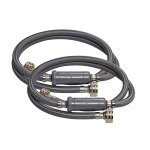
Had the same problem about a year after we bought a new washer even though the plumbing had anti hammer fittings. Talked to a buddy and this solved it

Hammerstop is the brand

41C97BF1-ABC5-4B13-B6C7-E189CE841FDF.jpeg
 
   / Water hammer
  • Thread Starter
#24  
OK....so no amount of those hammer arresters did anything ....well anything good - they gave me lots of drippy little leaks to keep fixing.

SO here is I'm guessing the problem....which lead to another problem:

151113.jpg


112 psi - about 2x what I'd want.

SO to fix it, i *thought* I just needed to adjust this set screw on this valve right above the main valve to turn water on/off for the house.


153327.jpg


You can see how far counterclockwise I turned it with no effect. That gauge stayed at 110ish no matter what. I got it to where it would go down to 80psi with the kitchen running wide open, but it wouldn't adjust any more than that. At just the hose bib with no water running anywhere, it's 110-112psi. I did disconnect the gauge, run the hose bib wide open for a minute or so, shut off, then reconnect the gauge. Other than while I was letting kitchen sink run - during that time I just left gauge on with mrs CMV watching it while I adjusted.

So took cover off that valve/pressure regulator/whatever it is. Everything looked ok (to someone who doesn't know what he's looking at). Diaphragm moved back & forth, spring looked OK, rubber around the diaphragm piece looked good. But unless that's not what adjusts the house's water pressure, it doesn't seem to be working. I tried going the other way and bottomed out that set screw which only bumped the pressure up a bit.

Guess I need to call plumber & get that pressure valve replaced? I have no PEX tools or knowledge so unless there's some type of shark-bite version where I can just cut the old one out and push connect the new one in its place, it's beyond my skill.
 

Attachments

  • 151113.jpg
    151113.jpg
    69.5 KB · Views: 96
   / Water hammer #25  
I would have the pressure control valve replacd as soon as possible. Hot water heaters do not like high inlet water pressures. Water expands when heated and water being heated under 110 pounds of pressure is going to cause expansion problems.
 
   / Water hammer #26  
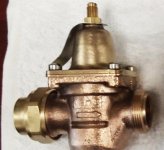
If I am seeing things right, that regulator has a union joint on the top, and I imagine there is one on the bottom too. That means you should be able to swap a new one in very easily by unscrewing the collar. To maintain the same spacing, you'd need the exact same model or one that has the same inlet-outlet dimension. Sometimes with a union it's a good idea to replace the o-ring or rubber washer when you swap things out.
 
   / Water hammer #28  
Been years but use to work on appliances and think the new valves do not close any quicker than the old ones did. They are electrically operated so they are fast. If your pressure is as high as I read it to be that is probably your issue. But some of the newer washers stop and start with water many more times during a cycle than older washers did. Another issue may just be the hoses on your new washer. Look the hoses on your new washer and see if they are braided hoses that are much stronger and less flexible than the ones on your old washer and most likely they are not giving or absorbing the shock the older style hoses were. I have seen many times those older hoses slightly swell and absorb the shock.
 
   / Water hammer #29  
These stand pipes only work for a while because they fill up with water and have to be re-charged with air after a while. Note my post above. They are commonly installed behind the washer valves while building and are about 12" long. The problem with the bladder tank acting as a water hammer device is that it is typically at the wrong end of the pipe and far from rapidly closing appliance valves. It's the slug of water after the pressure tank that causes the hammer as it is abruptly stopped by an appliance valve, or sink valve. Those pressure tanks will control the thermal expansion and reduce pump cycling though.

It is easy to refill the standpipe type. Turn off the water supply, drain down the system, then refill.

Ron
 
   / Water hammer #31  
After looking at more pics on eBay I THINK HE IS RIGHT INSTALLED BACKWARD!
 
   / Water hammer #32  
Yea, I have installed a lot of PRVs in my lifetime. The union end is always on the outlet side. Both ends are not normally union. His case; I am assuming the flow is upward and NC is not a slab on grade construction area; so, piping is in the floor crawl space.

Ron
 
   / Water hammer #33  
Looks like this valve could have unions on both ends
 

Attachments

  • pcv.jpg
    pcv.jpg
    391.3 KB · Views: 93
   / Water hammer
  • Thread Starter
#34  
The flow as pictured is from bottom to top. I am on a slab.

I saw Lowe's had same one as I have but didn't see how to just replace with same and not cut anything. Ya, the one side has the union but the other is a PEX crimp.

I ended up getting a larger and much more expensive one - thinking maybe will not have this problem again with a better quality part. Also figured the extra length would be perfect and give me some excess existing PEX line to work with.

But long story, comedy of errors, and using poor tools....I got it done, but not without much fuss. Basically, I added sharkbite fittings to each end of new pressure valve. But that run of line is pretty short and Ts off thru studs just a little above the valve. So that made the short run of 3/4" PEX have very little give so it was nearly impossible to get the last sharkbite connection. The line needed to push apart and then come back together and it simply wouldn't since the T above was stuck and just below is where the main city water line pops up from the garage floor so it won't move either.

But it's done, not leaking, and gauge now reads 56 psi at the hose bib. Pipes are quiet.

Only thing left to do at some point is fix a splice I made. While trimming the tube with the $16 Lowe's ratcheting tubing cutter, I kept getting angled cuts. Next time I'll just use a mini hacksaw and clean up the edges. But that left me with lots of little angled cutoffs and the existing pipe about 3/4" too short. I had a brass barb connector for 3/4" PEX but it doesn't take up much space. So I used it as a template and made the same thing on the lathe out of 7075 aluminum but with 3/4" space in between the barb ends. I used the stainless PEX clamps to secure it since I have that tool, but not a regular PEX ring crimper. Working great, but aluminum isn't used in residential plumbing for a reason I assume so probably shouldn't leave that piece there long term.
PEX-Couplings-image.jpg


Made this and to same diameters everywhere, but the part in the middle is much wider acting as a spacer.
 
   / Water hammer
  • Thread Starter
#36  
Was the original in backwards

No, the arrows were pointing "up" which is the direction of water flow :) It was just not working.

But it did have unions on both sides.....so could have saved much aggravation just replacing it with same. I didn't even notice that until I went to look at it to see which way the arrows were.
 

Tractor & Equipment Auctions

2018 CASE 340RT TRACKED TRACTOR (A60430)
2018 CASE 340RT...
2019 DRAGON ESP 150BBL ALUMINUM (A58214)
2019 DRAGON ESP...
2020 PETERBILT 567 (A58214)
2020 PETERBILT 567...
QUINCY INDUSTRIAL AIR COMPRESSOR (A52706)
QUINCY INDUSTRIAL...
2019 BOBCAT E45 EXCAVATOR (A59823)
2019 BOBCAT E45...
DOOSAN G25KW GENERATOR (A55745)
DOOSAN G25KW...
 
Top