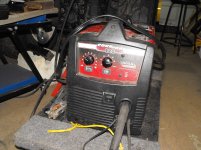
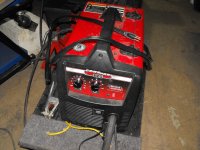
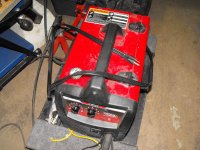
You are using .035" flux core wire right? I don't see much weld spatter, and flux core leaves a lot of spatter...
Like the old line goes "how do you get to carnegie hall?" You practice, practice and then practie some more. I have been doing this for decades, and I still occasionally run some practice beads before I weld on anything I want to put to work. It is far easier to get it right the first time, then grind it all off and re-do it(don't ask me how i know this

) Get some plate and start laying down beads. A good bead has the following characteristics:
It has a smooth even arch, no taller than about 1/3-1/2 it's width. So if it is 1/4" wide, it will be no more than about 1/8" tall but no less than 3/32" with the edge blending smoothly into the base metal(20-40 degrees from horizontal). Too much current(wire feed speed controls current) and the edge will blend in below the base metal(crater). To little current and the weld metal will be deposited on top of the base metal and leave a stepped edge. As described, you want a steady popping buzz. Too slow a wire speed, and the weld will interrupt and stutter. Too fast, and you will reach a point where the wire is jamming in there faster than it can melt(you can feel this in your hand). A bad ground or welder internal connection can also cause this last symptom, as can bad wire. If your lincoln is like mine, it has 4 voltage settings(abcd) and a 0-10 feed speed knob. I always use c or d and a speed setting between 2 and 2 1/2. A small speed setting makes a big difference. Trigger the gun onto a test plate and rotate that speed knob slowly. Don't watch the weld, just listen and feel, and you can duplicate the above sounds/symptoms with a very small speed change.
The weld bead has a even scalloped pattern, like a row of overlapping scales. This is achieved by a combination of wire feed speed and hand speed. The scalloped lines are the edge of individual puddles of molten weld metal, one overlapping the next. Move too slow, and the puddle spreads out and the lines blend closer together. Move to fast and the puddles start to separate into individual humps and drops. Having given my grandson his first welding lessons a few weeks ago, he reminded me that it is quite common when starting out to move the hand too fast. I turned him loose weld hardening my bucket edge, and BH bucket teeth(bead after bead).
The pic you posted wans't very clear, but it almost looked like you were moving too fast, as I can see what looks like individual drops of metal.
Are you using the lincoln wire? Wire is important. I have helped several people over the years work out problems with many different types of small wire feed welders. I can say pretty much half of their weld issues were caused from using junk wire. The best I have come across is the lincoln wire, and I have had no issues with the Miller products(this is all flux core I am refering to). The lincoln is easier for me to get(every home depot has it), so I have used nothing but that for the past few years. You also need to make sure the polarity connection is correct for the type welding you are doing. Innershield/flux core has the positive terminal going to the ground clamp, and the negative terminal going to the gun. MIG(with gas) is reversed from this with a negative ground. The flip up door on your welder should have a large sticker on the inside with reccomended settings for different processes. The sticker on mine shows the reccomended speed settings only varying between 1.5 and 2.0 from 14GA to 1/4" .
Keep at it, you will get the hang of it...