What kind of hydraulic flow restrictors do I need?

   / What kind of hydraulic flow restrictors do I need? #21  
We are getting pretty far out here aren't we? The reason a same size restrictor will result in a faster speed if used on the rod side hose is as follows. All other factors equal, the rod moves farther with the addition or removal of the same volume of oil to the rod end of the cylinder than if that same volume was added or removed from the base end. Since the flow rate through the restrictor is assumed to be constant for this discussion, the cylinder will move faster with the restrictor on the rod end hose than if it were in the base end circuit. The percentage of speed difference is equal to the percentage of section area the rod takes up.
 
   / What kind of hydraulic flow restrictors do I need? #22  
Yes.........Go for it. Report back how it works for you, please.
 
   / What kind of hydraulic flow restrictors do I need? #23  
In two words YES, YES

<font color="blue"> The reason why a cylinder will move faster in the retract direction than in the extend direction is because there is more volumn on the side that does not have the cylinder rod inside it, taking up space. For a given flow to a double acting cylinder, that cylinder will retract faster than it will extend. </font>

Henro and Jerry, I never thought of it in that perspective but the explanation makes good sense. I'll say uncle here.... /forums/images/graemlins/grin.gif
 
   / What kind of hydraulic flow restrictors do I need? #24  
I only speed read through this thread, but I don't think I saw this point ...

In the text for the flow restricter: "Adjustable flow control valve provides precise control of oil flow and shut-off in one direction and full flow the opposite direction ".

Most (all?) flow restricters have a valve in them so you get full flow in the reverse direction. Thus for the case of slowing down the grapple in both directions you'd need two, *AND* you'd have to make sure you put them in the right way round so that the restriction would be on the "return" side (to stop the cavitation and the like referred to above).

HTH. Appologies in advace if I missed this. Andrew

Ooops, missed the switch to pinhole ones. I'll leave this anyway. I think the concern with the pinhole, bi-directional ones, is that you could have cavitation problems when it's used on the supply side. Having them on the return side solves this problem (which is why they're made this way I would assume). For 25 bucks each I would think putting in two, adjustable, "one way" ones would be the way to go.
 
   / What kind of hydraulic flow restrictors do I need? #25  
<font color="blue"> I think the concern with the pinhole, bi-directional ones, is that you could have cavitation problems when it's used on the supply side. Having them on the return side solves this problem </font>

Banjo,

Could you explain why this would be the case?

Now let me say that I just want to understand and am by no means an expert on hydraulic systems.

First thought that came to my mind was that if cavitation did occur, what would it matter anyway in a simple single cylinder circuit? I know cavitation is a major concern in a pump, but we are talking cylinders well beyond the pump...

My second question concerns the difference between having a flow restrictor on the high side of the cylinder as compared to the low pressure side. Would there really be much difference? When the cylinder is unloaded almost the same pressure would be developed across the pinhole restrictor, regardless of which side of the cylinder it was on. As the cylinder takes more and more load, the cylinder would take more pressure drop up to the point when the cylinder stalls and full pressure is felt by the cylinder and the system pressure relief valve trips. So to this maybe simple mind, it appears that it should matter little which side of the cylinder a pinhole-type restrictor is on.

Just to be clear, I am asking why cavitation would be more of an issue when a pin-hole restrictor is placed on the high side of the cylinder as compared to the low pressure side.

Also, why is cavitation a concern anyway, in a simple two-way cylinder application that has a very low duty cycle?
 
   / What kind of hydraulic flow restrictors do I need? #26  
I've never used them, but heard they can create a jerky cylinder movement when heavily loaded. Cavitation? Is this true, pin hole users?
 
   / What kind of hydraulic flow restrictors do I need? #27  
Tom, here at TBN we end up discussing the merits of "brain surgery" just to describe how to pull a burr out of our toe. /forums/images/graemlins/crazy.gif /forums/images/graemlins/smile.gif For around $5, I'd go get a pinhole flow restrictor and put it in my grapple circuit in the easiest spot. If it doesn't give you the response you need, then go to the adjustable flow restrictor. Orifice type restrictors are used all over aircraft for limiting and timing applications. Even there, it ain't really "brain surgery." /forums/images/graemlins/wink.gif
 
   / What kind of hydraulic flow restrictors do I need? #28  
If you're needing some for your own use we spotted them at TSC with different configurations. They were rather inexpensive to boot.
 
   / What kind of hydraulic flow restrictors do I need?
  • Thread Starter
#29  
</font><font color="blue" class="small">( Tom, here at TBN we end up discussing the merits of "brain surgery" just to describe how to pull a burr out of our toe. /forums/images/graemlins/crazy.gif /forums/images/graemlins/smile.gif For around $5, I'd go get a pinhole flow restrictor and put it in my grapple circuit in the easiest spot. If it doesn't give you the response you need, then go to the adjustable flow restrictor. )</font>

Yes, I had already decided to do just that. I picked up a pinhole restrictor at my dealer the other day and will install it to see what happens. I may not get around to it for a few days, but will let you all know what happens. I spent $6 on it. If it doesn't work I'll just go try the more expensive scenario of two one-way restrictors.

My main concern, of course, is not wanting to damage something. I can't think of how installing this restrictor would cause a problem, however I'm not an expert so I wanted to check with you guys first.

Other than the mention of possible cavitation, no damage issues have been raised by those participating in this thread. Again, I'm not a hydraulics expert, but I don't think that installing this restrictor will cause cavitation.

My understanding of cavitation is that it occurs when a pump "runs away" from its incoming fluid. In other words, the outflow of the pump starts to exceed the inflow. Since the inflow to the hydraulic pump is from the sump and not the restricted grapple line, there should still be plenty of fluid to supply the pump.

It's been an interesting discussion anyway, even if it's not brain surgery. /forums/images/graemlins/smile.gif Thanks to all who offered info and advice.

Tom
 
   / What kind of hydraulic flow restrictors do I need? #30  
Henro, et.al.,

I think it turns out that this might be a bit of a case of the fingers being faster than the brain /forums/images/graemlins/blush.gif.

You can get cavitation in the supply line if you have a flow restricter there, AND the cylinder is being driven by an external load (as would happen in lowering a loader with a load on it for example). In this case the fluid can exit the system faster than it can be supplied. It's hard to figure out how this situation would occur for a set of grapples though.

A similar situation can occur with hydraulic motors if they end up running as a pump due to an external load (e.g. flywheel loads, braking with wheel motors).

Managing the return flow addresses these issues. FWIW, I think of it as making the cylinder "look" like it's under a heavier load.

I found a number of references to "smoother" control with the "one way" type of valves in the return path. This would be consistent with the above information, where the system might work like it had "air" in it.

The "brain surgery" comment is well placed too. The "right" solution take a lot of factors into account. It'll be interesting to hear how the simple solution works out in practice.

I should also mention, that I haven't had the need (chance) to use any of these valves in the hydraulics that I've done to date (loader and backhoe), so I was just going from (recollected ... always hazardous /forums/images/graemlins/grin.gif) experience from others, and from my efforts to "figure out" hydraulics. I'm no expert, and sometimes having an engineering background can work against you /forums/images/graemlins/wink.gif.

HTH, and sorry for any mis-information. Andrew
 
   / What kind of hydraulic flow restrictors do I need? #31  
I had considered them for running my 8gpm hoe on a 23gpm circuit, but was advised not to on similar grounds to Banjo's post, besides needing one for each function would have been 12 restrictors I think. (Not so cheap for that application) I went with adjustable 0-16gpm press compensated flow divider that takes what hoe needs from flow and sends rest to tank.
 
   / What kind of hydraulic flow restrictors do I need? #32  
MMM,
how's the pressure compensated flow divider for heat in that application? Unless I've got it wrong, isn't all the extra 15GPM times whatever PSI is needed at that moment converted to heat?

Rotary flow dividers are well worth looking into. They're not adjustable, but they're very efficient. Once I got my mind around how they work, I became a big fan of them.
 
   / What kind of hydraulic flow restrictors do I need? #33  
This system is on a crank drive front pump that I installed with industrial loader. I installed 24X12 cooler and pair of Sun Hyd flow dividers for dual aux hydraulics. I had looked into rotary dividers, but there is a problem with pressure intensificvation and the adjustability isn't there.
 
   / What kind of hydraulic flow restrictors do I need? #34  
</font><font color="blue" class="small">( Henro, et.al.,

I think it turns out that this might be a bit of a case of the fingers being faster than the brain /forums/images/graemlins/blush.gif.

You can get cavitation in the supply line if you have a flow restricter there, AND the cylinder is being driven by an external load (as would happen in lowering a loader with a load on it for example). In this case the fluid can exit the system faster than it can be supplied. It's hard to figure out how this situation would occur for a set of grapples though.

A similar situation can occur with hydraulic motors if they end up running as a pump due to an external load (e.g. flywheel loads, braking with wheel motors).

Managing the return flow addresses these issues. FWIW, I think of it as making the cylinder "look" like it's under a heavier load.

I found a number of references to "smoother" control with the "one way" type of valves in the return path. This would be consistent with the above information, where the system might work like it had "air" in it.

The "brain surgery" comment is well placed too. The "right" solution take a lot of factors into account. It'll be interesting to hear how the simple solution works out in practice.

I should also mention, that I haven't had the need (chance) to use any of these valves in the hydraulics that I've done to date (loader and backhoe), so I was just going from (recollected ... always hazardous /forums/images/graemlins/grin.gif) experience from others, and from my efforts to "figure out" hydraulics. I'm no expert, and sometimes having an engineering background can work against you /forums/images/graemlins/wink.gif.

HTH, and sorry for any mis-information. Andrew )</font>

I had you figured out on the first message, but I see you got back to it.

If the flow restrictor is on the high pressure supply side only, you sort of turn the cylinder into a one-way cylinder at times. Any time you allow the cylinder to move, oil can flow away from one side rapidly, while you are supplying oil very slowly to the other side. This will allow the cylinder to draw a vaccumn & fully extend if it has enough load on it, but will take a long time for the oil to build up on the other side of the cylinder.

It would indeed act like there is air in the system under certain conditions. One would have less positive control of the situation. You effectively have a 1/2 hose supplying oil to or from one side of the cylinfer, & a 1/16" hose supplying oil to or from the other side. That's unbalanced...

May not be important in a grapple.

And it would not cause damage, it just might, possibly, in some uses, cause a feeling that one isn't in control of what is happening all the time - extra slap or bounce on the controls.

As someone else said, this is brain surgery analysis, go ahead & hammer it together & have fun. /forums/images/graemlins/smile.gif

--->Paul
 
   / What kind of hydraulic flow restrictors do I need? #35  
adlertom
How did the pin-hole restrictor work? Did you get satisfactory flow control using it?

Hopefully we can find out the results. /forums/images/graemlins/wink.gif
 
   / What kind of hydraulic flow restrictors do I need? #36  
Tom, I hve been following this thread and am wondering why no one has mentioned, you don't have to push or pull the control handle all the way.That is the way to control how fast the graple opens or closes. At least thats how I operate mine.Yoy will get better with practice. Ron
 
   / What kind of hydraulic flow restrictors do I need? #37  
I use adjustable (one way)flow restrictors when I want controllable top speed one way and a full speed return. I use a single needle valve when I want to control (slow down)top speed in both directions and yes one direction will be slightly faster than the other(due to the fluid displaced by the cylinder rod). If I wanted to accurately control speed in both directions I would install two adjustable flow valves one for each direction. This has worked well for me in multiple applications. AS FOR CAVITATION ,HEAT ISSIES etc. I don't worry too much about turbulence at 30000 ft when for my usage my tractor barely leaves the runway.
Drussell--- Grand L 4240 cab 950 hrs- 854 loader with 3rd fuction control -4 way HD bucket - TnT- Hydraulic rear and front blades- 6 ft front snow blower with hyd controls.
 
   / What kind of hydraulic flow restrictors do I need? #38  
Tom, I hve been following this thread and am wondering why no one has mentioned, you don't have to push or pull the control handle all the way.That is the way to control how fast the graple opens or closes. At least thats how I operate mine.Yoy will get better with practice. Ron


Welcome to TBN Ron:D
You have been following this thread? Since 2005? And now just replied?:confused2:

Just bustin' chops...welcome again.
 
   / What kind of hydraulic flow restrictors do I need? #39  
All - I know this is an old tread and I made a posting yesterday without doing a very good search - sorry! My posting was in regarding a new grapple attachment for my Bobcat S160 and what I could do to slow the grapple movement down. Now that I've have found this thread, can anyone tell me if Tractor Supply has the type of in-line flow restrictors that might help me? It seems that I need one restrictor in each hose and if I get the simple "pin-hole" restrictor and it's reduces the flow too much then I can just drill it out a little. This seems like a "cheap" - "simple" fix for a frustrating problem.
 
   / What kind of hydraulic flow restrictors do I need? #40  
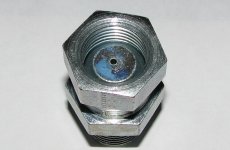
That little washer type restrictor is the cheapest way to go.

I am not sure TSC has them, but maybe. Maybe a local hyd shop or order off the Internet.

They might have something like this, a fitting restrictor.
 

Attachments

  • RestrictorPhoto-1.jpg
    RestrictorPhoto-1.jpg
    261.8 KB · Views: 315
 

Tractor & Equipment Auctions

2023 FORD F-150 XL CREW CAB TRUCK (A59823)
2023 FORD F-150 XL...
2018 HINO SA (A58214)
2022 CAT 289D3 (A60462)
2022 CAT 289D3...
Enmark Z Spray (A53316)
Enmark Z Spray...
2018 John Deere 245G LC Excavator - Hydraulic Thumb, Tooth Bucket, 56K LB Class (A56438)
2018 John Deere...
Massey Ferguson 4710 (A60462)
Massey Ferguson...
 
Top