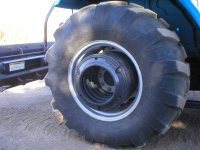
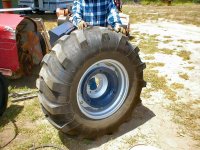
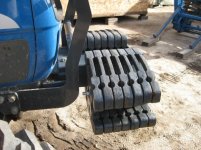
Traction Wheel weights

   / Wheel weights #1  

ShilohFarm

New member
Joined
Jan 2, 2018
Messages
6
Location
Cookeville, TN
Tractor
CaseIH Farmall 75C
Hi Everyone,

I have a CaseIH Farmall 75C and need to add rear wheel weights. I see that CaseIH sells 2 weights (220lbs) per wheel, but someone suggested that I really should consider 3 weights (330lbs) per rear wheel. I do have a CaseIH 620 loader on the front and with no added weights, I have brought one rear wheel off the ground - not may favorite thing to do. When not using the loader, I do remonve it for bush hogging, chisel plowing and discing. Any suggestions on 2 vs 3 weights per rear wheel? Thank you.
 
   / Wheel weights #2  
There are other places besides CIH when I got mine a few years ago I got 1200 pounds for about a dollar a pound delivered.
And I'm not sure but my 300# weights listed several CIH tractors that they fit.
 
   / Wheel weights
  • Thread Starter
#3  
Thank you for your response. I too, am looking at another source for the weights. With them I have the option of ordering either 220lbs or 330lbs for each real wheel. I am trying to determine which way I should go. Are using your 300# weights on a 75C? Is 220# enough for my tractor? Is there any problem with using 330# weights?
 
   / Wheel weights #4  
Any reason not to fill the tires? :confused3: A lot less $$$ than iron and heavier. :thumbsup:

On my 75hp tractor I have filled tires and 6 sets of weights to be able to get the maximum capabilities out of it.

I doubled up on front weights as well. Much nicer vs having the loader on for field work.
 

Attachments

  • P9270001.JPG
    P9270001.JPG
    374 KB · Views: 977
  • P5270006.JPG
    P5270006.JPG
    144.9 KB · Views: 822
  • IMG_0198.JPG
    IMG_0198.JPG
    136.2 KB · Views: 393
   / Wheel weights #6  
No I have 2 300# weights on each rear wheel on a Branson 8050, 65 pto hp, I have considered getting at least one more for each side.
I do not like filled tires, over the years I have decided that they are not worth the problem's and associated costs, also if you do any road work
liquid filled tires suck up a lot of horsepower and in rough fields the ride is terrible and then the problem's with flats and the cost and time for repairs.
 
   / Wheel weights #7  
No I have 2 300# weights on each rear wheel on a Branson 8050, 65 pto hp, I have considered getting at least one more for each side.
I do not like filled tires, over the years I have decided that they are not worth the problem's and associated costs, also if you do any road work
liquid filled tires suck up a lot of horsepower and in rough fields the ride is terrible and then the problem's with flats and the cost and time for repairs.

I guess it depends on your conditions-situation. In my opinion, the tractor rides by far better with filled tires vs just air and the wheel weights. I have never had a flat in the 17 years I've been running filled tires, so not familiar with those problems, but then I'm running R4s so that I don't have those kinds of problems.

So you have actual wheel weights that weigh 300lbs each?? Are they industrial weights? I've never seen AG weights that weighed that much. Any pictures of those?
 
   / Wheel weights #8  
Go to the tractor weight knock-off places in Texas and look up their charts of what will fit your tractor. Then cross the list to determine which tractors use your weights and the bolt spacing. That way, you can look for used weights and will likely learn your weights are on many models and makes. Note, bolt spacing on weights is between bolts and not on a circumference. Lighter weights and more of them are easier to handle than one big one.

I would start with two weights and avoid loading the tires. Do a search for the details but loaded tires rot the rims, add costs and present ginormous issues and costs if you get a flat. Plus, your weight is what you will always weigh and there will be times you do not want that weight. Cast weights can be removed or added nd when done generally sold for what you paid.

In a pinch, you can always add temporary weight with an implement or weight box on the back. Simple solution for a temporary loader issue.
 
   / Wheel weights #9  
I agree that filled tires will give you more weight, and a more stable tractor. But you are stuck with full weight all the time. If that matters, then wheel weights make more sense, at least for me they do. I have 2 tractors with similar rear tire sizes, one has filled tires and one has wheel weights. I need some weight for traction, but when I need the most weight it is for loader work. For loader work, the best place to have weight is hanging off the back to lighten the load on the front axle. When using a loader, heavy weight on or in the rear wheels puts the fulcrum stress on the front axle and steering components. Heavy weight hanging off the back puts the fulcrum stress on the rear axle and eases steering. I use wheel weights and a heavy rear ballast when using my loader for heavy work. Then I can drop the rear ballast to lighten the load for normal daily use, and not have such a heavy footprint.
 
   / Wheel weights #10  
I agree that filled tires will give you more weight, and a more stable tractor. But you are stuck with full weight all the time. If that matters, then wheel weights make more sense, at least for me they do. I have 2 tractors with similar rear tire sizes, one has filled tires and one has wheel weights. I need some weight for traction, but when I need the most weight it is for loader work. For loader work, the best place to have weight is hanging off the back to lighten the load on the front axle. When using a loader, heavy weight on or in the rear wheels puts the fulcrum stress on the front axle and steering components. Heavy weight hanging off the back puts the fulcrum stress on the rear axle and eases steering. I use wheel weights and a heavy rear ballast when using my loader for heavy work. Then I can drop the rear ballast to lighten the load for normal daily use, and not have such a heavy footprint.

Wish I would have said that.
 
   / Wheel weights #11  
Thank you for your response. I too, am looking at another source for the weights. With them I have the option of ordering either 220lbs or 330lbs for each real wheel. I am trying to determine which way I should go. Are using your 300# weights on a 75C? Is 220# enough for my tractor? Is there any problem with using 330# weights?

This is a picture of my 8050 with 2, 300# weights looking at the chart it seems that they are the same that would fit your tractor
View attachment branson weights.jpg

Product Details - Lonestar Weights
this is my first attempt at a link it is to Lonestar weights, they list weights of over a 1000# the largest I have seen is 500#
As I mentioned I am seriously considering adding another 600-1200# to her, either one or two more weights per side, likely putting one on the inside of the wheel.
 
Last edited:
   / Wheel weights #12  
I have the 220# on each wheel on my 75C, and I have not had any problems with rear wheel lift when using the FEL. I do have a delta hook on my 3-point hitch for quick implement attachment/detachment, so that adds another 100# to the rear of tractor. I have my front tires filled to minimize front end drift when plowing snow with my FEL mount hydro-snow plow.
 
   / Wheel weights #13  
This is a picture of my 8050 with 2, 300# weights looking at the chart it seems that they are the same that would fit your tractor
View attachment 534353

Product Details - Lonestar Weights
this is my first attempt at a link it is to Lonestar weights, they list weights of over a 1000# the largest I have seen is 500#
As I mentioned I am seriously considering adding another 600-1200# to her, either one or two more weights per side, likely putting one on the inside of the wheel.

Weights on the inside of the wheel can be pretty tricky to do and I went that route I would have a dealer do it that has done it before.
 
   / Wheel weights #14  
I've had two tractors in the 35+ years out here and have NEVER had a flat. My new tractor - Kubota M6040 - has Rimguard filled rear tires. Tires are 16.9 x 28 and hold 70 gallons( 770# per tire) of the sticky stuff per tire. You do have to maintain filled tires in a different manner than those with weights.

When I bought the tractor new in 2009 I was charged $420 extra for the filled tires.
 
   / Wheel weights
  • Thread Starter
#15  
When I am doing loader work, I typically have a box scraper on the back. It does add weight (it is a heavy built MF 6ft box scraper), but I have still lifted a rear wheel. The other issue I am trying to consider is ground work. When I am discing, I often have to go the 4wd otherwise the back tires slip. Same with a 5 shank chisel plow. Thus, I am thinking about adding the wheel weights to solve both issues.
 
   / Wheel weights #16  
When I am doing loader work, I typically have a box scraper on the back. It does add weight (it is a heavy built MF 6ft box scraper), but I have still lifted a rear wheel. The other issue I am trying to consider is ground work. When I am discing, I often have to go the 4wd otherwise the back tires slip. Same with a 5 shank chisel plow. Thus, I am thinking about adding the wheel weights to solve both issues.
I'm not disputing you need more weight because it sounds like you do. But I'd be using 4wd for all ground engaging field work, since that's what it's for.
 
   / Wheel weights #17  
This subject has been discussed extensively here on TBN.

Everyone has their opinion as to a solution.

I think the specific uses need determined first. Second would be budget.

Regarding uses. How many guys that have posted on this thread ever remove their wheel weights? How many guys that have posted on this thread have had a flat tire in the last 5 years? The answer to these two questions needs to have merit when determining what type of wheel weight to be added.

Regarding budget. Cast iron weights are going to cost you $1 per pound if purchased new or near new. Sometimes a guy can get lucky if your bolt pattern is common. Lucky meaning you might find a set at a farm sale. Those can generally be purchased for .60 cents a pound around here. I got lucky and had a pair given to me. I had to build brackets to convert the bolt pattern. My primary weight comes from fluid. I paid .19 cents a pound. How many guys that have posted on this thread paid .19 cents a pound, or less, for cast iron weights?

Moving past above logic, my personal opinion is always add fluid first, then use bolt on weights if the fluid isn't enough.

As to "ballast" on the 3pt, we probably don't want to drift over into that topic...... For the OP we probably should stick with his original question.

ShilohFarm, welcome to TBN!!!! :)
 
   / Wheel weights #18  
OK, I've had two flats on my yard tractors.
Did the repairs myself and went back with liquid on one (calcium chloride flake and water)
Of course it only took 4 days of wire brushing, welding up rust holes, grinding them back down, weld washers in for the valve stem holes, painting then remounting.
part of the repairs, this rim had been drained a long time ago and went back dry, it is a 18.4 x 30
View attachment rim 1.jpg View attachment rim 2.jpg View attachment rim 3.jpg View attachment rim 4.jpg View attachment rim 5.jpg View attachment rim 6.jpg

Over on the farm, 13 tractors some with liquid filled most not, a few flats every year. Usually slow leakers, if need be air it and get it moved or even go ahead and use it after its aired up.
Some times a gallon or 2 of slime and not even down an hour in time, if it's a liquid filled it may have dosed everything around with the fill fluid, or when you try to air it up the valve stem screws up, you end up being down for a day or two and now do you refill with liquid $$$$ again, the new tubes are half the weight of old and they don't last as long. Some of the older ones as soon as you start to work on them the rim is going to require repair or replacement so there is several hundred more $$.

So if low hours, not along old hedgerows and fences, never going to pick up any junk to flatten a tire, why go ahead and use liquid, any time I can possibly afford it I will use iron.
It is up to the owner what they want, there is almost no way that I would ever recommend liquid ballast for a tractor that has to be ready to work most every day. If it was mine and was going to mow my lawn or till a garden I might go liquid, because that isn't time critical. Others may feel differently they are certainly entitled to their opinions, I can certainly disagree and I've been around farm tractors for all my life and I'm 66 and I know what I believe in.
 
   / Wheel weights
  • Thread Starter
#19  
OK, I've had two flats on my yard tractors.
Did the repairs myself and went back with liquid on one (calcium chloride flake and water)
Of course it only took 4 days of wire brushing, welding up rust holes, grinding them back down, weld washers in for the valve stem holes, painting then remounting.
part of the repairs, this rim had been drained a long time ago and went back dry, it is a 18.4 x 30
View attachment 534397 View attachment 534398 View attachment 534399 View attachment 534400 View attachment 534401 View attachment 534402

Over on the farm, 13 tractors some with liquid filled most not, a few flats every year. Usually slow leakers, if need be air it and get it moved or even go ahead and use it after its aired up.
Some times a gallon or 2 of slime and not even down an hour in time, if it's a liquid filled it may have dosed everything around with the fill fluid, or when you try to air it up the valve stem screws up, you end up being down for a day or two and now do you refill with liquid $$$$ again, the new tubes are half the weight of old and they don't last as long. Some of the older ones as soon as you start to work on them the rim is going to require repair or replacement so there is several hundred more $$.

So if low hours, not along old hedgerows and fences, never going to pick up any junk to flatten a tire, why go ahead and use liquid, any time I can possibly afford it I will use iron.
It is up to the owner what they want, there is almost no way that I would ever recommend liquid ballast for a tractor that has to be ready to work most every day. If it was mine and was going to mow my lawn or till a garden I might go liquid, because that isn't time critical. Others may feel differently they are certainly entitled to their opinions, I can certainly disagree and I've been around farm tractors for all my life and I'm 66 and I know what I believe in.

The issue of rust and corrosion is a concern to me. The local tire folks here use a mix of water and methanol. They did not mention any rust inhibitor. It seems to be a trade-off between fluid which is cheaper and more weight added easily, but the potential for wheel corrosion and iron which is more expensive and it is difficult to add as much iron weigth as I can get with fluid, but no corrosion issue. Any addition thoughts on corrosion/rust prevention would be helpful.
 
   / Wheel weights #20  
And I would NEVER recommend Calcium Chloride for fluid. Bad idea. No long term gain at all. I use WW. No tubes. This allows you to "plug" the tire if it has a slow leaker.

I've been around farm tractors for all my life. I'm 66 and I know what's practical and cost effective. :D

Lastly, your CC filled example lasted how many years before the disaster pictured? ;)
 

Tractor & Equipment Auctions

2020 CHEVROLET SILVERADO CREW CAB TRUCK (A59823)
2020 CHEVROLET...
2011 CATERPILLAR 924H WHEEL LOADER (A60429)
2011 CATERPILLAR...
2015 DODGE DURANGO RT SUV (A59575)
2015 DODGE DURANGO...
2012 TOP HAT TRAILER GOOSENECK FLATBED TRAILER (A58214)
2012 TOP HAT...
KNOW BEFORE YOU BID - DO YOUR HOMEWORK AND BE HAPPY WITH YOUR PURCHASE (A60429)
KNOW BEFORE YOU...
Crown RM6025-45 4,500 LB Stand-On Electric Forklift (A59228)
Crown RM6025-45...
 
Top