Wiring lights directly to battery circuit.

   / Wiring lights directly to battery circuit. #1  

RidgeHiker

Gold Member
Joined
Mar 23, 2011
Messages
390
Location
Upper California Mountains
Tractor
Kioti DK5010 with KL5510 Loader & 72" Bucket. Kawasaki Mule Pro MX SE with 66" snow plow.
I was considering hooking my work lights into an existing circuit which I discussed on another thread and have decided on another approach.

I want to run them more directly off the battery with an in-line fuse.

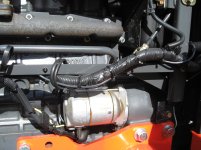
My question is where is the best place to connect in to? If I understood what I was seeing, it looks like the positive lead from the battery goes to the solenoid on the starter and a hot lead goes up to the main key/starter switch. Is it OK to connect in to either of those? Is there a better place?

The alternator is 35 amps. The most I would have on the circuit is three 55 watt halogens (13.75 amps). I could go to three 35 watt HIDs but they are more expensive and I would have to order online. One thing I noticed with HIDs is the start up draw can be double.
 
   / Wiring lights directly to battery circuit. #2  
I'm not sure if wiring lights directly to the battery is a good idea...however, when I installed a 12 volt outlet to my 4400, I talked to one of my local Deere dealer's technicians. He recommended hooking the hot (power) wire to the battery with an inline fusible link and the ground to the battery's ground.
Now, my 12v outlet is (primarily) for a flashing warning light that draws no more then a few amps. As a flashing light, it's pretty unlikely I'd leave it on when I'm not on the tractor.

So, yes you can...just make sure you turn those lights off!!!

BTW, I used 14 gage wire and crimped all connections. If you have a soldering iron, that might be better, but crimping does work well too (I didn't have a soldering gun and didn't want to buy one...not for a one time use). Although I used 14 gage wire, I suggest you use 12 gage (and I wish I had done so). I also ran the wires in a protective sheathing (buy it at any car parts store) and I suggest you do that too. Once you get to the operator's platform, you can determine the best routing to your ROPS (which is where I assume you'll mount the lights).
For neatness, I ran my wiring along side the stock wiring harness and wiretied every 10-12 inches.

Have you considered where you'll put the switch or switches?
 
   / Wiring lights directly to battery circuit. #3  
All our tractors/combines have up to 6 extra worklights on them many are 100watt works just fine off the battery with a fuse .
 
   / Wiring lights directly to battery circuit. #4  
12 volt blade fuse holders are cheap (they also have 12V circuit breakers). I have hooked up several directly to my battery but I also use a 12 volt relay to "enable" those circuits. The relay is connected to a circuit off of the key circuit so the lights etc can only be on when the key is on. This keeps you from draining your battery but at the same time prevents you from overloading the key circuits as well. IN my opinion, this is the best way to add most circuits.

Also, I really like the LED lights I have much better than halogen lights - brighter, whiter, and draw much less current.

Ken
 
   / Wiring lights directly to battery circuit. #5  
Wire size is dependant on total amp draw of the accessories added. If you are going to connect all three lights to one circuit/switch then #12 wire would be appropriate. The formula for computing a circuit load is derate to 80% of maximum allowable amperage for a given wire size. #12 is good for 20 amps x 80% = 16 amps. Similarly, #14 wire is 15 amp rated thus is capable of carrying a continuous load of 12 amps. The key word here is continuous load which is defined as 30 minutes or longer.

The only drawback to connecting any accessory directly to battery power is battery drain should it be left on or turned on accidently. The best place in this case to pick up power would be directly at the + battery terminal, with an inline fuse as close to the battery as possible, a 15 amp fuse should carry the load, though a 20 would be permissable also.
and be sure to use a switch rated higher than the total output of the load. In this case, a minimum 15 amp rated switch, 20 would give more of a safety margin.
The other possibility is run the lighting through a relay, allowing for a lighter duty switch and smaller wire to the switch, as it only controls the small relay instead of the higher amp loads the lighting will require. The main advantage of using a relay is usually shorter runs of heavier wire, (depending on lighting location) which helps guarantee full current to the lights. In this case wiring would be from power supply/fuse/relay to the lights on the high amp side. By using the relay you could pick up switch power at any convient location using smaller wire, say the switched hot side of an ignition switch, offering the safety margin of lighting would turn off with the switch off. Amp or wattage draw on the switch side of the relay would be almost non existant.
 
   / Wiring lights directly to battery circuit. #6  
   / Wiring lights directly to battery circuit.
  • Thread Starter
#7  
Is this how the relay works? I assume the power supply feeds into the relay and from the relay directly to the lights. A separate circuit would go from the relay to the switch and back to trigger the relay. Is this correct?

If the above is correct I guess I could do it 2 ways - does this make sense?:
1. Switch the relay from the main key switch and have an on/off switch in line to the lights from the relay. The lights would not stay on with the key off.
2. Switch the relay with an on/off switch which would permit the lights to be on with the key off.
 
   / Wiring lights directly to battery circuit. #8  
relay works as you describe; depending on where your lights will be, you can simply trigger the relay from one of your existing headlights (which is near the battery)...bring load power to the relay through a fuse or circuit breaker...I've frequently just hot-glued the relay (and the circuit breaker) to the top of the battery case. As stated, I'd use 12ga wire.
 
   / Wiring lights directly to battery circuit.
  • Thread Starter
#9  
Our battery is not easy to access so we may need to take off somewhere else. If we are able to access it what is the easiest way to hook in. Do you pull the clamp bolt and put a contact in?
 
   / Wiring lights directly to battery circuit. #10  
For the hot (red, +) use a ring terminal on the bolt that tightens the clamp;

[for the ground (black, -) you can attach to any good chassis ground (see where your black/- battery cable goes.]

you can make up by crimping ring terminal onto inline fuse like:

In-Line Fuse Holders

Any auto parts store should be able to help you
 
   / Wiring lights directly to battery circuit. #11  
I second the relay ( or continual-use solenoid) idea, hooked up to the key circuit. Whenever the key is on, the solenoid is active, but the lights wont operate unless their switch is turned on. However if you shut off the tractor, the lights WILL always turn off saving your battery. I use the same thing for a winch circuit on my F350. The same circuit also ran a work light by the winch, and i accidentally left it on. NOW it cant operate UNLESS the key is on.
 
   / Wiring lights directly to battery circuit. #12  

Good grief that's an expensive fuse block! Here are some other fuse blocks at a more reasonable price. ATC® & ATO® Fuse Panel w/ Grounding Pad

Is this how the relay works? I assume the power supply feeds into the relay and from the relay directly to the lights. A separate circuit would go from the relay to the switch and back to trigger the relay. Is this correct?

If the above is correct I guess I could do it 2 ways - does this make sense?:
1. Switch the relay from the main key switch and have an on/off switch in line to the lights from the relay. The lights would not stay on with the key off.
2. Switch the relay with an on/off switch which would permit the lights to be on with the key off.

Yep. Maybe this will help you with some ideas. https://picasaweb.google.com/110106108324823291002/LightsCameraACTION#
 
   / Wiring lights directly to battery circuit. #13  
I hooked my lights up to starter lug that runs to battery with in-line fuse. Philip.
 

Attachments

  • LIGHTS11.jpg
    LIGHTS11.jpg
    415 KB · Views: 465
  • LIGHTS10.jpg
    LIGHTS10.jpg
    525.1 KB · Views: 502
   / Wiring lights directly to battery circuit. #14  
if you have a cetner reading ammeter that shows net charge.. don't wire to the battery as you will defeat the net charge / discharge scheme.

if no ammeter / charge lamp.. then it really don't matter.. source from a spot capable of handling the load, and fuse to protect the wireing and switch.

soundguy
 
   / Wiring lights directly to battery circuit. #15  
Anything electrical might as well be martian to me but I was able to add a couple of work lights to my ROPS. I went off the battery with an inline fuse, plastic cable loom, blade connectors and waterproof electrical tape on all connections. I did not install a switch as my lights have individual on/off switches on each light, no chance of turning them on accidently in daylight. It is hard to walk away from your tractor with the rear work lights on at night. That being said guess who will do it this season.:laughing:
 
   / Wiring lights directly to battery circuit. #16  
Is this how the relay works? I assume the power supply feeds into the relay and from the relay directly to the lights. A separate circuit would go from the relay to the switch and back to trigger the relay. Is this correct?

If the above is correct I guess I could do it 2 ways - does this make sense?:
1. Switch the relay from the main key switch and have an on/off switch in line to the lights from the relay. The lights would not stay on with the key off.
2. Switch the relay with an on/off switch which would permit the lights to be on with the key off.

If I understand 1.correctly, you want the the relay to be triggered any time the key is "ON" then put a switch between the relay and the load. NOT the way to do this. (A) relay will be "ON" 100% of the time the key is "ON" (B) the switch must be able to handle the full current the load draws. Defeats the purpose of a relay. It WILL prevent the lights from working with the key "OFF"

2 Will work as stated. Lights can be controlled with the key "OFF" If this is what you want, Run fused 12 volts to relay. Jumper 12 volts to coil side of realy. Run switched side of relay to load. Run other side of relay coil to your switch, then from switch to ground.

The way I would do it: Run fused 12 volt to "IN" switched side of relay. Then from "OUT" switched side of relay to the load. The will be two switched "OUTS". NC (normally closed) and NO (normally open). You want NO (normally open). Then from your key switch you want a wire that is only powered when the key is "ON". splice into this wire, go to your switch, go to your relay coil, from other side of relay coil go to ground. Key must be "ON" AND switch must be "ON" for lights to work. As long as you don't leave the key "ON" the lights will not be "ON" and run down your battery.
 
   / Wiring lights directly to battery circuit.
  • Thread Starter
#17  
Thanks for all your help!!! :thumbsup:
We have completed the wiring.
 

Marketplace Items

60" HANG-ON WHEEL LOADER FORKS (A60429)
60" HANG-ON WHEEL...
24in pin on excavator tooth bucket (A61306)
24in pin on...
WOOD GRABBER FOR MINI EXCAVATOR (A58214)
WOOD GRABBER FOR...
2011 Toyota Camry Sedan (A56859)
2011 Toyota Camry...
Used Landpride GR1525 Stump Grinder
Used Landpride...
2013 Jeep Wrangler 4x4 SUV (A59231)
2013 Jeep Wrangler...
 
Top