$1000 TNT (dual tilt) for BX22

   / $1000 TNT (dual tilt) for BX22 #1  

jnjpream

Gold Member
Joined
Sep 27, 2008
Messages
266
Location
Berthoud CO
Tractor
BX22
When I searched for a TNT system for my BX22, I was pretty shocked by the cost of them. So I did some homework to find out what it really costs, and built one myself for just under $1000.. Some people will shy away when I say I built it myself, but stick with me here because it really isn't that bad!! And the welding is included in the cost.

Here are the details for those who may be interested. I'll break it apart into a few different posts.. This first post has a break down of the cost and some information I used in deciding what to use. (See the attached file.)

In the following posts, I've cover the details I used to select the parts and put them together.

I hope somebody out there finds this stuff useful.

Jeff

PS. Can somebody tell me how to inline pictures instead of attaching them?
 
   / $1000 TNT (dual tilt) for BX22
  • Thread Starter
#2  
The first thing I needed to do was determine what the specs were for the cylinders that I would need.. Let the fun begin. :)

I wanted to keep the link stroke, min, and max lengths the same as or better than OEM. So I measured distances from pin center to pin center for the top and the adjustable side links in both the retracted and extended positions. And since the cylinders would only be replacing the bodies of the links and not the ends, I measured the lengths of the ends from pin center to where the body started. Subtracting the length of the ends from the retracted measurements gave me the retracted length I needed for each cylinder. Simple enough.. Well I thought so.

Determining the cylinder diameter was pretty straight forward. The tractor manual gave me an idea of the 3pt capacity (have to tweak it a bit to find the load at the link points, there is a formula somewhere). With that info I looked at the pull and push specs for 1.5" and 2" and determined that the pull of the 1.5 was just too weak to handle a full load on the 3pt.

Most cylinders come with ends already on them. So I had to find specs for each cylinder that included measurements of the ends. Good cylinder specs (for my purposes anyway) also include distance from the ends to the cylinder body. And all of the cylinders I looked at varied in end lengths and rod lengths. So this turned out to be the most difficult task of the whole project..

In the end what mattered the most was finding a 2" cylinder with the stroke I needed to meet or beat the OEM specs and since the oem length was really short it had to have the shortest body length possible.

Although for the top link, I did have to vary from Kubota OEM measurements because the OEM stroke was 7" The only cylinders available w/o special ordering had 6 or 8 stroke. So you either had a retracted length 1 shorter with a short stroke, or 1 longer with a long stroke. Since I had added 3+ inches by using quick attach lower link ends, I chose the longer cylinder.

I found that Bailey had the cylinders with the shortest bodies, and their specs gave info for most all measurements with a clear diagram of what each measurement was measuring. Some simple math and I decided on the 2"x8" WP for the top link and a couple 2"x4" WT for the side links.
 
   / $1000 TNT (dual tilt) for BX22
  • Thread Starter
#3  
The next item needed was a valve..

It just happened that Bailey also had the least expensive 3 spool valve too! At the time I ordered it, I thought I needed a power beyond sleeve from reading about remotes other people added to BX's. But the BX22 backhoe uses an open center valve w/o power beyond, so nothing changed from stock by leaving the power beyond out of the circuit. The output ports take a bit of a load from the 3pt, but the valve is designed for this anyway. (So I've got an extra sleeve if anybody needs one.)

The picture is of the Bailey valve & cylinders.. You'll notice that the ends aren't quite right for a 3pt setup. This is why I was measuring body length of the cylinders when shopping for them, because I new they would be modified. (Sorry, I used a cell phone for this one because the real camera was dead.)

If you decide to order multiple pieces from Bailey, it is cheaper to break the parts into several shipments because you can keep the package weight down. They allow you to specify what parts to include in what shipment, which is kinda nice..
 

Attachments

  • IMAGE_060.jpg
    IMAGE_060.jpg
    53.9 KB · Views: 817
   / $1000 TNT (dual tilt) for BX22
  • Thread Starter
#4  
Time to make something..

The clevis ends for the side cylinders were pretty simple. Since I had the original side links, I already had a pattern. I bent my own clevis ends out of 1.25" x .25" flat bar stock I had laying around (if you don't have bar stock, ask the welding shop if they have scraps). I just marked the length of one of the clevis sides on the bar stock, added an inch, clamped it in the vise, and beat it to 90 degrees with a BFH. This left me with one side and the back of the new clevis. To get the other side, I took a piece of steel a bit smaller than the distance between the sides of the OEM clevis and clamped it and the new clevis in the vise. The extra steel helps keep the end of the clevis from colapsing and looking rounded. Then I beat the second side as close to a 90 as my vise would allow. To get the full 90 I needed to pinch the clevis end in the vice by the side and beat it the rest of the way. Now, since I left the sides a bit long, I trimmed them up using a saws-all so they were the right length and both sides were even.

Once all the clevis ends were made, I clamped them in the vice one by one, marked the hole centers using the OEM clevis ends as a template, center punched them and drilled the holes. It's easier to drill both sides of each clevis in one shot, than it is to drill one side, flip it, and try to line the second hole up with the first. Note that the OEM top clevis and bottom clevis have different size holes.

I would imagine that it wouldn't be too hard for a welding shop to make these ends for you. They probably have a press to make the bends nice and pretty. Just have them make the bends, you can trim them up and drill the holes yourself later even after they've been welded if need be.

The only pictures I have of the finished clevis ends are in pictures after they have been welded to the cylinders, but you just have to look at the OEM clevis ends to know what they should look like. Don't worry about the angles at this point, the clevis ends just have 90 degree bends.
 

Attachments

  • Imported Photos 00008.JPG
    Imported Photos 00008.JPG
    96.4 KB · Views: 418
  • Imported Photos 00009.JPG
    Imported Photos 00009.JPG
    312 KB · Views: 418
   / $1000 TNT (dual tilt) for BX22 #5  
Definitely interested... keep going! and definitely would love to see pictures of them on the BX!

[Anxiously subscribed]
 
   / $1000 TNT (dual tilt) for BX22
  • Thread Starter
#6  
Preview of the finished product..
 

Attachments

  • Imported Photos 00026.JPG
    Imported Photos 00026.JPG
    337.3 KB · Views: 634
  • Imported Photos 00024.JPG
    Imported Photos 00024.JPG
    362.7 KB · Views: 519
  • Imported Photos 00023.JPG
    Imported Photos 00023.JPG
    375.7 KB · Views: 651
  • Imported Photos 00014.JPG
    Imported Photos 00014.JPG
    360.4 KB · Views: 1,066
  • Imported Photos 00027.JPG
    Imported Photos 00027.JPG
    336.9 KB · Views: 533
  • Imported Photos 00004.JPG
    Imported Photos 00004.JPG
    98.6 KB · Views: 1,015
   / $1000 TNT (dual tilt) for BX22
  • Thread Starter
#9  
Modify the cylinders to fix the BX 3pt part 1..

Nothing like taking a saw and grinder to $400 in brand new cylinders.. Note: This will void the cylinder warranty :D.

An important note about hacking on cylinders.. Be very careful when clamping a cylinder in a vise or anything that can excerpt pressure on the cylinder wall. If you clamp down on the cylinder body, you can warp the cylinder body/wall and ruin the cylinder. Also, do not do anything that can mar the chrome on the cylinder rod. If you mar the rod it will tear up the seal and develop a leak. It is also a good idea to extend the cylinders so that the seals (piston, and gland) are as far away from heat as possible when grinding, cutting, or welding.

When I worked on the cylinders, I turned my vise so that I could clamp on the part I was cutting off and allowed the other end of the cylinder to rest on the bench. That way only the cross tube (the part on the end that I was cutting off) was taking any pressure from the vise.

The non-rod end of the cylinders was a no brainer. I just cut the cross tube off as close to the cylinder end as I could, then smoothed the surface off with a grinder.

The rod end of the cylinders took a bit of planning. You need to leave some rod exposed between the clevis (or swivel end) and the cylinder body so that when fully retracted it is less likely to pinch rocks and stuff between the body and the clevis (or swivel end) and damage the gland seal. And you need to leave some room for the weld bead. But don't hack off the rod ends just yet..

Details of the rod end surgery in the next post. But here are pictures of the ends that were cut off.
 

Attachments

  • Imported Photos 00032.JPG
    Imported Photos 00032.JPG
    282.2 KB · Views: 519
   / $1000 TNT (dual tilt) for BX22
  • Thread Starter
#10  
Modify the cylinders part 2: Top Link cylinder gets cut..

When sizing the top link cylinder there are a couple things you need to worry about. Clearance, and clearance..

The non-rod end of the cylinder needs enough distance between the swivel and the end of the cylinder so that it won't touch the part of the tractor that the pin goes through (See the 1st and 2nd pictures). You need to consider all angles that cylinder can be in, top to bottom, AND left to right. The way I figured it out was to pin the swivel onto the tractor, as if it was attached to the top link, and used a ruler and moved the swivel all around to find the spot of greatest interference. That told me the how much filler I needed between the swivel and the cylinder when it came time to weld. Mine ended up being 1/4 inch between the cylinder and the swivel, see the last picture.

The rod end of the top link was measured much the same way, only instead of pinning the swivel to the tractor you need to pin it to the implements. I screwed this one up a bit.. :eek: I didn't consider the girth of the cylinder and how close it would be to the 3pt frame on the implement when fully raised. You almost need to attach the implement to the tractor using the OEM top link in its fully retracted position, lift it all the way up, and measure the angle. Then hold the cylinder up at that angle and see what kind of clearance you need. Take a look at picture 3 and 4 and you can see where my cylinder hits my box blade frame. It's not bad and actually clears when the cylinder is perfectly centered, but how often is it perfectly centered in real life.. I cut it at 1 1/8 inches, but should have cut it at 1 1/2 inches. The only bummer about adding the extra length is, well, it adds extra length. But in reality an extra 3/8 inch wouldn't do any harm.

If you look at picture 5, you'll see a drawing of my cut points on the cylinder. You'll notice that the end of the rod has been angled a bit (~1/4 inch down the side). This is to allow room for the welder to get in as far as possible to ensure good penetration. The welder will fill that gap in with several passes of weld bead. I made the straight cut with a saws-all, then used the grinder to cut the sides down a bit. You'll also notice the small piece of filler on the non-rod end of the cylinder. I kept it small for the same reason as the angles on the rod.

To cut the cylinder rod with a hack saw, band saw, saws-all, or just about anything other toothed cutter, you will need to remove the chrome from the rod where you are going to cut. Any toothed cutter will just bounce off the chrome and do nothing but scratch it. I used a piece of tape and drew a line around the rod with magic marker then removed the tape. Then I used my grinder to chew off the chrome where the line was. Once through the chrome it will cut like any mild steel.

Next post is the side links..
 

Attachments

  • Imported Photos 00039.JPG
    Imported Photos 00039.JPG
    76.1 KB · Views: 452
  • Imported Photos 00038.JPG
    Imported Photos 00038.JPG
    276.3 KB · Views: 375
  • Top Link Drawing.jpg
    Top Link Drawing.jpg
    29 KB · Views: 275
  • Imported Photos 00044.JPG
    Imported Photos 00044.JPG
    308.5 KB · Views: 398
  • Imported Photos 00036.JPG
    Imported Photos 00036.JPG
    286.4 KB · Views: 369
   / $1000 TNT (dual tilt) for BX22
  • Thread Starter
#11  
Modify the cylinders, part 3. The side links get cut.

The side links aren't too bad. For the BX22 when using the bailey cylinders, when fully retracted, I just needed enough rod to keep from pinching stuff and give the welder enough room for the bead. I left 1/2 inch of rod total (see picture). There would be 1/4 inch ground off the side of it for the welder, and another 1/4 inch of untouched rod below the weld. You really don't want to go anything less than 1/4 inch between the weld and the seal because the heat from the welding will damage the chrome at least 1/8 inch below the weld which leaves only another 1/8 of good chrome. Not much..

If the OEM links were longer then I would have left more rod, but in this case the cylinders were an inch longer than the OEM links so shorter was better.

The new side links, once all put together using OEM sized clevis ends, left the total side link length 1 inch longer than OEM. It turned out to not be a big deal. And if I need to get that extra inch back there is enough clearance between the lower links and the top of the side link clevis ends that I can move the pin hole up an inch on the clevis end without any problems. I haven't found the need to do this though.

Next post is how to setup and jig for welding.
 

Attachments

  • Side Link Drawing.jpg
    623 KB · Views: 293
   / $1000 TNT (dual tilt) for BX22
  • Thread Starter
#12  
Time to attach the new ends to the cylinders.. Part 1, top link.

Before describing how things are put back together I need to be sure we are talking the same language so we can stay on the same page.. I will be talking about angles in all sorts of directions using the terms left and right, front and back, and rotation. When I say left or right I'm talking about the direction the end of something will point towards when looking at it as you stand behind the tractor. When I say front or back I'm talking about the direction the end of something will point towards in relation to the tractor in general. And when I say rotate, I will give you a point of reference and give the number of degrees clockwise or counterclockwise something will rotate from that reference.

When I put this together I didn't have a welder and didn't trust welding skills of the friend I knew who did have one (sorry Mark). The welding shop I use charges only $65 per hour with a $25 minimum, which is a SCREAMING deal. Most will charge $90 per hour. But in any case time is money and these days I don't have much of it. So my plan, which worked out well, was to have my friend tack weld the part together then let the pros finish them. This way I didn't waste time jigging each part while the pro's clock ticked along. It ended up costing a bit over the minimum for the entire weld job.

So let's start with an easy one, the top link

Don't have to worry about angles on this one, just rotation or lack there of in my case. The rod end swivel just needs to be straight and centered on the rod. The rod will turn in the cylinder, so it's pretty hard to screw the rotation on that one up.

The non-rod end worked out best when the swivel end aligned with the cylinder ports (See the picture). This way, when using it on the tractor, I can aim the ports up or down by flipping the cylinder over. If the swivel was aligned such that the ports aimed out the side when mounted, flipping the cylinder wouldn't make much difference because the left side of the 3pt hitch looks pretty much like the right side. So if it's in the way on one side, it will probably be in the way on the other side too. But use what you think will work best for you.


The side links come next..
 

Attachments

  • Top Link Align Drawing.jpg
    492.8 KB · Views: 252
   / $1000 TNT (dual tilt) for BX22
  • Thread Starter
#13  
Sorry, didn't mean to leave anybody hanging. The boss has had me working days and evenings, and my landscaping project has been killing my weekend time.. But anyway.

The side links (Rod end).. When I took the side links off the tractor the angles of the ends were pretty intimidating. But thought about it for a bit, it's just a bar with two ends. The ends just happen to angle back to front and side to side at the bottom, and side to side at the top. The rotational difference between the rod and non-rod end didn't matter because you can just give the rod a twist after things are welded if need be.

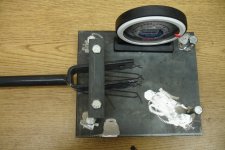
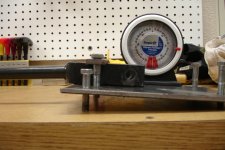
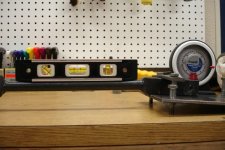
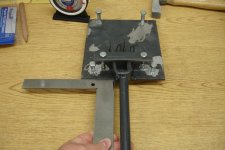
To figure out the angles I used a flat piece of steal approx 8"x8" ($1 scraps shelf at the welding shop), drilled and tapped each corner, and put bolts with nuts into the holes to make the angle of the plate adjustable. The I drilled and tapped two more holes to make a clamp to secure the side link ends to (see the first two pictures). This jig did a couple things for me, it gave me a consistent way of measuring the angles of the link ends, and it gave me a jig for welding.

How to setup the jig.. Slide the end to be measured/welded under the clamp with the holes of the clevis ends to the sides. Make sure the bar of the side link is square with the end of the plate, and tighten the clamp (third picture). Then, using a level (or eyeball), turn the bolts until the bar of the side link is level and the plate is level from side to side and doesn't wobble, then tighten the lock nuts (fourth picture). The pictures don't show lock nuts, but you want to use something to keep the bolts from turning or be careful not to unintentionally turn the bolts.

The measurements I took from my side links are in the last picture, yours may be different if Kubota changed anything from model to model. But the beauty of this jig is you really don't care what the measurements are since it will allow you to blindly duplicate the OEM angles.

The back to front angle is secured by the screws of the plate (the second picture). To secure the left to right angles, just take a marker and trace the clevis ends on the surface of the plate (the first picture). They are hard to see from the picture, but the non-rod ends are marked there too (Note for the BX22, the non-rod ends didn't have any back to front angles, just left or right).

Now that you have the jig adjusted for the rod ends, use the marks on the top of the plate to line up your new clevis end in the clamp. Square the cylinder with the plate and use shims to make sure the cylinder is level. If the clevis isn't the same height as the cylinder rod, just turn the four corner bolts equally until it is the right height. Then tack the clevis to the rod. That's it. Real easy once you have the jig set.

The non-rod ends are almost as easy, but with them you have to think a bit about port location.

I'll cover the non-rod ends in the next post.. (I promise it won't be as long before the next post this time)
 

Attachments

  • Imported Photos 00029.JPG
    Imported Photos 00029.JPG
    308.6 KB · Views: 286
  • Imported Photos 00030.JPG
    Imported Photos 00030.JPG
    298.6 KB · Views: 252
  • Imported Photos 00034.JPG
    Imported Photos 00034.JPG
    302.6 KB · Views: 229
  • Imported Photos 00035.JPG
    Imported Photos 00035.JPG
    339.4 KB · Views: 245
  • Side Link Align Drawing.jpg
    Side Link Align Drawing.jpg
    63.6 KB · Views: 204
   / $1000 TNT (dual tilt) for BX22 #14  
Wow, nice write up JNJ.

If you want to post pics 'in line', you'll have to host them else where first. Then use the
 
   / $1000 TNT (dual tilt) for BX22 #15  
Excellent!! First class thinking, planning, execution and final product.

You have the type of innovation that keeps America great.
 
   / $1000 TNT (dual tilt) for BX22 #16  
This is outstanding! Adding this to my, "hope to do this some day..." folder.
 
   / $1000 TNT (dual tilt) for BX22
  • Thread Starter
#17  
See.. It wasn't 11 days between posts this time. Only 9. :eek:

Where were we.. Ah yes, the non-rod end of the side links.

With the BX22 I had to consider where to locate the cylinder ports so that the ports and fittings wouldn't bend up the fenders when the hitch is raised. Take a look at the first picture and you'll see where the top port and 90 degree fitting are in relation to the fender.

The trick to making sure you will clear the fender is to consider the worst case scenario. The ball end in the lift arms will allow the clevis to rotate some, so you need to rotate it to towards the fender then figure out the safe angle for the ports in relation to the clevis end. Sounds difficult doesn't it..

Picture two to the rescue! Found it online somewhere. Print it out as multiple pages per sheet and it will print a handful of correctly sized protractors for a 2" cylinder. If they are still not the right size, try to save it as a .jpg and use a photo editor to resize it. Or you can google for a different one.

So how do you use the protractor? Just center it on the bottom of the clevis end such that either 0/180 or 90 is square with the open side and stick it there with a piece of tape (number side up). Raise the lift arm as high as it will go. Now pin the clevis end onto the lift arm and twist it to towards the fender. Eye ball the point where it clears the fender and mark it with a pencil or something. This will be the OUTSIDE of the cylinder port.

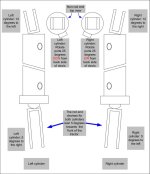
Hold the clevis end with protractor onto the non-rod end of the cylinder and line up the mark with the correct side of the port. Now make a mark on the cylinder for the point that is squared with the clevis end. For example, when I taped my protractor to the clevis end, I set the 90 degree to be square with the open side of the clevis. The mark I made on the protractor after holding it up to the fender was on the 65 degree point. So once I lined up my 65 degree mark with the cylinder port, I marked the 90 degree point onto the cylinder. (Please note that when I did it I guesstimated the center point of the port when I marked the protractor. I later determined that the side of the port would have been the more accurate & easy way to go. So where the last picture says the clevis is rotated 25 degrees from the ports, it is 25 degrees from the CENTER of the port. Your number will be different if measuring from the side of the port)

Once you have the mark on the cylinder, draw a line across the middle of the non-rod end of the cylinder using the mark as your reference. When you go to weld the clevis on to the cylinder, this line should run through the middle of the open side of the clevis end.

You can use the same jig as was used for the rod-end work. Do the same setup to figure out the angles, adjust the height, and tack weld the end onto the cylinder. The only difference here is you need to pay attention to where that mark on the cylinder is in relation to the open side of the clevis end.

And BE SURE you have the correct cylinder before you weld. The right cylinder rod end clevis angles to the left and to the front, with a non-rod end angled towards the right. The left cylinder rod end clevis angles to the right and front of the tractor, with a non-rod end angled towards the left. I screwed this up twice.. Yes, twice. :mad: This is why you TACK weld.

Now that you have both ends tacked to the cylinder, carefully pin it to the lift arms and lower arms. I say carefully because it is just tacked and cannot support much load w/o bending or breaking the welds. Now make sure everything fits like it should. If you need to change it, break or grind off the tack welds and adjust as needed.
 

Attachments

  • Imported Photos 00041.JPG
    Imported Photos 00041.JPG
    309.9 KB · Views: 368
  • conventional-protractor.pdf
    38.8 KB · Views: 208
  • Side Link Align Drawing.jpg
    Side Link Align Drawing.jpg
    63.6 KB · Views: 239
   / $1000 TNT (dual tilt) for BX22
  • Thread Starter
#18  
So now you have everything tack welded and you're ready to go all the way with the welds..

Before you, or the pros, hit it with the heat, be sure to extend the rods out (you can use compressed air to actuate the cylinders) as far as possible to keep the seals as far from the heat as you can. Also try to keep the rods/cylinder wrapped in wet towels to help things stay cool (or suggest it to the welder). And be sure to wrap any exposed chrome on the rod with a couple layers of painters tape to protect it from splatter.

If every thing is tacked where you need it and as much prep is done as you can do, if the welder knows what he/she is doing it shouldn't take but 15 or 20 minutes to weld it. Although they may charge you for setup time too (5~10 minutes).

And this is a little late in the game to bring it up, but, don't go overboard with the tack welds. If they are too thick, or gross, they may need to be ground out by the welder after they apply a good penetrating tack. And time is money when your at the welding shop. Also, it never hurts to stop by the welding shop to ask them how they like the surfaces prepped etc. It helps them do a better job, and helps shave some time off the clock.

And when they are all welded up, take the time to give them a good paint job. The paint from the factory is crap, and at least on mine they didn't use primer. I hit every thing with the wire wheel to get rid of the existing paint and slag (wear your particle mask). Then I used a self-etching primer.. You should always use an etching primer on bare metal to get a good bond, it's $15 a can or so but well worth it. So be sure to protect the chrome and be sure to wear a respirator when painting, especially the etching primer because it contains an acid. Then wait a day and hit it with some color.

Looking good? Great!

We'll cover the valve mount etc in the next post.
 
   / $1000 TNT (dual tilt) for BX22 #19  
WOW! Very nice job. Well documented. Thank you for all the info and taking the time to post and take pics. Well done.

YotaBota
 
   / $1000 TNT (dual tilt) for BX22 #20  
Wow, nice job ! I really like that you made both sides tilt, unlike most top & tilt kits. Very thorough explanation also. I look forward to a few action photos in the future. :)
 

Marketplace Items

2003 LEEBOY L150 ASPHALT DISTRIBUTOR TRAILER (A52707)
2003 LEEBOY L150...
flatbed trailer 24ft (A56857)
flatbed trailer...
2020 PETERBILT 567 (A58214)
2020 PETERBILT 567...
2014 Forest River Rockwood Premier 2317G S/A Pop Up Trailer (A59231)
2014 Forest River...
SWICT 78" SKID STEER BUCKET (A60430)
SWICT 78" SKID...
UNUSED RAYTREE RMLL60-60" HYD LAND LEVELER (A60432)
UNUSED RAYTREE...
 
Top