Voltmeter - what am I missing?

   / Voltmeter - what am I missing? #1  

Dyer retired

Gold Member
Joined
Feb 25, 2008
Messages
476
Location
Belgrade, Maine
Tractor
2003 Kubota BX1800 and 2010 B3030
With a lot of help from Shaun (Blackmagicwoman) I bought and installed a 40 amp alternator on my BX 1800, fired up the rig and tested the voltage readings across the battery terminals with my multimeter. I got a reading of 12.6 volts with the tractor off and 14.46 volts with the engine running just above idle and 14.32 volts at idle. I also got a reading of 14.32 volts with the engine just above idle with the lights on. Very exciting, nothing caught fire, no explosions, I finally installed something without a semi-major injury, so I was happy!

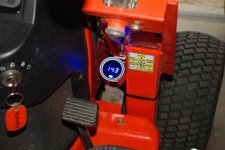
I bought a digital voltmeter gauge and tested it across the battery terminals and got the same readings as I had with the multimeter at the various rpm's and with the lights on and off. I then mounted it to the tractor and hooked it up to a keyed power source, so it would only display when the engine was running. For a keyed power source, I used the wire for a rear light that came installed on the tractor, but hadn't been used. I pulled the wire back through to the battery compartment and used only the length I needed for the positive lead and I just hooked the negative terminal to the battery negative auxiliary post. I then turned the key on and got a reading of 12.0 volts with the engine off and 14.1 volts with the engine running above idle. At one point, and at a little higher rpm's, it displayed 14.2 volts. When I turn the headlights on, the reading dropped to 13.2 volts on the newly mounted meter. I ran my multimeter across the battery terminals again while this reading was displayed and got a reading of 14.32 volts on the multimeter.

I know from other threads that I should be reading about 14.5 volts and feel confident that I'm getting that from the testing directly across the battery terminals with the new gauge and with the multimeter. Can someone help me, or explain to me how to correct this, or am I missing something? It seems that the new gauge should be reading accurately and did so before I ran it through the key?

Plan B would be to run the leads to the battery directly, but through a switch that I can kill the power to it when the engine is off. Any help is appreciated.

Dyer, retired
 
   / Voltmeter - what am I missing? #2  
You are reading the effect of the resistance through the switch and additional wiring, known as voltage drop. The more resistance in a circuit with a load, such as the lights, the more the voltage drops. If you want to know exactly what the voltage is at the battery you'll have to read it at the battery.
 
   / Voltmeter - what am I missing?
  • Thread Starter
#3  
You are reading the effect of the resistance through the switch and additional wiring, known as voltage drop. The more resistance in a circuit with a load, such as the lights, the more the voltage drops. If you want to know exactly what the voltage is at the battery you'll have to read it at the battery.

Skyco,

I guess it's on to Plan B. Thanks for the reply. John
 
   / Voltmeter - what am I missing? #4  
Skyco is exactly right about the voltage drop, especially in a 12 VDC circuit. The small difference you would gain by running wires to the battery might be negated by the wire resistance of the wire to the battery. What I would do is to read your voltage with the drop when you know it is correct at the battery. Use that value as your baseline for the future. If it reads 14.2 or 13.8, you don't care as long as it always reads this amount. If it drops to 12 or less, that would indicate a problem. Don't make it harder on yourself than it needs to be.:)
 
   / Voltmeter - what am I missing? #5  
The volt meter should have a high input impedance pretty much making wires to the meter from the point of measurement insignificant. The drop, of course, occurs because of the loads on the circuit.
But I agree with jinman:) If you know what is normal wherever you hook it up then you still have a valid frame of reference...;)
 
   / Voltmeter - what am I missing?
  • Thread Starter
#6  
Skyco is exactly right about the voltage drop, especially in a 12 VDC circuit. The small difference you would gain by running wires to the battery might be negated by the wire resistance of the wire to the battery. What I would do is to read your voltage with the drop when you know it is correct at the battery. Use that value as your baseline for the future. If it reads 14.2 or 13.8, you don't care as long as it always reads this amount. If it drops to 12 or less, that would indicate a problem. Don't make it harder on yourself than it needs to be.:)

jinman, Skyco,

The instructions, and about every post I've read, called for running the gauge through a keyed ignition source, so I used that rear light wire that was factory installed, which fed out from the 20 amp fuse, along with 5 or 6 other accessories. I know very little about electrical circuits, but thought that getting readings that were 1 full volt lower than what was actually occurring at the battery was unacceptable....or at least undesirable. I ended up running the meter directly to the battery with a toggle on/off switch in the hot lead. My readings are now only slightly lower than the multimeter is showing me and I'm much happier with what I'm seeing now. I've run the gauge against the multimeter now with engine off, engine on, lights off, lights on, etc., and am getting consistent readings only slightly lower than the multimeter throughout the ranges. For instance, now the gauge with the lights off and engine running is reading 14.4 volts and the multimeter is showing 14.6 volts. The gauge drops to 14. 2 volts with the lights on and the multimeter shows 14.4 volts, so I'm more comfortable with what I'm seeing. Thanks for the help and advice guys. John
 

Attachments

  • Voltmeter.jpg
    Voltmeter.jpg
    105 KB · Views: 302
   / Voltmeter - what am I missing? #7  
A full volt of drop at the "ignition" switch seems like a lot to me.

There are two issues. 1. all the advice telling you to note what is "normal" and go from there is basically sound except... 2. I'd be curious to find out why there is a voltage drop of a volt at the source you are tapping.

There is another way to use your new meter. Here is an example: you place one probe on the battery post itself and the other probe on the clamp on that post and note the voltage indicated on the meter when you turn on all the lights and all accessories you have. If the connection is clean and tight (good connection) there will be little or no voltage read (way less than a volt, A millivolt or less.)

Another example: you place one probe on the positive battery post and the other probe on the switch connection that is connected to the wire coming from the battery. Again you turn on all the "stuff" getting power via that switch. If you get more than a very small fraction of a volt then there is a "high resistance" somewhere between the battery and the input to the switch. If no problem detected at this stage put one probe on the input to the switch and then the other probe sequentially on each output of the switch (if there is more than one) with all the current users using current that are fed from each of the switch positions. IF more than a tiny voltage is found there is something wrong, a high resistance like a bad contact or similar.

Anyway the basic idea is that a run of wire or a connection or switch or relay contacts when passing their normal load of current should not have much of a voltage drop across them and if they do then there is something wrong. If a wire is undersized for the current it is trying to pass then you will get an excessively high voltage reading which for a piece of wire should be a tiny fraction of a volt at most.

There has to be a logical explanation for losing a full volt which in my opinion is excessive for your reported situation.

If your trouble shooting volt meter is connected directly across the contacts of the dash mounted meter do they read the same voltage? If not, it is fair to just note the difference, assume the dash meter is slightly off, and live with it as others suggested BUT I would not just ignore a lost volt and live with it. Something is NOT RIGHT.

Pat
 
   / Voltmeter - what am I missing? #8  
could it be that the factory installed some sort of resistor in the wire for the light wire ? I wouldn't think the wire would be long enough to have that much voltage drop. Provided the wire is in good condition
 
   / Voltmeter - what am I missing? #9  
The problem is that when you read the voltage on the wire after the key, you are getting a voltage drop due to the current flowing through the key wire. (Aux lights, dash lights, relays, etc.)

If you really want to only be able to read the voltage when the tractor is on, connect your sense wire to one of the relays. Due to its proximity to the battery, you shouldn't get too much of a voltage drop.

I'm assuming this is an analog meter? An analog meter has a much lower impedance vs. a digital meter, since you are using the battery to power the analog meter.

-Steve
 
   / Voltmeter - what am I missing?
  • Thread Starter
#10  
Pat,

I do plan to chase this around some more and will follow your suggestions. I did test the factory installed wire I used before pulling it back to the fuse location and got the same voltage drop readings using the multimeter as I did after connecting the gauge to it. That same voltage drop was read after the wire was cut to size. Again, I know very little about this stuff and imagined that the drop was somehow related to the length of wire prior to cutting it to what I needed. I ended up using less than 10 inches from where it was attached at the 20 amp fuse. I didn't count the various wires also coming through that 20 amp fuse, but there are at least 5.......all factory installed, nothing I've added. I did not have the gauge on a separate switch, but just hooked to that wire, which powered it up when I turned the ignition on and shut off when I shut the tractor down. I did test the gauge before installing it by touching the leads on the gauge to the battery posts directly and compared that to the reading on the multimeter when testing the same contact points. I got the same readings from both the gauge and multimeter with the engine off, the engine running, and with all the lights fired up, when testing directly from the battery, so I am satisfied that the gauge is accurate. I appreciate the help with this. John
 
   / Voltmeter - what am I missing?
  • Thread Starter
#11  
The problem is that when you read the voltage on the wire after the key, you are getting a voltage drop due to the current flowing through the key wire. (Aux lights, dash lights, relays, etc.)

If you really want to only be able to read the voltage when the tractor is on, connect your sense wire to one of the relays. Due to its proximity to the battery, you shouldn't get too much of a voltage drop.

I'm assuming this is an analog meter? An analog meter has a much lower impedance vs. a digital meter, since you are using the battery to power the analog meter.

-Steve

Steve,

It's a digital mulitmeter....if that's what you're asking.
If you're asking about the gauge, there is a picture attached to post #6, and it is also digital. Since my first post, I've wired the gauge directly to the battery with a toggle on/off switch and am gettng much more accurate readings...checking against the readings with the multimeter. I was hooked in after the key initially and got the full volt drop with that installation, so I went direct to the battery instead. John
 
   / Voltmeter - what am I missing? #12  
Steve,

It's a digital mulitmeter....if that's what you're asking.
If you're asking about the gauge, there is a picture attached to post #6, and it is also digital. Since my first post, I've wired the gauge directly to the battery with a toggle on/off switch and am gettng much more accurate readings...checking against the readings with the multimeter. I was hooked in after the key initially and got the full volt drop with that installation, so I went direct to the battery instead. John
Check out this link. Lots of good info in it relating to finding where voltage is being lost in a current carrying circuit. What patrick g described a few posts back.
http://www.tractorbynet.com/forums/parts-repairs/102900-starter-circuit-problem.html
larry
 
   / Voltmeter - what am I missing?
  • Thread Starter
#13  
Check out this link. Lots of good info in it relating to finding where voltage is being lost in a current carrying circuit. What patrick g described a few posts back.
http://www.tractorbynet.com/forums/parts-repairs/102900-starter-circuit-problem.html
larry

Larry,

Thanks. I read through the thread you directed me to and find all this stuff interesting. My wife showed up yesterday with a book, "Electronics for Dummies," so I'll be reading through that and seeing if it all eventually clicks for me. I'm going through the test procedures that Pat suggested, but am finding that I need to be a contortionist to do some of these. I still have my mmm deck on and trying to get at some of these contact points requires awkward positioning....none of them comfortable, so it's going to be slow. I'll make notes and report how it's going beginning with the battery post and clamps comparisons....those are at least easy to get at. I appreciate everyone's patience with my severe lack of circuit knowledge. John
 
   / Voltmeter - what am I missing? #14  
One thought. If you now have the meter wired on its own switch and forget to turn it off when you shut the tractor down, it will discharge the battery over time.
 
   / Voltmeter - what am I missing? #15  
That would take a long time to discharge. But it is still a drain on the battery. About the same as most car and truck batteries get keeping the clocks and alarms going while the vehicle is off. Keep a trickle charger going if the tractor is going to be stored for a extended period.
Just to toss in another point the accuracy of the DMM is probably a few percentage points better than any after market voltage indicator that mounts on your vehicle. That would account for differences in readings as well.
One test that may have been mentioned is to take your dmm with good test leads. Probe directly on the battery post. Then probe directly on the battery clamp. You really shouldn't see any voltage difference. If you do then the connections need to be cleaned up. This is especially true if you crank over the starter doing the same test with the DMM. Check both +/- post on the battery.
 
   / Voltmeter - what am I missing? #16  
IMO best way to wire a voltmeter in your tractor is to find which terminal of your ignition switch is at 12v when in the run position. use a crimp wire splice (sold at auto parts store) and your other end to frame ground close to the meter. Much simplier, don't have to worry about switches etc. and the wire from the alternator/battery is much thicker and you won't experience any appreciable voltage drop.

Good luck.
 
   / Voltmeter - what am I missing? #17  
Steve,

It's a digital mulitmeter....if that's what you're asking.
If you're asking about the gauge, there is a picture attached to post #6, and it is also digital. Since my first post, I've wired the gauge directly to the battery with a toggle on/off switch and am gettng much more accurate readings...checking against the readings with the multimeter. I was hooked in after the key initially and got the full volt drop with that installation, so I went direct to the battery instead. John
Dyer, when you get a chance please look at the specs of that gauge and see what the current is that it draws from the circuit. I know it will be too low to worry about it affecting the battery [even if on all the time] but it will draw MUCH more than a DMM since the DMM carries its own power source and therefore just samples the circuit, drawing about a millionth of an amp. Your gauge is powered from the battery and probably draws thousands of times more. Make sure your connections are good. With it drawing [relatively] so much current you could actually see a voltage drop across a bad connection with your MUCH more sensitive DMM. This drop, summed with all others in the circuit powering the gauge would cause an error in its reading. Except in extremely unusual marginal connection quality situations this error would be too small to see with the gauge resolution of 0.1V. However, where the batt voltage was 14.350, a V loss in your gauge circuit of 0.001V would cause your gauge to read 14.3 instead of 14.4 because of the round off. No serious implication here-just FYI
Larry
 
   / Voltmeter - what am I missing? #18  
... I'm going through the test procedures that Pat suggested, but am finding that I need to be a contortionist to do some of these. I still have my mmm deck on and trying to get at some of these contact points requires awkward positioning....none of them comfortable, so it's going to be slow.

I completely empathize with what you're going through. It's not easy to reach some of these connections.

I don't know what kind of meter you're using, but I really improved the usefulness of mine by cutting off the "needle" probe on the black wire (negative) and attaching an aligator clip in its place. It eliminated the need for an extra hand. I have an extra set of leads from an old meter that I can still use if I need the needle type.
 
   / Voltmeter - what am I missing? #19  
I agree with skyco.. the aux lamp wire you are using is undoubtedly run off either the igntion switch or a relay, that is being fed from , probably, a fuse panel.. and that fuse panel. which runs all the electrical loads onthe tractor except the starter.. is 'probably' powered from a single 10ga wire...

Thus with the low wire gauge, and all the contacts inline.. you are indeed getting a voltage drop. If you want to get by that.. buy a cheap 12v foglamp relay from an auto store.. should be less than 5 bucks... have your switched hot wire power the relay coil, and ground the other side of the relay coil. For the contacts ont he relay coil.. hook one to battery, and the other to your voltmeter.. thus when the keyed power wire comes on, it energizes the relay.. which then feeds 'bat' power to the voltmeter... the relay itself draws very litle so it should not overtax your fuse panel.

soundguy

post. I then turned the key on and got a reading of 12.0 volts with the engine off and 14.1 volts with the engine running above idle. At one point, and at a little higher rpm's, it displayed 14.2 volts. When I turn the headlights on, the reading dropped to 13.2 volts on the newly mounted meter. I ran my multimeter across the battery terminals again while this reading was displayed and got a reading of 14.32 volts on the multimeter.

I know from other threads that I should be reading about 14.5 volts and feel confident that I'm getting that from the testing directly across the battery terminals with the new gauge and with the multimeter. Can someone help me, or explain to me how to correct this, or am I missing something? It seems that the new gauge should be reading accurately and did so before I ran it through the key?

Plan B would be to run the leads to the battery directly, but through a switch that I can kill the power to it when the engine is off. Any help is appreciated.

Dyer, retired
 
   / Voltmeter - what am I missing? #20  
I completely empathize with what you're going through. It's not easy to reach some of these connections.

I don't know what kind of meter you're using, but I really improved the usefulness of mine by cutting off the "needle" probe on the black wire (negative) and attaching an aligator clip in its place. It eliminated the need for an extra hand. I have an extra set of leads from an old meter that I can still use if I need the needle type.

There are probe kits that have special alligator clips that slip over the needle tips provided in the kit. This gives you lots of options on how to use your probes. The ones I have seen and or used also have slip over tips that are like spade lugs, and bananas too.

To Larry (the OP)

The current draw of your panel meter is NOT MUCH but over a long enough period of time it will pull the battery down some (aided by self discharge.) The battery maint, i.e. float chargers are ideal for offsetting this and will keep your battery charged without overcharging and rapid electrolyte loss. I have used several different brands and ALL WORKED FINE. HF has them on sale every so often under $10.

They aren't intended to charge a flat battery but do keep a decently charged battery topped off, even with alarms and such constantly trying to drain the battery. Even with two large (100 AH) diesel starting batteries in my Dodge-Cummins truck, my extensive alarm system would pull the battery down if the truck wasn't used frequently which it wasn't. My $7 HF wall wart type maintainer has been keeping it topped off for years now. Always ready.

And Larry, in a series circuit the sum of all the voltage drops is exactly equal to the applied voltage. So as you move along a circuit if you find ANY voltage drops and you add them all up, including the voltage across the panel meter's power connections the total should be the same as the battery voltage.

I again assert there is something wrong in there somewhere. The current consumption of the panel meter is so low that it should not significantly load wires that were intended to run a relatively heavy current using light.

When you measure the battery voltage directly at the battery posts (not the cable clamps) and again at the power connections of the panel meter, the difference in volts will have to appear somewhere along that series circuit. It could even be a poor ground connection for the panel meter.

Also, always remember , "We are all ignorant, just about different things." Ignorance is curable but stupidity is permanent. Luckily you were ignorant and not stupid and are well on your way to not being so ignorant about electrical stuff.

Beat of luck to you,

Pat
 

Tractor & Equipment Auctions

SANY SY225C9C5KL EXCAVATOR (A59823)
SANY SY225C9C5KL...
2464 (A60432)
2464 (A60432)
1981 LINK BELT HSP 8028 (A58216)
1981 LINK BELT HSP...
2005 John Deere 7320 (A60462)
2005 John Deere...
Enmark Z Spray (A53316)
Enmark Z Spray...
Zero Turn Mower (A59231)
Zero Turn Mower...
 
Top