grunewald
Bronze Member
Anybody know what the tongue weight capacity on the drawbar of my 3510 would be? Sure dont want to crack my rear casing.

I've never seen it published anywhere either by Mahindra or TYM, but I sure wouldn't push it. It's designed to pull its load horizontally rather than made to support a lot of vertical load. Its long/adjustable length is also problematic in regard to tongue weight. Tongue weight numbers I've seen for other similar machines are not reassuring. As a practical matter, I'd probably want to keep it at or below 500 pounds +/-. Yes, that's probably way too conservative but better safe than sorry.Anybody know what the tongue weight capacity on the drawbar of my 3510 would be? Sure dont want to crack my rear casing.
Anybody know what the tongue weight capacity on the drawbar of my 3510 would be? Sure dont want to crack my rear casing.

In round numbers, the 3510 is about 3,500 pounds. 35% of 3,500 pounds would be about 1,200 pounds tongue weight in the rearward position?It should be stated in your owner manual but this may help. According to my Ford manual, it's about 48% of tractor weight on the short hole and about 35% on the long hole. But you need to know what your tractor weighs to use that guideline. The actual weight will depend on your tractor's mounting bracket. I've posted mine simply as a guide.
My Ford weighs about 4800lbs.
Short (9.25")- 2300lbs.
Long (14") - 1745lbs.
The measurement is from the end of the PTO shaft to the draw bar hitch point.
Drawbar/ tongue weight on a [2800 pound]Kub L2850 is listed as 1400#. The [larger+heavier] Mahindra should do a bit more.In round numbers, the 3510 is about 3,500 pounds. 35% of 3,500 pounds would be about 1,200 pounds tongue weight in the rearward position?
I wouldn't do it, but I'm more than happy to sit back and let someone else do that test and report the result.
Rusty
That is amazing. The only tractor manufacturer that I know of that currently publishes max drawbar tongue weight in its specifications is Deere. Most of the current Deere CUTs and UTs are either 400 kg (882 pounds) generally below 45 HP or 500 kg (1,102 pounds) generally above 45 HP.Drawbar/ tongue weight on a [2800 pound]Kub L2850 is listed as 1400#. The [larger+heavier] Mahindra should do a bit more.
larry
It seems high to me too. I think that amt of dead weight there would be abusive in bump loading conditions. A trailer tongue tho is flexible and the flex would limit peak load. The Kub picture shows a trailer attached via tongue. They dont make any distinction from this to dead weight situated inflexibly on the drawbar.That is amazing. The only tractor manufacturer that I know of that currently publishes max drawbar tongue weight in its specifications is Deere. Most of the current Deere CUTs and UTs are either 400 kg (882 pounds) generally below 45 HP or 500 kg (1,102 pounds) generally above 45 HP.
IMHO, the drawbar on the L2850 is not very impressive compared to my 3510, but I can't say that I have examined how the L2850's drawbar attaches to the tractor vs the 3510. I wouldn't load my own drawbar with 1,400 pounds of vertical load, but maybe that is just me.
Rusty
That is amazing. The only tractor manufacturer that I know of that currently publishes max drawbar tongue weight in its specifications is Deere.


Anybody know what the tongue weight capacity on the drawbar of my 3510 would be? Sure dont want to crack my rear casing.
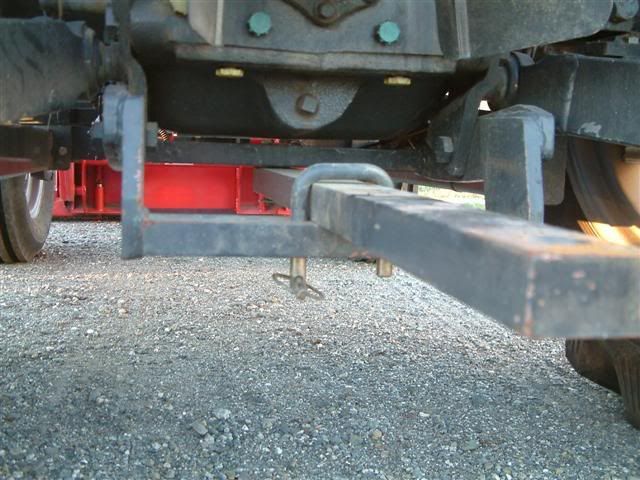
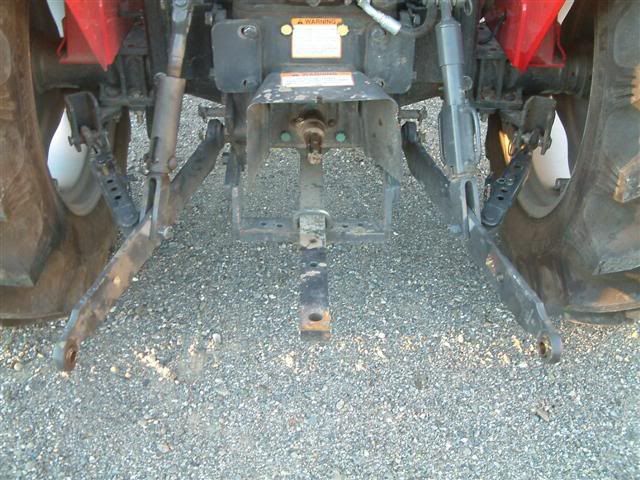
Didn't mean to slight you or ignore the data you posted from your tractor's manual. Perhaps I should have said "currently publishes max drawbar tongue weight in its advertised specifications..."Now you know two. I just gave you what the Ford manual stated to use as a guide. When you look for the specification, look for "Maximum Static Downward Load" under/in drawbar section. But you are probably wise to derate the Ford spec for your tractor.
Your drawbar attachment scheme looks much safer than the one on my 3510.The downward component of the tongue load is carried by the rear part of the support bracket below the drawbar. The upward component of tongue load is resisted by the front part of the bracket above the drawbar. The tongue load is transferred to the tractor structure via the two pins that attach the front part of the bracket to the tractor structure. There are two bolts that attach the rear of the bracket to the tractor structure.
The pulling load on the drawbar is transferred to the tractor via those two pins and the pin that attaches the front end of the drawbar to the bracket.
I would be happier if Mahindra would include tongue load limit and drawbar pull info in the ops manual. Wonder if they have that data (how about it Mahindra dealers?)


