Conversion Factor for 3PH load capacity

   / Conversion Factor for 3PH load capacity #21  
Spyder, you seem to have it all figured out, please enlighten me if I am wrong.

Hitch ratings are devalued, lessening with distance behing attachment. That's a fact in the real word bore out by both theory and what can be realized in practice.

What you seem to be going on about is the fact that no matter how far behind the attachment the load is, the tractor sees the same load. I'll grant you that. One will notice that the weight transfers to the rear tires as the load is extended behind, with the rear gaining the same amount that the front loses. Something about a moment happening there.

The vertical force component (for a given load) bore by the lift arms is a function of the top link angle (to vertical) and distance beyond the lift arm attachment. That's a fact. It works for the case of parallelogram too.

If you keep extending a load out on your boom pole, how far out can it go before there is a failure in the hitch linkage? I'll bet if the top link doesn't fail in tension, the lower link will fail in compression at some point. Or, the front wheels come off the ground. That's a fact.

Where am I wrong so far?

On the cantilevered thing, think of your perfect parallelogram supporting the cantilever. I hope you didn't think that I thought the parralelogram could support anything without the lower link being controlled.
 
   / Conversion Factor for 3PH load capacity #22  
Spyder, you seem to have it all figured out, please enlighten me if I am wrong.
[[Hitch ratings are devalued, lessening with distance behing attachment. That's a fact in the real word bore out by both theory and what can be realized in practice.]]

What you seem to be going on about is the fact that no matter how far behind the attachment the load is, the tractor sees the same load. I'll grant you that. One will notice that the weight transfers to the rear tires as the load is extended behind, with the rear gaining the same amount that the front loses. Something about a moment happening there.
[[The vertical force component (for a given load) bore by the lift arms is a function of the top link angle (to vertical) and distance beyond the lift arm attachment. That's a fact. It works for the case of parallelogram too.]]

[[If you keep extending a load out on your boom pole, how far out can it go before there is a failure in the hitch linkage? I'll bet if the top link doesn't fail in tension, the lower link will fail in compression at some point. Or, the front wheels come off the ground. That's a fact.]]

Where am I wrong so far?

[[On the cantilevered thing, think of your perfect parallelogram supporting the cantilever. I hope you didn't think that I thought the parralelogram could support anything without the lower link being controlled.]]
Good!
There are a few points to look at that you have highlighted in you summary:
[[One reason for this is the near impossibility of setting the 3ph up in perfect //ogram form on all implements. Others you brought out well [[here]].]]

Lets talk about it in the perfect sense. [[ Think more about that //ogram - starting at the tractor body and completed by the implement hookup...If all weight of the load is concentrated at the hookup point it bears straight down on the eyes. Tension and Compression in the links is extremely small and relates to the angle of the links to horizontal. When you extend the load behind the hookup point that same load presses down on the eyes. The torque required of the tractor hydraulics doesnt change but the torque back tipping the tractor does. T&C forces in the opposing links transfer this torque directly into the tractor body. The opposing forces balance.
Extended load 3 cases; 1]Movable links Horizontal - take the horizontal T&C forces directly to the tractor mount points. No force on verticle links, 2]Movable links up - take the T&C forces generated by the overhung load. These inputs are purely horizontal but T&C comes into play in the vertical links to preserve the form. As the top link is pulled it tries to move the assembly down due to its angle, but is balanced by compression of the lift link making an equal effort to rise, 3]Movable links down... Youve got the idea.:)]]

[[No, I didnt think that, but I thot that somehow you thot the lifting force needed would increase as overhang increased even if actual assembly weight didnt. Torque consolidated in the earth moorings has to take the the increased strain along with the associated T&C elements of the structure.]]

Thanks for taking a serious look at this.
larry
 
   / Conversion Factor for 3PH load capacity #23  
Not getting into any calculations, I just happened to have my owners manual on the desk to look up capacities for my tractors upcoming first service.
It says "three point hitch Max. lift force:
at lift points 970 kg 2139 lbs.
24 in. behind lift point 760 kg 1676 lbs."
 
   / Conversion Factor for 3PH load capacity #24  
Hi,

New member here.

I am trying to compare 3PH load capacity but they are measused differently. I found a thread that seemed to have a conversion but I was unable to get a seemingly reasonable answer. Perhaps I'm just too stupid.

How can I convert from say 2400lbs @ lift link ends to 24" behind link arms.

Thanks,

John King

This is the essence of the OP's question.

No. When you lift something straight up w/o pivoting it torque does not enter in.

My original reply was taking note of this statement. Torque does come into play. Think about the weight distribution on a tractor lifting @ various points beyond the 3PH.

If you lift a hammer straight up by the end of the handle or by the head you apply exactly the same upward force. The resistance you must apply to keep the heavy extended end from drooping is surely felt by you but doesnt amount to any work.

Here you are not discounting the torque or moment needed to support the hammer, e.g. "felt". This disagrees with your earlier statement about "torque does not enter in".

When you say work, do you mean in the classical sense of force x distance and/or torque x angular displacement? I understand you do. Holding a hammer or holding a 3PH attachment does no work.

Make this a dynamic situation where the the 3PH is lifting, then work is done. If the load is "rotating", or more precisely rising to a higher point (or faster rate of lift) than the lift eyes, the work done on the 3PH by the tractor is the same as the work done on the implement by the three point hitch. Remember work = effort x displacement. In relative terms between the implement and 3PH, the 3PH is experiencing a greater effort (tension in the lift arms or torque in the rocker shaft) over a shorter displacement; the implement is offering a lower resistive effort over a greater displacement. Energy conservation is working here.

If you have a boom pole to put on your tractor try lifting it from its tip, middle, and lift eyes while installed. The forces you must apply to lift it will be near the same at each place because it is going up w/o much pivot. Intuitively you would think that it would be a cinch to lift way back at the tip... All that leverage. The linkage cancels it for your lift, making you lift the same full weight of the pole and the tractor 3ph no matter where [rearward of the eyes] you lift from. Likewise for the tractor hydraulics, the linkage cancels the intuitive mechanical disadvantage of where on the length of the pole the weight is as the tractor lifts it.
larry
larry

I'll just say that I cannot lift any of my attachments. :) I see you just saying one could supply the vertical component of lift and move the implement. Again, you are discounting the moment, or torque, supplied by the 3PH linkage. I can lift the implement by the remote end and the tractor supplied the moment to prevent any rotation. I can lift the implement by the center of gravity and the tractor supplies no moment. I can lift by the attachment points and the tractor supplies the opposite moment from the first case.

I think you said it somewhere; it is wrong to discount or simplify the problem because you miss some important factors which result in not seeing the complete picture. I'm saying you missed the moment part of the consideration, at least you didn't communicate that part here too well. I guess that's my point. You can't discount the moment or torque; or loosely put the lever effect.

The important part of the OP's question is "how do you devalue the lift capacity to account for distance removed from the lift eyes?" Your first answer was fairly good in that it's complicated.

Without delving into the analysis of forces on the lower link, I'd the guess the limiting component is the lower link. At some point the combination of bending and buckling stresses will make it fail.

It's rained so much here the past two night that I'm stuck inside surrounded by mud. I wonder how bad the equations would get trying to relate the load to distance for the linkage components. Care to take a shot at it?

My final thought for this post; The 3PH not only transfers the weight from the implement to the tractor, it imparts a corresponding moment also. This moment increases with distance and likewise increases the strain seen by the linkage parts.
 
   / Conversion Factor for 3PH load capacity #25  
Here you are not discounting the torque or moment needed to support the hammer, e.g. "felt". This disagrees with your earlier statement about "torque does not enter in". Machines do not feel. The same torque is on the tractor body as it lifts the item at steady speed as there is when it stops and holds it. The effort "felt" is in the lift not the hold. The effort/force x distance rise, as you say, amounts to the energy used. If the load rises straight&level it moves up exactly the same as the arms

When you say work, do you mean in the classical sense of force x distance and/or torque x angular displacement? I understand you do. Holding a hammer or holding a 3PH attachment does no work. Right, the tractor doesnt feel it.

Make this a dynamic situation where the the 3PH is lifting, then work is done. If the load is "rotating", or more precisely rising to a higher point (or faster rate of lift) than the lift eyes, the work done on the 3PH by the tractor is the same as the work done on the implement by the three point hitch. Remember work = effort x displacement. In relative terms between the implement and 3PH, the 3PH is experiencing a greater effort (tension in the lift arms or torque in the rocker shaft) over a shorter displacement; the implement is offering a lower resistive effort over a greater displacement. Energy conservation is working here. Sure, but were moving the load straight up. Distances of lifter and liftee are same

I'll just say that I cannot lift any of my attachments. :) I see you just saying one could supply the vertical component of lift and move the implement. Again, you are discounting the moment, or torque, supplied by the 3PH linkage. Its knowing how the forces act that let you properly discount or account for them. The hydraulics do not see any change in moment due to the position of the load. The tractor body sees the change. I can lift the implement by the remote end and the tractor supplied the moment to prevent any rotation. Right! no energy - just a holding force I can lift the implement by the center of gravity and the tractor supplies no moment. Ditto - just a steadying force in this case I can lift by the attachment points and the tractor supplies the opposite moment from the first case. Ditto. And in every case you have had to lift the weight of the entire implement and the 3ph links. If you would try that with a boompole you would be able to observe the effect. The tractor does it from the lift eyes of course. The pivot stops the moment at the coupling point.

I think you said it somewhere; it is wrong to discount or simplify the problem because you miss some important factors which result in not seeing the complete picture. I'm saying you missed the moment part of the consideration, at least you didn't communicate that part here too well. I guess that's my point. You can't discount the moment or torque; or loosely put the lever effect.In completely the picture you are jumbling it. You mix in things that are discounted by the //setup.

The important part of the OP's question is "how do you devalue the lift capacity to account for distance removed from the lift eyes?" Your first answer was fairly good in that it's complicated. Yes, because it is not an ideal//ogram and its not just an extended lever. Were it the latter it would be simple and the answer would be in the 50-60% range. If it were the former it would be around 99% with well lubed balls. Since it isnt perfect the leverage/moment creeps into the mixture and load position begins to have more than no bearing on lift capacity. The manufacturer numbers established emperically or crunched by machine come out in the hi 70s to mid 80s% range.

Without delving into the analysis of forces on the lower link, I'd the guess the limiting component is the lower link. At some point the combination of bending and buckling stresses will make it fail. Agreed, but it would depend on their specific design for accomodation of compressive load vs the easily perceived tensile limit of the top link.

It's rained so much here the past two night that I'm stuck inside surrounded by mud. I wonder how bad the equations would get trying to relate the load to distance for the linkage components. Care to take a shot at it?No.:eek: The kinematics are easy in the perfect case, giving the intuitively obvious solution described previously. It would take too much review for me to put the force and motion equations together totally variable/adjustable infinity of imperfect cases. Sure would like to see a mathematician on the forum take it up tho!

My final thought for this post; The 3PH not only transfers the weight from the implement to the tractor, it imparts a corresponding moment also. This moment increases with distance and likewise increases the strain seen by the linkage parts. But not the hydraulics if the linkage is pure //ogram


Concentration on leverage misses the beauty of the // nature of the system even tho imperfect. We are talking a higher order design of the system. -You miss what happens at the joints that can completely eliminate any change in leverage against the lift force as the load moves rearward.
larry
 
Last edited:
   / Conversion Factor for 3PH load capacity #26  

Concentration on leverage misses the beauty of the // nature of the system even tho imperfect. We are talking a higher order design of the system. -You miss what happens at the joints that can completely eliminate any change in leverage against the lift force as the load moves rearward.
larry

Since you keep goin' on on // linkages... here's what would happen. The tractor would break something trying to lift a remote load, or tip back. Sure the effort the tractor sees doesn't change but the moment induced by the links do! Their is a limit to the lift, even w/ // four bar links.

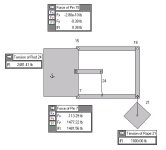
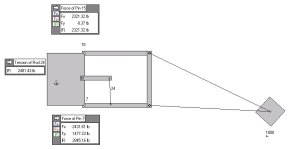
If anyone cares to supply actual data, such as pin-to-pin lengths and weights, I could simulate pin forces. From that I could build a model of the lower link to see where it'll reach it's failure point.

These are with a 1000 lb weight with 31" top and bottom link, 25" rear link. Somewhere about a 50" setback.
 

Attachments

  • Parallel direct.JPG
    Parallel direct.JPG
    23.9 KB · Views: 260
  • Parallel Remote.JPG
    Parallel Remote.JPG
    26.6 KB · Views: 202
   / Conversion Factor for 3PH load capacity #27  
[[ Think more about that //ogram - starting at the tractor body and completed by the implement hookup...If all weight of the load is concentrated at the hookup point it bears straight down on the eyes. Tension and Compression in the links is extremely small and relates to the angle of the links to horizontal. When you extend the load behind the hookup point that same load presses down on the eyes. The torque required of the tractor hydraulics doesnt change but the torque back tipping the tractor does. T&C forces in the opposing links transfer this torque directly into the tractor body.
larry

Since you keep goin' on on // linkages... here's what would happen. The tractor would break something trying to lift a remote load, or tip back. Sure the effort the tractor sees doesn't change but the moment induced by the links do! Their is a limit to the lift, even w/ // four bar links.
So you apparently still dont know what Ive said. You continue to throw argument into the mix while making re statements of virtually identical descriptions I have made and original misstatements of things you falsely attribute to my statements. The limit to the load is the force at the eyes. The limit to how far back that load can be is the back tipping point of the tractor. Nothing will break unless you add front weight to keep the tractor from tipping - - or maybe drive around over bumps while teetering back and forth. Most people would catch that indication and call it a clue.
larry
 
   / Conversion Factor for 3PH load capacity #28  
You cant without an analysis of the lift geometry. Ideally, it is a parallelogram linkage. If it truly were it would lift the same at the balls and any distance behind them. The closeness with which the 3ph setup matches this determines how much loss in lift you get as you go back from the eyes. The match will vary with the placement of pivot points on the tractor and implement and many are selectable on both ends. Trust #s the manufacturer provides is a conservative average. The best you can achieve is 1:1 -- this would be if the implement rose straight w/o pivoting at all wrt the tractor. The worst would be if the implement pivoted the same as the lift arms [or more:eek:] as it rose. Real life will show a variable % loss across tractor brands due to the non ideal geometry achievable....and to a small extent Friction.
larry

No. When you lift something straight up w/o pivoting it torque does not enter in. If you lift a hammer straight up by the end of the handle or by the head you apply exactly the same upward force. The resistance you must apply to keep the heavy extended end from drooping is surely felt by you but doesnt amount to any work. If you have a boom pole to put on your tractor try lifting it from its tip, middle, and lift eyes while installed. The forces you must apply to lift it will be near the same at each place because it is going up w/o much pivot. Intuitively you would think that it would be a cinch to lift way back at the tip... All that leverage. The linkage cancels it for your lift, making you lift the same full weight of the pole and the tractor 3ph no matter where [rearward of the eyes] you lift from. Likewise for the tractor hydraulics, the linkage cancels the intuitive mechanical disadvantage of where on the length of the pole the weight is as the tractor lifts it.
larry
larry

All on the wrong track. Take a look at how a laboratory balance scale works. The weighing platform is controled with a //ogram linkage so that it does not pivot as the balance arm moves. Consequently it does not matter where on the platform the sample to be weighed is placed.
larry

[Yes, these things can be ignored because their resultant at the eyes is given.]....However, ignoring the fundamentals of a //ogram linkage by modeling it as a simple lever brings no understanding of the factors that cause its superior performance. Getting a "close" answer with your shortcut encourages you into thinking you are considering all the correct factors. You are not. The reason your answer comes close is that, in its normal lift and carry usage the linkage does not lend itself to a purely correct // setup so the manufacturer gives 24" numbers for the degraded setup that actually happens in normal use. These #s come out at about 80% of what is available at the eyes. [Not really all that close.:)]

In order to get 100% of what is available at the eyes all 4 arms must form a true //ogram. -- The top link must be the same length as the lift arms. Also, on the implement, the vert dimension from the pins to top link connection must be the same as that vertical dimension at the link connection points on the tractor body. Now all opposite arms will remain // as they move.

All that remains to test this straightforwardly is to get the vertical going segments of the //ogram truly vertical. [In many cases the tractor body lift link pins are well forward of the top link attach point. -- so the tractor rear would have to be elevated to acheive this.] Set up thusly an implement would rise straight and level and would rise exactly as far as the lift eyes. If you have 2K# lift at the eyes you would be able to lift 2k# minus the weight of the boompole at any point on your boompole.
larry

.......OK. Iv explained it pretty well. Yous are wrong. Im sorry that the mechanics of the situation confuses you. Fortunately there are people who understand it in the world so that it can be used on stuff where appropriate. Like scales, weight cancelation mechanisms, vehicle suspensions, tractor seats, tractor 3phs, robotics, camera stabilizing, etc. It is a shame not to have a glimmer of how this system works to control motion and force over distance. If yous did perhaps you could use it. How in the world could a // linkage allow cantilevering to any distance? [Unless you had weightless elements of infinite strength.] To answer a question not asked: The moment is borne by tension and compression of top and lift links and consolidated in the tractor body. There is no energy in this - only a torque, proportional to the distance out the weight is from the tractor body pivots, trying to tip the tractor backward.
larry

[Exactly! No //ogram linkage on the loader.] That is just simple leverage and you seem to be conveniently ignoring that the lift loss is much greater on FEL than 3ph. Im talking physics - not magic. It predates Merlin. Get a glimmer.
larry

Sorry that I was offensive. I really wish that you could say something correct about this so that we could build a fuller understanding. Learning to spell physics may be a good 1st step to using it. Perhaps you should find something you have a question about. To answer one unasked: [[ The compression/tension on opposing elements actually balance one another, pushing down and up equally.]]

The weldup you suggest is totally unrealistic to what is actually happening.
larry

Good!
There are a few points to look at that you have highlighted in you summary:
[[One reason for this is the near impossibility of setting the 3ph up in perfect //ogram form on all implements. Others you brought out well [[here]].]]

Lets talk about it in the perfect sense. [[ Think more about that //ogram - starting at the tractor body and completed by the implement hookup...If all weight of the load is concentrated at the hookup point it bears straight down on the eyes. Tension and Compression in the links is extremely small and relates to the angle of the links to horizontal. When you extend the load behind the hookup point that same load presses down on the eyes. The torque required of the tractor hydraulics doesnt change but the torque back tipping the tractor does. T&C forces in the opposing links transfer this torque directly into the tractor body. The opposing forces balance.
Extended load 3 cases; 1]Movable links Horizontal - take the horizontal T&C forces directly to the tractor mount points. No force on verticle links, 2]Movable links up - take the T&C forces generated by the overhung load. These inputs are purely horizontal but T&C comes into play in the vertical links to preserve the form. As the top link is pulled it tries to move the assembly down due to its angle, but is balanced by compression of the lift link making an equal effort to rise, 3]Movable links down... Youve got the idea.:)]]

[[No, I didnt think that, but I thot that somehow you thot the lifting force needed would increase as overhang increased even if actual assembly weight didnt. Torque consolidated in the earth moorings has to take the the increased strain along with the associated T&C elements of the structure.]]

Thanks for taking a serious look at this.
larry

So you apparently still dont know what Ive said. You continue to throw argument into the mix while making re statements of virtually identical descriptions I have made and original misstatements of things you falsely attribute to my statements. The limit to the load is the force at the eyes. The limit to how far back that load can be is the back tipping point of the tractor. Nothing will break unless you add front weight to keep the tractor from tipping - - or maybe drive around over bumps while teetering back and forth. Most people would catch that indication and call it a clue.
larry
Since the things I have said are being misrepresented I have consolidated them here so their cohesiveness can be seen. [All except post#25 which is interspersed in a quote.]
larry
 
   / Conversion Factor for 3PH load capacity #29  
I honestly don't know the point you're arguing. My only contention with what you said, or didn't say (originally), is you didn't mention anything about the induced moments on the 3PH. Even with a //, the moment exist and will cause a failure if the component forces in the links are allowed to grow too large. I see now (post 13?) where you mention the moments of the 3PH linkage; I missed that @ 3:30 this morning. That was my original point. The lift will be limited by either the forces of the moment or the forces on the lifting links, with a // being a special case which is not realized here. If it were realized, the moment consideration still holds.

After the moment issue, I think we are on the same page.
 
   / Conversion Factor for 3PH load capacity #30  
Here's a thought;
If the perfect parallelogram is worthwhile it might just be worth doing a project.

OK, it seems that Cat 1 lower lift arms are about 32, 33, 34 inches long.
Gadgets like Pats easy change would affect this by a bit, but that could be dealt with later. The top link is significantly shorter than that, but adjustable in a range of maybe 20 to 30 inches.
Well, that could be extended, but it would tilt the implement WAY back, unless the forward attachment point could be moved forwards 12 inches or more.... I hope to come back to this.
I think it would be impractical to shift the implement's attachment point back 12+ inches to accommodate this, that would bastardize an existing standard and even hacking up 1/2 dozen personal implements to a new standard would not be acceptable (to ME).

With a leveled implement the top pin is very close to vertically above the lower pins, I havn't done a precise measurement or consulted the specs, but could probably find that info.
The distance between these should be matched by the height of the top link's attachment point above the lift arm attachment points.
That would get a true parallelogram, opposite sides being of equal length.

Ahh, here's the problem (and it is too late to blame old Fergie for this).
Relocating the top forward corner of said parallelogram to get equal opposite sides puts that corner just about in the center of the rockshaft (on a sample class 1 tractor that I just checked, but it is a typical Class 1 tractor).
"Curse that black tractor" You say ?

I think there is a way around this problem.

Any interest ?
No, I do NOT propose hacking up the rockshaft housing and everything in it.
I propose very little "hacking up", in fact I would expect to adhere to the "easily returnable to factory standard" goal.

Is it worth doing ?
How much work, hassle, trouble, etc would it be worth to have this ?
Would it be worth giving up something for ? some feature or function of the tractor.
Assuming that the feature/function given up would be returned when the perfect parallelogram were removed.
 
   / Conversion Factor for 3PH load capacity #31  
Spyder, I'd reconsider thinking along those lines. The lift capacity is determined by a function of the weight (force) and the distance from the lift assembly, or moment (torque). You are completely discounting the moment part.

I honestly don't know the point you're arguing. My only contention with what you said, or didn't say (originally), is you didn't mention anything about the induced moments on the 3PH. Even with a //, the moment exist and will cause a failure if the component forces in the links are allowed to grow too large. I see now (post 13?) where you mention the moments of the 3PH linkage; I missed that @ 3:30 this morning. ---I also dealt with that several other times with replys regarding your cantilever comment, general description to separate it from the hydraulics, and when I addressed a couple of your points in post 25.--- That was my original point. The lift will be limited by either the forces of the moment or the forces on the lifting links, with a // being a special case which is not realized here. If it were realized, the moment consideration still holds.

After the moment issue, I think we are on the same page.
OK, so when you said "lift capacity" you meant catastrophic failure of link parts or front lift rather than pushing upward as much as the hydraulics will do at the eyes and not being able to lift something weighing that much. I had thot that was the subject. It changes when you want to talk about the required tensile and compressive strength of link elements to transfer the moment/torque into the tractor body and the required body mass distribution to resist. It certainly wasnt clear to me what you meant when you used the term in so cryptic a statement. I consider it almost a change of subject ocurring without warning on the heels of similar terms thrown about previously but referring to lift arm torque. And particularly since these links are way stronger than needed to tip a tractor back at whatever backset the required force is applied. Of course you can contrive to make them buckle or stretch if you prevent backtip by adding weight.

Yes, the moment consideration as developed does hold. The misunderstanding came from me thinking you had put it into a part of the system where it was not an issue.
 
   / Conversion Factor for 3PH load capacity #32  
You guys are making me chuckle...:D

Two things must be true

1. sum of forces on lower arms must be zero.
2. sum of moments on lower arms must be zero.

Whoever said that it doesn't matter how long the lower lift arms are, that the hydraulics can still lift the same amount of weight needs to go back to engineering school ;)

Think about how you could or couldn't lift a bag of concrete placed on the end of an 8 foot wooden 2x6 board, depending on where you chose to grip the board !!

There were also some arguments related to the tractor tipping backwards...what I didn't see was that the sum of moments are taken about the center of the rear axle (IOW the contact point between the dirt and the rear tires). The force holding the tractor down can be resolved into a point mass located where the tractor's center of mass is...probably about where the clutch/flywheel is.

Analyzing the bending stresses in the lower arms has practical merit, but for analyzing what the OP was asking about it means nothing.
 
   / Conversion Factor for 3PH load capacity #33  
Here's a thought;
If the perfect parallelogram is worthwhile it might just be worth doing a project.
Any interest ?
No, I do NOT propose hacking up the rockshaft housing and everything in it.
I propose very little "hacking up", in fact I would expect to adhere to the "easily returnable to factory standard" goal.

Is it worth doing ?
How much work, hassle, trouble, etc would it be worth to have this ?
Would it be worth giving up something for ? some feature or function of the tractor.
Assuming that the feature/function given up would be returned when the perfect parallelogram were removed.
Iv thot along the same line and I have a couple tractors it would not take much on. The 3 tractor fixed points are in a vertical plane. Id just have to extend the top point up about 6". [It has 3 choices now but the highest one is ~6" low compared to std implement spacing.]

Is it worth it is a good question. +/-You lose some lift range but dont lose force as you reach. Might be worth doing to have on hand for the job where you really need it. Tractor has a darn strong lift for its size anyway... If I only had time to play constantly.:)
larry
 
   / Conversion Factor for 3PH load capacity #34  
You guys are making me chuckle...:D

Two things must be true

1. sum of forces on lower arms must be zero.
2. sum of moments on lower arms must be zero.

Whoever said that it doesn't matter how long the lower lift arms are, that the hydraulics can still lift the same amount of weight needs to go back to engineering school ;)
Nobody did that I noticed or Id have jumped on it immediately. What post is that in??
larry
 
   / Conversion Factor for 3PH load capacity
  • Thread Starter
#35  
Hi,

Thanks everyone. I didn't know this was such in interesting subject.

I was not able to follow this thread completly because it had grow so large while I was buying and driving my new tractor. My comparisions are done.

If a reasonable conversion factor exists it may be useful to others.
 
   / Conversion Factor for 3PH load capacity #36  
I think PART of the problem here may be analogous to trying to perform a detailed analysis of exactly WHY a perpetual motion machine of a particular design will not work.
Yes, this part seems to work here, yes that part works there, in fact every individual part appears to work, so why doesn't the whole thing work ?

As a practical matter the lift capacity 24 inches (or 24 ft) behind the lift arm eyes is much more limited by the tractor's mass and the distance of it's center of mass from the rear axle center line.
Clearly hanging a loader on the front would change the arithmetic, as would suitcase weights or (just for experimental fun) another front mounted 24ft boom pole.
I am guessing that the manufacturers worry about steering stability, i.e. their de-rating for 24 inches behind the lift eyes is much more about stability and liability than it is about 3PH geometry.
There are 2 examples of manufacturers' figures posted in earlier replies, one of them is from an 85 HP tractor (Class 2) and the other from a Class 1.
They almost certainly have different length lift arms, I doubt that much can be done with these figures.

I am content to accept that a) the 3PH works well enough as is b) Steering stability matters at least as much as absolute lifting capacity. c) Manufacturers are more concerned with liability than capacity even when it means that an item or two in their spec sheet has to be less than competitive.

I'm still a little bit interested in the development of a true parallelogram mechanism.
It has appeal, at least on paper. I'm not (yet) sure that it has practical advantage.

From a Marketing POV; Golly Gee if it is THAT good why isn't there market pull for it ?
Why hasn't somebody cobbled something together (Hewlett Packard garage style) shown it around at Ag fairs and become very rich very quickly ?
SOME time in the last 80 or so years... though VHS did beat out Betamax (-:
 
   / Conversion Factor for 3PH load capacity #37  
You guys are making me chuckle...:D


There were also some arguments related to the tractor tipping backwards...what I didn't see was that the sum of moments are taken about the center of the rear axle (IOW the contact point between the dirt and the rear tires).

Matt, it's like a barrel of monkeys around here. :)

The sum of the moments can be taken from any point you wish and doesn't have to be the rear axle. If the moments don't sum to zero, things are rotating. But choosing the rear axle can eliminate one of the unknown moments.

The parralellogram mechanism that spyder brought in will and does work. He sited several examples in the real world. The lifting forces would remain the same but the tension and compression forces in the members increase with distance.

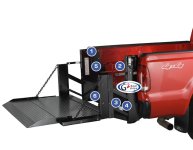
Here's one real world example of a parrallelogram linkage; a "Tommy Gate" lift that can be found on the back of pickups and trucks. It takes the same effort to lift the load anywhere on the platform. The lift effort does vary as you go through the lift distance though.

Why is this arrangement not used in 3PH? One reason could be because the current arrangement gets the implement further off the ground, such as for transport reasons.
 

Attachments

  • features_g2_ps.jpg
    features_g2_ps.jpg
    41.9 KB · Views: 230
   / Conversion Factor for 3PH load capacity #38  
:eek: Hope you all had a good weekend! I spent mine welding tractor parts (new stuff, not fixing).

Parallelogram has no significant effect on the lift capacity of the 3ph; its only purpose is to maintain the orientation of the implement. The best way to see this is to simplify the mechanism and eliminate the extra parts. There might be a little difference in capacity at lower, mid and highest position but that is not part of the equation here. The OP wanted to know how to calculate the projected capacity using published specs. The only way to practical way to do this is to make the hitch static as already stated, the sum of all forces including torque must be zero.

The capacity of the hitch is limited by the amount of torque from the rockshaft. It can稚 matter what you add to the front of the tractor, tire pressure, or the weather. Everything you add to the hitch itself is still limited to the torque output of the rockshaft.

Also - with the hitch in a horizontal position and static - the horizontal forces in the top link (tension) and the lift arms (compression) are equal and they are at 90 degrees to the moment. Knowing this you can eliminate the whole parallelogram thing and really simplify the problem.
 
   / Conversion Factor for 3PH load capacity #39  
:eek:Parallelogram has no significant effect on the lift capacity of the 3ph; [[[its only purpose is to maintain the orientation of the implement.]]] The best way to see this is to simplify the mechanism and eliminate the extra parts.
[ ...Ya think?...Try accomplishing this in a fundamentally different way and see what you get.] A tractor with 2k# at the eyes would be hard pressed to get a 1k# implement off the ground.
larry
 
   / Conversion Factor for 3PH load capacity #40  
Wow I don't know how I have managed to miss this thread for the last few days:rolleyes:

All I can say is that I do agree with Spyderlk. His fundamentals and math seem to be right on with everything I know. However their is an easier way of measuring lift capacities of loaders and 3ph's.

It has to do with ratios and percentages. The force of a cylinder/length of travel is directally proportional to the lift force/distance of the lift. This is a whole lot easier than trying to figure angles and forces.

Example: Let's say lower lift arm is 32" long with the lift link exactally half way. In order to achieve 2000lbs lift at the ball ends, you need to apply 4000lbs force at the lift link. This part is a simple lever. Likewise, for every inch of travel at the lift link results in 2" travel at the ball ends. Thus the ratio of lift force to lift distance that I mentioned.

Lets say your tractorhas 2000lbs lift at the ball ends, and you want to know how much it can lift @24" back, first is to find out how much it can lift at the lift links, as described above, we'll use the 4000lbs. Measure the hight of the lift link, and measure the height of a point on your implement @24". Raise it up some, and take the measurements again. If the lift link moved say 4" and the point on the implement moved say 10". 4/10 =40% of lift at the lift links. Which would be 1600lbs @24" and 2000lbs at ball ends. You could also do this equation using the lift cap at the ball ends to start with. Which in this example would have moved 8". So 8/10 = 80% of 2000 still = 1600lbs.

As mentioned, the distance lifted, and the force required are directally proportional. In A perfect parallelogram, it doesn't matter how far back you go, it raises the same as the ball ends, thus what SPYDER said, would have no effect on lift capacity. But in the real world, none of us have perfect parallelograms, and even one tractor can be changed to lessen or increase the lift @24" just by adjusting the length or position of the toplink to make the implement raise slower or faster.

Same method can be applied to loaders, if you know the spec at the pins, pressure, and cyl diameter. Use the pressure(spec and not actual for this part) and cyl diameter to figure the force of the cylinder, times 2 cylinders and you have your total force. Now you need to find the ratio of force lost due to the angle and levers effect.

With the loader on the ground, measure to the pivot pin, and take a measurement on the cylinder. Raise the loader some and take the measurements again. If the pin raised 40" and the cylinder extended 8" that is 20%. Take the 20% and multiply by the cylinder force.
Now you got the total lift force at the pins, which may seem way higher than your lift spec, and it is. You have to take the lift spec @pins out of your book, and subtract it from this. So lets say total lift force is 2500lbs and your lift spec is 1300lbs, 2500-1300=1200lbs. It take 1200lbs just to lift the loader frame and empty bucket.

If you want to know the capacity at the bucket edge, put it flat on the ground, (so you can start with 0" for the measurement) and measure the cylinder. Raise the loader (but do not curl) and measuer again. Using the same method as above, find the % and use the total cylinder force # we used above. Then subtract the force required to raise the loader frame and bucket and you have your answer.

Sorry for the extremely long post, but I was bored.:D
 

Marketplace Items

2019 FREIGHTLINER CASCADIA TANDEM AXLE SLEEPER (A59904)
2019 FREIGHTLINER...
PALLET OF (20) BOXES OF CARPET SQUARES (A60432)
PALLET OF (20)...
UNUSED AGT INDUSTRIAL STSD10 SEEDER (A60432)
UNUSED AGT...
Classic 1969 Massey Ferguson 135, newly rebuilt engine, refurb front end, 3-pt blade.
Classic 1969...
2409 (A60432)
2409 (A60432)
CASE CX318 EXCAVATOR (A60429)
CASE CX318...
 
Top