R1 versus R4

Status
Not open for further replies.
   / R1 versus R4 #101  
Well, it's been an interesting and enlightning discussion, despite some of the individual comments.

I have a Kubota M5040 (50 hp) with Kubota loader and R1 tires. When I get a full bucket of dirt or gravel, the front tires really squat bad, to the point of worrying me. I've wondered if the dealer should have put stiffer tires on the front with the loader. They way the fronts squat down, I certainly do not feel that the tires are matched to the loader capability.

I have not noticed any "rough ride" with the tires on concrete.

I have an old B21 TLB that has R-4s on it. Those lugs certainly get filled up with mud when working in wet clay.

Ken

Just one of the reasons to have R4s. That is one of the reasons the standard R1 tires that the manufacturers offer are not all that good for loader work. There might be some R1s that do have a heaver rating for your tire size, but they aren't offered as a std tire from the manufacturer.

You could fill the fronts and that should help with the tire squatting, but I think that Kubota doesn't recommend having the front tires filled. I know that on my Mahindra 7520, the std AG tires for the front have about half the weight capacity of the std R4 front tires.

My guess is that the tractor manufacturers offer the R1s for farming and the R4s for the people that are using their tractor as a general utility tractor.

Just my opinion ;)
 
   / R1 versus R4 #102  
Just one of the reasons to have R4s. That is one of the reasons the standard R1 tires that the manufacturers offer are not all that good for loader work. There might be some R1s that do have a heaver rating for your tire size, but they aren't offered as a std tire from the manufacturer.

You could fill the fronts and that should help with the tire squatting, but I think that Kubota doesn't recommend having the front tires filled. I know that on my Mahindra 7520, the std AG tires for the front have about half the weight capacity of the std R4 front tires.

My guess is that the tractor manufacturers offer the R1s for farming and the R4s for the people that are using their tractor as a general utility tractor.

Just my opinion ;)

And a very well informed opinion it is. :)
 
   / R1 versus R4 #103  
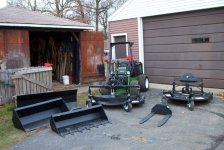
That's a pretty Bad A** looking tractor! Put some monster truck tires on it, a lift kit and mow EVERYTHING down. I didn't know CC made something that big...

My Cub Cadet is a 40hp and when i bought it they offered a 45hp too. Im supprised you cant tell that its accually a Kioti DK40 with yellow and white paint. sold by Cub Cadet.

I guess if a have to buy new rims to get R1s then ill just stay with the R4s. Due to all the rain that has fallen, I was kinda wanting to try R1s that might help with the side ways slidding that happens on hillside mowing.
 
   / R1 versus R4 #104  
My Cub Cadet is a 40hp and when i bought it they offered a 45hp too. Im supprised you cant tell that its accually a Kioti DK40 with yellow and white paint. sold by Cub Cadet.

I guess if a have to buy new rims to get R1s then ill just stay with the R4s. Due to all the rain that has fallen, I was kinda wanting to try R1s that might help with the side ways slidding that happens on hillside mowing.

You could always throw chains on it if it's that bad. Then you could take them off when not needed.
 
   / R1 versus R4 #105  
Well, it's been an interesting and enlightning discussion, despite some of the individual comments.

I have a Kubota M5040 (50 hp) with Kubota loader and R1 tires. When I get a full bucket of dirt or gravel, the front tires really squat bad, to the point of worrying me. I've wondered if the dealer should have put stiffer tires on the front with the loader. They way the fronts squat down, I certainly do not feel that the tires are matched to the loader capability.

I have not noticed any "rough ride" with the tires on concrete.

I have an old B21 TLB that has R-4s on it. Those lugs certainly get filled up with mud when working in wet clay.

Ken
Just air up the R1s a bit. The ones on my 7520 are rated at 26psi, but say you can use 36 to seat the bead. The way I see it, if they think its safe enuf to stand beside a cockeyed tire at 36 psi then it safe to ride on a well seated one at that pressure. At 26psi there is definitely a problem moving with a full capacity load. At 32psi its fine. I have never needed to run it with 36. One time tho I got it up to 80psi by accident while filling with water. I was a little leery of approach - glad there wasnt much air in there! - Altho I would never have run it it does show theyll take a lot without failure.
I also do not experience a ruf riide on pavement w R1 - havent in 47yrs of tractor use...
larry
 
   / R1 versus R4 #107  
I have a Kubota M5040 (50 hp) with Kubota loader and R1 tires. When I get a full bucket of dirt or gravel, the front tires really squat bad, to the point of worrying me. I've wondered if the dealer should have put stiffer tires on the front with the loader. They way the fronts squat down, I certainly do not feel that the tires are matched to the loader capability.


My front R1 did this also , just aired them up to 45 or 50 lbs and all is well ( this was back in 1995 )
 
   / R1 versus R4 #108  
I've read this entire thread. A lot of info from a large variety of users.

One thing that has me wondering. Mossroad's objection to R4s was his 2wd loader tractor that had them. A 2wd loader tractor is severely handicapped regardless of tire type. But certainly R4s were the wrong choice.

So rather than pick on tire type, I'd have to say the setup of that tractor was wrong for R4s. It needed R1s and a pair of chains laying around for worst case scenarios, along with a huge ballast tool.

I'll sacrifice the traction loss I suffer with R4s to gain the durability and load carrying stability to accomplish what I expect my tractor to do. FEL, no AG tilling, no lawn mowing, 4wd.
 
   / R1 versus R4 #109  
I've read this entire thread. A lot of info from a large variety of users.

One thing that has me wondering. Mossroad's objection to R4s was his 2wd loader tractor that had them. A 2wd loader tractor is severely handicapped regardless of tire type. But certainly R4s were the wrong choice.

So rather than pick on tire type, I'd have to say the setup of that tractor was wrong for R4s. It needed R1s and a pair of chains laying around for worst case scenarios, along with a huge ballast tool.

I'll sacrifice the traction loss I suffer with R4s to gain the durability and load carrying stability to accomplish what I expect my tractor to do. FEL, no AG tilling, no lawn mowing, 4wd.

That tractor was kind of an odd ball. IH2500b. Late '70s, HST, 4 cylinder gas engine, factory built loader with a 3PT hitch. Most of them came without the 3pt hitch and had backhoes. That is most likely why they came with R4 type tires. They were industrial units, not farm units. That's why it was yellow, not red. ;) The loader could not be removed. It was part of the tractor. That is why we bought it. We needed to do some heavy loader work cutting in our road. Several of my farmer friends suggested I get a purpose built loader instead of a farm tractor with a loader as they thought the purpose built loaders had heavier front ends and heavier loaders. They all said farm tractors with add on loaders are weaker than the purpose built units and since we had a lot of excavating to do and very little farming, this is what I should get. I took their advice. The cab added weight. The tires were loaded. I originally had a 5' brush hog on the back. But I quickly found it was hanging back too far when I needed to do loader work. So I took a 55 gallon drum, welded up some 3pt attachment points to a rebar frame inside it and then filled it with concrete. That was my ballast until I got the box blade. It had plenty of weight. But the R4 tires would still spin in the sandy soil if we tried to take any bites of any size or pushed on a stump, tree, etc.... They didn't have enough bite for the soil type. But, that is what the tractor came with, so that is what I used. We managed to mow between our tree rows for 5 years and dig out the side of the hill at the highway and put in a road with it, clear an area for a barn foundation and clear an area for our future home site with it. We just had to take smaller bites and work with what we had. We did not want to put any $$ into it, as our plan was to get rid of it once the large tasks were done and downsize to a smaller tractor to be used for maintaining the property, which we did. I could have switched to R1 tires, but that would have been a big expense and I'm not all that certain that we could have gotten them in the same width that we had with the R4s. They most likely would have been skinnier and that would have required different rims. Then they might not have taken the weight, so I may have had to go to duals. We all thought it would have done better than it did in those conditions, but it didn't. That was 20 years ago. Knowing then what we know now, we probably should have gotten a wide tracked loader, extended our plan from 5 to 10 years and got more of the heavy clearing done as well as a pond put in. But then I would have also known that I was having two children! :) Live and learn. :)
 
   / R1 versus R4 #110  
If your rears were slipping, more ballast weight would probably have helped a lot. I'm not sure, in sandy soil, if R-1 tires would have solved anything except helped you dig ruts faster and easier :D:D:D

Ken
 
   / R1 versus R4 #111  
If your rears were slipping, more ballast weight would probably have helped a lot. I'm not sure, in sandy soil, if R-1 tires would have solved anything except helped you dig ruts faster and easier :D:D:D

Ken

Could be right. Before we bought it the two fields were farmed. We leased it out for the first year. So I know farm tractors could move through it pulling plows. But they were much larger and had duals on all corners. Not sure if I could have added any more weight to the thing. Maybe wheel weights in addition to the filled tires, 55 gallons of cement on the 3pt, the steel cab, full fuel tanks and my fat butt in the seat? :p
 
   / R1 versus R4 #112  
Could be right. Before we bought it the two fields were farmed. We leased it out for the first year. So I know farm tractors could move through it pulling plows. But they were much larger and had duals on all corners. Not sure if I could have added any more weight to the thing. Maybe wheel weights in addition to the filled tires, 55 gallons of cement on the 3pt, the steel cab, full fuel tanks and my fat butt in the seat? :p

While the 55 gallons of concrete help, it's isn't all that heavy compared to the loader and a scoop full of material. Now if you had filled that 55 gallon drum with lead, it would have helped more ;-) Of course your loaded tires helped. But with a loader, you have a very unbalanced tractor that takes away from the weight on the rear tires. Your 55 gallons of concrete was probably about as much as the empty bucket weighed, but the bucket was further forward and so the concrete didn't fully balance the weight of the bucket.

A good heavy tractor helps, but if you look at modern loaders, they are always 4wd, even the big machines. There is a reason for that, you just can't beat putting drive traction where the weight is, IMO.
 
   / R1 versus R4 #113  
While the 55 gallons of concrete help, it's isn't all that heavy compared to the loader and a scoop full of material. Now if you had filled that 55 gallon drum with lead, it would have helped more ;-) Of course your loaded tires helped. But with a loader, you have a very unbalanced tractor that takes away from the weight on the rear tires. Your 55 gallons of concrete was probably about as much as the empty bucket weighed, but the bucket was further forward and so the concrete didn't fully balance the weight of the bucket.

A good heavy tractor helps, but if you look at modern loaders, they are always 4wd, even the big machines. There is a reason for that, you just can't beat putting drive traction where the weight is, IMO.

You know, I probably could have gotten some lead back then. I work for a newspaper and they still had lead pigs laying around from the old hot metal days. :)

My bucket was 3/4 yard and yes, you could notice the traction difference when it was full VS empty. The concrete barrel was heavier than the empty bucket, though. I know this because one time I cracked the bucket and took it off to get it welded. I put it in the back of my pickup truck myself with some ramps. I could lift one end of it. It was all I could do to move that concrete barrel around by hand. I was lucky if I could tip it over, then roll it in that sand. Then, standing it up again was a bear! :D Maybe it was due to the compact size of the barrel VS lifting one end of the bucket?

As for the 4wd... I agree. That's why my current tractor is all wheel drive. It is a fine little loader. :D
 

Attachments

  • MossRaodsPT425.jpg
    MossRaodsPT425.jpg
    63.5 KB · Views: 159
   / R1 versus R4 #115  
:confused:anybody know a company that makes r1 tires for a John Deere 2305

You should probably start a new thread with a new title in this or the John Deer forums. You should also include your current tire sizes, front and rear.

Hope that helps.
 
   / R1 versus R4 #116  
Because I can't let a sleeping doe lie... and dead horses are fun to beat because they can't get away...

On my TC45 - I have R1's and I would never change that... the tractor pulls like a monster and the tires almost never slip or spin - just all traction. Yes they rut - but it's a farm tractor - so ruts are acceptable.
The loader on this tractor is impressive - and when it's full of heavy stuff - the front tires are NOT happy, they bulge, sway and resist turning... moderate loader work is fine - round bale on the front and it's a little spooky.

The JD 4310 is R4's - loader never makes anythign squat on the front... but good luck going up a wet ground clay soil hillside... the tires load - don't unload - and that's it... you are walking up the hill with the chainsaw...

So - if anyone is still wondering what tires to put on their tractor after 12 pages of posts and flames... it goes back to the begining... depends on what you are doing MOST of the time... then you will have to use operator prowess to address the other percentage of time when your tires are not matched for your conditions.

I know it's been said - but I wanted to sumarize with examples :D
 
   / R1 versus R4 #117  
With all due respect because I know you're a moderator and you could give me penalty points, I would say now you may be looking down on all the TBN members who make a living with tractors and equipment by making that statement. I would never say I could learn to do someone's profession in "short order". It takes thousands of hours of seat time on construction or farm equipment to see what I have seen and develop the techniques to operate efficiently.

I'd like to see someone tell a full size backhoe or excavator operator they could work next to buried electric or natural gas lines or freshly poured concrete walls as good as them in "short order". Seems like a very demeaning post to me. :(

As far as the R-4/ R-1 debate goes, nobody (including myself) debates that R-1's don't get better traction in soft ground than R-4's, but they don't put R-1's on backhoes or most utility tractors for a reason that you don't seem to understand.

On edit: I notice your lawn tractor has turf tires on it.
What seat time experience do you have on a tractor with R-1's ?

So exactly HOW many hours does it take to be efficient? At not getting stuck with R4's?

How many hours? is it 1001? or 2467hrs?

Moving a tractor around a worksite ain't exactly clinical trials brain surgery. No offense, but if tractor gets moved from a to b in 4.3698432 seconds, it doesn't matter how many hours the operator has.

tractor moved or it didn't.

hole got dug or it didn't.

Job completed on time or didn't.

Gas line touched or not.

I would say tractor experience counts as far as bidding a good price and scheduling an accurate completion time. But you can't knock a guy at operating any type of machinery or argue that he can't do your job if he has at least past a beginner's level of experience in that particular machine. Perhaps he can.

I'm just saying that both you (and Mossroad's to smaller degree) arguments are degenerating into irrelevant ad hominem arguments that don't prove your points. It's just johnson rod measuring at this point.
 
   / R1 versus R4 #118  
So exactly HOW many hours does it take to be efficient? At not getting stuck with R4's?

How many hours? is it 1001? or 2467hrs?

That's why I said "thousands" of hours.

Moving a tractor around a worksite ain't exactly clinical trials brain surgery. No offense, but if tractor gets moved from a to b in 4.3698432 seconds, it doesn't matter how many hours the operator has.

tractor moved or it didn't.

hole got dug or it didn't.

Job completed on time or didn't.

Gas line touched or not.

The you obviuosly don't have much experience, because it does take many hours to get used to a machine and the way it works, shortcuts for efficiency, touch of the machine. Trench workers lives are in your hands. Don't believe me? Rent a backhoe and start digging next to a propane line or a power main. Just for good measure, have a have a few of your coworkers stand nearby. Then add traffic noise, dirt piles and other obstacles. Oh yeah, be sure to have your old lady take out extra life insurance before you unlock the dipperstick. Think you can just jump in a farm tractor & plant seed? I really don't think so. How about a crane? Can you really lift that 10 ton HVAC unit off the corp center building and lay it perfectly on a flatbed. I've forgotten more construction site accidents than you've ever seen 9 of 10 are from INEXPERIENCE.


I would say tractor experience counts as far as bidding a good price and scheduling an accurate completion time. But you can't knock a guy at operating any type of machinery or argue that he can't do your job if he has at least past a beginner's level of experience in that particular machine. Perhaps he can.

Based on you comments above, you obviously have no appreciation for experienced operator and don't realize that one with 10 years experience is better than one with 1 year experience on the same machine, but there's no point in debating with you. That kind of arrogance causes accidents.

You probably would entrust any upcoming surgeries to a doc fresh out of residencey over an experienced surgeon, too. :rolleyes:
 
Last edited:
   / R1 versus R4 #119  
Builder, about the only thing I'd add to your post and comments is the fact that some people are simply able to learn how to operate machinery much faster and with more efficiency than others. I'm fortunate to have always been able to pickup about any sport and become competitive in it in a relatively short order. I raced motocross for several years (the most brutal thing I think you can do to your body - playing HS and collegiate football doesn't even come close), raced winged spring cars for a half a season and raced late model cars as well as having raced off road 4 wheel vehicles. Besides the racing, I was able to bs my way into operating dozens of pieces of large mining machinery without ever getting busted. Some people seem to just be able to gain a "feel" for a piece of equipment quickly, others can gain that feel after a lot of practice and others, unfortunately, cannot ever become proficient at operating some machinery no matter how many hours they practice.

You may recall that I've mentioned before that I've been partially buried in trenches twice in the past. This was before the safety barriers were even invented. Not being able to move and struggling for each breath due to being crushed is nothing I care to experience again! The trackhoe operator had hundreds of hours in the seat of that machine but just flat out wasn't a good operator. He banged the sides of the trench with danged near every dip.

I'm sure you know what I'm talking about. I'd bet you've seen people who can get on nearly any piece of equipment and be running it well in only an hour or so of practice. I'd also bet you've seen those guys who you would never let operate any of your equipment even though they have thousands of hours of experience. A lot of their experience has been "bad" experience. Racing in our local mud drags and bog races (yeah, I know; redneck through and through) gave me a lot of 'seat of pants' feel for mudding as well as practical experience. On many occasions I've take a piece of equipment across or through an area that someone said would be impossible. Based on what you've posted, I'd have to assume that you too are one of those people who can gain a reasonable amount of expertise on a machine in short order. With that being the case, I think you'd agree that there is no specific time designation as to when someone is proficient on a machine. It all depends...on a lot of factors.
 
   / R1 versus R4 #120  
Not much to do with r-1/r-4 here, but maybe there are a few who can feel a machine out quickly, but I still know for a fact that nobody can be trusted to run one around dangerous areas or know all the secrets about not getting stuck, loading on a truck, how to dig/load efficiently, what rpm to run the machine, etc.

I know our wonderful moderator could not out-operate me on a backhoe, (especially mine) or probably any tractor for that matter, except his little itty bitty tractor. I would not be so arrogant as to say that I could out-operate him on a machine he has a lot of hours on.

Those who claim they could show up on a jobsite and keep up with an experienced operator are arrogant fools who would learn many a hard lesson in the first full working day.
 
Status
Not open for further replies.

Tractor & Equipment Auctions

2014 Dodge Charger Sedan (A59231)
2014 Dodge Charger...
2021 CATERPILLAR RM500B ROTARY MIXER (A60429)
2021 CATERPILLAR...
206707 (A58375)
206707 (A58375)
32in. Tilting Bucket Mini Excavator Attachment (A59228)
32in. Tilting...
UNUSED IRGC80 Battery Powered Golf cart (A55272)
UNUSED IRGC80...
2012 DOOSAN G25 GENERATOR (A55745)
2012 DOOSAN G25...
 
Top