My first attempt at brazing for hydraulic hard-lines

   / My first attempt at brazing for hydraulic hard-lines #1  

mjncad

Super Member
Joined
Aug 19, 2006
Messages
5,111
Location
In the civilized First World
Tractor
A couple
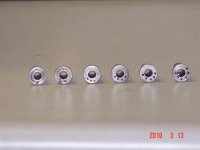
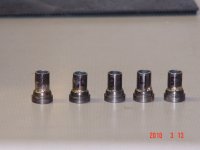
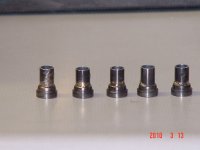
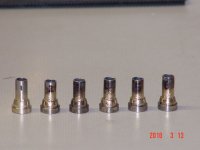
I need to make some modifications to the tractor's hydraulic system due to interference problems. The space is so tight that hydraulic hoses are out of the question. This leaves hard-lines. There are two ways to terminate the ends; one is to have them flared for a special sleeve for the tube nut, or to braze on a sleeve for the tube nut. The local Parker hydraulics shop flares the tubing; but at $17.50 per end makes it cost prohibitive for the number I need done (~24). The tools to do the flaring run into the thousands, so that is out as far as me owning the tools. They do not do brazing. Fortunately a neighborhood friend loaned me a small plumber's oxy/acetylene torch for me to try my hand at brazing. So after cleaning out a Parker store of six 3/8 and five 1/2 brazing sleeves, and they gave me a couple scraps of tubing to play with, I present to you my attempts for your comments. I had to make my own braze rings as the Parker store didn稚 carry those. Making the braze rings was the most time consuming part; but they worked slick. Stick one in the sleeve, put in the tubing, heat to brazing temperature and the sleeve settles onto the tube end thanks to gravity.

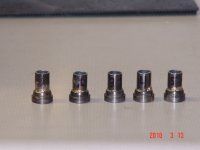
I numbered them in order of completion. I cleaned up the first one with an aggressive knot wire cup brush; but it tears up the sleeve too much. The rest were cleaned up with a soft brass or brass plated wire brush in the drill press set to maximum speed. I cut them down to length after cleaning them up.

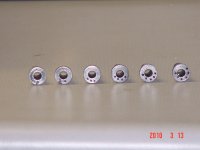
The back side.

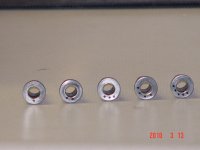
The sleeve face that the O-rings seal too. The first one was cleaned up as best as possible with emery cloth. The rest were cleaned up with the drill press mounted wire brush. Note the mottled appearance of the faces, which is similar to the texture of hot rolled steel. This was I believe caused by too much heat. Through my Shade-5 welding goggles, I couldn't tell if the filler metal melted until the steel was bright orange.

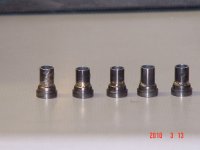
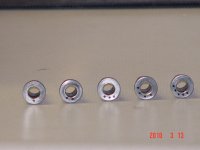
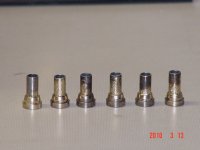
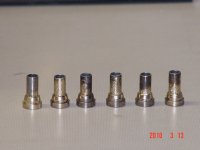
Here are the 1/2 tubing tests.

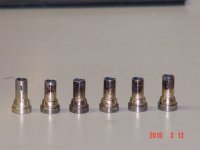
The back side of the 1/2 tests.

Notice that Number-1 has the mottled hot-rolled steel texture on the face. For the rest, I took off my welding goggles (I know, I'm bad), and I was able to clearly see when the filler metal melted, which was at a dull red color in the steel.

The sleeves were $13 with tax, and the brazing wire and flux was $21 due to the 45% silver content of the wire; however, this was money well spent to see if I can actually braze the sleeves on before investing in a bunch stuff.

Next step is to acquire a tubing bender capable of bending 1/4? 3/8? and 1/2 tubing to see if I can successfully bend the tubing. I have some leads on a handheld one.

Thanks!
 

Attachments

  • DSC03762.JPG
    DSC03762.JPG
    99.9 KB · Views: 926
  • DSC03763.JPG
    DSC03763.JPG
    103.9 KB · Views: 776
  • DSC03768.JPG
    DSC03768.JPG
    93.2 KB · Views: 616
  • DSC03770.JPG
    DSC03770.JPG
    99.2 KB · Views: 531
  • DSC03773.JPG
    DSC03773.JPG
    91.9 KB · Views: 562
  • DSC03777.JPG
    DSC03777.JPG
    95.3 KB · Views: 570
   / My first attempt at brazing for hydraulic hard-lines
  • Thread Starter
#2  
I need to make some modifications to the tractor's hydraulic system due to interference problems. The space is so tight that hydraulic hoses are out of the question. This leaves hard-lines. There are two ways to terminate the ends; one is to have them flared for a special sleeve for the tube nut, or to braze on a sleeve for the tube nut. The local Parker hydraulics shop flares the tubing; but at $17.50 per end makes it cost prohibitive for the number I need done (~24). The tools to do the flaring run into the thousands, so that is out as far as me owning the tools. They do not do brazing. Fortunately a neighborhood friend loaned me a small plumber's oxy/acetylene torch for me to try my hand at brazing. So after cleaning out a Parker store of six 3/8 and five 1/2 brazing sleeves, and they gave me a couple scraps of tubing to play with, I present to you my attempts for your comments. I had to make my own braze rings as the Parker store didn稚 carry those. Making the braze rings was the most time consuming part; but they worked slick. Stick one in the sleeve, put in the tubing, heat to brazing temperature and the sleeve settles onto the tube end thanks to gravity.

I numbered them in order of completion. I cleaned up the first one with an aggressive knot wire cup brush; but it tears up the sleeve too much. The rest were cleaned up with a soft brass or brass plated wire brush in the drill press set to maximum speed. I cut them down to length after cleaning them up.

The back side.

The sleeve face that the O-rings seal too. The first one was cleaned up as best as possible with emery cloth. The rest were cleaned up with the drill press mounted wire brush. Note the mottled appearance of the faces, which is similar to the texture of hot rolled steel. This was I believe caused by too much heat. Through my Shade-5 welding goggles, I couldn't tell if the filler metal melted until the steel was bright orange.

Here are the 1/2 tubing tests.

The back side of the 1/2 tests.

Notice that Number-1 has the mottled hot-rolled steel texture on the face. For the rest, I took off my welding goggles (I know, I'm bad), and I was able to clearly see when the filler metal melted, which was at a dull red color in the steel.

The sleeves were $13 with tax, and the brazing wire and flux was $21 due to the 45% silver content of the wire; however, this was money well spent to see if I can actually braze the sleeves on before investing in a bunch stuff.

Next step is to acquire a tubing bender capable of bending 1/4? 3/8? and 1/2 tubing to see if I can successfully bend the tubing. I have some leads on a handheld one.

Thanks!
 

Attachments

  • DSC03770.JPG
    DSC03770.JPG
    99.2 KB · Views: 374
  • DSC03768.JPG
    DSC03768.JPG
    93.2 KB · Views: 274
  • DSC03763.JPG
    DSC03763.JPG
    103.9 KB · Views: 403
  • DSC03762.JPG
    DSC03762.JPG
    99.9 KB · Views: 349
  • DSC03773.JPG
    DSC03773.JPG
    91.9 KB · Views: 268
  • DSC03777.JPG
    DSC03777.JPG
    95.3 KB · Views: 281
   / My first attempt at brazing for hydraulic hard-lines #3  
I have a tip or two for you. Clean everything shiny bright on both pieces to be brazed using coarse emery cloth. Flux coat the female and male pieces then fit together. Use your torch to equally heat each piece,to about 800 F depending on your solder but dont overheat, If flux turns black, it probably got too hot. Dont wrap the solder around the joint,as you describe above. As you are heating, touch a piece of solder to the piece, when it is hot enough it will "take " to the joint. Make sure the pipe and fitting are equally heated ALL the way around, then using your torch and solder, run a bead all the way around. The torch flame can be used to pull the solder into the joint. The solder will run toward the heat, so keep you feather from the flame neutral and concentrate the tip about equal distance between top and bottom of the socket and dont get it too hot. When properly heated, you will have full joint penetration and still have little bead of silver solder on the top lip if the socket. There should be evidence of solder in the inside of the joint but not run thru or lumps inside. The temperature has to be hot enough for the solder to flow, but not so hot that it runs like water. If you see little pin hole porosity in the silver solder, you got it too hot and the flux vaporized
 
   / My first attempt at brazing for hydraulic hard-lines #4  
Can't comment on the brazing. Can you pressure test a few?

On the tubing bender hand held ones are readily available. I have one with the three sizes on you mentioned. The handles are too short or I'm not very strong for it to handle steel tubing.:(

I've also got a longer handle 3/8 bender of industrial quality. It works very nicely. :thumbsup:
 
   / My first attempt at brazing for hydraulic hard-lines #5  
No comment on what you've done other then to say that I admire your ambition and ingenuity.

I had a hard line crack on my dozer for the blade. I don't know how much pressure is in those lines, but I would think it's considerable. It's a Case 1550 that is similar in size to a D6.

My thought was that it's broke, and to replace it. My dad knew that my neighbor used to be a welder, and brought it over to him to see what he thought. He got out his oxy/acc torch and used a coat hanger to weld it back together. That was while I was digging my big pond and running it 7 days a week, all day long. I probably have 1,000 hours on that weld, and it's still holding strong.

Good luck and keep us updated on how it works out for you,
Eddie
 
   / My first attempt at brazing for hydraulic hard-lines #7  
you are a brave man! I am not sure if I could do that! :eek:

So what are you plan on making ?
 
   / My first attempt at brazing for hydraulic hard-lines #8  
#1 and #3 may work. The face on all look good. I think they all would hold. Keeping the shoulder where the nut seats clean is important so everything sits flat. I have had better luck using silver solder and Sta-silv flux. Clean your parts very well and put flux on the parts and your solder wire. Heat the assembley a dull red and touch the solder wire to the joint and it will suck around just like soldering copper pipe. Being good at copper pipe helps a lot. I think using a small A/O torch works best because it has a cleaner flame.

Dan
 
Last edited:
   / My first attempt at brazing for hydraulic hard-lines #9  
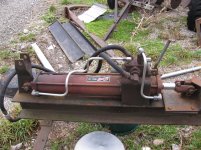
Here is another option I used on my log splitter. These are 1/2" stainless but you can get them in steel as well. I think they are rated up to 3000 psi and can be found at Parker. They are compression fittings.

Dan
 

Attachments

  • IMG_0597.jpg
    IMG_0597.jpg
    798.4 KB · Views: 926
   / My first attempt at brazing for hydraulic hard-lines #10  
MJNCAD, aren't you a welder by trade? or maybe I am thinking of someone else.

Either way, do you have access to tig? You could chase around those with Silicone bronze and a Tig pretty quick and neat I would think.
 
   / My first attempt at brazing for hydraulic hard-lines
  • Thread Starter
#11  
you are a brave man! I am not sure if I could do that! :eek:

So what are you plan on making ?

I need to relocate my three rear remotes and power beyond, and there is no room for hoses.

#1 and #3 may work. The face on all look good. I think they all would hold. Keeping the shoulder where the nut seats clean is important so everything sits flat. I have had better luck using silver solder and Sta-silv flux. Clean your parts very well and put flux on the parts and your solder wire. Heat the assembley a dull red and touch the solder wire to the joint and it will suck around just like soldering copper pipe. Being good at copper pipe helps a lot. I think using a small A/O torch works best because it has a cleaner flame.

Dan

I'm good at soldering copper pipe, so I have hopes I can teach myself brazing too.

Here is another option I used on my log splitter. These are 1/2" stainless but you can get them in steel as well. I think they are rated up to 3000 psi and can be found at Parker. They are compression fittings.

Dan

I'll go through my Parker 4300 catalog again, and look at their compression fittings. Thanks for the tip.
 
   / My first attempt at brazing for hydraulic hard-lines
  • Thread Starter
#12  
I have a tip or two for you. Clean everything shiny bright on both pieces to be brazed using coarse emery cloth. Flux coat the female and male pieces then fit together. Use your torch to equally heat each piece,to about 800 F depending on your solder but dont overheat, If flux turns black, it probably got too hot. Dont wrap the solder around the joint,as you describe above. As you are heating, touch a piece of solder to the piece, when it is hot enough it will "take " to the joint. Make sure the pipe and fitting are equally heated ALL the way around, then using your torch and solder, run a bead all the way around. The torch flame can be used to pull the solder into the joint. The solder will run toward the heat, so keep you feather from the flame neutral and concentrate the tip about equal distance between top and bottom of the socket and dont get it too hot. When properly heated, you will have full joint penetration and still have little bead of silver solder on the top lip if the socket. There should be evidence of solder in the inside of the joint but not run thru or lumps inside. The temperature has to be hot enough for the solder to flow, but not so hot that it runs like water. If you see little pin hole porosity in the silver solder, you got it too hot and the flux vaporized

Gary:

Thanks for the tips. The biggest hassle I had was flipping the torch from side to side to evenly heat the parts. I need a dual tip nozzle or an induction heater; but the induction heater is toooooooo expensive. Also taking the goggles off to see what I was doing made life easier as the silver alloy brazing filler melted at a colder temp than I could judge when wearing the goggles. Only the last four 1/2" ones were done sans goggles. I used emery cloth on the tube; but I'll need to find a way to get into the sleeve as copper fitting brushes used by plumbers are too big. I did you a delinted pipe cleaner to get flux on the inside of the sleeve.

The braze ring went inside the sleeve between the tube end and the sleeve's inside face per Parker's instructions. I would have posted them; but the file size exceeded TBN's limit for PDF files.

Can't comment on the brazing. Can you pressure test a few?

On the tubing bender hand held ones are readily available. I have one with the three sizes on you mentioned. The handles are too short or I'm not very strong for it to handle steel tubing.:(

I've also got a longer handle 3/8 bender of industrial quality. It works very nicely. :thumbsup:

Unfortunately I have no real way to test them; so when I make the real deal, that's when the testing will be done.

No comment on what you've done other then to say that I admire your ambition and ingenuity.

I had a hard line crack on my dozer for the blade. I don't know how much pressure is in those lines, but I would think it's considerable. It's a Case 1550 that is similar in size to a D6.

My thought was that it's broke, and to replace it. My dad knew that my neighbor used to be a welder, and brought it over to him to see what he thought. He got out his oxy/acc torch and used a coat hanger to weld it back together. That was while I was digging my big pond and running it 7 days a week, all day long. I probably have 1,000 hours on that weld, and it's still holding strong.

Good luck and keep us updated on how it works out for you,
Eddie

Now using a coat hanger as filler rod takes skill to use and make a weld last.


Thanks for the links, I'll review them after reading tractor **** tonight. I did watch some YouTube videos on brazing, which helped a lot.

MJNCAD, aren't you a welder by trade? or maybe I am thinking of someone else.

Either way, do you have access to tig? You could chase around those with Silicone bronze and a Tig pretty quick and neat I would think.

Alan:

You must be thinking of someone else, I was a CADD Dweeb by trade for 24-years. Unfortunately I have no access to a TIG; but I'd love to try one out.


Thanks to everyone for the encouragement. I'll take a look at Fleabay and Craigslist for a bender, and if I come up empty, I'll probably get this one. Irvan-Smith, Inc. : Imperial Triple Head Tube Bender [IST-370-FH] - $49.95

I'm concerned about the die-cast aluminum; but Irvan-Smith was real responsive and sent me the vague instructions in PDF format and even called the manufacturer asking if I could use them on steel lines. According to the manufacturer, I should be able too; but that was vague also.
 
   / My first attempt at brazing for hydraulic hard-lines #13  
One word of caution on compression fittings. Follow the recommended torque spec for seating them. I have seen lines crushed by people with size 52 coats and #2 hat...

Depending on the size of tubing and wall thickness the tube can be crushed and ruined very easily. Yes I have done this....

Best of luck

Roy
 
   / My first attempt at brazing for hydraulic hard-lines #14  
Nice job for your first time!:thumbsup:
 
   / My first attempt at brazing for hydraulic hard-lines #15  
The two threads have been merged together because they are duplicates. I left a re-direct in the hydraulics forum to point to here.
 
   / My first attempt at brazing for hydraulic hard-lines #16  
Follow the recommended torque spec for seating them.

Some use the number of turns from a finger tight connection.:D
 
   / My first attempt at brazing for hydraulic hard-lines
  • Thread Starter
#17  
One word of caution on compression fittings. Follow the recommended torque spec for seating them. I have seen lines crushed by people with size 52 coats and #2 hat...

Depending on the size of tubing and wall thickness the tube can be crushed and ruined very easily. Yes I have done this....

Best of luck

Roy

I'm a great believer in using a torque wrench whenever possible.

Nice job for your first time!:thumbsup:

Thanks!

The two threads have been merged together because they are duplicates. I left a re-direct in the hydraulics forum to point to here.

Thanks, I posted twice due to the crossover between welding and hydraulics.
 
   / My first attempt at brazing for hydraulic hard-lines #18  
i braze useing my cutting torch goggles.

just spent some time brazeing up some rust holes in a chicken water'r

it certainly is a challenge on thin wall rusty metal
 
   / My first attempt at brazing for hydraulic hard-lines
  • Thread Starter
#19  
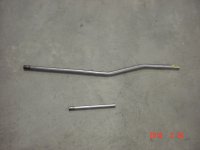
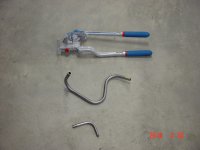
I got my tubing bender the other day, and gave it a try on the scrap 3/8" and 1/2" tubing I had. 3/8" bent easily holding the bender in my hand, while 1/2" required me putting the bender in a vise. I used a light coating of Lubriplate grease on the movable 'form die' while the stationary die was left unlubricated per the instructions (who says men don't read instructions).

I didn't make any attempts at precision angles or lengths; I just wanted to see if I could bend the stuff.

Now I need to finish fabricating the new remote mounting bracket before I order tubing and braze sleeves or compression fittings per another poster's suggestion.
 

Attachments

  • DSC03786.JPG
    DSC03786.JPG
    858.6 KB · Views: 284
  • DSC03794.JPG
    DSC03794.JPG
    877 KB · Views: 384
   / My first attempt at brazing for hydraulic hard-lines #20  
Slip some pipes over the bender handles for a little more leverage. It will make it easier to control the bend and not over bend.:thumbsup:

http://www.swagelok.com/FittingInstallVideo.htm

A short video showing how another type of compression fitting is tightened.
 
Last edited:

Tractor & Equipment Auctions

2016 ISUZU NPRXD 14' BOX TRUCK (A60430)
2016 ISUZU NPRXD...
2013 Felling Trailers T/A Side Dump Flatbed Trailer (A56857)
2013 Felling...
2018 HYUNDAI VC2530152-JS DRY VAN TRAILER (A59575)
2018 HYUNDAI...
Year: 2016 Make: Ford Model: Explorer Vehicle Type: Multipurpose Vehicle (MPV) Mileage: Plate: Body (A55853)
Year: 2016 Make...
500BBL WHEELED FRAC TANK (A58214)
500BBL WHEELED...
1453 (A57192)
1453 (A57192)
 
Top