Another "myth to kill"??.....what makes it go???

/ Another "myth to kill"??.....what makes it go??? #61  
Well "flow" sure makes the keyboards go!

I couldn't add any to the group mind, except for some levity!
 
/ Another "myth to kill"??.....what makes it go??? #62  
How you doin' tonight Egon?

Been outside working on the camper all day.

:DThat means that tonight I'm tired, the feet hurt and most of the major joints ach and pain!:D
 
/ Another "myth to kill"??.....what makes it go??? #63  
Well "flow" sure makes the keyboards go!

I couldn't add any to the group mind, except for some levity!

Well, I had some flow going last night, but that just gave me some pressure in the head this morning! :laughing:


For the formula units folks, I pulled out a reference for the resistance units in the SI system. Note the Hydraulics entry in Table 3.1 of the attachment*.

I think Newtons second law is probably more applicable here, since we're talking about "making it go", F=ma, or a=F/m.

Now think about the causality of what the laws of motion (equations) say in terms of cause and effect. Cause is the input and effect is the output. For a=F/m, the force is the input (or what we control) and the output is the resultant acceleration.

Now applying causality to the "makes it go" myth The two different "make it go" scenarios for simple hydraulic systems are as I stated earlier;

1) Positive displacement pumps: Pressure = Flow x Resistance. These pumps can only produce flow, thus flow is causing the pressure according to the causality of the defining relationship.

2) Centrifugal pumps: Flow = Pressure/Resistance. These pumps produce pressure (input or cause) and the pressure results in flow (output or effect) according to the causality of the defining relationship.

So in case 1, Flow causes pressure which converts to force which causes acceleration.

In case 2, pressure converts to force which causes acceleration.

This is just an exercise in thinking which does extend to real world applications. This is a process that allows logical steps between understanding, design and implementation. I think we can all agree that when the rubber hits the road (or the oil hits the piston face:laughing:) and you boil down the "myth", Newton says it best via the Second Law of Motion;

a=F/m

which says motion is the result of a force applied!


*Karnopp, Dean. (2006). System Dynamics: Modeling and Simulation of Mechatronic Systems. Hoboken New Jersey: John Wiley and Sons, Inc.

 

Attachments

  • hyd res002.pdf
    68.1 KB · Views: 128
/ Another "myth to kill"??.....what makes it go??? #64  
Riddle me this...

Say I have a reservoir of fluid which I can vary the height above ground. This reservoir is connected via hose to a hydraulic cylinder. This cylinder is connected to a load of some kind, say a block on the ground. To make the block move, I'll have to raise the tank to a sufficient height to produce the pressure to overcome the friction... then the block will move. I am supplying pressure which results in motion (or flow). Ergo, pressure makes it go. Say the Pressure-Flow interaction is a linear relationship with friction,

Flow=Pressure/Friction

Here Flow is a function of the pressure, that is the pressure dictates (is in charge of) the motion. The myth is dead!

Take the tank in the example above and replace it with a positive displacement pump (spinning at a constant speed) providing a constant flow. The relationship between the motion and the pressure then becomes

Pressure=Flow x Resistance.

In this case, the pressure is a function of the Flow, i.e. the Flow dictates the pressure. The myth is alive! The flow made it go!

The two examples above are different. One has an input of flow and the other has an input of pressure. The myth is... well it depends!

I dont dispute the "sensibleness" of your equations. The reason they dont work out right as AKKAMAAN shows is that the treatment does not accomodate interfunctionalities. For instance, in the P=FR, Resistance is a function of Flow -- true in the piping but not the actual load. In truth Pxarea=Resist. These are forces. Throw in Flow and suddenly your talking Power so youve got Pressure = Power in your equation. You cant be jumping around like this. These things will mix up without a rigorous treatment, and skew your conclusions.

I see the difficulty is grasping that Pressure makes it go because the movement from pressure is incrementally zero but done an infinite number of times. Each motion is just followed an infinitisimal time later by flow to maintain the motive force from the pressure and therefore motion. Its a good physical demo of the infinitely precise approximation resulting from integration in calculus.
larry
 
/ Another "myth to kill"??.....what makes it go???
  • Thread Starter
#65  
Thank you for "sobering up" from your first initial posts....LOL
your take on this start making sense now....I have a few comments on your pump alternatives

1) Positive displacement pumps: Pressure = Flow x Resistance. These pumps can only produce flow, thus flow is causing the pressure according to the causality of the defining relationship.

2) Centrifugal pumps: Flow = Pressure/Resistance. These pumps produce pressure (input or cause) and the pressure results in flow (output or effect) according to the causality of the defining relationship.

Centrifugal pumps are creating pressure from the kinetic energy of the fluid. kinetic energy is the product of velocity and mass. A positive pump create pressure from the force behind displacing the fluid. I do not see a reason to draw any further parallels to to centrifugal pumps, since they are of zero interest for hydrostatic applications.
(However, here is a link to a introduction to centrifugal pumps)

Your pressure-flow-resistance discussion is a matter of how we want to vary the hydraulic power output.
We can sum up to two basic pump systems, applied into three different power systems.

A: a fixed displacement pump in a open center system. FLOW is CONSTANT, and PRESSURE will be VARIABLE with the resistance. >>> "Pressure = Flow x Resistance"

B: a variable displacement pump, pressure compensated, in a closed center system. PRESSURE will be CONSTANT and FLOW will be VARIABLE with the resistance. >>> "Flow = Pressure/Resistance"

(Note: A centrifugal pump application is basically a CONSTANT PRESSURE system, and "Flow = Pressure/Resistance" applies, so is a basic electric system, I=U/R )

C: a variable displacement pump, load pressure compensated, Load sensing system, LS, where both flow and out put pressure can be varied to regulate the power output

So in case 1, Flow causes pressure which converts to force which causes acceleration.
Sorry I can not "buy" this one, only force can cause pressure....force from kinetic energy, gravity, torque, pressure etc .....force unit includes "lbs", and there is no "lbs" in the flow unit.......

In case 2 ???, pressure converts to force which causes acceleration.
:cool:
I think we can all agree that when the rubber hits the road (or the oil hits the piston face:laughing:) and you boil down the "myth", Newton says it best via the Second Law of Motion;

a=F/m

which says motion is the result of a force applied!
:thumbsup:
 
/ Another "myth to kill"??.....what makes it go??? #66  
Oh, I was sober at my first post :thumbsup:

Guys, remember the preface to my string of post here;

some randumb guy on the internet said:
:) ...In some world of dynamic modeling...

That world actually exist!

AKKAMAAN said:
Sorry I can not "buy" this one, only force can cause pressure....force from kinetic energy, gravity, torque, pressure etc .....force unit includes "lbs", and there is no "lbs" in the flow unit.......

I'm talking in terms of causality in the functional relationships, cause and effect.

Thanks for the pumpintro pdf.

pumpintro pdf said:
...velocity is converted to pressure...

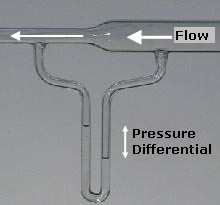
Another way to say this is... velocity (flow) causes pressure. Just look at a pump curve! :laughing: Another example of the velocity/pressure interdependence is a jet pump. And look what Bernoulli figured out!

VenturiFlow.png


Just remember Newton's 2nd Law, a=F/m!

And Larry, perhaps I should have said

P=f(Q,R) Pressure is a function of flow and resistance,

and

Q=f(P,R).

I had stated, for this example and the sake of simplicity, that the relationship was linear. But I think most know the relationship is really a bit more complicated than that!


Here's a semi-related question for one to ponder; would you use Newtons laws or Bernoulli's principle to explain how an airplane produces lift? :)
 
/ Another "myth to kill"??.....what makes it go??? #67  
I wish I was smart enough to add more to this, but I do have the popcorn popper going! Keep bringing more guys, It is a good debate.:thumbsup:
 
/ Another "myth to kill"??.....what makes it go??? #68  
There are engineers that dream this stuff up, and there are technicians that make it work. The end user however, is the owner, and usually brings it back to the technician to get it fixed. Even the engineer goes back to the technician to make sure it works to get the job done. I am just saying.
 
/ Another "myth to kill"??.....what makes it go??? #69  
Another example of the velocity/pressure interdependence is a jet pump. And look what Bernoulli figured out!

VenturiFlow.png


Just remember Newton's 2nd Law, a=F/m!

And Larry, perhaps I should have said

P=f(Q,R) Pressure is a function of flow and resistance,
[[[...Yes, but resistance can be a function of flow, so youre multiplying something by a function of itself.]]]
and

Q=f(P,R).

I had stated, for this example and the sake of simplicity, that the relationship was linear. But I think most know the relationship is really a bit more complicated than that!


[[[Here's a semi-related question for one to ponder; would you use Newtons laws or Bernoulli's principle to explain how an airplane produces lift? :)]]]
I would say Newtons Laws because the air can be standing still and must suddenly do a semi orbit around the top surface of a wing. The acceleration it undergoes toward the center of the orbit is A = Vrel^2/r. To achieve the Force needed to accelerate its mass the air sucks on the wing. The Force of this sucking is F=MairA=MVrel^2/r.
larry
 
/ Another "myth to kill"??.....what makes it go??? #70  
would you use Newtons laws or Bernoulli's principle to explain how an airplane produces lift?

First we should determine the mode the wing is working in should we not?:thumbsup:

I've always wondered how a wing produces lift yet a plane can fly upside down?:thumbsup:
 
/ Another "myth to kill"??.....what makes it go??? #71  
First we should determine the mode the wing is working in should we not?:thumbsup:

I've always wondered how a wing produces lift yet a plane can fly upside down?:thumbsup:

These kind of discussions typically are endless, because they are like onions. Just when one layer is peeled away, another is presented for more madness!:laughing:

Your second question... an inverted airfoil uses a negative angle of attack to produce the different path lengths that lead to different velocities above/below the wing leading to differential pressures that form the mechanism of lift. Sounds like Bernoulli, eh? But airfoils are two dimensional and the real world is three. The resultant airflows, as Larry points out, represent vortices that are incorporated in a produced down wash. The reaction to the generation of the vortices and downwash follows Newtons laws.

Gotta run to a wedding.. Undoubtedly with more pressure in the head tomorrow morning! :laughing:

I'll leave you with a nice photo:

vortices.jpg
 
/ Another "myth to kill"??.....what makes it go???
  • Thread Starter
#72  
Another way to say this is... velocity (flow) causes pressure. Just look at a pump curve! :laughing: Another example of the velocity/pressure interdependence is a jet pump. And look what Bernoulli figured out!
Velocity is NOT equal to flow...you can increase velocity even if flow stay constant....it is what happens in a restriction, or an air plane wing......
here is the Bernoulli tube showing the pressure loss through a restriction....
bernoulli_tube_delta_p_power_loss.jpg


P=f(Q,R) Pressure is a function of flow and resistance,
I would rather say that flow is a function of pressure and resistance....."no force (pressure), no flow"....Q=f(P,R)...:thumbsup:
and

I had stated, for this example and the sake of simplicity, that the relationship was linear. But I think most know the relationship is really a bit more complicated than that!

I think flow is linear to resistance if pressure is constant...but hydraulic resistance is not equal to orifice diameter, neither orifice cross area, hydraulic resistance is so much more complicated than that....shape of orifice, fluid viscosity, delta P, etc etc..
If you enjoy math and calculus....spend a few hours on this one.....

Here's a semi-related question for one to ponder; would you use Newtons laws or Bernoulli's principle to explain how an airplane produces lift?

If flow stays constant and we increase velocity by making air travel a longer way on top of the wing, pressure will decrease on top of the wing and the Delta P will make the wing lift the airplane .....so it will be the Bernoulli Principle that will apply to that....
 
/ Another "myth to kill"??.....what makes it go???
  • Thread Starter
#73  
There are engineers that dream this stuff up, and there are technicians that make it work. The end user however, is the owner, and usually brings it back to the technician to get it fixed. Even the engineer goes back to the technician to make sure it works to get the job done. I am just saying.

And the technician/end user, start changing/replacing "cylinder seals", or a pump, when they are good, because he do not know enough about the basics, to apply them in practice....:laughing::licking::D
 
/ Another "myth to kill"??.....what makes it go???
  • Thread Starter
#74  
This threads is dead now, like the myth "flow makes it go" is dead too....
I have made my point, and with out force, we cant make any thing move. Newton's law's about motion....

If you guys want to continue discussing air planes and such, please start a now thread.

I am now preparing for a new topic, that will be posted soon.....maybe about another "myth"....:thumbsup:

Later
akkamaan...."ah come on"....
 
/ Another "myth to kill"??.....what makes it go??? #75  
AKKAMAAN, I have no doubt in you. After seeing your answers, replys, and just plain knowledge, if you told me there truly was a pot of gold at the end of a rain bow, I would take your word for it.:thumbsup::thumbsup:
 
/ Another "myth to kill"??.....what makes it go???
  • Thread Starter
#76  
AKKAMAAN, I have no doubt in you. After seeing your answers, replys, and just plain knowledge, if you told me there truly was a pot of gold at the end of a rain bow, I would take your word for it.:thumbsup::thumbsup:

I sure do appreciate your "trust"! Thank you mmurphy!

Arguing for basic "knowledge", is like a case in court....we wont accept "the facts" without PROOF. Many times we build our knowledge, more on "mouth to mouth rumors" than basic logics, facts and PROOF!

Make sure to build your on your own basic "trust" foundation, so you don't have rely on others "rumors"....

One common "rumor" is that "flow makes it go", another one is that a restriction, unconditional, will control/decrease flow....but that will have to be discussed in another thread....

Over and out!
 
/ Another "myth to kill"??.....what makes it go??? #77  
And the technician/end user, start changing/replacing "cylinder seals", or a pump, when they are good, because he do not know enough about the basics, to apply them in practice....:laughing::licking::D

Perhaps you do not understand what being a technician means.. He is the guy that analyze the situation, removes the part, puts it on the test bench, and if it needs fixing, he does it. Sometimes the owner can do that also.

And then there are those people that have the knowledge, but can not fix their own tractor/hydraulic equipment because they theorize to much. Most times, one does not need the professor to exercise what knowledge one has.

Perhaps the hyd prophet has not appeared yet, but some think they are.

I try and not use smiley / faces, because you don't know how serious the person is. They may not reflect what the person is really trying to say. Sometimes they reflect distorted, or just smart as* humor.
 
/ Another "myth to kill"??.....what makes it go??? #78  
gpflepsen,

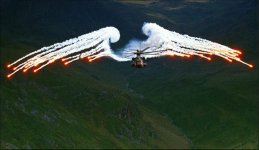
I believe the title of that picture is called the Angel of Death. The effect you see was caused by flares, and prop wash.
 
/ Another "myth to kill"??.....what makes it go??? #79  
gpflepsen,

I believe the title of that picture is called the Angel of Death. The effect you see was caused by flares, and prop wash.

The aircraft looks like a C-5, which doesn't have props but rather turbofan engines. The smoke from the flares offer a means to see the airflow pattern which is the result of the creation of lift. Think Newton's F=ma, the force keeping the aircraft in the air is a result of the acceleration of the air. The vortex is generated from the air trying to move from the high to the low pressure area of the wing. Clouds in the first picture and flares in the helicopter pic show this too.

Akkamaan, sorry if you think I was trying to discount your myth debunk, I wasn't. I look forward to your next installment ;)
 

Attachments

  • wing-vortices1.png
    wing-vortices1.png
    246.5 KB · Views: 96
  • 1237.jpg
    1237.jpg
    48.9 KB · Views: 112

Marketplace Items

2015 International TranStar 8600 T/A Day Cab Truck Tractor (A59230)
2015 International...
KNOW BEFORE YOU BID - DO YOUR HOMEWORK AND BE HAPPY WITH YOUR PURCHASE (A59823)
KNOW BEFORE YOU...
2003 IC Corporation 3000IC School Bus (A59230)
2003 IC...
2007 FORD F750 XLT SUPER DUTY SERVICE TRUCK (A58375)
2007 FORD F750 XLT...
(1) 48"X15' ADS DRAINAGE PIPE (A60432)
(1) 48"X15' ADS...
JOHN DEERE 850K LGP (A58214)
JOHN DEERE 850K...
 
Top