6013 vs 7018 vs ??

   / 6013 vs 7018 vs ?? #1  

Jay4200

Veteran Member
Joined
Nov 23, 2005
Messages
2,054
Location
Hudson/Weare, NH
Tractor
L4200GST w/ LA680 & BX2200D w/ LA211
I sort of know the meaning behind the numbers on welding rods (although I can never REALLY remember), but have no clue what the advantages of one over the other is. IOW, when would I want to use a 7018 rod over a 6013, for example? (using these two numbers because that is what I happen to have on hand at the moment).

A descriptive link might help too if there is one of those handy....

Also - my 6013 rods have developed a chalky white powdery substance on it's surface - the box has been sitting open all winter in unconditioned space. Any clue what that is? I don't think any mice have peed on them, although that is certainly possible. They seem to work OK, at least my welds still look just as crappy as ever.

Thanks - JayC
 
   / 6013 vs 7018 vs ?? #3  
I will just give my personal observations. 6013 is an easy rod to strike, and certainly easier to restrike than 7018. It is easier and more forgiving to hold an arc, works good with AC or DC. the weld is not as pretty as 7018 IMHO. Now I like 7018 better, after solving the restrike problem. by either pinching off the "corn" or glaze that forms on the end when you end the arc. or rub it across a rough file, or I have seen people "sling" it, but do not reccomend that, due to a lot of fireballs hitting the floor. I like the looks of 7018 beads. they make my welds look like I know what I am doing..(even when I dont). A lot of welders consider 6013 "Bambi" rod. good for beginners. but I use it sometimes for tacking in bad places, as it tacks easy, especially when you are contorted like with your head in a barrell.. I will usually finish up with 7018. For thick beveled metal use 6010 or 6011 for root pass then finish up with 7018 . 6010 and 6011 are deep penetrators, and cut thru dirt and rust better too. Of course 6013 is 60000 psi and 7018 is 70000 psi the 1 in the third digit means all position . Here I looked up a table for you.

E stands for "Electrode"
The first two digits (or first 3 if it's a 5-digit number) are an abbreviation of the weld's strength. To figure out the strength of the weld, take the 2 digits, in this case 60, and multiply by 1000 to get the weld strength in PSI.

So if you had welded two plates together, with the weld covering one square inch (or even 1/4" x 4" : that's still one square inch) that weld could take 60,000 pounts of pulling force.

Typical vales are 60,70,80,90,100,110.
The 3rd digit tells you what position the rod is recommended for.
1 : Flat, Horizontal, Vertical, Overhead.
2 : Flat and Horizontal only.
3 : Flat, Horizontal, Vertical Down, Overhead.
The last digit tells you about welding current and the coating.
1 : DC:ROD+ ................... cellulose sodium
2 : AC or DC:ROD+ or DC:ROD- .. cellulose potassium
3 : AC or DC:ROD- ............. titania sodium
4 : AC or DC:ROD- or DC:ROD+ .. iron powder titania
5 : DC:ROD+ ................... low hydrogen sodium
6 : AC or DC:ROD+ ............. low hydrogen potassium
7 : AC or DC:ROD+ or DC:ROD- .. iron powder iron oxide
8 : AC or DC:ROD+ ............. iron powder low hydrogen

There you go.

James K0UA
 
   / 6013 vs 7018 vs ?? #4  
The last digit tells you about welding current and the coating.

Hmmm... so that means 6011 is DC rod only? Seems like 0 should mean DC Rod + as in 6010.

Ian
 
   / 6013 vs 7018 vs ?? #5  
Found this...

EXX10 DC+ (DC reverse or DCRP) electrode positive.
EXX11 AC or DC- (DC straight or DCSP) electrode negative.
EXX12 AC or DC-
EXX13 AC, DC- or DC+
EXX14 AC, DC- or DC+
EXX15 DC+
EXX16 AC or DC+
EXX18 AC, DC- or DC+
EXX20 AC ,DC- or DC+
EXX24 AC, DC- or DC+
EXX27 AC, DC- or DC+
EXX28 AC or DC+
 
   / 6013 vs 7018 vs ?? #6  
Hmmm... so that means 6011 is DC rod only? Seems like 0 should mean DC Rod + as in 6010.

Ian

That is interesting, no 6011 is an AC version of 6010 a DC only rod.
well what do you expect from the internet:laughing:

James K0UA
 
   / 6013 vs 7018 vs ?? #7  
First 2 numbers are tensile strength. (60=60,000, 70=70,000, 80=80,000 PSI tensile, etc.).
3rd number = positions suitable for (i.e. 1= all position rod suitable for all positions. anything other than 1 will be more limited position wise when welding).
4th number indicates flux type and it will sorta tell you suitable for AC or DC power source and rod storage requirements.

7018 is a low hydrogen rod good for alloy mixture steels or even regular plain old mild steel if and only if it has been stored properly (i.e. rod oven or brand new in a hermetically sealed new container). If it has not been stored properly 7018 can actually be worse than a plain old mild steel electrode as hydrogen embrittlement can result in the welds. That said many people use 7018 without properly storing it without any issues whatsoever.

7018 can also be fussy to run on cheaper power source welders. 7018AC will be slightly easier to run.

If you have an AC only power source which is the cheapest of all welder types: 6011 (for rusty metal and deep penetration), 6013 for general medium penetration and gy eneral mild steel, and 7014 rod which is easy to run so much so that it is called idiot rod (nearly the strength of 7018 without the storage hassles) will all be your best friends and cover 95% of your welding needs.

Really anything other than 6010 can be run on AC although it may require slightly more skill, 6010 is a DC only rod, but 6011 is the AC equivalent and performs similarly. It is generally accepted that any rod that will run on AC will run on DC slightly better - approximatly 15%-20% better if you need it quantified.

Here is my philosophy on AC as compared to DC: Yes DC gives you the advantage of reversing polarity's but is it really worth the extra hassle and extra expense for the occsional backyard user since there is more to break on a DC capable welder . DC electrode positive (70% heat into rod and 30%heat into workpiece), DC electrode negative (30% heat into rod and 70% heat into workpiece) which allows welding slightly thinner metals than electrode positive would permit, AC there is no polarity switching possible since the polarity is actually switching at 60 hertz
so (50% heat into electrode and 50% heat into workpiece is kinda a general indirect way of thinking about AC welding power).
 
Last edited:
   / 6013 vs 7018 vs ?? #8  
6011 is a AC OR DC rod. And to my recollection most things I have seen state it is a + or - rod. Primarily it is used in DC+ as DC- is mostly for light gauge use if used at all.
 
   / 6013 vs 7018 vs ?? #9  
i use 6013 for sheet metal ,6011 for deep penetration on rusty or painted steel and 7018 for strength on prepared steel and some high quality cast.
 
   / 6013 vs 7018 vs ??
  • Thread Starter
#10  
Thanks all for the info. Most importantly..."7014 rod which is easy to run so much so that it is called idiot rod".

I know what kind of rod I'm buying next :).

JayC
 
   / 6013 vs 7018 vs ?? #11  
Thanks all for the info. Most importantly..."7014 rod which is easy to run so much so that it is called idiot rod".

I know what kind of rod I'm buying next :).

JayC

Only disadvantage with 7014 is if you happen to have a small power source welder (e.g. 115 volt arc welder that is limited to 70-80 amps or so max output).

In general 7014 requires more amps than 6013 will in the same size rod. If you have a 220 volt welder though you will love 7014 as it is the easiest rod to use which is where the "idiot rod" name originates.
 
   / 6013 vs 7018 vs ?? #12  
7018 7018 7018 and never look back !!!!!!!!!!!!! :thumbsup:
 
   / 6013 vs 7018 vs ?? #13  
I've settled on 6011 and 7014 for my uses. No need for anything else.

Ian
 
   / 6013 vs 7018 vs ?? #14  
6013 6013 6013 and never look back :thumbsup:!!!!!!!!!!!!!

7018 falls out of the sky around here. You can find new cans of it at every garage sale. There is so much shipbuilding going on around here they surplus a ton of it.
I just dont like the way it re-strikes plus I can get 6013 from 1/16" to 5/32" in stock at most places.
 
   / 6013 vs 7018 vs ?? #15  
Re-strike and humidity sensitivity are the only reasons I won't buy any more 7018 unless I need it for a specific purpose. 6013 didn't seem to run as smoothly as 7014 for me. Of course, I struck my first arc about 2 months ago, so experience is something I don't have.

Ian
 
   / 6013 vs 7018 vs ?? #16  
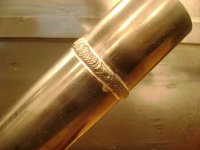
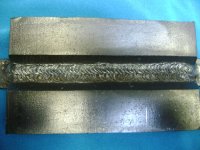
10P-Plus 10P-Plus 10P-Plus 10P-Plus, and never look back. :thumbsup::laughing:
 

Attachments

  • 10P Plus cap.jpg
    10P Plus cap.jpg
    161.4 KB · Views: 2,476
  • 6010 cap 9.jpg
    6010 cap 9.jpg
    237.9 KB · Views: 860
  • 10P Plus B.jpg
    10P Plus B.jpg
    355.2 KB · Views: 918
   / 6013 vs 7018 vs ?? #17  
Won't work well if you're welding aluminum to titanium. Gotta use a phasor set on stun with a unobtanium filler rod for that.
 
   / 6013 vs 7018 vs ?? #18  
maybee silicon bronze-tig? :)

soundguy
 
   / 6013 vs 7018 vs ?? #19  
7018 7018 7018 and never look back !!!!!!!!!!!!! :thumbsup:

That's because if I look back I see how bad my welds look with 7018. :laughing:
 
   / 6013 vs 7018 vs ?? #20  
maybee silicon bronze-tig? :)

soundguy

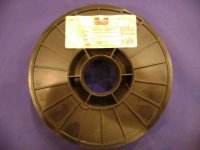
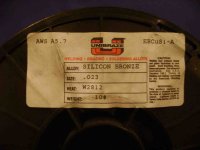
Never ran any silicon bronze Tig, but years ago I worked in a sheet metal shop, we ran a lot of silicon bronze Mig. When I bought my Mig welder it had a roll of it on the spindle.
 

Attachments

  • Silicon Bronze spool.jpg
    Silicon Bronze spool.jpg
    88 KB · Views: 280
  • Silicon Bronze label.jpg
    Silicon Bronze label.jpg
    96.2 KB · Views: 314

Tractor & Equipment Auctions

2022 THOMPSON PUMP 6X6S1 PORTABLE PUMP (A59823)
2022 THOMPSON PUMP...
2018 VOLVO EC480EL EXCAVATOR (A60429)
2018 VOLVO EC480EL...
2018 Ford F-550 4x4 Altec AT37G Forestry Chipper Bucket Truck (A59230)
2018 Ford F-550...
2010 LAREDO 5TH WHEEL (A55745)
2010 LAREDO 5TH...
Case 1083 20ft Corn Head (A56438)
Case 1083 20ft...
JEEP FOR DOUBLE TRAILER (A58214)
JEEP FOR DOUBLE...
 
Top