Thanks Peter. Good idea...I was able to use clamps to temporarily straighten out the plate and get it off. It's quite mangled, so looks like I'll be trying to order a new one. At least it's off. With the use of the clamps, I may even be able to use it on my other implements until I get the new one.
You are using an out of date browser. It may not display this or other websites correctly.
You should upgrade or use an alternative browser.
You should upgrade or use an alternative browser.
Hydraulic disconnect is stuck..help!
- Thread starter Homebrew
- Start date
- Views: 8550
More options
Who Replied?
/ Hydraulic disconnect is stuck..help!
#21

Clumber
Gold Member
Thanks Peter. Good idea...I was able to use clamps to temporarily straighten out the plate and get it off. It's quite mangled, so looks like I'll be trying to order a new one. At least it's off. With the use of the clamps, I may even be able to use it on my other implements until I get the new one.
Glad you were able to remove it. Can you post a photo of it? Just curious.

J_J
Super Star Member
- Joined
- Sep 6, 2003
- Messages
- 18,973
- Location
- JACKSONVILLE, FL
- Tractor
- Power-Trac 1445, KUBOTA B-9200HST
Homebrew,
You never did tell me if the QA cyl went into relief, and therefore was exerting the full force on the cyl rod.
The reason I ask is that if your cyl is a 1 in cyl, and 1/2 in rod, at 3000 psi, that cyl should exert a pressure of 2300 lbs in the extend mode, and 1700 lbs in the retract mode.
Does your three spool valve work well in other functions?
It puzzles me that the cyl could not pull or push past the lugs.
The only way I can see that the hyd would not work is that if the mechanical force, as in a bent plate might put enough force of steel on steel to overcome the pull or push of the cyl.
You never did tell me if the QA cyl went into relief, and therefore was exerting the full force on the cyl rod.
The reason I ask is that if your cyl is a 1 in cyl, and 1/2 in rod, at 3000 psi, that cyl should exert a pressure of 2300 lbs in the extend mode, and 1700 lbs in the retract mode.
Does your three spool valve work well in other functions?
It puzzles me that the cyl could not pull or push past the lugs.
The only way I can see that the hyd would not work is that if the mechanical force, as in a bent plate might put enough force of steel on steel to overcome the pull or push of the cyl.
Last edited:

ponytug
Super Member
I'm glad you were able to get it off!
I know that other folks have beefed up various PT attachments to meet their needs. Without knowing how yours got warped, it is hard to comment, but you might want to consider having a local welder press it flat, and then reinforce it to help prevent future warping.
Then again, there may have been something structurally wrong with the original, and a replacement plate from PT will put it to rest. It wouldn't be the first time that a piece of plate steel had a defect in it.
Personally, I wouldn't want to use it any more than I had to until it is fixed. I would be concerned that the warped plate will press on the other QA receivers on your attachments and warp them... I don't think that any of the steel is hardened, so it is pretty malleable.
Good luck.
All the best,
Peter
I know that other folks have beefed up various PT attachments to meet their needs. Without knowing how yours got warped, it is hard to comment, but you might want to consider having a local welder press it flat, and then reinforce it to help prevent future warping.
Then again, there may have been something structurally wrong with the original, and a replacement plate from PT will put it to rest. It wouldn't be the first time that a piece of plate steel had a defect in it.
Personally, I wouldn't want to use it any more than I had to until it is fixed. I would be concerned that the warped plate will press on the other QA receivers on your attachments and warp them... I don't think that any of the steel is hardened, so it is pretty malleable.
Good luck.
All the best,
Peter
Thanks Peter. Good idea...I was able to use clamps to temporarily straighten out the plate and get it off. It's quite mangled, so looks like I'll be trying to order a new one. At least it's off. With the use of the clamps, I may even be able to use it on my other implements until I get the new one.
pajoube
Veteran Member
- Joined
- Oct 11, 2001
- Messages
- 2,225
- Location
- Montana (Near Bozeman)
- Tractor
- Former Owner PowerTrac 425 (September 2003)
Thanks Peter. Good idea...I was able to use clamps to temporarily straighten out the plate and get it off. It's quite mangled, so looks like I'll be trying to order a new one. At least it's off. With the use of the clamps, I may even be able to use it on my other implements until I get the new one.
This has happened to me. I finally figured the reason for my bent quick attach plate. I have the mini hoe and when attaching it to the quick attach plate you need to shut off the engine to get the hoses put into place. I noticed that at times the quick attach lugs would not fully seat in the locked position as I would put the plate on the ground. First time putting force on the bucket would pull the lug out of the locked position and bend the plate.
PJ
J_J
Super Star Member
- Joined
- Sep 6, 2003
- Messages
- 18,973
- Location
- JACKSONVILLE, FL
- Tractor
- Power-Trac 1445, KUBOTA B-9200HST
pajoube,
Hello, Haven't seen you posting for a while. What have you been up to. Working hard I suspect.
Hello, Haven't seen you posting for a while. What have you been up to. Working hard I suspect.
pajoube
Veteran Member
- Joined
- Oct 11, 2001
- Messages
- 2,225
- Location
- Montana (Near Bozeman)
- Tractor
- Former Owner PowerTrac 425 (September 2003)
pajoube,
Hello, Haven't seen you posting for a while. What have you been up to. Working hard I suspect.
Thank You J.J.
Yes, summers are none stop. Put in a 30 by 48 green house, new roof (hail damage), finished painting the outside, and still teach middle school and high school woodworking (volunteer).
Our home, yard and landscaping have been featured in a number of University Horticulture publications this past three months so had to keep up with the weeding and mowing. Taking classes at the University Horticulture Level 3 Master Gardener Program.
Tractor time has been high with all these projects along with winter plowing all the old peoples driveways. I should be in that category pretty soon.
Now I need fall and winter to let me relax and read more.
PJ

MossRoad
Super Moderator
- Joined
- Aug 31, 2001
- Messages
- 66,103
- Location
- South Bend, Indiana (near)
- Tractor
- Power Trac PT425 2001 Model Year
... all the old peoples driveways. I should be in that category pretty soon.
Not hardly, PJ! :laughing:

woodlandfarms
Super Member
- Joined
- Jul 31, 2006
- Messages
- 6,149
- Location
- Los Angeles / SW Washington
- Tractor
- PowerTrac 1850, Kubota RTV x900
Pj. You have pix of your greenhous? I am going to build one for the wife and looking for ideas.
Homebrew,
You never did tell me if the QA cyl went into relief, and therefore was exerting the full force on the cyl rod.
The reason I ask is that if your cyl is a 1 in cyl, and 1/2 in rod, at 3000 psi, that cyl should exert a pressure of 2300 lbs in the extend mode, and 1700 lbs in the retract mode.
Does your three spool valve work well in other functions?
It puzzles me that the cyl could not pull or push past the lugs.
The only way I can see that the hyd would not work is that if the mechanical force, as in a bent plate might put enough force of steel on steel to overcome the pull or push of the cyl.
Hi JJ,
I'm still not entirely sure if the QA cyl went into relief. By the time I read your post about how to check this, I had already unbolted the cylinder and was able to see that I then got full travel. Although this might not have been the brightest thing to do, I also whacked on the stuck pegs awfully hard and they just would not budge past a certain point. I'll try to get a good picture of the bent plate, but there sure was a lot of menchanical binding. I have a new plate on the way at which point I'll get everything re-assembled and see if I can hear the relief valve.
Anyway, I haven't had a chance to get the hyd gauge and fittings to check the pressure, but I would like to do that at some point. I assume the three spool valve has something to do with the three degrees of motion? As far as using implements like the grapple and mini-hoe, I have NOT had any issues or problems. Of course, it's possible that the hyd pressure isn't what it should be and I just can't tell.
All in all, I'd be surprised if this was anything other than a case of simple mechanical binding. I really hit those pegs harder than I probably should have without a hint of movement. As soon as I put the clamp on and straightened the plate, they moved quite easily.
Thanks again for all the help. This will probably sound odd, but having the PT break down can be pretty fun...I'm enjoying the learning!
J_J
Super Star Member
- Joined
- Sep 6, 2003
- Messages
- 18,973
- Location
- JACKSONVILLE, FL
- Tractor
- Power-Trac 1445, KUBOTA B-9200HST
Just about every cyl if fully extended or retracted will activate the relief valve, if the cyl and valve are good, you may or may not hear the sound, depending on ambient noise around you. However, if a hyd gage is in the circuit, you will see the results of any pressure in the system. The pressure readings may not make sense at first, because you will see low pressure, but the lift and tilt are working. As pressure is developed because of load, the pressure gage will reflect that.
You can use the gage as a load measuring device by the pressure . At 3000 psi, you can lift 800 lbs, and if the load is about 400 lbs, it will only take about 1500 psi to raise it.
The cyl and the position of the cyl pins, are designed for a load factor, and for the 425, it is around 800 lbs. The relief valves are a safety valve for over pressure, and are usually set about 50 to 100 psi below the pump max pressure. Looking at the gage , you will see any pressure between 0 and the relief pressure. When you max out the cyl , the relief will go off and the pressure is reflected on the gage. That reading is a good reference for the ability of the hyd system to preform it's task. If the relief pressure should be lower than specs, it can be adjusted. Your pressure might be around 2900 psi.
Some PT owners say the relief never goes off, and the machine will go into the PT Pucker, which is a balance of the load fwd of the front wheels, and the rest of the machine. If the load is more than the rear, the PT rear end will stay in the air.
Can the 425 lift more, probably, if there is some more weight added to the rear, but one must give thought to the load on the wheel motors shafts and mounts, and more air pressure in the tires.
If in the Pucker mode and you want to come down quick, just hit the float. If you want to come back to level slowly, ease on the down lever. Sometimes turning the steering will cause the Pucker, because of weight shifting.
You can use the gage as a load measuring device by the pressure . At 3000 psi, you can lift 800 lbs, and if the load is about 400 lbs, it will only take about 1500 psi to raise it.
The cyl and the position of the cyl pins, are designed for a load factor, and for the 425, it is around 800 lbs. The relief valves are a safety valve for over pressure, and are usually set about 50 to 100 psi below the pump max pressure. Looking at the gage , you will see any pressure between 0 and the relief pressure. When you max out the cyl , the relief will go off and the pressure is reflected on the gage. That reading is a good reference for the ability of the hyd system to preform it's task. If the relief pressure should be lower than specs, it can be adjusted. Your pressure might be around 2900 psi.
Some PT owners say the relief never goes off, and the machine will go into the PT Pucker, which is a balance of the load fwd of the front wheels, and the rest of the machine. If the load is more than the rear, the PT rear end will stay in the air.
Can the 425 lift more, probably, if there is some more weight added to the rear, but one must give thought to the load on the wheel motors shafts and mounts, and more air pressure in the tires.
If in the Pucker mode and you want to come down quick, just hit the float. If you want to come back to level slowly, ease on the down lever. Sometimes turning the steering will cause the Pucker, because of weight shifting.
pajoube
Veteran Member
- Joined
- Oct 11, 2001
- Messages
- 2,225
- Location
- Montana (Near Bozeman)
- Tractor
- Former Owner PowerTrac 425 (September 2003)
Pj. You have pix of your greenhous? I am going to build one for the wife and looking for ideas.
Heading to GEG to talk with popcorn growers and will return end of next week. Will post pictures then.
PJ
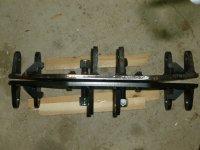
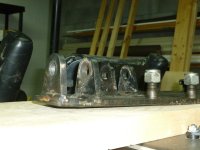
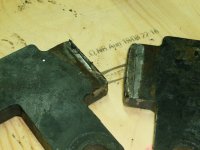
Clumber
Gold Member
Here are some pictures of the bent plate next to the new one and the QA pins. You can see on the pins where they were bound up. I think you can see from the pics how bent the QA plate is.
Thanks for posting he pics. Did Power-Trac replace free under warranty?
I notice that mine is slightly bent on one side. The two plates can actually move slightly when joined. There is no indication of binding. So I guess I will just wait and see. I now have 70 hours on my PT-425.

BobRip
Elite Member
I bent mine while pushing the plate against a tree. I was able to straighten it. Heat it up with a forge or torch and straighten it on an anvil. You can clean up those locking pins and use them again.
Thanks for posting he pics. Did Power-Trac replace free under warranty?
I notice that mine is slightly bent on one side. The two plates can actually move slightly when joined. There is no indication of binding. So I guess I will just wait and see. I now have 70 hours on my PT-425.
I bought my PT in 2008. I didn't even ask about warranty...assumed it was out. The plate was $180 plus about $13 shipping. I forget what they wanted for the pins, but it was in the neighborhood of $25 or $30 each, so I decided I would grind the burrs off the old ones.
MossRoad
Super Moderator
- Joined
- Aug 31, 2001
- Messages
- 66,103
- Location
- South Bend, Indiana (near)
- Tractor
- Power Trac PT425 2001 Model Year
So what do you think caused it to bend?
BobRip
Elite Member
I bought my PT in 2008. I didn't even ask about warranty...assumed it was out. The plate was $180 plus about $13 shipping. I forget what they wanted for the pins, but it was in the neighborhood of $25 or $30 each, so I decided I would grind the burrs off the old ones.
If I had known is was only $180, I would have replaced mine and then fixed the old one. Actually mine has been working fine for about three years after straightening. It was not as bad as yours though.
So what do you think caused it to bend?
You know, I'm still not entirely sure. I think it may be related to the box blade I bought.
I bought a nice heavy-duty 3pt hitch box blade. Not sure how heavy it is, but it takes all my strength to slide it, let alone pick it up. I had a 3 pt hitch adapter made. The blade has been used very little, but maybe the pulling action caused the bend. The PT seems to have little trouble lifting it, but given the adapter and then the box blade, there sure is quite a bit of weight hanging way out there. If the box got torqued such that the PT arms sort of twisted a little, I could see the plate getting bent this way.
The other possibility is that I did lend the machine and minihoe to a friend. I'm relatively certain that I've never not gotten the pins seated correctly before use, but perhaps my friend didn't. Someone earlier in this thread mentioned this caused a bend.
I do seem to remember having a little trouble getting the pins to drop when I switched to the mower deck, but nothing too bad. I find it hard to believe I could have bent it with the mower on.



