Look what I got for $1700

   / Look what I got for $1700 #1  

theghoul

Bronze Member
Joined
Jul 4, 2010
Messages
67
Location
Michigan
Tractor
Ford 1920 / Farmpro (Jinma) 2425
I needed a backup machine for my Ford 1920. I was trying to find a subcompact or even a beefy riding mower to do light hauling and mowing tall weeds.

Fate intervened and I found this divorce sale for this Farm Pro 2425 w/ 236 hrs and included a finish mower, backblade and hauling cart.

It has one problem though, the battery wont charge. I'm hoping its something simple.

Wow, this thing has a lot of controls.. A fuel cut off?

The manuals that came with it are hilarious. I couldn't help but read them in broken English.

What do you think? Good deal or dump it quick?
 

Attachments

  • farmpro.jpg
    farmpro.jpg
    63.8 KB · Views: 730
   / Look what I got for $1700 #2  
Many reasons for a battery not charging; (a) the battery itself not accepting a charge, (b) the alternator not putting out sufficient charging voltage, (c) a loose/slipping/missing alternator belt, (d) wiring, to mention a few. The fix could cost anything from $0 to $125, depending upon what you need to replace - and what you replace it with. To me that's not worth arbitrarily dumping a $1700 investment.

Obviously you'll have to follow the traditional electrical troubleshooting tree. We're here to help with that. So let's start by asking if you have access to a digital electrical multimeter?

//greg//
 
   / Look what I got for $1700 #3  
Preliminaries:
Water in the battery?
Cleaned the terminals?
 
   / Look what I got for $1700 #4  
It has one problem though, the battery wont charge. I'm hoping its something simple.


If it has the original chinese battery, throw that out and get a new better one. That is where I would start, those batteries are junk. Also check ALL connections, basically start with the cheapest stuff 1st then go from there.

I had a 254 and wish I didn't let it go, it NEVER let me down.
 
   / Look what I got for $1700 #5  
You will need a meter to check the output of the alternator,the voltage regulators have also been a known problem.I think you got a great buy at $ 1,700.00,if you take off the value of the implements you prob. have less than $ 500.00-600.00 in the tractor.Parts are avaliable thru us or several other parts dealers.Your FarmPro is the same as the Jinma 254 tractor

Let us know if we can help

Tommy
Affordable Tractor Sales
"Your Jinma Parts Superstore"
www.affordabletractorsalesco.com
 
   / Look what I got for $1700
  • Thread Starter
#6  
Many reasons for a battery not charging; (a) the battery itself not accepting a charge, (b) the alternator not putting out sufficient charging voltage, (c) a loose/slipping/missing alternator belt, (d) wiring, to mention a few. The fix could cost anything from $0 to $125, depending upon what you need to replace - and what you replace it with. To me that's not worth arbitrarily dumping a $1700 investment.

Obviously you'll have to follow the traditional electrical troubleshooting tree. We're here to help with that. So let's start by asking if you have access to a digital electrical multimeter?

//greg//

I have mulitimeter and will start working my way back. I'll charge the battery first and see if it'll at least hold a charge.

I've read elsewhere on this forum that there are some grounding issues that may be present.

I'm on it today! I'll keep you updated!
 
   / Look what I got for $1700
  • Thread Starter
#7  
You will need a meter to check the output of the alternator,the voltage regulators have also been a known problem.I think you got a great buy at $ 1,700.00,if you take off the value of the implements you prob. have less than $ 500.00-600.00 in the tractor.Parts are avaliable thru us or several other parts dealers.Your FarmPro is the same as the Jinma 254 tractor

Let us know if we can help

Tommy
Affordable Tractor Sales
"Your Jinma Parts Superstore"
Home of compact Jinma, Foton, and Koyker Tractors and Parts, Wood Chippers, Backhoes - Affordable Tractor Sales Company

Good to know. I WILL be ordering parts soon from you guys I'm sure.
 
   / Look what I got for $1700 #8  
I'd have bought that deal in a heartbeat! If you do find that the charging system is at fault after cleaning connections, checking the battery etc, look on here and the web for changing the altenator to a 10 or 12 si Delco three wire. You then will not need a regulator either. Or you can juyst replace OEM parts but generally the electrical system on these is not known for its strength or robustness. A little checking and wrenching and I think you will be happy with your purchase
 
   / Look what I got for $1700 #9  
for 1700 a great buy!
I have a 284 and the electrical (battery and alt) are as others have sudjested not the best quality. First is to do a load test on your battery. Just take out both battery and alt and bring them to a local place that services altinators they will do a test on both for you. But chances are that the alt will need rebuilding (aprx 100 to 150) and the battery replaced.
They are nice little machines I use mine a lot.
I would change all fluids in it also, oil sump, hydrolic, power steering, rear and front end along with the oil in the injector pump.
I believe you will be happy with your new purchase:thumbsup:
 
   / Look what I got for $1700 #10  
I seem to recall a gentleman who has posted on here who put the Jinma engine in a pickup(search this forum). He discovered that a mazda b2000(I think) alternator was a nearly direct bolt-on with only minor mechanical changes required to install. It would of course need some wiring changes as any alternator with an internal regulator will, but that is fairly easy compared to fabbing the mount hardware to properly align the alt pully and allow proper tensioning. The Delco's are great, and found everywhere, but I don't know how much extra work would be required to physically mount it. It is also way overkill for your electrical needs on this little tractor. You don't need a very large alternator. I think the stock alt is only rated for 15-20A output, and when working properly is more than adequate unless you start adding large working lights/electrical load. In fact if you don't use it after dark much, you could probably get by with adding a float charger/battery maintainer and just plugging in the beast whenever you park it so you have a full charge available for startup...

Good find, I too would have jumped at that in a heartbeat:)
 
   / Look what I got for $1700 #11  
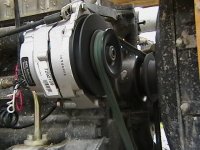
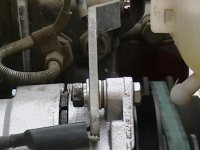
The OEM alternators are only ~14 amp. Won't even keep up with your headlights. Ask me how I know this.. The Delco 10 Si or 12 Si are direct shoe-in replacements - even use the same pulley. The only real mod you will have to do is get a different length fan belt and insert a couple of spacer washers for the adjusting arm. I went with the segmented belt from Harbor Freight - I will never have to replace it again.
I went with the 12Si 72 amp alternator because I use electric winches, powerful lights, and a 110v inverter.

Actually, what RonMar said is true If all you need the battery for is starting the engine. Just use the alternator to keep the belt tight.
 

Attachments

  • New alt. 008.jpg
    New alt. 008.jpg
    112.1 KB · Views: 386
  • New alt. 009.jpg
    New alt. 009.jpg
    109.1 KB · Views: 323
   / Look what I got for $1700 #12  
14A of current at 14V is enough to power 200W of lights... I think my headlights on mine are only about 55W each...

I didn't know the delco 10 or 12 was a direct bolt in for the jinma, that is good info to know, thanks.
 
   / Look what I got for $1700 #13  
14A of current at 14V is enough to power 200W of lights... I think my headlights on mine are only about 55W each...
Well, the voltage regulator cuts the alternator output down to 12v for lighting and accessories. So that leaves ~168w of power to be consumed by headlights, side lights, brake lights, tail lights, instrument lighting, et cetera. And if your headlights are still original, they're probably 35w. Folks early on tried replacing the rather dim OE with 55w aftermarket, and quickly ran into alternator limitations.

//greg//
 
   / Look what I got for $1700 #14  
Yes, exactly what everyone has said, Congratulations on a super buy. And I've installed the 10SI three wire alternater on my JM354 and it had to have the wider pulley and also I had to get the special nut for the wide pulley. The 10SI cost me $16 at the wrecking yard and has been the best invest so far, I also installed a group 31 battery $120 from O'riellys Auto supply (Used to be Shucks). bjr
 
   / Look what I got for $1700 #15  
Well, the voltage regulator cuts the alternator output down to 12v for lighting and accessories. So that leaves ~168w of power to be consumed by headlights, side lights, brake lights, tail lights, instrument lighting, et cetera. And if your headlights are still original, they're probably 35w. Folks early on tried replacing the rather dim OE with 55w aftermarket, and quickly ran into alternator limitations.

//greg//

UH Greg, if the voltage regulator cut the voltage down to 12V, the battery would never reach a full charge... Bare minimum float voltage to maintain a lead acid battery at full charge is around 13.2V

A proper voltage out of an alternator is 14.5V +/- .5V. Mine is barely acceptable at it's output. My 284 running at 1200 RPM delivers 13.9 VDC at the battery. This was with all the lights off. Under the same conditions, with all the lights(head, running and rear work light) switched on, the voltage actually increased slightly to 13.95 VDC at the battery. If the voltage regulator is working properly, The voltage should stay fairly constant with load and RPM changes up to it's current limit.
 
   / Look what I got for $1700 #16  
UH Greg, if the voltage regulator cut the voltage down to 12V, .the battery would never reach a full charge.
Check your wiring diagram Ron, not all battery charge circuits include the voltage regulator (VR). Some are on a separate circuit that is independent of the VR. At least it did on the 4 Chinese tractors that I owned. That said, they were all 3-wire alternators (external VR). What follows is not necessarily applicable to 1-wire alternators or conversions.

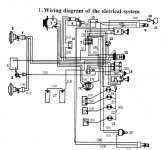
Take this Jinma 200 Series diagram for example; the + post on 3-wire Alternator (5) sends unregulated voltage on wire #4 to the ammeter (12). At this point it's also paralleled to the keyswitch (13) on wire #5. When the keyswitch is placed in the RUN position, the ammeter then sends said voltage via wire #3 to/through the system fuse - then onward to the starter solenoid (6) on wire #2. From there it rides the battery cable back to the + post on the battery. This is charging voltage, no VR in the circuit. Any "regulation" done is a feedback function of the battery charge state; low charge/high voltage, normal charge/maintenance voltage.

FWIW, unregulated voltage also travels wire #8 between the alternator and the VR. From there wire #7 feeds regulated voltage to the rest of the circuits in the fuse panel.

Assuming your 284 conforms to the above diagram, your symptoms describe both regulated and unregulated voltage. But since accurate voltage readings are dependent upon a good ground, you might want to clean both ends of the battery ground cable. You've been around long enough to know to clean the paint/rust under the ground lug on the frame. And if there's any white stuff showing between the cable strands and the insulation, it might be time to replace the cable as well. If none of that returns your voltage reading to normal, it might be time to start thinking new alternator.

//greg//
 

Attachments

  • 200 series wiring.jpg
    200 series wiring.jpg
    87 KB · Views: 1,276
Last edited:
   / Look what I got for $1700 #17  
Wire 7 is a sense line, the regulator senses this point to control current in the field windings of the alternator. More current = stronger field = higher voltage. Less current = weaker field = lower voltage. The output of the alternator is wire 4.

If the voltage on the + terminal of the ammeter is higher than the battery voltage, the ammeter will show charging. If the voltage is lower, the ammeter will show discharge.

The point is that the regulator sees to it that it maintains the alternator output at a regulated level. The regulator regulates current in the alternator windings, it does not output a regulated voltage to anything.
 
   / Look what I got for $1700 #18  
I see. Perhaps I misinterpreted the wiring diagram. I was keying off the fact that wires #2 and #3 do not physically feed the fuse panel bridge. Rather, they simply connect the ammeter and the battery via the 30A system fuse. So going by your asserting, then it's wire #6 that actually feeds the bridge. Wire #7 is then paralleled off for purposes of VR feedback (sensing) to the alternator. Is that more in line with how you see it?

//greg//
 
   / Look what I got for $1700 #19  
I see. Perhaps I misinterpreted the wiring diagram. I was keying off the fact that wires #2 and #3 do not physically feed the fuse panel bridge. Rather, they simply connect the ammeter and the battery via the 30A system fuse. So going by your asserting, then it's wire #6 that actually feeds the bridge. Wire #7 is then paralleled off for purposes of VR feedback (sensing) to the alternator. Is that more in line with how you see it?

//greg//

Yes. Wire 5 gets connected to wire 6 via the ignition switch to power up the rest of the system.
 
   / Look what I got for $1700 #20  
Thank you for the edification. I've apparently been misinterpreting that diagram for quite a while now.

//greg//
 

Tractor & Equipment Auctions

2021 Chevrolet Silverado 1500 4x4 Crew Cab Pickup Truck (A59230)
2021 Chevrolet...
2006 CATERPILLAR D8T HIGH TRACK CRAWLER DOZER (A60429)
2006 CATERPILLAR...
Case-IH 180 Magnum (A57148)
Case-IH 180 Magnum...
Adams Tender / Magnolia Trailer (A56438)
Adams Tender /...
2017 Ford Expedition SUV (A59231)
2017 Ford...
207269 (A52708)
207269 (A52708)
 
Top