Landscape plane questions

   / Landscape plane questions #1  

woodlandfarms

Super Member
Joined
Jul 31, 2006
Messages
6,149
Location
Los Angeles / SW Washington
Tractor
PowerTrac 1850, Kubota RTV x900
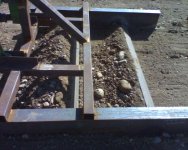
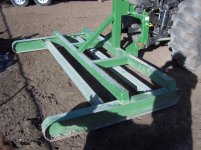
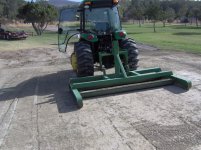
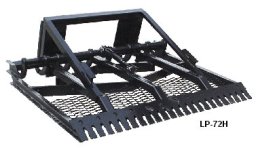
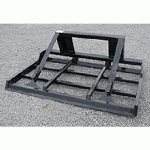
I have a heavy duty 72" woods box blade. Works good but I reall feel a landplane will be way better for maintaining my roads. So here are mybuestions and happy to take all comments? I am going to build this implement.

Anyone have one?

Push or pull? I am so tired of pulling butt think the pt arms are going to be an issue and oushupingbwill never work. But my runners should be quite long 5 ft at least.

I can pull the box blade unless I am on a slope and the box blade really loads up. I am thinking about an 84 inch wide landplane.
 
   / Landscape plane questions #2  

Attachments

  • landplane.jpg
    landplane.jpg
    219.5 KB · Views: 316
  • landplane 001.jpg
    landplane 001.jpg
    409.3 KB · Views: 393
  • landplane for x749 001.jpg
    landplane for x749 001.jpg
    608.5 KB · Views: 344
  • landplane 004.jpg
    landplane 004.jpg
    475.5 KB · Views: 419
  • landplane (1).jpg
    landplane (1).jpg
    22.6 KB · Views: 663
  • land_plane_5.gif
    land_plane_5.gif
    55.2 KB · Views: 350
Last edited:
   / Landscape plane questions #3  
I'd look at some of the commercial ones available and copy their design.

(I ain't too original or creative, if you haven't noticed over the years :laughing: ).

I was always interested in the D.R. brand for smaller tractors. Perhaps a good place to start looking.
 
   / Landscape plane questions #4  
Do some searching, lots of threads on this, bought and home built. Build it as heavy as your tractor will handle and don't get greedy with the width. You are better off with a heavy 6 foot unit than a lighter 7' unit. You are best off with no less than 150lbs per foot of width. Heavier is better, but your tractor will only handle so much.

Good luck
 
   / Landscape plane questions
  • Thread Starter
#5  
Thanks everyone. I have my design for the most part (Still struggling on wether to angle the cutting blades or have them run parallel, no one seems to have the straight answer on that).

But the killer for me is push or pull. Box blade will not work in push mode, I would love it if the landscape would, but I think that if it gets hung on something I am going to push over top of it. Probably better to pull it but this will make for a miserable mile of road I have to grade.

Carl
 
   / Landscape plane questions #6  
I have a similar situation with a mile long private road of blue crusher mix stone. I have used my PT 425 with a box blade on a short section of the road with good result, but it is slow and pulling the blade works best. The road has deep ruts due to water runoff.

I am thinking about buying a Power-trac Power Rake attachment for another purpose, but I'm thinking that the power rake might be a faster solution to smoothing out the deep ruts on the road. The rake can be operated in push-mode. However, a final pass with the box blade may still be necessary.

Anybody here ever use a power rake like this?
 
   / Landscape plane questions #7  
Thanks everyone. I have my design for the most part (Still struggling on wether to angle the cutting blades or have them run parallel, no one seems to have the straight answer on that).

But the killer for me is push or pull. Box blade will not work in push mode, I would love it if the landscape would, but I think that if it gets hung on something I am going to push over top of it. Probably better to pull it but this will make for a miserable mile of road I have to grade.

Carl

As far as I know of, every commercially built unit has angled blades. The home built units are common to have the blades straight. Why do you think that may be? It sure wouldn't be because it is easier to build with the blades straight, now is it? :rolleyes:
 
   / Landscape plane questions #8  
Dear Carl,

Based on my experience, I think that you want the cutting blades in a multiple chevron design <<>>. This will redistribute and level the material the best. As suggested by MtnViewRanch, keep it heavy enough to dig in. To break up bad ruts or potholes, you may need to scarify a bad section first before using the land plane.
Finally, a little clay or fine rock dust will go a long way to permanently keeping your roadbed solid, and keep potholes from reforming. Many people make the mistake of filling the potholes only with larger aggregate, which then creates a holding space for water that vehicles dislodge, carrying the binder (rock dust/fines/clay) out of the roadbed, making the pothole worse.

Have fun.

All the best,

Peter

Thanks everyone. I have my design for the most part (Still struggling on wether to angle the cutting blades or have them run parallel, no one seems to have the straight answer on that).

But the killer for me is push or pull. Box blade will not work in push mode, I would love it if the landscape would, but I think that if it gets hung on something I am going to push over top of it. Probably better to pull it but this will make for a miserable mile of road I have to grade.

Carl
 
   / Landscape plane questions #9  
If the commercial ones were built both ways, and both types stocked by dealers, I think most buyers would buy the angled ones, thinking it will build a crown better. But some users of angled ones say there is almost no sideways movement of material.

Others build straight ones because they intend to use it for leveling and don't want sideways movement of material.

Bruce
 
   / Landscape plane questions #10  
If the commercial ones were built both ways, and both types stocked by dealers, I think most buyers would buy the angled ones, thinking it will build a crown better. But some users of angled ones say there is almost no sideways movement of material.

Others build straight ones because they intend to use it for leveling and don't want sideways movement of material.

Bruce

For my uses anyway, I agree with this statement 100%. If I were to build a crown on my roads based solely on the sideways material movement, I doubt that it could even be done, but at best it would take thousands of passes and that is no exaggeration. ;)
 
   / Landscape plane questions #11  
Think about chopping a carrot VS slicing a carrot.

Think about teeth on a bucket VS no teeth.

I think that's why there are angled blades VS straight blades... less force to get it going and less force to keep it going.

That's my opinion, based on no facts at all. :laughing:
 
   / Landscape plane questions #13  
Because your going to use it on a P/Trac, there are a lot of differences over using it on a 3pt hitch on a tractor. I can understand why you would want to push, but have my doubts on it preforming the same as behind a tractor. Sooooo.... why not look at it like a Pond Scoop and make it reversible? It would only take a little extra material to make it reversible, I would think, though I haven't looked closely at the P/Trac attachment points.
Just a thought...
David from jax
Mine was built with angled blades, and I am glad of it.
 
   / Landscape plane questions #14  
   / Landscape plane questions
  • Thread Starter
#16  
I assume it is the odd geometry that the PT has, but pushing has issues. Iwill indeed make mine reverseable, and aim to push but the PT tends to climb up a pushed device. Not sure why, but box blades end up being a pita.

I found most of my steel in my neighbors junk pile, along with stuff for a welding table so I am pretty stoked.

More to come as I move forward on this project next week.

Carl
 
   / Landscape plane questions #17  
One of the reasons that the PT does not push well is that the push points for the loader arms are about 36 in off the ground, and tend to ride up.

I believe if you push low or pull low you will accomplish more.

I have a push point on the bottom front of my PT, that is used for my flail.

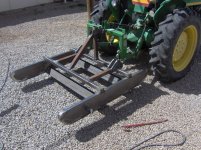
If you put the two angle points down, you should be able to push or pull equally as in my third picture above.
 
   / Landscape plane questions #18  
Think about chopping a carrot VS slicing a carrot.


The land plane doesn't slice. The angle is too small.

Think about slowly crosscutting a carrot with the knife horizontal, pressing straight down
VS
slowly crosscutting a carrot with the knife at 30 degrees, pressing straight down. Be careful you don't let the knife slip sideways.


Bet you can't tell the difference.

:)

Bruce
 
   / Landscape plane questions #19  
I believe that the angled blades do a better job with wash boarding, other than that probably not much difference. But I would think that there is some definite reason, otherwise the OEM guys would be building them with the blades straight. It has to cost more to have the blades at an angle, even if it is just more material used to build the unit. ;)
 
   / Landscape plane questions #20  
The land plane doesn't slice. The angle is too small.

Think about slowly crosscutting a carrot with the knife horizontal, pressing straight down
VS
slowly crosscutting a carrot with the knife at 30 degrees, pressing straight down. Be careful you don't let the knife slip sideways.


Bet you can't tell the difference.

:)

Bruce

The angled blade on the land plane is at a compound angle to the surface of the ground. And, the blade is moving forwards as opposed to straight down. Right at the surface of the blade, the soil will peel up, then be pushed sideways by the next bits of soil, clearing the blade, and so on.

Ever use a draw knife on wood? Try pulling it perpendicular to the wood and it bites in and sticks. Pull it at an angle to the wood and it slides right along.
 

Tractor & Equipment Auctions

SEMI AUTOMATIC QUICK-CHANGER FOR MINI EXCAVATOR (A58214)
SEMI AUTOMATIC...
Willmar 4550 Wrangler Articulating Loader (A56438)
Willmar 4550...
2024 Kubota M7-174D (Deluxe) 4WD Tractor - 244 Hours (A56438)
2024 Kubota...
2020 MACK GR64FT (A58214)
2020 MACK GR64FT...
2009 Cadillac CTS Sedan (A59231)
2009 Cadillac CTS...
2020 PETERBILT 567 (A58214)
2020 PETERBILT 567...
 
Top