Willl
Elite Member
What programmer are you running and what level are you running it on?
Quadzilla Adrenaline, level 8.
I've got it set to start to detune at 1100.
What programmer are you running and what level are you running it on?

I don't need a:
"Service Engine Soon" light.
"Service Tire Monitoring System" light.
"Service Air Bag" light.
"Seat Belt Unbuckled" light.
"Door Open" light.
"Hood Latch Open" light.
"Turn Signal Is On" light.
I just need a simple truck. A truck that doesn't complain to me while I'm driving down the road. Or at least a truck that would say something nice to me now and then.
Quadzilla Adrenaline, level 8.
I've got it set to start to detune at 1100.

Boy you really have a hard time with reading, don't you...?I guess we both don't understand because the only thing you mention is a different computer program.
Of course you want to talk power at the crank, it's the only thing that makes the Ecoboost look good and no one can prove. Last I checked that power needs to make it to the ground first unless your one of those that buys by the advertisement (typical Ford buyer) and not by the real world test.Are we back to transmission talk? I thought we were talking torque at the crank.
Actually I responded then and you still didn't get it. Not surprised...I asked you a question months ago about torque and HP and you left it unanswered. I will ask again here and see if you flee like you did in the past. If HP is so important to you rather than torque, which would make a better engine for a truck:
a HEMI with 395 HP and 407 lb-ft of torque or
a Cummins with 350 HP and 800 lb-ft torque? I kept it Ram terms for your convenience. Hemi has 45 more HP. Just gear that HEMI and it is better.
Well yeah it is easy to get your egts that high running a program like that. I'm talking stock tune, towing tune and even street tune on my mini max in usually no higher than 800 even getting on it hard. I haven't played with performance tune much. Don't see a point it is a 3/4 ton not a hot rod.
Exactly. HP measures work performed.horsepower is a measurement of power relating the amount of work
Boy you really have a hard time with reading, don't you...?
I also mentioned fuel delivery (high pressure pumps, larger injectors, etc...), internal engine components (larger connecting rods, stronger low compression pistons sometimes with extra oil passages, etc...), larger and different designed exhaust, larger sometimes extra cooling, the list goes on.
Of course you want to talk power at the crank, it's the only thing that makes the Ecoboost look good and no one can prove. Last I checked that power needs to make it to the ground first unless your one of those that buys by the advertisement (typical Ford buyer) and not by the real world test.
Actually I responded then and you still didn't get it. Not surprised...
Your only looking at peak numbers and not where it's made. The real show of power is WHERE that HP is made. When that Cummins makes 800 lb.ft at just 1600 rpms, it's making 244 HP. Show me a gas engine that can make 244 HP at 1600 rpms...
Using Ford's inflated engine dyno chart, your Ecoboost is only making 199 HP at 2500 rpms (peak TQ output).
Torque is merely a calculation of where the engine makes it's horsepower. T = 5252 x HP / rpm. The higher the RPMs, the lower the Torque.
As I mentioned before, Torque is a calculated number. Need more TQ? Increase the leverage (gearing).
Horsepower is a measure of "Work" and cannot be calculated, only measured.
So would I take a diesel that produces 244 HP at 1600 RPMs vs a gas engine that produces around 150 HP at the same RPMs...? YES of course if that low end power is needed. Again, your only looking at peak numbers and not where it's made. If the gas HEMI made that 395hp at 2500 rpms, it would be putting down 829lb.ft. I would certainly take that over a diesel.
Now to compare gas engine to gas engine, I will gladly take the one making more HP at a lower broader RPM range regardless of peak TQ output. With TQ numbers nearly equal, I will gladly take the one making more HP as that is the true measure of Work which can be performed.

Some of the best free entertainment happens around boat launching ramps!:boat:
Exactly. HP measures work performed.
Torque is what's measured on a dyno but again that number can easily be manipulated with leverage. HP is the measure of work. If an engine makes a ton of TQ but only at low rpms then it will have less HP which means less work compared to an engine making the same or even less TQ at higher RPMs .
Diesel vs Gas is another story because of the way the fuel burns, the HP/TQ in diesel engines does not drop nearly as fast under load because of the different burn patterns.
How does an engine on a dyno manipulate torque with leverage? We are comparing engines not transmissions here.
Actually, we're talking trucks. Try and keep up.How does an engine on a dyno manipulate torque with leverage? We are comparing engines not transmissions here.
Maybe not high tech but unnecessary which is what this thread is about. Things not needed.Actually reading comes pretty easy for me when written logically. None of those items you mention are high tech items.
Again with the dynos, TQ may be measured on a dyno but it's still a simple calculation (lb.ft) pounds of force on the end of a 1 foot arm. Extend the arm and you have more TQ. HP can be calculated from TQ but it's still a measurement of work that can not be changed like TQ. You extend the arm for more TQ with the same force on the end of the arm and your RPMs drop. Less HP so less work.Last I checked a dyno measures torque. From that number, HP is CALCULATED, not the other way around. HP=torque x rpm/5252. Come on not this argument again. Acceleration follows the torque curve not the HP curve.
My argument is they both make less HP than the Cummins at 244 so I would choose that due to HP not just TQ.Ok, ecoboost makes 199 HP at 2500 rpms. Hemi makes 180 HP. And your argument is what?
Once again the Cummins is making 244 HP so I would choose that due to HP not TQ. The better truck engine makes more HP too not just more TQ.Your answer is still vague, which is it? You said you could use gearing to get your desired torque. Is it the Hemi or the Cummins in this example of real numbers a better truck engine?
Of course you want to talk power at the crank, it's the only thing that makes the Ecoboost look good and no one can prove. Last I checked that power needs to make it to the ground first unless your one of those that buys by the advertisement (typical Ford buyer) and not by the real world test.

I can reach 1000 plus degrees exhaust temp with a little extra go pedal in my dodge. Not hard to do at all.
So what engine dynos lie?
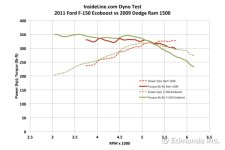
Here is a chassis dyno for you.
How We Dyno Tested Ford's 3.5-liter EcoBoost V-6 and 5.0-liter V-8 Engines - PickupTrucks.com News
Yes I have seen that article and it still cracks me up that Ford's uber-complicated transmission/ecu setup is so difficult to manage it can't even dyno properly. Because a small displacement engine even when turbocharged can't make good low end power, it has to slip the torque converter, dump a ton of fuel into the engine, create as much exhaust pressure as possible and get those turbos spooled as soon as possible. None of this is possible without a ton of extra sensors, mechanical/electronic components, wasted fuel and the hope that it all works! Way too much that can go wrong.Oh he has seen that article and had negative comments on it as well. I don't dislike the hemi, just dislike his putting down the ecoboost. It out performs the hemi under 5000 rpms and he doesn't like it. Of coarse the hemi makes more HP but I typically don't like running my truck engine at a constant 5600 rpms to get it.
He thinks all the numbers are made up by Ford yet real world it performs well
Most of them, manufacturers will remove all the accessories including the water pump and alternator just to get 1 more HP. It's far from accurate.So what engine dynos lie?
Most of them, manufacturers will remove all the accessories including the water pump and alternator just to get 1 more HP. It's far from accurate.
Anyways, back to useless stuff of modern trucks...
Yes I have seen that article and it still cracks me up that Ford's uber-complicated transmission/ecu setup is so difficult to manage it can't even dyno properly. Because a small displacement engine even when turbocharged can't make good low end power, it has to slip the torque converter, dump a ton of fuel into the engine, create as much exhaust pressure as possible and get those turbos spooled as soon as possible. None of this is possible without a ton of extra sensors, mechanical/electronic components, wasted fuel and the hope that it all works! Way too much that can go wrong.
I'm not saying the Ecoboost doesn't perform but this whole thread is about unneccesary things on modern trucks and that F150 Ecoboost is a perfect example. It has all this extra stuff that can break yet performs similarly to much simplier long running basic V8's. Also, the HEMI doesn't just make more HP at 5k, it makes more at lower rpms too!
I don't need turbos, direct injection, an active torque converter, high pressure fuel pumps, etc... Just a good ole proven pushrod V8 with the same basic fuel delivery, ignition, exhaust and intake system used for over 10 years still getting it done at the top.
You don't need 400lb.ft for 99% of a trucks duties so to say a HEMI will constantly be at 5600 rpms is just plain ignorant. I know I've never seen over 3000 while towing and have no doubt I've towed more with that truck than you have with that Ecoboost and I bet I got better fuel mileage towing too! :laughing:
Most of them, manufacturers will remove all the accessories including the water pump and alternator just to get 1 more HP. It's far from accurate.
Anyways, back to useless stuff of modern trucks...
Back to the orig. point. My first truck was a 61 chevy. 6 cyl 4 speed with the creeper low. AM radio and not much else. Worked that truck hard. Now I have an '05 ram 2500 with all the bells and whistles. It's a nice truck to ride in and I love 4WD but...... It left me stranded with an electronic failure- cost me over a grand to get it going again. On the other hand it went over 100,000 miles on the orig tires. Not bad.
Overall, I think the new ones are pretty nice. You have to be an old guy like me to remember changing points and condensor every 10,000 miles and being lucky to get anywhere near 100,000 miles before the vehicle was headed to the junk yard. By the way 1st car was a 1949 Ford coupe. I loved that car.