Things that I don't need on my truck

Status
Not open for further replies.
   / Things that I don't need on my truck #161  
I've still got two trucks with points, a '69 F-350 cab/chassis and a '75 C60 dump truck. I keep telling myself I need to change them over to electronic ignition but can't bring myself to do it. Something about the simplicity and nostalgia of it. You walk into an auto parts store nowadays and ask for a points file or a dwell meter and they look dumfounded. :laughing:

(BTW, I'm only 28, I must just be a glutton for punishment.)

Even scarier, most single engine and small twin engine airplanes have magnetos and big Borg Warner carburetors that look like they came off an antique tractor. One would think technology would first appear in aircraft. Not in our sue happy world. Being an aircraft mechanic years ago, had to set the timing for both magnetos in the engines. One fired the bottom plugs and the other the top plugs. Each mag probably weighed 10 lbs.
 
   / Things that I don't need on my truck #162  
Even scarier, most single engine and small twin engine airplanes have magnetos and big Borg Warner carburetors that look like they came off an antique tractor. One would think technology would first appear in aircraft. Not in our sue happy world. Being an aircraft mechanic years ago, had to set the timing for both magnetos in the engines. One fired the bottom plugs and the other the top plugs. Each mag probably weighed 10 lbs.

I wouldn't say scarier, simplicity and redundancy means high reliability. I too was an aircraft mechanic back in my college days, restoring P-51 Mustangs. I wasn't A&P certified so I didn't get to work with the engines, but knew my way around them well enough. A Rolls-Royce Merlin V12 is a beautiful thing to behold. In our shop we actually didn't do any engine work aside from basic maintenance and such. The engines were sent to Roush for overhaul. Alas, this thread is way off topic again, but there is a lot of interesting mechanical stuff in the aviation world.
 
   / Things that I don't need on my truck #163  
The adjustable pedals in both my Ford and Nissan are one of our favorite features. For the little lady especially being 5-4 she can keep the seats off the dash and have a little more wiggle room. It has memory buttons that you program and with one touch adjust the pedals, seat, mirrors, ect. Great features in my eyes.

I do not care for the auto 4x4. Had it in a Ford and a GMC and neither were to my liking. In both I hit a patch of ice and was correcting when it engaged and made my corrections over exaggerated due to the instant gain in traction. I prefer to just select 4x4 when needed.

Chris

I use the auto 4x4 becuse I drive about 65 miles a day from country roads to interstates and don't want to switch in and out...I can say that I can't tell the difference between auto and all-in 4x4 in a correction situation on the 2011, it's immediate and accurate...I could feel it kick in on the 2004, and there was a slight delay. The '04 didn't have a locker or any of the other stuff though.

Doubt I'll ever use the adjustable pedals unless I shrink.
 
   / Things that I don't need on my truck #164  
Things I don't need on my truck: a bow tie. Sorry I just could not resist. :)
 
   / Things that I don't need on my truck #165  
I like watching the first of boating season and seeing the boats leave the dock with the drain plug still in the glove box!

Unfortunately I did this one morning about daybreak circa 1997. Wife and I were going fishing. Back down ramp, push boat off trailer, wife holds rope while I park truck. Walking back I notice back end filling with water. I did not learn until later that you can haul *ss across the water and it will be sucked back out. Stripped down to my tightie whities and went under to feel around and put plug in. Fortunately, only one older gent was on the pier fishing.:(
 
   / Things that I don't need on my truck #166  
If the truck that heavy runs a good ET then it should have power to tow.

I've seen 1980's Delta 88's turn a 11 sec 1/4...Doubt it's a great tow vehicle...Fast is fine, and mine is, but I couldn't care less what my truck will ET. I does what a truck should be able to do, and that's why I bought it.
 
   / Things that I don't need on my truck #167  
I wouldn't say scarier, simplicity and redundancy means high reliability. I too was an aircraft mechanic back in my college days, restoring P-51 Mustangs. I wasn't A&P certified so I didn't get to work with the engines, but knew my way around them well enough. A Rolls-Royce Merlin V12 is a beautiful thing to behold. In our shop we actually didn't do any engine work aside from basic maintenance and such. The engines were sent to Roush for overhaul. Alas, this thread is way off topic again, but there is a lot of interesting mechanical stuff in the aviation world.

I got my A&P in the early 90's. I agree they were reliable but only because of the constant attention they received. 100 hour and annual inspections. Electronic ignition with non moving parts and nothing to get out of time or wear would be better and less chance of a failure. Yes in their day they were works of art. Unfortunately things are still the same and never evolved. Having carburetor ice on final is something I shouldn't be experiencing past the year 1970 in which I was a year old.
 
   / Things that I don't need on my truck #168  
What you all are missing is the fact that the good ole farm truck as we know it is a thing of the past what with all the computers and sensors therein.
The more creature comforts gadgets and widgets the bigger the computer you will need in the garage to maintain your farm truck.
As it is even dealers have trouble finding the gremlin that set off the fault codes.
An example is my friends New Holland TC75: it has become a shop queen, they changed just about everything, even down to the computer.
Starts and runs about 500 ft and stops moving. He has 2, so fortunately one seems to usually run and they were purchased just to remove the snow at his place of business. I am starting to believe that he'd have been better off with a couple of old Ford N's at a fraction of the cost.And perhaps maybe one N would have been enough.
Heck for the price of some of the electronic modules in the TC75 he'd have bought a 'good ole N' and kept it running with bailing wire and spare spark plugs and besides it would start without being plugged in all night.
 
   / Things that I don't need on my truck #169  
Since I have put 65,000 miles on my truck in the last two years the majority if which is dragging 17,000 lbs behind me, I enjoy the creature comforts and power of the newer trucks. What I don't enjoy is that I can't make a simple repair like replacing the exhaust pipe between the manifold and turbos. My pipe broke right at the flange where it bolts to the manifold. I got the nuts off at the manifold flange and removed the exhaust pipe out of the turbos so I could get to a couple of the other bolts, but could not get them out because I did not have a good angle or the leverage to loosen them, and there were two I could not even get too. Either the transmission has to come out or the cab has to come off.

Brian
 
   / Things that I don't need on my truck #170  
Since I have put 65,000 miles on my truck in the last two years the majority if which is dragging 17,000 lbs behind me, I enjoy the creature comforts and power of the newer trucks. What I don't enjoy is that I can't make a simple repair like replacing the exhaust pipe between the manifold and turbos. My pipe broke right at the flange where it bolts to the manifold. I got the nuts off at the manifold flange and removed the exhaust pipe out of the turbos so I could get to a couple of the other bolts, but could not get them out because I did not have a good angle or the leverage to loosen them, and there were two I could not even get too. Either the transmission has to come out or the cab has to come off.

Brian

Ain't that the truth. You can tell real quick turning wrenches how the vehicles are put together as assemblies. Makes it efficient to build them but he!! to work on sometimes.
 
   / Things that I don't need on my truck #171  
The only thing I don't like about the newer trucks is the headlight dimmer switch being on the column. I have a heck of a time getting my foot up there to dim the headlights!

Yeah, and them new fangled key starters, I miss when the starter was a metal push rod right by the gas pedal, hooked straight to the starter. Put your toe on the starter and pump the gas with your heel. A lot less electrical problems back then:snickering:
 
   / Things that I don't need on my truck #172  
Well.... some keyed starters today I could do w/o.....

Many seem to drain the battery, even in the "Off" position, if you leave the keys in 'em. Becomes an issue in a service shop.

Or.... the vehicle security system decides there is a threat, and decides to roll up the windows, and lock the doors - better have a second key or fob available !

Progress ? :rolleyes:

Rgds, D.
 
   / Things that I don't need on my truck #173  
Yes Ford engineers designed the torque converter and computer to act this way on purpose to enhance performance. That is a bad thing?
Yes, it's a bad thing!
It's another computer controlled mechanical object subject to wear and made to slip EVERY time you accelerate since it needs those high rpms to spin the turbos and make power. You may think it locks early and stays locked but it doesn't. There's a reason why they had to put this type of live torque converter in the Ecoboost and not in the other trucks with the 5.0l or 6.2l. Because the Ecoboost doesn't make the low end power Ford wants you to think it does. Small displacement engines need large volumes of compressed air and fuel to make power, turbos need high pressure exhaust to create large volumes of compressed air, engines need high rpms to create that high pressure spinning the turbos enough to make the proper boost. It's just not possible to make that low end power without those turbos creating a decent amount of boost.
From your link
The second complication is its transmission's torque converter, which actively manipulates its lockup characteristics. When you whack the throttle to the floor when holding a fixed gear, it slips to let the revs soar so that the turbos can come on song.

It's more stuff to break that most don't need considering the minimal gains this whole package returns. Sure you get better fuel mileage empty, well if you buy a truck just to drive empty then the Ecoboost is a fine choice. If your towing/hauling on a regular basis like most truck buyers then that expensive drivetrain with more stuff to break gives little to no gains and less fuel mileage while towing.

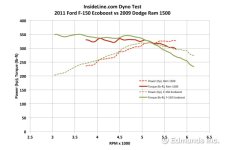
Convienent how they compare a non-current 2009 model to the all new 2011 Ford. Either way, that dyno shows both engines nearly equal yet one is a 7 year old simple design that's been used for decades (traditional N/A pushrod V8, simple 5 speed auto, standard locking torque converter, etc...). Secondly they say
torque curve breadth is a specialty of turbo gas engines.
which is true AFTER the turbo has made boost which is not typical below 3000 rpms.

So what does all that extra technology and greater chance of catastrophic failure gain you? A couple extra mpg's empty but less mpg's towing and similar overall performance...

And since you love asking questions to try and prove a point, here's one for you.
If the Ecoboost is such a diesel like low rpm powerhouse, then why does it go to almost 6k rpms before shifting at WOT?
Any racer and builder will tell you to shift at peak torque for best acceleration. My truck shifts at 5,500 at WOT with an old 5 speed yet Ford engineers have to rev the Ecoboost to 6k, or is that just the torque converter slipping?

The 8 speed auto will make all that tech an even harder sell.
 
   / Things that I don't need on my truck #174  
Yes, it's a bad thing!
It's another computer controlled mechanical object subject to wear and made to slip EVERY time you accelerate since it needs those high rpms to spin the turbos and make power. You may think it locks early and stays locked but it doesn't. There's a reason why they had to put this type of live torque converter in the Ecoboost and not in the other trucks with the 5.0l or 6.2l. Because the Ecoboost doesn't make the low end power Ford wants you to think it does. Small displacement engines need large volumes of compressed air and fuel to make power, turbos need high pressure exhaust to create large volumes of compressed air, engines need high rpms to create that high pressure spinning the turbos enough to make the proper boost. It's just not possible to make that low end power without those turbos creating a decent amount of boost.
From your link

It's more stuff to break that most don't need considering the minimal gains this whole package returns. Sure you get better fuel mileage empty, well if you buy a truck just to drive empty then the Ecoboost is a fine choice. If your towing/hauling on a regular basis like most truck buyers then that expensive drivetrain with more stuff to break gives little to no gains and less fuel mileage while towing.

Convienent how they compare a non-current 2009 model to the all new 2011 Ford. Either way, that dyno shows both engines nearly equal yet one is a 7 year old simple design that's been used for decades (traditional N/A pushrod V8, simple 5 speed auto, standard locking torque converter, etc...). Secondly they say which is true AFTER the turbo has made boost which is not typical below 3000 rpms.

So what does all that extra technology and greater chance of catastrophic failure gain you? A couple extra mpg's empty but less mpg's towing and similar overall performance...

And since you love asking questions to try and prove a point, here's one for you.
If the Ecoboost is such a diesel like low rpm powerhouse, then why does it go to almost 6k rpms before shifting at WOT?
Any racer and builder will tell you to shift at peak torque for best acceleration. My truck shifts at 5,500 at WOT with an old 5 speed yet Ford engineers have to rev the Ecoboost to 6k, or is that just the torque converter slipping?

The 8 speed auto will make all that tech an even harder sell.

I thought this was put to rest.
 
   / Things that I don't need on my truck #175  
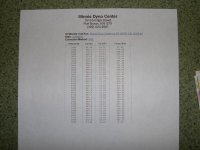
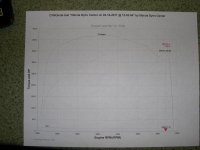
If we are going to through some dyno sheets around, here are some from my Challenger. 5.7 hemi, auto, not stock. It has exhaust, a CAI, and a tuner. This is probably about 10% higher than stock. Notice the torque curve, its pretty strong around 3500 to 4000 rpm, not a screaming 5200 rpms. One problem with these curves, my car is an auto and the pulls were all done in 4th gear (a 5 speed auto). You can't really do a pull and get the lower rpm's, the car will just down shift. So the lower RPM numbers don't mean anything as that was the point he was rolling into the throttle slowly to keep it from down shifting.

The hemi in the truck is different than in the cars, it has a better intake, and these numbers for a truck would probably be as good or better.
 

Attachments

  • dyno-sheet.jpg
    dyno-sheet.jpg
    47.5 KB · Views: 143
  • dyno-curve.jpg
    dyno-curve.jpg
    41.4 KB · Views: 147
   / Things that I don't need on my truck #176  
Sorry guys but I cannot allow someone to state false information without having to correct it. It is ok for someone to have an opinion but not to make false claims to which they have no experience.

It's another computer controlled mechanical object subject to wear and made to slip EVERY time you accelerate since it needs those high rpms to spin the turbos and make power. You may think it locks early and stays locked but it doesn't. There's a reason why they had to put this type of live torque converter in the Ecoboost and not in the other trucks with the 5.0l or 6.2l. Because the Ecoboost doesn't make the low end power Ford wants you to think it does.

It is a desirable design characteristic that is engineered to improve performance for the rare occasion of someone going from idle to WOT. I am willing to bet that this drivetrain spends more time with the torque converter locked than most, if not all, gas engine powertrains offered today. You think Ford made up the low end power claim? That is rediculous! What is your personal experience that has brought you to this conclusion? Real world experiences have backed up the claim. Again, have you towed with this engine yet?

It's more stuff to break that most don't need considering the minimal gains this whole package returns. Sure you get better fuel mileage empty, well if you buy a truck just to drive empty then the Ecoboost is a fine choice. If your towing/hauling on a regular basis like most truck buyers then that expensive drivetrain with more stuff to break gives little to no gains and less fuel mileage while towing.

Most HALF ton truck buyers are what I would call weekend warriors who tow maybe 10% of the miles they drive. During this 10%, the low end torque is a pleasure. During the 90%, the low end torque is still and pleasure and much better fuel efficiency and initial cost than the 6.2 liter it is a substitute for.


Convienent how they compare a non-current 2009 model to the all new 2011 Ford. Either way, that dyno shows both engines nearly equal yet one is a 7 year old simple design that's been used for decades (traditional N/A pushrod V8, simple 5 speed auto, standard locking torque converter, etc...). Secondly they say which is true AFTER the turbo has made boost which is not typical below 3000 rpms.

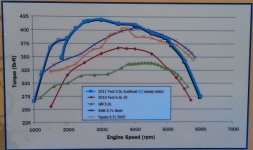
How is the 2009 model different from the 2011 Ram? They both require 89 octane fuel and have the same HP and Torque values. You were the one who wanted to compare your 2003 Ram to my 2011 ecoboost in some towing challenge. Remember the quote for the article "Ram's downshift-happy transmission means no data below ~3700 rpm, there's little chance it can touch the Ecoboost at revs below this point -- torque curve breadth is a specialty of turbo gas engines".
Below 3700 rpm is where all of the advantages of the ecoboost shine. I will repost the published torque curves again for you.
Do you really believe your 2003 will out perform the ecoboost? Your truck is stock is it not? If so, what form of brainwash have you subscribed to?

And since you love asking questions to try and prove a point, here's one for you.
If the Ecoboost is such a diesel like low rpm powerhouse, then why does it go to almost 6k rpms before shifting at WOT?
Any racer and builder will tell you to shift at peak torque for best acceleration. My truck shifts at 5,500 at WOT with an old 5 speed yet Ford engineers have to rev the Ecoboost to 6k, or is that just the torque converter slipping?

The 8 speed auto will make all that tech an even harder sell.

I will gladly answer any of your question with honesty. I don't have the code Ford has installed in their ECU available so I cannot answer this question with anything other than speculation. Peak torque is at 2500 rpm and it makes 90% between 1700-5000 rpms. I trust the code was written for some logical reason and for whatever the reason, I like it.

The 8-speed is, as I stated, another great improvement but only half of the powertrain. Why are you happy with stopping technology on the other half? Just because you have a great transmission shouldn't stop the continued improvement of the engine. I get it, with the exception of the 8-speed transmission, you like simple.

If you are to answer one question, please answer: Have you ever towed with an ecoboost truck? I have towed with a Hemi and it performed well and wouldn't steer anyone away from it. Currently I am very impressed with a turbo charged truck engine. What will be the next thing to impress me? I anxiously await.
 

Attachments

  • image-939230194.jpg
    image-939230194.jpg
    153.9 KB · Views: 119
   / Things that I don't need on my truck #177  
Interesting to compare that torque curve for the Hemi to the one I posted above. Remember mine are at the rear wheels. You can probably add 10 to 15% to the numbers I got to get to the back of the engine.

I suspect some of what Dmace is talking about is what Chrysler calls torque mangement. I suspect Ford uses that in the Eco-boost engines also. The engine could be making more horsepower at certain times, but for durability issues, it doesn't. The is most likely the case when the truck shifts, it pulls power back. I have a tuner on my Challenger and have turned this torque mangement off. It makes a big difference but I'm sure its harder on the drive train. It seemed like in the link to the dyno test the talked about the computer pulling power and not getting good dyno pulls.
 
   / Things that I don't need on my truck #178  
Yes, it's a bad thing!
It's another computer controlled mechanical object subject to wear and made to slip EVERY time you accelerate since it needs those high rpms to spin the turbos and make power. You may think it locks early and stays locked but it doesn't. There's a reason why they had to put this type of live torque converter in the Ecoboost and not in the other trucks with the 5.0l or 6.2l. Because the Ecoboost doesn't make the low end power Ford wants you to think it does. Small displacement engines need large volumes of compressed air and fuel to make power, turbos need high pressure exhaust to create large volumes of compressed air, engines need high rpms to create that high pressure spinning the turbos enough to make the proper boost. It's just not possible to make that low end power without those turbos creating a decent amount of boost.
From your link

It's more stuff to break that most don't need considering the minimal gains this whole package returns. Sure you get better fuel mileage empty, well if you buy a truck just to drive empty then the Ecoboost is a fine choice. If your towing/hauling on a regular basis like most truck buyers then that expensive drivetrain with more stuff to break gives little to no gains and less fuel mileage while towing.


Convienent how they compare a non-current 2009 model to the all new 2011 Ford. Either way, that dyno shows both engines nearly equal yet one is a 7 year old simple design that's been used for decades (traditional N/A pushrod V8, simple 5 speed auto, standard locking torque converter, etc...). Secondly they say which is true AFTER the turbo has made boost which is not typical below 3000 rpms.

So what does all that extra technology and greater chance of catastrophic failure gain you? A couple extra mpg's empty but less mpg's towing and similar overall performance...

And since you love asking questions to try and prove a point, here's one for you.
If the Ecoboost is such a diesel like low rpm powerhouse, then why does it go to almost 6k rpms before shifting at WOT?
Any racer and builder will tell you to shift at peak torque for best acceleration. My truck shifts at 5,500 at WOT with an old 5 speed yet Ford engineers have to rev the Ecoboost to 6k, or is that just the torque converter slipping?

The 8 speed auto will make all that tech an even harder sell.

Opinions do not = facts. You have a lot to learn but your ego will keep you from ever getting there.
 
   / Things that I don't need on my truck #179  
It is a desirable design characteristic that is engineered to improve performance for the rare occasion of someone going from idle to WOT. I am willing to bet that this drivetrain spends more time with the torque converter locked than most, if not all, gas engine powertrains offered today.
Desirable? :laughing: Your kidding right?
Who would "desire" to have some trick torque converter constantly trying to make up for the actual lack of power...?
You think Ford made up the low end power claim? That is rediculous! What is your personal experience that has brought you to this conclusion? Real world experiences have backed up the claim.
I firmly believe Ford is padding the actual power output of this engine at low RPMs and they know it's nearly impossible to prove. Real world claims show it equals the old technology V8's but lacks towing fuel mileage and simplicity. If it's not light years ahead of old technology then what's the point?
Remember the quote for the article "Ram's downshift-happy transmission means no data below ~3700 rpm, there's little chance it can touch the Ecoboost at revs below this point -- torque curve breadth is a specialty of turbo gas engines".
Below 3700 rpm is where all of the advantages of the ecoboost shine. I will repost the published torque curves again for you.
Post that dyno sheet all you want, all it proves is the Ecoboost can match V8 power OVER 3,000 RPMs. It DOES NOT PROVE ANYTHING UNDER 3,000! Again, I have yet to see any real proof of low end power from this engine because I know it's not there. Small displacement turbocharged engines just don't do it. They can not possibly make that power without boost which does not come on that early.
Funny how you found a different dyno that shows stock ENGINE numbers and not Rear Wheel HP. Try using the real one you posted earlier which shows nothing under 3k rpms for either and shows them nearly equal.
309132d1363745687-things-i-dont-need-my-image-3154440836.jpg
I trust the code was written for some logical reason and for whatever the reason, I like it.
Yes it was and that reason is NO LOW END GRUNT. If it shifted sooner, the turbos would have to wait for the torque converter to slip and RPMs to climb so the turbos spool again and that lag would cause too much a drop in power.
The 8-speed is, as I stated, another great improvement but only half of the powertrain. Why are you happy with stopping technology on the other half? Just because you have a great transmission shouldn't stop the continued improvement of the engine. I get it, with the exception of the 8-speed transmission, you like simple.
I certainly don't want to stop technology but I question any technology that doesn't make sense. Why go through all this trouble designing this complex system just to get similar results to others? Even compared to their own 5.0l...
If you are to answer one question, please answer: Have you ever towed with an ecoboost truck? I have towed with a Hemi and it performed well and wouldn't steer anyone away from it. Currently I am very impressed with a turbo charged truck engine. What will be the next thing to impress me? I anxiously await.
No I have not towed with one only driven but driven plenty and have seen plenty of test that show it performs very similar to the other offerings. I don't doubt it tows as well as the other V8's but at the cost of so much more that can fail for such little gain. So why take a chance with all this new unproven tech for minimal gains?

Last questions and I highly doubt your answer truthfully as that answer would be against all your trying to sell here.

If the Ecoboost makes so much low end power and torque so early and so flat, Why did they need this active torque converter? Why not put the same basic simple torque converter from the 5.0l and 6.2l? They don't need slipping drivetrains to put the power to the ground...
If this engine replaces the 6.2l, Why is it not in the Super Duty pickups? Is it because that trick rear end can't handle 12k+ loads or constant tow duty?


sld said:
Opinions do not = facts. You have a lot to learn but your ego will keep you from ever getting there.
Feel free to post some facts then, so far the only facts I see prove nothing spectacular here yet the "opinions" of these internet articles seem to be written in gold to the Ford camp...
Fact - Turbo equals great flat mid-range power but lag on low end and lean on top end.
Fact - Supercharger equals great low end and mid-range power but lacking top end.
Fact - There is NO replacement for displacement. You cannot simply replace a large explosion with one half the size but slightly more concentrated.

Opinion - Direct injection will take over Port injection in ALL engines within 15 years or until the take-over of electric engines. Trucks will utilize large displacement direct injection engines over small displacement turbo engines due to simplicity and longevity.
Experience - I built a well-tuned 4 cylinder 2.0l 4G63 Eagle Talon engine over and over again trying every combination of fuel management, turbo sizing, exhaust, ignition, cams, timing, etc... to better my 330ft and 660ft times (true show of power and traction) and nothing worked. UNTIL I built a 2.4l with the exact same setup and gained a TON of low end power that the smaller displacement just couldn't make.
 
   / Things that I don't need on my truck #180  
Feel free to post some facts then, so far the only facts I see prove nothing spectacular here yet the "opinions" of these internet articles seem to be written in gold to the Ford camp...
Fact - Turbo equals great flat mid-range power but lag on low end and lean on top end.

There will be some lag with a proper size turbo on the bottom end. It will make good power to the top end. With proper tuning it will not go lean.

Fact - Supercharger equals great low end and mid-range power but lacking top end.

Centrifugal style super chargers make good power on the top end and don't have much bottom end.

Fact - There is NO replacement for displacement. You cannot simply replace a large explosion with one half the size but slightly more concentrated.

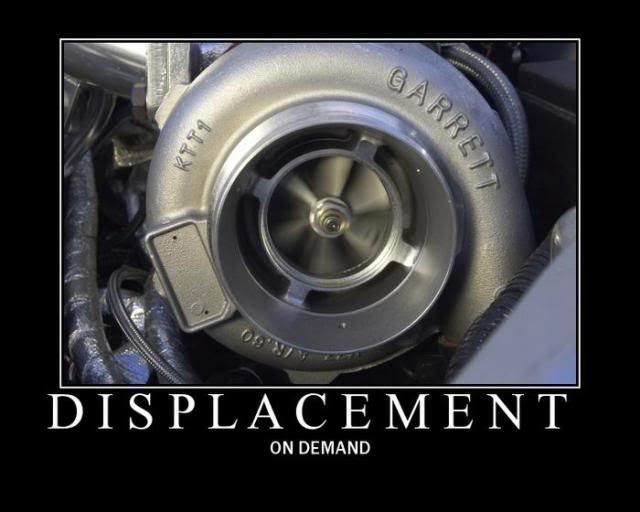
Turbo, nitrous, and supercharger are the displacement replacement The Ecoboost proves that.

motivator3becb7e91b4d8dec8673f0366cd1dded_zpsc4e386f8.jpg


n4eer8_zpsda7a0c5d.jpg
 
Status
Not open for further replies.

Tractor & Equipment Auctions

WHISPERWATT 220 DIESEL POWERED GENERATOR (A58214)
WHISPERWATT 220...
Booster Cables (A59230)
Booster Cables...
MINI KID DIRT BIKE (A56859)
MINI KID DIRT BIKE...
UNUSED FUTURE PC71-71" HYD PLATE COMPACTOR (A60432)
UNUSED FUTURE...
Tafe 45DI (A53317)
Tafe 45DI (A53317)
HUSQVARNA RIDING MOWER 46IN DECK (A56859)
HUSQVARNA RIDING...
 
Top