You are using an out of date browser. It may not display this or other websites correctly.
You should upgrade or use an alternative browser.
You should upgrade or use an alternative browser.
Grapple Which type of grapple is best suited for...
- Thread starter TSO
- Start date
- Views: 159044
More options
Who Replied?
/ Which type of grapple is best suited for...
#21




ovrszd
Epic Contributor
- Joined
- May 27, 2006
- Messages
- 33,727
- Location
- Missouri
- Tractor
- Kubota M9540, Ford 3910FWD, Ford 555A, JD2210
I definitely recommend dual claws with separate cylinders. Allows you to grip anything.
I prefer a solid bottom bucket so I can carry loose material on a project without having to go switch attachments.
I built mine on a LowPro Bobcat tooth bucket. Seems to be the best of both Worlds for me.
Good luck with your choice.
I prefer a solid bottom bucket so I can carry loose material on a project without having to go switch attachments.
I built mine on a LowPro Bobcat tooth bucket. Seems to be the best of both Worlds for me.
Good luck with your choice.

EverythingAttachments
Elite Member
Awesome pictures Roger!! Nice stump.:thumbsup:
Awesome pictures Roger!! Nice stump.:thumbsup:
Thanks, I thought the stump was a good way to try it out.

PRF
Gold Member
- Joined
- Dec 21, 2012
- Messages
- 260
- Location
- Connecticut
- Tractor
- 2012 Kubota L5740, 1970 IH 2444, John Deere x485
EverythingAttachments
Elite Member
Yes, but at 800 pounds for a 63" and 900 pounds for a 74", they're pretty much useless on a compact tractor. Maybe not useless, but very hard to deal with!
Travis
Travis

sd455dan
Super Member
- Joined
- Oct 23, 2012
- Messages
- 6,343
- Location
- North Idaho
- Tractor
- Rhino 554, Ford 550 TLB (JD X500, MTD, Gilson riding mowers) Ford 3000-Sold
Yes, but at 800 pounds for a 63" and 900 pounds for a 74", they're pretty much useless on a compact tractor. Maybe not useless, but very hard to deal with!
Travis
Agree there, on the c and scut's that weight/ strength balance is probably one of the first things to consider.. that may be the largest draw back to the type I have in the sense the rest of the design has to be stronger and to some extent heavier and what good is a setup that weighs so much the actual (payload is reduced to the point of being virtually useless)
PRF
Gold Member
- Joined
- Dec 21, 2012
- Messages
- 260
- Location
- Connecticut
- Tractor
- 2012 Kubota L5740, 1970 IH 2444, John Deere x485
Maybe not so good for payload, but looks pretty rugged for digging roots out, no ?

Gordon Gould
Super Member
- Joined
- Apr 1, 2007
- Messages
- 6,724
- Location
- NorthEastern, VT
- Tractor
- Kubota L3010DT, Kubota M5640SUD, Dresser TD7G Dozer
Those big grapples are great if you have the tractor to handle them. It takes a lot of grunt to really use a rock or root rake to clear land. I have a 15000 lb dozer with a root rake and it is really to small for that job. If you just need to do light tractor work or pick stuff up and move it there are lots of options
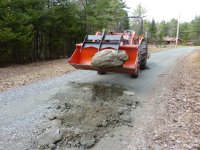
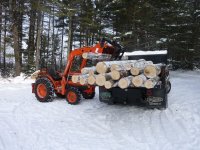
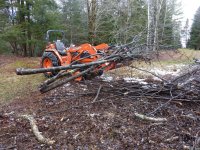
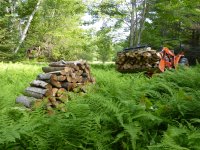
I have a 30 hp tractor with a pin on bucket so I bought a light weight bolt on grapple so I wouldn't loose to much lift. It is quite capable but not scary looking. Also, both the bucket and the grapple are always right there when I need one or both. Have had it about 8 years. I would not discount a simple solution like this. It has served me very well.
I have a 30 hp tractor with a pin on bucket so I bought a light weight bolt on grapple so I wouldn't loose to much lift. It is quite capable but not scary looking. Also, both the bucket and the grapple are always right there when I need one or both. Have had it about 8 years. I would not discount a simple solution like this. It has served me very well.
Attachments



TomSeller
Super Member
They look nice, maybe they will Swiss Cheese it and bring the weight down a little.
sd455dan
Super Member
- Joined
- Oct 23, 2012
- Messages
- 6,343
- Location
- North Idaho
- Tractor
- Rhino 554, Ford 550 TLB (JD X500, MTD, Gilson riding mowers) Ford 3000-Sold
Maybe not so good for payload, but looks pretty rugged for digging roots out, no ?
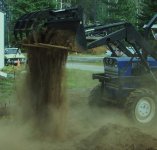
Actually got it for barn stalls and manure, great for that,
And even tho not really designed for it I have removed quite a few stumps, but it it is a good size 66" for the 55hp 4x4 tractor and the loader is rated to 2000lbs. to full height but I wouldn't think this one would be good for a light tractor that say has a 800-1200 lb loader. Wish it had the dual independent top grapple but right now it's not in the budget..
One other thing it has been really handy for is separating out old rotted wood. that for some reason is all over this property , even a couple feet down and years ago the area was logged but the loggers left all the slash piles un-burned, and piled up with more dirt than wood, it works well to sift out the wood... I would recommend a mask
 View attachment 312 As Gordon G said a dozer can even get over worked doing some of this stuff (Family group shares a JD550 dozer with ripper) but it's to heavy to move very often, so- I take my time with what I got, like a lot of the people here...
Attachments
BeltfedGoodness
Member
I love reading these post with action pics and testimony. This site is invaluable to new guys when looking to buy. Once I found this site I could NOT go without checking it DAILY!!
FINALLY, I have some input on this topic as we pulled the trigger on a new tractor and grapple set up. Trying to decide on one with so many models, weights, clamp types, and bucket forms was tough. We went with a model the dealer had on the lot as he provided the hook ups for us on our tractor when we bought.....so the work was pretty much done for us. The model was a 6 foot model called an ETG Worksaver. Worksaver ETG Series Sjid Steer Tine Grapple
Since we bought I have had about 20 hours of work time with it. It worked great for combing out black berry bushes and the roots from our fields. Just drop and front leading edge to the pipe cross bar and drive. The pipe gives the edge a depth gauge as to not dig too deep in the ground as it rips out the roots. At the end of the run just bump the clamp lever ( on my auxiliary remote controls) and clamp the big snarl of blackberry bushes and roots.
I also played with knocking over cedar trees with the grapple. With the clamp arm opened and the toothed edge leading, i can push about 4 feet up on a 4-7 inch cedar tree and lay it down with out snapping it. (Helps to have a good soaking rain or wet spring ground to do this) The roots just pop out when the tree lays down. Then the grapple comes in from the bottom and grips the rest of the root systems lifts the whole tree up and out. When you clamp on the root ball/tree base, you can stack the entire tree nicely for burning later. I have cleared a few acres this way already for new pasture lands. What I noticed was nice about the single over arm clamp is that you can grab heavy objects and have the load balanced straight out the front of the loader and not have offset weight on the loader frame as a dual clamp grapple may get you. The clamp edge as teeth, which helps grab root ball/tree bottoms. Other grapples have more of a fang type top clamp look to them and can not grab the tree roots/bases when you tip them over.
It was not the best for trying to uproot smaller cedars and trees. it would do more damage to the ground trying to comb out the smaller tree roots and/or snap the sapling off while trying to push it over...... but i have that problem solved already. Last night my tree puller arrived and i already have about 3-4 hrs of use on it!
Back on track now....
Another nice feature of this grapple was the ability to pick up small sticks/branches with the grapple tips. The bucket on my tractor angles down and i can clamp on one small item with precision as the grapple tips to not over lap or pass each other.... they clamp tip to tip.
Complaints that I may have are that the gaps between the bottom rails are too far apart and cannot hold smaller rocks....BUT, so far i can live with that.
I have used it with aggression with our 60 HP tractor and haven't seen any weak points at all. I felt i would break something on the tractor before the grapple!!
FINALLY, I have some input on this topic as we pulled the trigger on a new tractor and grapple set up. Trying to decide on one with so many models, weights, clamp types, and bucket forms was tough. We went with a model the dealer had on the lot as he provided the hook ups for us on our tractor when we bought.....so the work was pretty much done for us. The model was a 6 foot model called an ETG Worksaver. Worksaver ETG Series Sjid Steer Tine Grapple
Since we bought I have had about 20 hours of work time with it. It worked great for combing out black berry bushes and the roots from our fields. Just drop and front leading edge to the pipe cross bar and drive. The pipe gives the edge a depth gauge as to not dig too deep in the ground as it rips out the roots. At the end of the run just bump the clamp lever ( on my auxiliary remote controls) and clamp the big snarl of blackberry bushes and roots.
I also played with knocking over cedar trees with the grapple. With the clamp arm opened and the toothed edge leading, i can push about 4 feet up on a 4-7 inch cedar tree and lay it down with out snapping it. (Helps to have a good soaking rain or wet spring ground to do this) The roots just pop out when the tree lays down. Then the grapple comes in from the bottom and grips the rest of the root systems lifts the whole tree up and out. When you clamp on the root ball/tree base, you can stack the entire tree nicely for burning later. I have cleared a few acres this way already for new pasture lands. What I noticed was nice about the single over arm clamp is that you can grab heavy objects and have the load balanced straight out the front of the loader and not have offset weight on the loader frame as a dual clamp grapple may get you. The clamp edge as teeth, which helps grab root ball/tree bottoms. Other grapples have more of a fang type top clamp look to them and can not grab the tree roots/bases when you tip them over.
It was not the best for trying to uproot smaller cedars and trees. it would do more damage to the ground trying to comb out the smaller tree roots and/or snap the sapling off while trying to push it over...... but i have that problem solved already. Last night my tree puller arrived and i already have about 3-4 hrs of use on it!
Back on track now....
Another nice feature of this grapple was the ability to pick up small sticks/branches with the grapple tips. The bucket on my tractor angles down and i can clamp on one small item with precision as the grapple tips to not over lap or pass each other.... they clamp tip to tip.
Complaints that I may have are that the gaps between the bottom rails are too far apart and cannot hold smaller rocks....BUT, so far i can live with that.
I have used it with aggression with our 60 HP tractor and haven't seen any weak points at all. I felt i would break something on the tractor before the grapple!!
OP

TSO
Elite Member
I love reading these post with action pics and testimony. This site is invaluable to new guys when looking to buy. Once I found this site I could NOT go without checking it DAILY!!
FINALLY, I have some input on this topic as we pulled the trigger on a new tractor and grapple set up. Trying to decide on one with so many models, weights, clamp types, and bucket forms was tough. We went with a model the dealer had on the lot as he provided the hook ups for us on our tractor when we bought.....so the work was pretty much done for us. The model was a 6 foot model called an ETG Worksaver. Worksaver ETG Series Sjid Steer Tine Grapple
Since we bought I have had about 20 hours of work time with it. It worked great for combing out black berry bushes and the roots from our fields. Just drop and front leading edge to the pipe cross bar and drive. The pipe gives the edge a depth gauge as to not dig too deep in the ground as it rips out the roots. At the end of the run just bump the clamp lever ( on my auxiliary remote controls) and clamp the big snarl of blackberry bushes and roots.
I also played with knocking over cedar trees with the grapple. With the clamp arm opened and the toothed edge leading, i can push about 4 feet up on a 4-7 inch cedar tree and lay it down with out snapping it. (Helps to have a good soaking rain or wet spring ground to do this) The roots just pop out when the tree lays down. Then the grapple comes in from the bottom and grips the rest of the root systems lifts the whole tree up and out. When you clamp on the root ball/tree base, you can stack the entire tree nicely for burning later. I have cleared a few acres this way already for new pasture lands. What I noticed was nice about the single over arm clamp is that you can grab heavy objects and have the load balanced straight out the front of the loader and not have offset weight on the loader frame as a dual clamp grapple may get you. The clamp edge as teeth, which helps grab root ball/tree bottoms. Other grapples have more of a fang type top clamp look to them and can not grab the tree roots/bases when you tip them over.
It was not the best for trying to uproot smaller cedars and trees. it would do more damage to the ground trying to comb out the smaller tree roots and/or snap the sapling off while trying to push it over...... but i have that problem solved already. Last night my tree puller arrived and i already have about 3-4 hrs of use on it!
Back on track now....
Another nice feature of this grapple was the ability to pick up small sticks/branches with the grapple tips. The bucket on my tractor angles down and i can clamp on one small item with precision as the grapple tips to not over lap or pass each other.... they clamp tip to tip.
Complaints that I may have are that the gaps between the bottom rails are too far apart and cannot hold smaller rocks....BUT, so far i can live with that.
I have used it with aggression with our 60 HP tractor and haven't seen any weak points at all. I felt i would break something on the tractor before the grapple!!
Great review, thanks for taking the time. I actually tried to clear some logs and brush today with my QA forks... The logs were not so bad since they can be moved easily as long as you have them balanced properly. The brush piles were another story though, since you have to be very precise with getting everything balanced and centered, and even then stuff falls off half of the time when u hit a bump.
I also tried to experiment with digging out some roots and rocks with the forks today... And quickly learned that any down pressure on the forks likes to pop them out of the frame. When it happened the first time I thought it was a fluke, but after the second time and some cussing I decided to give it a rest.
Boy was I wishing I had a grapple bucket today !
TomSeller
Super Member
quickly learned that any down pressure on the forks likes to pop them out of the frame. When it happened the first time I thought it was a fluke, but after the second time and some cussing I decided to give it a rest.
!
This is not normal.

crazyangel
Gold Member
This is not normal.
It really depends on the fork design. There are some models that will fold up like described when exposed to down pressure. I learned this when shopping for mine, and made a point to avoid them for exactly that reason.
OP
TSO
Elite Member
It really depends on the fork design. There are some models that will fold up like described when exposed to down pressure. I learned this when shopping for mine, and made a point to avoid them for exactly that reason.
I bought this set at an auction, only paid just above $300 so I can't really complain. It's not intended to "dig" anyhow, so I'm not crying about it. As soon as one of my other "toys" sells in the next couple weeks, I'm hoping to get the grapple, and I'll probably get a stump-bucket too - that will take care of the "digging" work that I was trying to do with the forks anyhow.
crazyangel
Gold Member
I bought this set at an auction, only paid just above $300 so I can't really complain. It's not intended to "dig" anyhow, so I'm not crying about it. As soon as one of my other "toys" sells in the next couple weeks, I'm hoping to get the grapple, and I'll probably get a stump-bucket too - that will take care of the "digging" work that I was trying to do with the forks anyhow.
You got a great deal! I'd have done the same for sure. Happy toy shopping....
TomSeller
Super Member
It really depends on the fork design. There are some models that will fold up like described when exposed to down pressure. I learned this when shopping for mine, and made a point to avoid them for exactly that reason.
Sorry, I thought he meant the forks would pop out of the quick attach. Yes, some forks do allow the forks themselves to raise up out of the frame.
Last edited:

IslandTractor
Super Star Member
- Joined
- Sep 15, 2005
- Messages
- 16,647
- Location
- Prudence Island, RI
- Tractor
- 2007 Kioti DK40se HST, Woods BH
You'll get MANY opinions on rake style single lid design vs. L style dual lids but we sell MANY more dual lid grapples than single and that was the case even before our Wicked Grapple arrived on the scene. IMO the dual lid design is more versatile because you'll get a tighter grip on loads that are not uniform and the L shaped design will allow you to cradle logs/debris. Our tines are designed to penetrate the ground easily and minimize turf damage.(see pic below)
The squeezing power will be the same either way. The flow goes to the cylinder with the least resistance until it is closed tightly and is then it is transferred to the other one until the same is accomplished.
Travis
View attachment 312533
Ted, you obviously are in the business and are well aware of the different types of grapples. However, I am not sure you are right about the notion that two upper jaws are better than one for managing an asymmetric or odd shaped object. While it certainly seems logical to think that "more is better" when it comes to upper jaws, I would remind you that our human hand has only one thumb and that more thumbs ("all thumbs") is not always better. For an oddly shaped object, say a stump, the question is not whether one or two arms does better but rather what part of the stump you try to pick up. If you pick up the stump so the rootball is to one side, then you are picking up an imbalanced load which can be quite dangerous to transport. If instead you move 90 degrees and just pick up the rootball itself with the stump pointed away from the tractor, then 1) the load is balanced and 2)a single upper arm is probably better as it clamps directly in the middle of the rootball rather than tangentially clamping both sides with two arms.
On a more practical level, I have used a single arm light duty grapple for over seven years now and I cannot think of a time when I could not grapple a load that I might have been able to grapple with two upper arms. I can understand why the big skidsteer grapples (72") need two upper arms especially as they are used frequently for clean up of construction debris but for general duty around the farm or for clearing land, I really don't see the benefit of two upper arms (or wide grapples). The only example I can recall on TBN of a situation where two upper arms would be a benefit was in moving small cut/split firewood. The downsides of two arms however are easy to see 1) more weight and 2) more expense.
Ted, you obviously are in the business and are well aware of the different types of grapples. However, I am not sure you are right about the notion that two upper jaws are better than one for managing an asymmetric or odd shaped object. While it certainly seems logical to think that "more is better" when it comes to upper jaws, I would remind you that our human hand has only one thumb and that more thumbs ("all thumbs") is not always better. For an oddly shaped object, say a stump, the question is not whether one or two arms does better but rather what part of the stump you try to pick up. If you pick up the stump so the rootball is to one side, then you are picking up an imbalanced load which can be quite dangerous to transport. If instead you move 90 degrees and just pick up the rootball itself with the stump pointed away from the tractor, then 1) the load is balanced and 2)a single upper arm is probably better as it clamps directly in the middle of the rootball rather than tangentially clamping both sides with two arms.
On a more practical level, I have used a single arm light duty grapple for over seven years now and I cannot think of a time when I could not grapple a load that I might have been able to grapple with two upper arms. I can understand why the big skidsteer grapples (72") need two upper arms especially as they are used frequently for clean up of construction debris but for general duty around the farm or for clearing land, I really don't see the benefit of two upper arms (or wide grapples). The only example I can recall on TBN of a situation where two upper arms would be a benefit was in moving small cut/split firewood. The downsides of two arms however are easy to see 1) more weight and 2) more expense.
I prefer a grapple with 2 lids/ jaws. Here is a picture of stump I got out and if I had one lid I would not have been able to get it out unless the load was off center.

I can also handle a really big load of brush.


