Calculating Your Predicted Rollover Angle

   / Calculating Your Predicted Rollover Angle #41  
Lots of interesting discussion on an important topic. The static physics surely do need to be understood. And the dynamic aspects (terrain, speed, moving weights) must be properly respected. I scared the xxxx out of myself a few times, having to lower everything to the ground to get an uphill tire down, and then crabbing out inch by inch. What I found out is my need to be out on chancy slopes is a whole lot less than it used to be. That really reduces rollover risk.
 
   / Calculating Your Predicted Rollover Angle
  • Thread Starter
#42  
Pat,

A week after I had the spacers installed my father-in-law came over. It was before my physics buddy did the math in my OP. He's been driving tractors since he was a kid. I told him how cautious and fearful I was on the hills (see below) and that even with the spacers my spidey sense was recoiling bush hogging straight across a 15-18 degree relatively flat side slope. I wanted to pick up some rocks where a tracked loader had cleared small trees and big bushes down the hill and needed someone to drive the tractor (since getting off and on the tractor on slopes seems like a really bad idea!) while I walked to each rock and tossed it into the bucket.

We got over to the steep part where I would never (and never will - it is just not necessary!)) attempt a U turn after going uphill to downhill. I motioned for him to back down and instead he just drove sideways across that slope. Later he said he didn't feel alarmed. How steep was it? It had to be 25-30 degrees. And the guy who owned the property before me said he drove his old narrow front axle, two wheel drive, tractor in circles, across the slopes, while bush hogging.

Not me! The spacers are just insurance!

So far the scariest times I've had are almost getting the tractor stuck in mud at the bottom of the hill on Day One of my ownership. I had that sinking feeling when you try and go and one side begins mushing down and you're tilting. And visions of my lifelong rural-living neighbors laughing their *****'es off after pulling me and my new Kioti back up the hill. Probably a couple of decades worth of, "Remember when ol' Rhino got his new tractor stuck the first day he had it? You just can't stomp the city-slicker out of some people!" And then another time I got the front end down into a little creek ravine and thought I wouldn't get it backed out. Both times that little heel pedal that locks the rear wheels into some kind of "can't turn one rear wheel while the other doesn't turn" mode saved me.

I also had a moment going across a side hill, before the spacers were on, where the dirt was a little loose and the tractor started sliding a little down the hill. That was probably on a 15 degree sideslope. I realized that day that rollovers can happen when the tractor slides sideways and the slope steepens. Not to mention even if you don't roll it over you can slide sideways into trees and thick bushes - not good for man or machine.

Thanks for posting.

Rhino

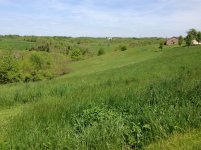
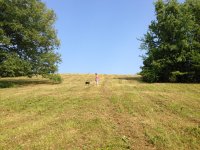
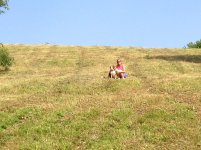
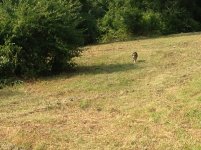
Some shots of the slopes I bush hog.

IMG_0134.jpgIMG_0295.jpgIMG_0296.jpgIMG_0297.jpgIMG_0298.jpg
 
   / Calculating Your Predicted Rollover Angle #43  
I also had a moment going across a side hill, before the spacers were on, where the dirt was a little loose and the tractor started sliding a little down the hill. That was probably on a 15 degree sideslope. I realized that day that rollovers can happen when the tractor slides sideways and the slope steepens. Not to mention even if you don't roll it over you can slide sideways into trees and thick bushes - not good for man or machine.

You can also roll in this situation when sliding sideways and the tire on the lower side either piles enough loose soil up it "hangs" or if the tire slides against an immovable object. The momentum of the slide can carry you right over onto your side...
 
   / Calculating Your Predicted Rollover Angle
  • Thread Starter
#44  
Sysop,

Yehaaa! I am picturing Slim Pickens in Dr. Stangelove riding the nuclear bomb out of the bomb bay on his B-52.

I agree that encountering a sudden stoppage while sliding is a hazard worth keeping in mind.

I got the industrial tires because I have to drive on lawn to get to a few places. They definitely can slide.

Best,

Rhino
 
   / Calculating Your Predicted Rollover Angle #45  
Hi,

My take on it is that at the end of the day, calculations are calculations but do not necessarily represent reality, as others have mentioned previously.

The dynamics of one's particular experience is a variable that static calculations cannot take into account.

Static calculations are valuable inasmuch as they show us how to make things better with our tractors. IE, how to increase resistance to a roll over, by setting tires wider, adding ballast and so on.

I think the best we can do is everything that improves our tractor's stability, and maximizes the tractors potential to stay stable when a roll over situation is experienced.

It is important that we do not use calculations of theoretical tip over points to make ourselves more comfortable on slopes. We MUST understand that the dynamics override static theory when operating our tractors.

Calculations are fun, BUT, after you turn your tractor on its side, you come to realize that such things do happen, when in theory they should not.

I would never have expected that sliding a short two foot drop off that I had built up while using my box blade(on nearly level ground) would have resulted in a roll over. Bit it did. Even with foam filled front tires and 75% liquid filled rear tires.

So my advice would be to calculate away, to gain understanding of what will help make the tractor more stable, but NEVER forget that the dynamics of the real world override the calculations of the static theoretical world. I said static...if you can build in dynamics into your model, so much the better. But can you predict what you might encounter on a slope in the worst case? If you can, you may realizes that all the improvements you made will not prevent the worst from happening, if that unpredictable situation comes upon you...
 
   / Calculating Your Predicted Rollover Angle #46  
Good discussions, not really enough math done to effectively calculate the real world, complex enough with static hill and tractor...

Take away from this thread, be careful on slopes, don't get into a slope more than you are comfortable with and watch out for obstacles (like holes or dips or mounds) that can change things in a hurry...

I'll share a story about my Dad. He grew up in the Palouse region of eastern Washington and was a young man when they were making the transition from teams of horses to tractors for farming. The Palouse is rolling hills and they farmed steep hills using horses. Wheeled tractors had troubles on those hills, but crawlers did better. He actually was a "Cat Skinner" and could drive a tractor with tracks on very steep hills by slipping it sideways. If you just went straight across the hill, you would slide down.
 
   / Calculating Your Predicted Rollover Angle #47  
Reminds me of that popular comic razor commercial from about 5 years ago with the father showing his son how to shave.
"Up and down like this. Never side to side like this..."
 
   / Calculating Your Predicted Rollover Angle #48  
Is there any manufacturer that makes a narrow front end tractor today? Why not?
 
   / Calculating Your Predicted Rollover Angle #49  
Is there any manufacturer that makes a narrow front end tractor today? Why not?

I believe Kubota makes a special tractor for vineyard and orchard use. Never seen one but recall seeing a brochure or website.
 
   / Calculating Your Predicted Rollover Angle #50  
The vineyard tractors are narrow front and back to fit between the rows of vines but there is no point in not having the fronts run in the same track as the rear wheels.
 
   / Calculating Your Predicted Rollover Angle #51  
The vineyard tractors are narrow front and back to fit between the rows of vines but there is no point in not having the fronts run in the same track as the rear wheels.

Are you interested in a tricycle type tractor? I don't think those are made by anyone these days?
 
   / Calculating Your Predicted Rollover Angle #52  
No just making the point that they stopped making them that way for a good reason, and that it is their increased liability from unnecessary rollovers is that reason.
 
   / Calculating Your Predicted Rollover Angle
  • Thread Starter
#53  
All,

I just want to thank everyone for joining in the discussion. I appreciate everyone's thoughts and ideas, and especially the cautions about dynamic variables.

Best,

Rhino
 
   / Calculating Your Predicted Rollover Angle #54  
Has anybody made calculations for a Massey Ferguson 1635 with FEL but without a cab?

Last fall I was pulling a 2 bottom plow on a sidehill and got nervous with one wheel in the furrow and the other on the hill side. I realize a plow 5 to 6 inches in the soil would lower the CG but how do you factor that into the computations?
 
   / Calculating Your Predicted Rollover Angle #56  
I suppose that is a verifiable fact?

Well my first hit from goggle popped up this from wiki.
Agriculture in the United States is one of the most hazardous industries, only surpassed by mining and construction. No other farm machine is so identified with the hazards of production agriculture as the tractor.[25] Tractor-related injuries account for approximately 32% of the fatalities and 6% of the nonfatal injuries in agriculture. Over 50% is attributed to tractor overturns.[26]

The roll-over protection structure (ROPS) and seat belt, when worn, are the most important safety devices to protect operators from death during tractor overturns.[27]

Modern tractors have a ROPS to prevent an operator from being crushed if the tractor turns over. The ROPS does not prevent tractor overturns; rather, it prevents the operator from being crushed during an overturn. This is especially important in open-air tractors, where the ROPS is a steel beam that extends above the operator's seat. For tractors with operator cabs, the ROPS is part of the frame of the cab. A ROPS with enclosed cab further reduces the likelihood of serious injury because the operator is protected by the sides and windows of the cab.

These structures were first required by legislation in Sweden in 1959. Before they were required, some farmers died when their tractors rolled on top of them. Row-crop tractors, before ROPS, were particularly dangerous because of their 'tricycle' design with the two front wheels spaced close together and angled inward toward the ground. Some farmers were killed by rollovers while operating tractors along steep slopes. Others have been killed while attempting to tow or pull an excessive load from above axle height, or when cold weather caused the tires to freeze to the ground, in both cases causing the tractor to pivot around the rear axle.

For the ROPS to work as designed, the operator must stay within its protective frame. This means the operator must wear the seat belt; not wearing it may defeat the primary purpose of the ROPS.
As this change was made before the internet much of the history is still in libraries on paper. For a nominal fee I'll research it for you if you need hard proof.
 
   / Calculating Your Predicted Rollover Angle #57  
Well my first hit from goggle popped up this from wiki.

As this change was made before the internet much of the history is still in libraries on paper. For a nominal fee I'll research it for you if you need hard proof.

Nothing there says product liability to me. Market share & customer preference drove the demise of the narrow front. If it was anything else, production numbers would have abruptly ceased rather than declined to a point where manufacturers lost interest in the late 1970's.
 
   / Calculating Your Predicted Rollover Angle #58  
Nothing there says product liability to me. Market share & customer preference drove the demise of the narrow front. If it was anything else, production numbers would have abruptly ceased rather than declined to a point where manufacturers lost interest in the late 1970's.
Now you’re just being contrary to stir up an argument. You don't think that any tractor manufacturer ever sent out a press release saying "Stop using all those narrow front end tractors we sold you. They are unsafe!!”? It would give too many widows and their lawyers a heads up.
Farmers are a stubborn bunch and when JD introduced ROPS systems in the sixties they didn't sell well and JD released their patents on it to let other competitors offer them, but it took a long time to catch on. You can still find people debating the need and risking their lives.
Keep the wheels pointed down and have a happy new year.
 
   / Calculating Your Predicted Rollover Angle #59  
Are you interested in a tricycle type tractor? I don't think those are made by anyone these days?

Tricycle type tractors were popular with farmers because of front mounted equipment, especially corn pickers and cultivators, were mounted that way. I miss the front mounted cultivator. It was easier to watch your work, more controllable, and as a result you were less likely to plow out your crop. Oh well, that's progress.

Tricycles are almost impossible to operate in muddy conditions and are less stable at higher speeds. I wouldn't drive one today except with a cultivator or other front mounted equipment.
 
   / Calculating Your Predicted Rollover Angle #60  
Tricycle type tractors were popular with farmers because of front mounted equipment, especially corn pickers and cultivators, were mounted that way. I miss the front mounted cultivator. It was easier to watch your work, more controllable, and as a result you were less likely to plow out your crop. Oh well, that's progress.

Tricycles are almost impossible to operate in muddy conditions and are less stable at higher speeds. I wouldn't drive one today except with a cultivator or other front mounted equipment.

Even with 3pt mounted cultivators you could cultivate later into the season. Without the (low) wide-front axles, you can cultivate corn that is much taller. You're right that the mounted were easier to keep on track though, and also didn't take out crop on curved rows...
 

Tractor & Equipment Auctions

INGERSOLL RAND  G25 GENERATOR (A58216)
INGERSOLL RAND...
2022 Vermeer 573 (A55973)
2022 Vermeer 573...
Dump Truck Body with Tarp System (A55851)
Dump Truck Body...
CAT 336E (A58214)
CAT 336E (A58214)
2009 Ford F-550 4x4 Ext. Cab Brush Fire Truck (A59230)
2009 Ford F-550...
2018 ROSCO LEEBOY CHALLENGER 7 SWEEPER (A60429)
2018 ROSCO LEEBOY...
 
Top