Does widening front end stress axle/bearings more?

   / Does widening front end stress axle/bearings more? #21  
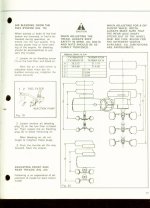
Attached is a diagram from a manufacturer's operating manual showing the front wheels in their respective "dished-in" and "dished-out" positions. I'm not for sure what it does for bearing wear (I can understand the OP's argument though that the magnitude of the torque shouldn't be more just whether it is positive or negative) but I know the tractor steering wheel is much more difficult to turn when the front wheels are at their wider position.
 

Attachments

  • Bolens iseki safety and operations manual tx1300 tx1500.jpg
    Bolens iseki safety and operations manual tx1300 tx1500.jpg
    120.6 KB · Views: 309
   / Does widening front end stress axle/bearings more? #22  
Yes, but when you reverse (or swap) the tires to make a wider stance the distance between the center lines hasn't changed, it just the center line of the tire has moved from one side of the bearing's center line to the other. The offest distance is the same in both cases. Same distance = same torque on bearings.

The center line of the tire has move from one side of the HUB FACE to the other. The offset distance is the same FROM THE HUB FACE. Are the bearings in line with the hub face?

xtn
 
   / Does widening front end stress axle/bearings more? #23  
If the rim is centered on the wheel, and the wheel is centered in the tire, and the tire is symmetrical, then reversing the rims will not increase the width of the tractor or the the axle. In such a case, reversing the rims doesn't do anything for or against you unless you want to evenly wear the back side of the treads. I've never run into a need to rotate the tires on a tractor, but then I'm not habitually spinning my rear tires and grinding them down.

If the rims are not centered on the wheels, then swapping them around will decrease or increase your width (depending on which way you change them). This will also decrease or increase the moment arm, and consequently, the forces on your axle and bearings. On a CUT, I'm assuming that's going to be roughly 6 inches per side. Obviously on the big farm rigs, that may be a foot or more depending on the size of the tires and rims.
 
   / Does widening front end stress axle/bearings more?
  • Thread Starter
#24  
Good discussion. But no consensus. :cool: Reminds of that old Dire Straits song lyric: "Two men say they're Jesus, one of them must be wrong!" :confused2:
 
   / Does widening front end stress axle/bearings more? #25  
concensus:

Yes Widening the front end stresses bearings more.

Consider to decrease the load by a corresponding amount, and perhaps decrease the travelling speed when carrying large loads.

If you make changes, small changes are better than big changes.

You might ask yourself if this stance change actually increases productivity.

howzzat for a concensus? (actually its just my opinion…..:thumbsup:)
 
   / Does widening front end stress axle/bearings more? #26  
I would say regardless of the wheel bearing debate, having the wheels wider will definitely put more stress on the pivot bearings of the steering knuckles, and the axle beam itself.

If you want to get technical it is impossible to make a rim that is centered on the bolt face in both directions because the rim has thickness. I guess you could compensate for this if the hub flange was offset by exactly half the thickness of the rim. I understand this isn't the question, but someone brought up a point sort of implying this.
 
   / Does widening front end stress axle/bearings more? #27  
...but if the rim is centered on the hub because of the dish, it's going to be centered when you turn it around (or swap it) around, and you haven't changed the width . That's the point, I'm trying to make, it's offset when in narrow, and it's offset just as much when its turned around = same amount of torque on bearing.

That is: When it's dish in (narrow) the torque wants to fold the bottom of the tires in. When you swap the "dish" and widen, the torque wants to collapse the bottom of the tires out. Your offset is the same in both cases, just on a different side of the vertical axis of the bearing, and thus the torque is the same on the bearing, just in a different direction.


If the rim is centered on the wheel hub in both positions, then... you haven't widened the stance!
 
   / Does widening front end stress axle/bearings more? #28  
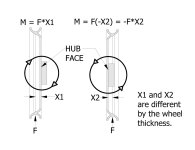
Here is my (possibly poor) attempt to put some sort of math to the problem. My better judgement says not to do this, but "'tis the season for sharing", right? The moment (torque) M is calculated in each scenario. The "hub" is considered fixed in position by the bearing arrangement, whatever that is, as long as it's the same in both cases (which is sure ought to be!) The moments magnitudes will calculate out differently by the difference in the thickness of the rim at the point of contact with the hub. This may or may not be significant depending on the ratio of the thickness of the rim to the offset of the "dish". In other words, if the dish is offset by 1" (from the centerline of the tire where the force is assumed to be acting from the weight of the machine) and the wheel thickness is 0.25", then the moment will be different by about 25%. If the dish is 3" offset from the centerline, then it would only affect the moment by about 0.25/3 = 8%. Not really the results I had in mind, but this is what my diagram indicates. Certainly mark it up or propose alternate diagrams so we all can learn what's really happening in this wonderful endeavor. The subject comes up enough to deserve a correct answer while we wait around for the next tractor job :)
 

Attachments

  • wheel arrangement diagram.jpg
    wheel arrangement diagram.jpg
    172.9 KB · Views: 215
   / Does widening front end stress axle/bearings more? #29  
Coby got in on this type of discussion on another thread here on TBN. I posted some pictures on that thread to show the OP that he was adding stress to his front axle. I'll help Coby out and post them here.

Also, let me comment on Gary Fowler's statement about the front wheel being the same distance inside the bearing cupped in as it as outside the bearing cupped out. That's not true. The center of bearings are inside the hub flange. You can never get the wheel as far inside the bearing center as you can outside. With the wheel set clear in, it's still running outside the bearing center.

Okay guys, which tractor is exerting the most force on the axle bearing assembly and why?????


   / Does widening front end stress axle/bearings more? #30  
After thinking this over some more I've concluded my analysis in my previous post is wrong for the purposes of this thread. The question revolves around the stresses on the bearings and the analysis does not address that question. Therefore, it should be adjusted to consider each bearing position on the final drive shaft in relation to the force applied to the center of the tire (if we assume the force is indeed centered on the tire). I'm thinking this would then lead to a conclusion that moving the tires out would indeed increase the stresses seen in the bearings.
 
   / Does widening front end stress axle/bearings more? #31  
The bearing sees an "overturning moment" (rotation about a F/A axis) from the tire's vertical force vector. There are also moments (forces times a distance) due to side-forces from turning and from inclination. There is usually a positive camber angle set on the front spindle to assist with turning (steering), by means of the tire contact patch is moved inward. "Scrub radius" is a term that usually appears in a discussion on the subject but not here because front tractor wheels usually don't have brakes. The camber is from the kingpin inclination as seen in the rear (or front) view.

When you extend the tire's rim inward or outward, you increase or decrease this moment. You usually can not flip the wheel spider around to maintain a unchanged wheel offset because it would be pointless and redundant. The wheel's offset induced moment (force times a distance) is reacted by the span of the inner and out wheel bearings (called a "couple"). So, when the tire-on-its- rim is moved outward, the internal forces on the bearing (and the spindle) increase proportionally. Tire centerlines are usually set to match the rears for rut negotiations row crop following and to make it easier to load onto tractor ramps, etc.

Setting wheels outward increases steering effort because there is a larger scrub radius and spindle length, there is also extra body roll because of caster angles (for self centering steering) and kingpin inclination (which lifts the front end upwards as you turn).

Setting wheels inward has some advantages for loader work, especially if you have manual steering. The extra vertical load on the front axle makes it much harder to steer, so a reduced front track is set to lower these efforts. Some knowledgeable readers can attest to the swiftness of the returning wheel kick when doing loader work and the front track is large. It can break your wrists.

Manufacturers design spindles, axles, wheels and tires with all this is mind as design-for conditions, so there SHOULD be no trouble unless you have a marginal machine, your loads are higher than recommended or your tires are out of spec for size or pressure.
 
   / Does widening front end stress axle/bearings more? #32  
After thinking this over some more I've concluded my analysis in my previous post is wrong for the purposes of this thread. The question revolves around the stresses on the bearings and the analysis does not address that question. Therefore, it should be adjusted to consider each bearing position on the final drive shaft in relation to the force applied to the center of the tire (if we assume the force is indeed centered on the tire). I'm thinking this would then lead to a conclusion that moving the tires out would indeed increase the stresses seen in the bearings.

And the stress is more severe because of the location of the bearing set in relationship to the location of the hub face that the wheel bolts to.
 
   / Does widening front end stress axle/bearings more? #33  
Manufacturers design spindles, axles, wheels and tires with all this is mind as design-for conditions, so there SHOULD be no trouble unless you have a marginal machine, your loads are higher than recommended or your tires are out of spec for size or pressure.

Or if your owners manual specifically says to not reverse the dish or in any way widen the front track farther than the recommended setting.

In the case of the second picture I posted, that's my M9540. The manual discusses setting track width on the front and rear. It specifically and clearly states to not set the tires/wheels wider than the setting in the picture. That setting is accomplished with the dish inward and the rim mounted outward on the dish as far as possible. The next setting outward would be reversing the dish and moving the rim one setting inward.

Here's a sortta side view of that setup. Dish inward, outer rim outward. Notice the centerline of the tire is very close to the mounting flange location. Yes, I can probably reverse the center and move the outer rim inward to it's maximum, but as mentioned above, that would be redundant.

Kubota does not want operators to widen the front tire track of this particular tractor any further than this setting. I'm assuming that's because they are concerned about overly stressing the bearing assembly. Actually I think it states that in the manual as the reason to not do so.


   / Does widening front end stress axle/bearings more? #34  
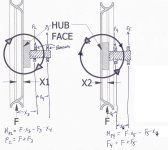
Here's another analysis (isn't this fun???). Excuse the "chicken-scratching" as I didn't want to redraw w/ bearings, etc. Anyway, all "F" variables are forces, and all "X" variables are distances. MF2 and MF4 are the sum of the moments around the bearing closest to the hub in each case. Since the distance "X3" is more than "X5", with "F" a constant representing the weight of the tractor on the tire, the forces on "F2" and "F3" must be higher, and therefore see more stress in the left scenario (wheels out) vs. the right (wheels in). This analysis assumes the bearings can pivot in their race which may or may not be true.
 

Attachments

  • front axle bearing stress.jpg
    front axle bearing stress.jpg
    128 KB · Views: 175
   / Does widening front end stress axle/bearings more? #35  
So many theories here!:laughing:
 
   / Does widening front end stress axle/bearings more? #36  
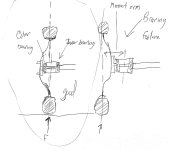
Very good i started reading this earlier and was getting frustrated reading through the thread and made this picture showing pretty much the same thing but you posted first.

In design you really want the centerline of the contact patch to be centered between the bearing races to minimize the moments as you have mentioned. On a side note I work as an engineer at GM my group owns the Brake and Bearing components.
Bearingwheel-vi.jpg


Here's another analysis (isn't this fun???). Excuse the "chicken-scratching" as I didn't want to redraw w/ bearings, etc. Anyway, all "F" variables are forces, and all "X" variables are distances. MF2 and MF4 are the sum of the moments around the bearing closest to the hub in each case. Since the distance "X3" is more than "X5", with "F" a constant representing the weight of the tractor on the tire, the forces on "F2" and "F3" must be higher, and therefore see more stress in the left scenario (wheels out) vs. the right (wheels in). This analysis assumes the bearings can pivot in their race which may or may not be true.
 

Attachments

  • Bearingwheel-vi.jpg
    Bearingwheel-vi.jpg
    121.2 KB · Views: 97
   / Does widening front end stress axle/bearings more? #37  
I suspect Kubota doesn't recommend going further outward because there will be tire to frame or tire to chassis contact. This could potentially make a wheel to lockup and cause a crash.
 
   / Does widening front end stress axle/bearings more? #38  
Very good i started reading this earlier and was getting frustrated reading through the thread and made this picture showing pretty much the same thing but you posted first.

In design you really want the centerline of the contact patch to be centered between the bearing races to minimize the moments as you have mentioned. On a side note I work as an engineer at GM my group owns the Brake and Bearing components.
Bearingwheel-vi.jpg

Thanks for the secondary analysis and design tips/goals. I put some numbers to the variables and came up with the attached. I tried running it with your method, but I wasn't sure how to resolve the vertical forces and moments. Anyway, I'm getting an outer bearing stress increase of 63% and inner bearing increase of around 157% based on the numbers I can find for an Iseki TX1300. I don't have exact values for bearing spacing or distance between the outer bearing and tire centerline in each case so I made some guesses. Obviously each tractor is going to have its own unique results. Of course, this could be way off reality but it was a fun exercise. I don't get to do much engineering at work so it's good to brush the dust off the tools once in a while even if the results are wrong :shocked:
 

Attachments

  • Front axle bearing stresses.pdf
    84.5 KB · Views: 132
   / Does widening front end stress axle/bearings more? #39  
I reversed the tires of a old L245DT. Trailer had two rails and tractor needed reversed wheels to fit. Could have bought another trailer for the cost to repair tractor. The popping sound of the crushed bearings is very expensive. Owners manual was very clear in what not to do.
 
   / Does widening front end stress axle/bearings more? #40  
I suspect Kubota doesn't recommend going further outward because there will be tire to frame or tire to chassis contact. This could potentially make a wheel to lockup and cause a crash.

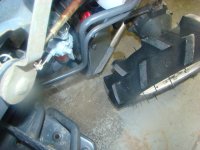
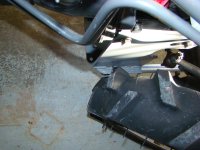
On my tractor I need to move the tires to the outer position to give me more tire clearance while turning. My tires rub if they are in the inner position with a modified blower/plow mount attached to the tractor frame. Instead of reversing the rim, I just made spacers for the added weight and I prefer the dish out to in.
 

Attachments

  • New clearance right.jpg
    New clearance right.jpg
    687.6 KB · Views: 186
  • Front tire insufficient clearance before hub.jpg
    Front tire insufficient clearance before hub.jpg
    692.2 KB · Views: 116

Marketplace Items

Redirective Crash Cushion Guardrail (A59230)
Redirective Crash...
2016 Freightliner M2 106 Ambulance (A59230)
2016 Freightliner...
2007 DELTA GOOSENECK TRAILER (A58214)
2007 DELTA...
NEW HOLLAND 706 30 INCH 3PT DIRT SCOOP (A55315)
NEW HOLLAND 706 30...
2004 JOHN DEERE 650H LGP CRAWLER DOZER (A60429)
2004 JOHN DEERE...
2010 Deere 318D (A60462)
2010 Deere 318D...
 
Top