Haying Process

/ Haying Process #1  

orangehay

New member
Joined
May 28, 2014
Messages
17
Location
Nebraska
Tractor
Kubota MX5200 Kubota L4330
This is my first year haying and I'm trying to figure out the proper process to get my hay cut and baled. I'm using a plain old sickle bar mower, a side delivery rake and a small square baler. My field is a 3 acre grass pasture mix(i know it has ochardgrass and some fescue). Here is what I'm planning to do:

Day 1: Cut field with sickle bar mower after dew has burned off

Day 2: Let hay sit and dry

Day 3: Rake into rows after dew has burned off

Day 4: Bale after dew has burned off

Does this sound right to you guys? I appreciate any help. I hope to cut hay on Saturday if rain stays out of the forecast.
 
/ Haying Process #2  
Sure.
You may have to combine windrows if your crop is thin so you baler has enough hay throughput.
Good luck.
 
/ Haying Process #3  
This is my first year haying and I'm trying to figure out the proper process to get my hay cut and baled. I'm using a plain old sickle bar mower, a side delivery rake and a small square baler. My field is a 3 acre grass pasture mix(i know it has ochardgrass and some fescue). Here is what I'm planning to do:

Day 1: Cut field with sickle bar mower after dew has burned off

Day 2: Let hay sit and dry

Day 3: Rake into rows after dew has burned off

Day 4: Bale after dew has burned off

Does this sound right to you guys? I appreciate any help. I hope to cut hay on Saturday if rain stays out of the forecast.

It's not just the dew. The moisture of the hay itself has to be low enough to prevent spoilage and preserve the nutrient value of the forage. Baling too wet will be a problem for you and your barn. Ask a neighbor in your area that bales hay. I know there are plenty in the Salem area. Your local Extension agent is also a help.
 
/ Haying Process
  • Thread Starter
#4  
I was also wondering if it would be ok to let the bales sit outside overnight before stacking them in the barn the next day? Would the sun or dew do any harm to the quality?
 
/ Haying Process
  • Thread Starter
#5  
It's not just the dew. The moisture of the hay itself has to be low enough to prevent spoilage and preserve the nutrient value of the forage. Baling too wet will be a problem for you and your barn. Ask a neighbor in your area that bales hay. I know there are plenty in the Salem area. Your local Extension agent is also a help.

My neighbor bales 16 acres and this is the same process that he follows, but he bales his hay in hot July while I'm trying to get mine done here in late May/early June.
 
/ Haying Process #6  
It may be preferable to let bales sit outside for a day or two. The internal heat of the bales should equalize before stacking inside. The feed value depends on the maturation and type of forage used for hay. If your cutting too early you may be loosing volume and feed value.
 
/ Haying Process #7  
It all depends on how thick it is and how dry it is. I can remember one day when I was a kid it was hot and dry summer and the hay was thin. We cut , raked and bailed it all in one day and it was dry. We sometimes (not often) cut one day and rake and bale the next.
If it sits a day or it is thick we will ted it the day after we cut. Ted again if wet on day 3 or Rake on day 3 if it is ready we bale if not possibly turn it over and bale on day 4. we usually rake and bail on the same day, but not all the time. If you do not you may have to "turn it over" again as the bottom may not dry. . We Cut in mid to late June and July when it is hot and the hay is usually thick. We have never in my lifetime let square bales sit in the lot overnight they will just get dew on them. On a few occasions we have piled and tarped it outside. A good dosing of salt if it feels a bit wet. We usually wait until we have a 3 to 4 day window according to the weather
 
/ Haying Process #8  
It is important to have the hay at a proper moisture level or you will get mold inside the bales or worse possibly burn a barn down. The climate of the area that you live in plays a huge factor. The type of crops are also a factor (Leafy stuff takes more time to dry than grassy stuff).

What works for a guy in an arid dry heat climate like Texas is not going to work for a guy in a high humidity climate even if temps are otherwise similar. I am not familiar with Oregon climate so will pass on offering opinions about Oregon.

My experience of using crude and primitive haying equipment in Ohio (high humidity can be a problem in Ohio) of baling orchard grass, fescue, clover and a slight hint of alfalfla mix is to use my rake as an improvised tedder which signifigantly cuts down on the time needed to dry the hay (getting 4 days in a row without rain is rough in Ohio). Plus the other biggest benefit is I think you obtain a much better smell of hay along with the color. Putting up pleasant smelling hay is much more enjoyable than the alternative.

Anytime, I have let hay lay flat it gets bleached on top and smells damp and rank underneath when I leave it lay too long. On the other hand, if I use my rake to get the crop up into a fluffy windrow after about a day of sun exposure after cutting, then flip the windrow like a pancake 1/2 to 3/4 of a day later using the very tail tip of the rake to then turn my windrow and my hay always smells extremely pleasant to the human nose. Really wet hay and less optimum drying conditions will have me resorting to a 3rd trip over the field in the middle of my flippying the windrow trips where I use the rake tines like a beater to break up the wet clumps.

Now if I had an operational tedder then I would use that instead of the rake but my junkpile tedder still needs some refurbishment. No huge disadvantage to overworking non leafy hay crops as leaf loss is not a problem with grassy based crops - assuming you can tolerate the additional fuel and time to do it -neither of which should pose a problem on a small 3 acre patch. Hate to be the bearer of bad news but making a profit on 3 acres is going to be hard. I have yet to make a profit on 4.5 to 6 acres of hay but do enjoy doing it nonetheless. A masochistic hobby it is.

In short, If the stuff on top is dry and the stuff underneath is wet then you know what you need to do...flippying with the rake time it is...
 
/ Haying Process
  • Thread Starter
#9  
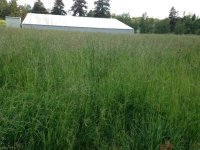
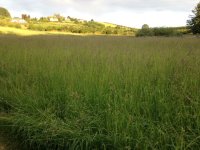
What kind of yield(50 pound small square bales) can I expect per acre with grass like this? There's quite a bit of orchard-grass and I believe fescue in it. It ranges from 4 to 5 feet tall. I fertilized with 16-16-16 at the rate of 200 pounds per acre back in March. I'll attach pics. Thank you very much for the replies guys I really appreciate it.
photo 1 (4).JPG

photo 2 (4).JPG
 
/ Haying Process #10  
At 4'-5' tall a lot more sq bales per acre than this old man care's to haul. I'll guess 80 per acre.
 
/ Haying Process #11  
What kind of yield(50 pound small square bales) can I expect per acre with grass like this? There's quite a bit of orchard-grass and I believe fescue in it. It ranges from 4 to 5 feet tall. I fertilized with 16-16-16 at the rate of 200 pounds per acre back in March. I'll attach pics. Thank you very much for the replies guys I really appreciate it.
View attachment 377291

View attachment 377292

My neighbor baled his 8 acre irrigated hayfield two weeks ago (forage mix plus a little vetch). He got about 2-3/4 tons per acre. His baler is 3-twine (100-120 lb) and he stacked 430 bales. Sold the lot for $12/bale.
 
/ Haying Process
  • Thread Starter
#12  
Hmm. 80 per acre was about what I got last year without fertilizer. I thought the fertilizer would increase it to more like 120. We've had a pretty wet spring also.
 
/ Haying Process #13  
Hmm. 80 per acre was about what I got last year without fertilizer. I thought the fertilizer would increase it to more like 120. We've had a pretty wet spring also.

You will probably surpass my guess. Looking at grass in person VS a photo is a totally different thing. Heck in my 25+ yrs custom baling hay I've fooled myself on amt of production per acre even when looking in PERSON.
 
/ Haying Process
  • Thread Starter
#15  
I cut the field on Sunday, really nice grass. Sickle bar mower worked like a charm even in the thick grass that was lodged/leaning. But the mower did need a little revamping. Tried to cut it on saturday but the mower didn't work due too the old belts and blades. So I went down to the local kubota dealer and bought new serrated blades, the same ones they put on swathers. It took a little retrofitting to get them to fit on the mower but I got them on. Only took me about 3 hours to cut the entire field, so I did an acre an hour. Hope to have it baled by Thursday/Friday If i can get it to dry out well. I'll post how many bales to an acre I got for those who are curious.
 
/ Haying Process
  • Thread Starter
#16  
Here's a video of me out there cutting it. I was using a 6ft Massey Ferguson #32 Sickle bar mower, with new serrated blades of course. :)
 
/ Haying Process
  • Thread Starter
#17  
Got it baled finally. Took forever to dry. Averaged 81 bales to the acre.
 
/ Haying Process #18  
Orangehay - loved the video and good job on the hay. I just have to chime in that it has been about 25-30 years since I've used a sickle mower (we switched to using a disc mover when our old sickle wouldn't cut our clover without clogging). I can vaguely remember going throught field at about the speed your were going. I can remember when the sickle was working well, it was a smooth, if slow, day. When we got our first disc mower, we were simply amazed at how fast we could cut.

Anyway, once again, good job and thanks for posting a snippet.

Good luck and take care.
 
/ Haying Process #19  
Here's a video of me out there cutting it. I was using a 6ft Massey Ferguson #32 Sickle bar mower, with new serrated blades of course. :)

Excellent video. I had the same experience with my MF #31 sicklebar and the 5525 Mahindra--clogging. It's a chore shifting into reverse to clear the clogs with the simple transmission/two stage clutch in that 5525. A hydrostatic tranny is much better for that task.

I rebuilt the mower several times but it still isn't perfect. If it ever rains again here in No. CA during my lifetime, I'll try haying again--and this time with a 5-ft drum mower.

Good luck.
 

Marketplace Items

2023 WRANGLER 5500T ARTICULATED WHEEL LOADER (A58214)
2023 WRANGLER...
(20) WOOD PALLETS (A60432)
(20) WOOD PALLETS...
2015 Ram 1500 4x4 Crew Cab Pickup Truck (A59230)
2015 Ram 1500 4x4...
2016 KOMATSU D65PX-18 CRAWLER DOZER (A60429)
2016 KOMATSU...
60" HANG-ON WHEEL LOADER FORKS (A60429)
60" HANG-ON WHEEL...
2015 LOAD TRAIL 24+6 GOOSENECK TRAILER (A58214)
2015 LOAD TRAIL...
 
Top