Anything else to do when changing a head gasket?

   / Anything else to do when changing a head gasket? #101  
Most all engines I've worked on, actually I can't remember one, that didn't need (require) a re-torqueing the head bolts after warm up or some limited run time.
Check your repair manual for the proper procedure.
 
   / Anything else to do when changing a head gasket?
  • Thread Starter
#102  
Most all engines I've worked on, actually I can't remember one, that didn't need (require) a re-torqueing the head bolts after warm up or some limited run time.
Check your repair manual for the proper procedure.

Repair manual didn't mention it, but I did it anyway. They did turn some. Thanks!
 
   / Anything else to do when changing a head gasket?
  • Thread Starter
#103  
Kubota Runs!


After some foibles about not ordering hoses and some of the gaskets, I have it back together and it runs very well. Rebuilt head, rebuilt injectors, valve job, valve clearance adjusted, new hoses, gaskets and belts. New Rotella T 15w40 (?) and new ~ 50/50 Rotella ELC/distilled water (might be closer to 60/40, have to look at that -- coolant capacity is only 2.2 quarts!). Can't tell much difference in the way it runs than before though. It always started and ran fine. Might start a little faster. Not hard to start at all. Just overheated. Before I rebuilt it, it would overheat in 10-15 minutes. Seemed like it was using water. We would always be putting distilled water in it (stealing it from under my wife's ironing board).

BUT ...

It still overheats! :banghead:

But only if you put some load on it. Just sitting there running full throttle, the temp gauge will only go to the middle white line. If you mow with it, it will creep up close to the highest white line (just before the red area). This is about where we would normally shut it down and let it cool off. We would let it get close to or almost touch the top white line.

SO ...

This is where it gets interesting, or maybe laughable for those of you who know what you're doing. :rolleyes:

So I started wondering... Exactly how hot is it actually getting? Time to pull out some nerd power. So I did what I probably should have done in the first place -- pull off the temp sensor and check it out (screws into a water passage on the head on the opposite side of the head from the water pump). So it's just a resistor thermocouple type thing, so we got a pot of water on the stove, and a digital cooking thermometer (again stolen from the wife), and hooked the sensor up to an ohm meter. Put the thermometer and sensor the pot and turn on the heat. We took readings of temp and resistance and made a table of the findings. But we could only get to about 210 F, so we plugged in into a spreadsheet and did an exponential regression function (just finds a function that approximates your data set). This allowed us to carry the values out further and it was pretty close.
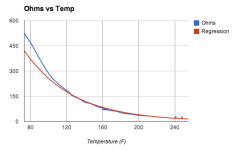
KubotaRegression.png

On to the mower. I wanted to know how hot it was actually getting and also what temp the sensor thought it was. We had a point and shoot infrared thermometer and also a thermocouple that comes with a nice Fluke multimeter (s'posed to be pretty accurate). So we got all set up and stuck the Fluke probe in the radiator right where the upper radiator hose will flow right onto it. We also took measurements with the infrared on the surface of the radiator right next to the upper radiator hose. We used the infrared to measure the temp of the surface of the head next to the temp sensor and also the surface of the block below the head.

Turns out that the measuring radiator surface with infrared gave very close to the same reading as the Fluke probe in the coolant flowing from the upper radiator hose (within about 2 deg or so). So we dropped the Fluke and put the radiator cap back on. The block temp by the temp sensor was also within a few degrees of the radiator by the upper hose. The temp sensor was consistently indicating a higher temp than we measured with the Fluke or the infrared. Seemed like the hotter it got, the more difference there was between the two. We did notice when the thermostat opened.

We could only get it to about the middle (straight up) white line while sitting there, so I started mowing with it -- pretty tall kinda wet grass with kinda dull blades. The temp gauge started creeping higher. I wanted to know the temp when it touched the top white line. But it never got there. It stopped going up when it was just a little bit before the upper white line -- a little over 3/4 of the way from the middle line to the top line -- bout an 1/8" from the top line. Hmmm. So we checked the temp. The radiator but the upper hose measured 209 F and the head by the temp sensor measured 206 F -- but it cools down kinda fast, so hard to know. The block was 211 F. The temp sensor resistance showed that it thought it was about 214 F. I read that many engines (and have experience with one) have a thermo switch to shut them down at 230 F.

So whaddaya think?!
  • Is my temperature measuring good enough?
  • Are the temps in the normal range?
  • Is my temp sensor bad?
  • Or is it the gauge?
  • Or some of both?


I still need to do more mow testing to see if it will eventually go up higher, but it was starting to rain and I need to sharpen the blades. Maybe tomorrow.
 
   / Anything else to do when changing a head gasket? #104  
Did you pressure test the radiator cap or replace it? What about the thermostat? Did you replace it?
 
   / Anything else to do when changing a head gasket?
  • Thread Starter
#105  
Did you pressure test the radiator cap or replace it? What about the thermostat? Did you replace it?

Yes, replaced cap and thermostat -- new OEM parts. Had radiator tanked last year. Cleaned and no leaks. BUT I have noticed that the rim of the radiator where the cap goes is a little bent. Tried to make it even again. I think it seals.
 
   / Anything else to do when changing a head gasket? #106  
Yes, replaced cap and thermostat -- new OEM parts. Had radiator tanked last year. Cleaned and no leaks. BUT I have noticed that the rim of the radiator where the cap goes is a little bent. Tried to make it even again. I think it seals.

Do you have a pressure tester? If so, pressure test the cap. If passed, then pressure test the system cold and see if the system holds pressure. What you're looking for is a leak over say 10-15 minutes. The pressure should not change when pressurized to whatever the radiator cap's max pressure is.

If a pass, then release pressure but keep the pressure tester hooked up and then start the engine. In this test you're looking for pressure to be built up before heat builds up. Pressure building up before heat is indicative of a head leak somewhere. If pressure build up is normal, take note if the pressure and temperature ratio. Once hot (but not overheating) shut off the engine and see if the system is holding pressure.

If everything passes, then everything is pointing toward not enough cooling either a worn impeller on a water pump, clogged cooling galleries in the radiator or something. If everything passes the pressure test (and you can rent these things too) then I'd look to replace the thermocouple on the fan as my first shot—unless you have an electric fan—in which case we want to know what temps it kicks on and off at and is likely that the tempt sending unit is bad.
 
   / Anything else to do when changing a head gasket?
  • Thread Starter
#107  
Well, did some mowing yesterday. Didn't go well. Didn't seem to have an overheating problem though -- IF we go by the temperatures (as measured from an infrared thermometer pointed at radiator by the upper radiator hose, which has been shown to be within a couple of degrees from actual coolant temp as measured with a thermocouple on a Fluke meter). The temp did get to about 216, but if we didn't cut grass as fast (i.e., let load), they would stay in the 195-208 range. I have not been able to get a good feel for what acceptable temp ranges are, but from the fuzzy indication I have got from reading, this seems OK. Seems like they should definitely be > 180 (the thermostat opening temp) and >220 is getting kinda hot. 230 means something went wrong and you need to let it cool off and shut it down. (Can someone tell me if these temp ranges are OK?) I looked at the coolant level this morning ant it was normal. So, no boiling over. Prior to head gasket fix, the coolant level would have been quite low and I would have to add some. So, I think the temp gauge/sensor is just reading kind of higher than it should be.

BUT...

It started doing something different. It would act like it was running out of fuel or something. But it wasn't. It started running very rough, like it was only running on 1 cylinder or something, and then it would stall out and stop. Thought it might just be some air still in fuel system, but I don't think so. Started doing this often. Got some video of it, but don't have it handy at the moment. This morning, cold, it started right up and ran normally for maybe 60 sec, then it did the same thing. Started again and it didn't stall out, but would periodically run rough and then recover. But it was acting intermittently. Does not seem to smoke when it does this. Injectors have been rebuilt by diesel shop with good reputation. Didn't drop them or anything. I have not messed with the injector pump at all. I did remove the hard lines when doing the head. I did remove and clean the fuel filter -- didn't seem dirty enough to replace (cleaned in kerosene and blew off with air). I did bleed the fuel system afterward (fuel bowl, line to pump, caps on injectors).

Any ideas?

It sort of seems to me that the cooling system is right on the edge of being insufficient. This Kubota engine is a 14 HP engine with a 2.2 QUART coolant capacity. The Yanmar is a 19 HP engine with a 1.1 GAL coolant capacity (about twice as much coolant). Yanmar radiator seems quite a bit bigger too, but haven't measured.

I would like to do the pressure test that Eric talked about. Don't have a pressure tester though. Maybe Advance Auto has one I can rent. I did notice that coolant flows EASILY out the temp sensor hole in the head. Found this out by accident by trying to add coolant with temp sensor out. And the temp sensor is on opposite side of head from the water pump.
 
Last edited:
   / Anything else to do when changing a head gasket? #108  
With all the overheating, loss of coolant, etc. before tearing into the engine and the current readings you're getting, and considering you replaced radiator cap and T-stat, I'd say it's time to try another head temp sensor.
Some good things so far is it seems to not be boiling over, using coolant, etc, so all that is definite progress. Temp sensors don't last forever especially if exposed to the high end of their range like yours has been over a long period of time. Changing it will also give feedback on if the new one reads differently on your gauge.
The intermittent running to stall or nearly- I would change out the fuel filter rather than trying to clean it. You have rebuilt injectors, why chance something getting to them, or worse yet jamming up the IP with a 'used' fuel filter? Change to new filter and drain your tank and use only fresh fuel from a known clean source and report back results.
 
   / Anything else to do when changing a head gasket? #109  
For the stalling, what is your current fuel level? Changing the fuel filter instead of reusing a cleaned one is good advice so you can cross that off as a possible cause.

I'd suggest filling it up to the bottom of the filler neck and see if the stalling still occurs. My F935 does what sounds like exactly the same same thing you're describing if I don't keep it very full. My tanks have pickup lines that are cracked/broken and I haven't had the time to pull the tanks and replace those two lines (I'm so looking forward to once that task is done!). When fuel gets close to being below the broken sections, it will suck a bit of air and run terribly/stall. It only happens to me if I forget to top it off after or before starting to mow. I can get 6-9 acres mowed before it happens to me, and when it does it's seemingly random. I've kept it full before starting to mow and haven't had an issue since.
 
   / Anything else to do when changing a head gasket?
  • Thread Starter
#110  
I'd suggest filling it up to the bottom of the filler neck and see if the stalling still occurs. My F935 does what sounds like exactly the same same thing you're describing if I don't keep it very full. My tanks have pickup lines that are cracked/broken and I haven't had the time to pull the tanks and replace those two lines (I'm so looking forward to once that task is done!). When fuel gets close to being below the broken sections, it will suck a bit of air and run terribly/stall. It only happens to me if I forget to top it off after or before starting to mow. I can get 6-9 acres mowed before it happens to me, and when it does it's seemingly random. I've kept it full before starting to mow and haven't had an issue since.

Wish that were the case. When it happened the first time, we thought it ran out of fuel, but it had 1/4 tank. I filled it up until the bottom of the filter screen was submerged. Also, it didn't used to do anything like that before I did all this work on it.
 
   / Anything else to do when changing a head gasket? #111  
Wish that were the case. When it happened the first time, we thought it ran out of fuel, but it had 1/4 tank. I filled it up until the bottom of the filter screen was submerged. Also, it didn't used to do anything like that before I did all this work on it.

Well, even though it wasn't directly related I'd still pull the sender just to inspect the pickup line. And we can assume you have bled the lines just to make sure? Life has a funny habit of messing with me by letting other things fail as I fix issues completely unrelated. I'm not trying to send you chasing your tail, just thinking out loud.
 
   / Anything else to do when changing a head gasket?
  • Thread Starter
#112  
Well, even though it wasn't directly related I'd still pull the sender just to inspect the pickup line. And we can assume you have bled the lines just to make sure? Life has a funny habit of messing with me by letting other things fail as I fix issues completely unrelated. I'm not trying to send you chasing your tail, just thinking out loud.

I called the diesel shop and they suggested about the same thing. Check from fuel pickup line on. He said it sounds like air is getting in there or maybe never got out good enough. He said these little engines use so little fuel that it can be hard to get the air out. His words were: "It's kinda like milkin' a mouse." Little piece of trash can get on the intake and block it, and then after the engine runs out of fuel and dies, that vacuum is released and it will start and run fine. Then it will suck it back on there. They found lots of stuff in fuel tanks: walmart bags, shop rags, etc. He said that one time they found a condom in a school bus' fuel tank that was doing this.
 
   / Anything else to do when changing a head gasket? #113  
Also, what's condition/age of air filter?
 
   / Anything else to do when changing a head gasket?
  • Thread Starter
#114  
Also, what's condition/age of air filter?

Couple years old. Blew it out too and cleaned the housing it goes in. It needed cleaning, but I've seen much worse ones.

Can't do it tonight, but I'm gonna replace the fuel filter and check the fuel tank for trash. And crack the injector caps and see if I can get any air to come through.

Diesel shop suggested that I disconnect fuel line to the banjo on the injector pump and connect a clean fuel line or tube and gravity feed it and see if it still happens. That way I know there's no problem between the pump and the tank pickup line.

There IS a little electric fuel pump -- tank is under the seat.
 
   / Anything else to do when changing a head gasket? #115  
Well, did some mowing yesterday. Didn't go well. Didn't seem to have an overheating problem though -- IF we go by the temperatures (as measured from an infrared thermometer pointed at radiator by the upper radiator hose, which has been shown to be within a couple of degrees from actual coolant temp as measured with a thermocouple on a Fluke meter). The temp did get to about 216, but if we didn't cut grass as fast (i.e., let load), they would stay in the 195-208 range. I have not been able to get a good feel for what acceptable temp ranges are, but from the fuzzy indication I have got from reading, this seems OK. Seems like they should definitely be > 180 (the thermostat opening temp) and >220 is getting kinda hot. 230 means something went wrong and you need to let it cool off and shut it down. (Can someone tell me if these temp ranges are OK?) I looked at the coolant level this morning ant it was normal. So, no boiling over. Prior to head gasket fix, the coolant level would have been quite low and I would have to add some. So, I think the temp gauge/sensor is just reading kind of higher than it should be.

BUT...

It started doing something different. It would act like it was running out of fuel or something. But it wasn't. It started running very rough, like it was only running on 1 cylinder or something, and then it would stall out and stop. Thought it might just be some air still in fuel system, but I don't think so. Started doing this often. Got some video of it, but don't have it handy at the moment. This morning, cold, it started right up and ran normally for maybe 60 sec, then it did the same thing. Started again and it didn't stall out, but would periodically run rough and then recover. But it was acting intermittently. Does not seem to smoke when it does this. Injectors have been rebuilt by diesel shop with good reputation. Didn't drop them or anything. I have not messed with the injector pump at all. I did remove the hard lines when doing the head. I did remove and clean the fuel filter -- didn't seem dirty enough to replace (cleaned in kerosene and blew off with air). I did bleed the fuel system afterward (fuel bowl, line to pump, caps on injectors).

Any ideas?

It sort of seems to me that the cooling system is right on the edge of being insufficient. This Kubota engine is a 14 HP engine with a 2.2 QUART coolant capacity. The Yanmar is a 19 HP engine with a 1.1 GAL coolant capacity (about twice as much coolant). Yanmar radiator seems quite a bit bigger too, but haven't measured.

I would like to do the pressure test that Eric talked about. Don't have a pressure tester though. Maybe Advance Auto has one I can rent. I did notice that coolant flows EASILY out the temp sensor hole in the head. Found this out by accident by trying to add coolant with temp sensor out. And the temp sensor is on opposite side of head from the water pump.

I don't know the average specs for diesel engine off the top of my head but a gassers engines kick on electric cooling fans in the 210-220 range and kick off the cooling fans at 180ish to 200 degrees. New CAT diesels warn at 215 degrees and auto shut down at 225. In other words, 225 seems hot.
 
   / Anything else to do when changing a head gasket? #116  
Water boils at 212* F at atmospheric pressure. Coolant mixed with correct amount of distilled water boils at ? under pressure...
Your small fuel pump may want to be put to the test too, as to whether it might be cutting out electrically, possible supplying varied/intermittent fuel delivery/pressure to your fuel system, resulting in the symptoms you describe.
This is another instance of rule out the causal factors to solve the issue.
 
   / Anything else to do when changing a head gasket? #117  
I don't know the average specs for diesel engine off the top of my head but a gassers engines kick on electric cooling fans in the 210-220 range and kick off the cooling fans at 180ish to 200 degrees. New CAT diesels warn at 215 degrees and auto shut down at 225. In other words, 225 seems hot.

Diesels and gasoline engines in general have the same temperature specs for overheating. Basically, at 210+ I'd be concerned and at 230 damage can occur. Of course, cast iron blocks/heads for either fuel system are more resistant to warping, but not impervious. Diesel engine blocks themselves are also inherently more resistant to warping as well, due to the reinforced nature of the block designs.

Water boils at 212* F at atmospheric pressure. Coolant mixed with correct amount of distilled water boils at ? under pressure...
Your small fuel pump may want to be put to the test too, as to whether it might be cutting out electrically, possible supplying varied/intermittent fuel delivery/pressure to your fuel system, resulting in the symptoms you describe.
This is another instance of rule out the causal factors to solve the issue.

50/50 mixed coolant/water would boil at 265 degrees F with a 15lb cap at sea level.

Good idea with testing the lift pump...maybe it's not supplying the minimum psi or flow rate to the IP.
 
   / Anything else to do when changing a head gasket?
  • Thread Starter
#118  
Some eeenteresting discoveries.... First is that the stalling out only seems to happen when under load. Could not make it happen just sitting in garage. Will act OK with mower blades engaged but I can tell that its on the verge of stalling. If I start mowing I don't get very far until it wants to stall out. If I remove the load by disengaging the mower blades it will recover to a steady run.

So I took the fuel line off the injector pump and turned the key on to start the electric fuel pump. VERY weak looking stream. Took several seconds to just fill up the fuel line so that any came out. Then just barely a dribble -- like its got severe prostate problems. Same thing on the line going into the fuel filter. Didn't have any line to rig up a gravity feed directly to the injection pump so I traced the fuel lines back to the tank. Found the fuel pump and, lo and behold, there was another inline filter between the tank and the fuel pump. But of course there would be. Just makes good sense. I bet he's clogged up. But I think I'm gonna get some line and bypass him just to make sure. Then I can get everything in one order.

Thoughts?
 
   / Anything else to do when changing a head gasket? #119  
If you're lucky it's just the filter you found that is causing the problem. One step at a time. I have to wonder how she ran at all before?!
 
   / Anything else to do when changing a head gasket?
  • Thread Starter
#120  
If you're lucky it's just the filter you found that is causing the problem. One step at a time. I have to wonder how she ran at all before?!

I wonder if that can cause the tractor to run lean. Seems like it stalls either because its too lean or sucking air. Can running lean make it run hot?
 
Last edited:

Marketplace Items

2012 NORAM POWER SYSTEMS 100KW GENERATOR (A55745)
2012 NORAM POWER...
Year: 2016 Make: Ford Model: Taurus Vehicle Type: Passenger Car Mileage: Plate: Body Type: 4 Door (A55853)
Year: 2016 Make...
UNUSED FUTURE 72PRO-72" MULCHER (A60432)
UNUSED FUTURE...
2014 International WorkStar 7300 4x4 Altec AA55E 55ft. Material Handling Bucket Truck (A60460)
2014 International...
UNUSED FUTURE FT-GB200-79"X71 1/2"-1" STEEL PLATE (A60432)
UNUSED FUTURE...
2009 MULTIQUIP 25KW GENERATOR (A55745)
2009 MULTIQUIP...
 
Top
