For those retired - do you see college as important as when you were college age?

/ For those retired - do you see college as important as when you were college age? #1  

newbury

Super Star Member
Joined
Jan 8, 2009
Messages
14,845
Location
From Vt, in Va, retiring to MS
Tractor
Kubota's - B7610, M4700
From http://www.tractorbynet.com/forums/newreply.php?do=postreply&t=317601 it seems it could use a separate thread

The primary question is How important is college to career success? and also What level of college? Associates? Bach? Masters? Doctors? Post Doc?
The secondary question is How long should it take to pay off a college education?

I'm not saying it doesn't happen but in my part if the country I don't see it paying. Took the wife 3years after graduation of working a minimum wage job for school system to get a teachers position. Was looked at many times and said we want experience. You don't have any. She would have made more at Walmart than the school system those years. My job requires an 8th grade education. Maybe full high school. I don't use what I learned in college and my degree is in Ag. Heck if high school would prepare the kids for the real world and not some ****ing test we would all be better off. These kids could come out and make a living.

This seems to be getting pretty "off topic" and I'm going to start a separate thread.

Although being retired I do enjoy complaining about things.

And from the thread.

Farmer wrote it's can take a long time to pay off a college degree now.


Also true for me. College in the mid 70s, then law school. I loaded pop trucks when I was in high school then drove the trucks in during college/law school breaks when the older guys took their vacation. I was able to pay for my 7 years post H.S. without any student loans except for the last two years in law school. I didn't mind the hard work, I actually had more fun and learned more about life working with the older guys during those years. Mostly WW II and Korean War veterans. I didn't have any trouble finding jobs when I finished school either. It's completely different for young kids these days. I don't think they will have the same luck I had. Student loan debt, no good jobs to be had, and a world that seems to be falling apart. I'm a federal lawyer now counting down the last 2-4 years till retirement. Guys my age are probably in the last generation of Americans who will live a better retirement than our parents. I hope that I'm wrong, but I doubt it.

I remember working my way thru college at jobs such as janitor and "mop boy" at a doughnut shop. Real difficult to keep the grades up when you work all night. SWMBO got her way paid by a Daddy who got his MD from the GI bill. We decided our 4 kids would be funded like her if we could afford it. They all got good used cars while in college and the last two got new cars as "graduation presents". 3 have Masters degrees, 1 an Associate and 1 of the Masters is closing on her Doctorate. All now earning their own way and "contributing to society".


I paid about $600 for the first YEAR (2 semesters) of college tuition and fees at UVM (not books etc.). The minimum wage was about $1.45 and I made about $1.85 and took home about $1.50. So I worked about 200 hours just to pay for tuition. Today that same two semesters cost about $16,000 and you can probably get $10 per hour to take home. That would take 1,600 hours to to pay the base cost.

When I went to college, in the mid 70's, my college tuition was $17 per credit hour. Now it is about $400, per credit hour. ( same school ) We used to be able to make enough with summer factory jobs to pay tuition, and room and board. The costs of just school are way higher than what we had to pay. And the summer jobs are hard to find.

When I went in to college in 1969 I expected to be able to earn enough with a Bachelor's sheepskin to make it worthwhile. I did and quickly.

Now it seems almost EVERYONE is expected to have a college degree. And usually a masters or better.

With the AVERAGE student loan debt up around $30K a "starter job" (rookie teacher, lab assistant, researcher) barely pays the interest after other costs of living.

As a retired guy I'm now looking at the situation and wondering if I should start advising the grandchildren to get a job BEFORE college that will pay their way thru college.

Is it worth it to work your butt off for decades to pay off a moderate increase in salary?
 
/ For those retired - do you see college as important as when you were college age? #2  
Fwiw,my sister has a doctorate in statistics. She has decades of very expensive schooling. I do not know the total number but from 4 years of private 8-12 then 4 years of college to another 4 years of follow up and another 2-3 of something else. ( I may have missed a year or two ) she is now ..teaching. Idk what a teacher makes but I can't imagine it is going to have a speedy ROI.
 
/ For those retired - do you see college as important as when you were college age? #3  
I went to college for one year, got a summer job in construction and never went back. I worked my way up from helper to welder to supervisor and finally upper management at one point working overseas making almost $300K per year. It was a great life for me, but I don't see many young folks wanting to do that kind of work now. They all want to get a Bachelor's degree and then expect to be put into a management position. It's not going to happen. I don't think today's colleges prepare the kids for future employment as well today as high school did 50 years ago.

DO KIDS TODAY NEED A COLLEGE EDUCATION? SURE AS HECK THEY DO. A Bachelors degree will just about guarantee them a job at McDonald's where they can work their way up to manager in a few years.
Without it, they would still be flipping burgers.
 
/ For those retired - do you see college as important as when you were college age? #4  
It really depends on the degree field. Engineering and sciences are still marketable degrees. Other degrees, not so much. The traditional college needs to rethink what they are doing. Students should be able to take courses in areas of interest or need for their career path, then move on. Employers need to embrace applicants who may not have a degree, but have education in a relevant field.

We also need to embrace vocational training again. Seems like skilled trades are looked down upon, which is a shame.
 
/ For those retired - do you see college as important as when you were college age? #5  
I would say you don't really need the college education, just the diploma. It is a simple way to filter resumes and it happens all the time. "No college degree, we're sorry.." I heard that a lot when looking for a job after I got out of the Marine Corps. 6 years of working on airborne radar, laser and infrared weapons systems etc etc which included 18 months of electronic and specialty schools doesn't qualify you to repair machines in an arcade unless you have a college degree... true story. So I used the GI Bill, got credits for my military experience and started night classes at University of Phoenix with student loans to cover what the GI Bill didn't. Eventually I also started a job with a company that had tuition assistance (although today they pay much less than they did back then). I ended up paying very little for tuition (books is another story) and got my piece of paper.

I got a degree in Information Technology, a field I was already working in. With my day-to-day real world experience I found I often knew just as much if not more than my instructors for a given IT subject. I even taught a few of the evenings because I had a better grasp of the subject matter than the instructor did. So now I have a piece of paper that shows I know what I already knew and I can get past the 'Do you have a college degree?" question. Having the paper opens up a whole slew of jobs that require a college degree so why not get the paper if you can?
 
/ For those retired - do you see college as important as when you were college age? #6  
I got a degree in Information Technology, a field I was already working in. With my day-to-day real world experience I found I often knew just as much if not more than my instructors for a given IT subject. I even taught a few of the evenings because I had a better grasp of the subject matter than the instructor did. So now I have a piece of paper that shows I know what I already knew and I can get past the 'Do you have a college degree?" question. Having the paper opens up a whole slew of jobs that require a college degree so why not get the paper if you can?
Agreed. I have have a BS in Information Technology and with the exception of my Java programming and Cisco classes, it was just a matter of learning how that particular teacher or test wanted the information I already knew (from my life/work experiences) regurgitated.

Aaron Z
 
/ For those retired - do you see college as important as when you were college age? #7  
Both our girls had trouble getting the jobs they wanted with a 4 year degree. So they put themselves through grad school, one got a MA in hydrology and the other a MS in public health. They immediately got excellent jobs. I have a nephew, in his 30s, who made a good living as a residential building contractor with a high school education. He now is learning engineering at a 4 year college.
 
/ For those retired - do you see college as important as when you were college age? #8  
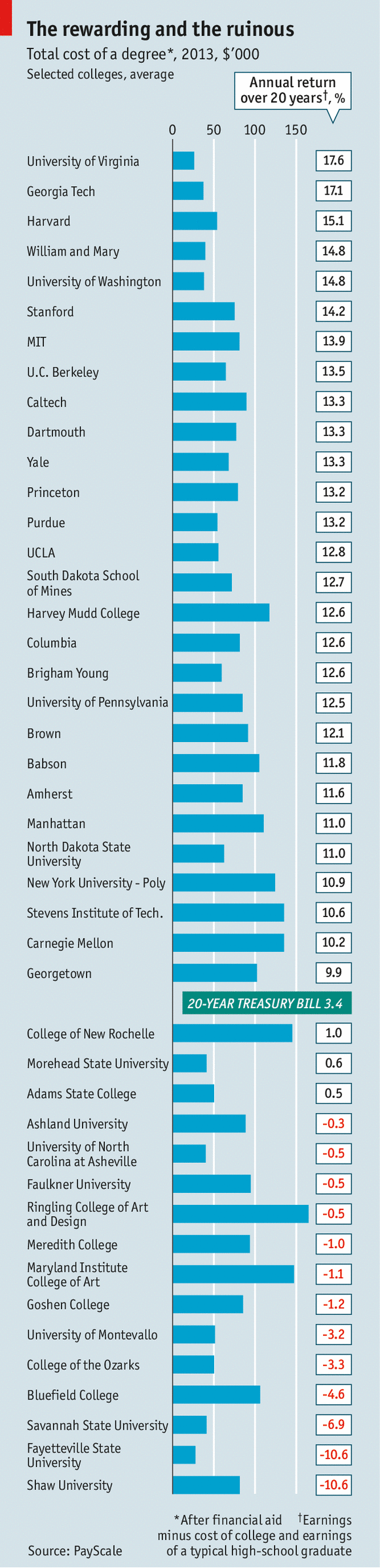
Regarding the returns to a college degree, http://www.payscale.com/college-roi/sort-by/AnnualRoi/financial-aid/yes provides estimates of the returns on investment for various colleges (and majors).

20140405_USC662_0.png


Steve
 
/ For those retired - do you see college as important as when you were college age? #9  
I barely graduated high school and I had to cheat in a couple of classes to make it through. College was never an option for me, I'm just not smart enough for all that thinking, so I rely on hard work and doing it better then my competition. It's worked for me and I'm able to live a very comfortable life and do the things I want to without having to worry about money. My wife has two masters degrees. One in nursing the other in business. She is currently a nurse manager with over 100 nurses working for her, and she taught nursing at the university for several years. She is taking two classes right now for her PhD and then her last class will be in the winter or spring. While I make more money then she does, the potential for her to make more is there. She has been offered positions to teach nursing online as a part time, extra income at $3,000 a month. Once she is done with school, that is probably going to happen. The big advantage with her degrees and education is that she is in demand all over the country and she is regularly offered positions at other hospitals and universities. If we wanted to move, she could get a job anywhere and make really good money. I would have to start over and build up my clientele again. Looking back, I can see where it would have been smart to have gone to school and gotten an education. It's probably my biggest failure in life.

When I worked as a driver for Airborne Express back in the 90's, half the guys there had college degrees. They all said they where making more money delivering freight then they could working in the fields they had a degree in. It could just be that they where all the type to want the easy job and not push themselves in their fields, which is also what I kind of thought about them, but then I don't know anything about their degrees or what it takes to make a living in those kinds of jobs.

I have learned that if you want to be a RN, you better get a four year degree because the day of the 2 year degreed RN is quickly ending. Karen and the other managers at the hospital are not hiring them if all they have is an Associates degree. And if you want to get ahead, you better have your Masters.

Three of Karen's kids have their BS degrees. None of them work in those fields. Her youngest has recently dropped out after two years working on his degree in computers and IT. He has come to realize the field is saturated and feels it's a worthless degree. He is now talking about going back to school and focusing on physical therapy. There seems to be a demand for that, and it's something he enjoys.

Eddie
 
/ For those retired - do you see college as important as when you were college age? #10  
I enlisted in the Navy at age 17 in 1965. I visited 22 countries during my time in the Navy.

I graduated DEBT FREE from (very expensive) George Washington University on the G.I. bill and working for Safeway Food Stores. Not easy, but it can be done.

My college BA degree was absolutely key to my later success and ability to thrive in upper management in the wine industry.

ROTC is a government funded college education in exchange for four years service as AN OFFICER. No brainer.

I retired at age 58. My (first and only) wife and I live comfortably on my IRA mutual fund accounts, first one opened at age 26, the first year they became law. I am 67 now, will draw Social Security at 70.

I always have a plan. My time frame has always been NOW.
 
Last edited:
/ For those retired - do you see college as important as when you were college age? #11  
Steve has the best description of...well, it depends...that I have ever seen!!
 
/ For those retired - do you see college as important as when you were college age? #12  
I have about 20 hours of college credits, mostly in writing and communications. I am 52 and for
the first time in my life not having a degree limits my opportunities moving up the ladder
at the company that just bought the company I work for. Since I am well into 6 figures as a sales
rep for this company and I don't want to go into management I am not sure this is really
a limitation. I've been debating this with myself for a while now.

I was a offset press operator, trained at a technical school for a couple of years and then
I went to work. I have been in the same industry for over 30 years and to me the knowledge I
picked up along the way is worth as much as many degrees but it does limit my access to the Ivory tower.

My kids both have degrees, one has a masters and I think for today's kids getting the right degree can make
a huge difference. Some degrees seem to be worthless when it comes to getting hired.
 
/ For those retired - do you see college as important as when you were college age? #13  
Agreed. I have have a BS in Information Technology and with the exception of my Java programming and Cisco classes, it was just a matter of learning how that particular teacher or test wanted the information I already knew (from my life/work experiences) regurgitated.
One other comment, I graduated debt free and moved to a new job last month which pays significantly more than my old one. Would I have gotten it without my degree? Maybe, but it helped I am sure.

Aaron Z
 
/ For those retired - do you see college as important as when you were college age? #14  
I think BA degrees from most state colleges have been dumbed down so they are only equivalent to good high school degrees of forty years ago. That is why a Masters degree is important today.

Black studies, Gender studies, Native American studies, Women's studies, and other ME, ME, ME! studies, all fine but have added less than zero to GDP.

Above one reason Engineering and Science degrees, half obtained by women, increasingly by people of color and sometimes trans-genders, retain value in the marketplace of life.
 
Last edited:
/ For those retired - do you see college as important as when you were college age? #15  
College is not for every-one and a college degree is no guarantee of a high paying job in your selected field.
I was fortunate in getting into a trade and severing an apprenticeship(5 years) that was fully paid by my union.
I like to use a high school friend as an example.I was a regents student and did ok with grades and did go to college for a while.My friend went to "trade school" in high school taking auto mechanics.
After high school he got a job in a body shop,used his money to purchase his own tools;borrowed $5,000 from his father and opened his own body shop.
Today he is a millionaire and has 20 people working for him.Smart businessman and extremely hard worker.He sure didn't need a college degree!
New York state today requires "all"students get a regents diploma,HUGE mistake,all kids are just not capable.
 
/ For those retired - do you see college as important as when you were college age? #16  
I have a niece who graduated from two privte colleges with a masters degree. Lives in San Franciso as a socal worker. About $90,000 in college debt and will probably never be able to pay it off. She is in her mid twenties now. Saw a news artical the other day where social securty is deducting from folks still paying student loans. I was lucky, 21 years active duty Navy paid for my education and GI bill for the rest.

mark
 
/ For those retired - do you see college as important as when you were college age? #17  
I have about 20 hours of college credits, mostly in writing and communications. I am 52 and for
the first time in my life not having a degree limits my opportunities moving up the ladder
at the company that just bought the company I work for. Since I am well into 6 figures as a sales
rep for this company and I don't want to go into management I am not sure this is really
a limitation. I've been debating this with myself for a while now.

I was a offset press operator, trained at a technical school for a couple of years and then
I went to work. I have been in the same industry for over 30 years and to me the knowledge I
picked up along the way is worth as much as many degrees but it does limit my access to the Ivory tower.

My kids both have degrees, one has a masters and I think for today's kids getting the right degree can make
a huge difference. Some degrees seem to be worthless when it comes to getting hired.
I can relate to your comment as I gather you are in the print industry.. one of my sons has a BS from Rochester Inst. of Tech. which I am told is the school for imaging sciences, printing etc in the country. Although he has a technical degree after about 5 years he ended up in sales as that is where the money is in the industry. But like you, he knows the nuts and bolts and can go into anyone of his company plants and work with the guys on the floor to get a problem solved-with no finger pointing. At this point in your career I would say your lack of a degree is a non issue. You know the nuts and bolts and more importantly have probbly worked to build up a solid customer base. Most important? do you like your job? If so that IMO is what matters most.

My oldest son has an associate degree in business and a BS in recreation management. He does very well in a sales function that I'm sure makes very uyse of either one of his degrees.
Sad to say though, he never would have got his foot in the door without the piece of paper.
 
/ For those retired - do you see college as important as when you were college age? #18  
The most important thing emphasized in my MBA program was to recognize, understand, and take advantage of change as it occurs around you.

The world around us is no longer static. You need to adapt and take advantage of new circumstances as they occur - or else get left behind. I think everyone should recognize you may need to re-train for another career several times through your working years. Hopefully each change will be an improvement.

After a first career of buying and improving rentals, I went back to school at age 32 for an MBA specializing in financial analysis and investment management. Case studies examined in the MBA program convinced me that the real estate boom of the 70's was unsustainable, and that selling my rentals and carrying the financing would be more profitable than operating them. This hadn't been obvious before my finance classes. Then the MBA qualified me for a civil service career, with a steady income for the first time in my life. I still was able to be outdoors much of the time. (in state highway construction field offices and the construction contractors' offices, all over this large state). I liked this a lot better than a 100% desk job. A good paycheck (and retirement plan), investment income from re-investing the rental sales proceeds during the financial boom of the 90's, and our dedication to living reasonably and saving the excess made it possible to retire at 54.

15 years later, this has worked out better than the projections I calculated before retiring. Savings balance is same as the day I retired and meanwhile we've put two kids through UC-Berkeley (see chart above), have lifetime health care assured through pension plan, and now our spendable income is increased by reaching SS age.

Conclusion - get educated in the skill of anticipating change. Recognize where trends are going and prepare to take advantage of them. It may require re-training into several new careers during a lifetime to 'ride the wave' of progress as it unfolds.

Getting back to the specific question in the thread title - formal education is required for nearly any good job opening advertised today. You can't ignore this and expect to keep up with those who qualify.
 
/ For those retired - do you see college as important as when you were college age? #19  
I have about 20 hours of college credits, mostly in writing and communications. I am 52 and for
the first time in my life not having a degree limits my opportunities moving up the ladder
at the company that just bought the company I work for. Since I am well into 6 figures as a sales
rep for this company
and I don't want to go into management I am not sure this is really
a limitation. I've been debating this with myself for a while now.

I was a offset press operator, trained at a technical school for a couple of years and then
I went to work. I have been in the same industry for over 30 years and to me the knowledge I
picked up along the way is worth as much as many degrees but it does limit my access to the Ivory tower.

My kids both have degrees, one has a masters and I think for today's kids getting the right degree can make
a huge difference. Some degrees seem to be worthless when it comes to getting hired.

Since I am well into 6 figures as a sales
rep for this company

Well if you are well into the 6 figures in earnings that means you are making $500 to $700,000 .00 + per year...so I would say you are not doing bad for only 20 hrs. of college credit....Does the IRS know you make that much ?
 
/ For those retired - do you see college as important as when you were college age? #20  
When I hired, I advertised for new employees in industry trade journals.

Industry experience essential, no education requirement specified.

Usually received about 300 resumes per opening.

Secretary would open envelopes, then send regrets to all without college degrees. I would read the rest.
 

Marketplace Items

Adams 16T Tender Body (A61307)
Adams 16T Tender...
2025 JMR Tree Boom Mini Skid Steer Attachment (A59228)
2025 JMR Tree Boom...
(INOP) MASSEY FERGUSON 1552 TRACTOR (A59823)
(INOP) MASSEY...
2019 Dodge Durango AWD SUV (A59231)
2019 Dodge Durango...
2013 COACHMEN CATALINA TRAVEL TRAILER (A55745)
2013 COACHMEN...
2020 Chevrolet Silverado 1500 4x4 Crew Cab Pickup Truck (A59230)
2020 Chevrolet...
 
Top