For those retired - do you see college as important as when you were college age?

   / For those retired - do you see college as important as when you were college age? #61  
I have learned that if you want to be a RN, you better get a four year degree because the day of the 2 year degreed RN is quickly ending. Karen and the other managers at the hospital are not hiring them if all they have is an Associates degree. And if you want to get ahead, you better have your Masters.
People have been spouting that line for more than 20+yrs. It's true that certain facilities will only hire those with Bachelors degrees (that BTW is primarily marketing propaganda for the hospital).

Given this countries, and the world wide shortage of RN's, the vast majority of facilities hire any one with a nursing degree and a pulse.

As for advanced nursing degrees, those people are great at writing dissertations on the theory of making a bed, but need to find a orderly to help then when it actually comes time for them to make a bed.
 
   / For those retired - do you see college as important as when you were college age? #62  
Spiker you can also take clep CLEP - College Level Examination Program (CLEP) -Save Time. Save Money. Take CLEP | College Board CLEP Site classes that let you study and then test out of a class you just have to pay for the credit hours.

I recommend these to anyone going into the military. Much easier than trying to take classes around a deployment schedule, they are paid for by the government/military and if you don't pass the first time you can take it again. These get you past what I consider 'filler' classes that the colleges/universities make you take your first year or two just to pad their pockets. Shaves time off getting your degree and saves money.

I think most high school kids should take them right after graduation/finals. Easy to pass and they are good for life so you even if you don't go to college right away they will still serve you well if you decide to later in life.
 
   / For those retired - do you see college as important as when you were college age? #63  
I have read every post up to #61. To help me better understand the thread (and others from time to time) can somebody please tell me the ages at which people in USA attend school 1) before junior high 2) junior high and 3) high school. Also what is the difference between a college degree (length of term and age if going straight from school) and a university bachelors degree - similar info please. Can a Masters degree be an extended term Bachelors - eg 5 years instead of 4, or is it something taken after a Bachelors? What is the normal term of study/research for a PhD? I realise people sometimes take decades to complete a PhD.

With this info I can relate it to my knowledge of British and Australian systems, with which I am familiar. I thought I had requested part of this info before, but I cannot find any notes on it in my records.
 
   / For those retired - do you see college as important as when you were college age? #64  
I have read every post up to #61. To help me better understand the thread (and others from time to time) can somebody please tell me the ages at which people in USA attend school 1) before junior high 2) junior high and 3) high school. Also what is the difference between a college degree (length of term and age if going straight from school) and a university bachelors degree - similar info please.

Kindergarten usually starts at age 5, 1st grade at 6, etc. Junior high includes grades 7-9, and high school includes grades 10-12.

Some colleges offer Associate degrees that require 2 years of coursework. Most bachelors programs require 4 years of coursework, but some undergraduate professional degrees require more time (e.g., architecture).

Can a Masters degree be an extended term Bachelors - eg 5 years instead of 4, or is it something taken after a Bachelors? What is the normal term of study/research for a PhD? I realise people sometimes take decades to complete a PhD.

With this info I can relate it to my knowledge of British and Australian systems, with which I am familiar. I thought I had requested part of this info before, but I cannot find any notes on it in my records.

A Masters degree (with thesis) usually requires 2 years beyond the Bachelors. Some schools offer 4+1 Masters programs. I think this is more common for MBA degrees than for other fields of study.

Universities (and programs within universities) differ in the coursework hours beyond a Bachelors (or Masters) degree required to obtain a PhD.

I would guess a "typical" PhD program would require 6 years of graduate school.

Steve
 
Last edited:
   / For those retired - do you see college as important as when you were college age? #65  
I washed dishes right out of high school, and recognized the value within three months!
 
   / For those retired - do you see college as important as when you were college age? #66  
Adding to Smstonypoint's comments -

In general - a Community College will be operated by a separate tax district in a city or region, and will grant 2-year degrees in specific trades such as dentist's assistant or an IT certificate. Also here (California) and I assume many places, the first two years of a four year college degree can be completed at community college while the student lives with his/her parents.

Colleges (as distinguished from community college) and Universities both grant Bachelor's and Master's degrees but the distinction is generally that a University will in addition emphasize groundbreaking original research and grant doctoral degrees for this original research while a College will generally aim toward training in an established subject area.

For the age of a specific grade level, figure grade level + 5 years. So a high school Senior (final year) will usually start 12th grade at age 17.
 
   / For those retired - do you see college as important as when you were college age? #67  
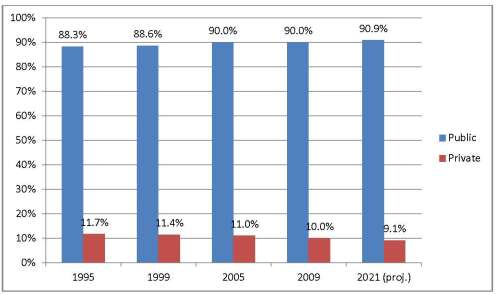
As an additional followup, the US may differ from the UK and Australia in terms of the relative importance of public versus private education.

Enrollment of pre-K through 12th grade

2013-03-28-Chart1.jpg


From Proportion of U.S. Students in Private Schools is 10 Percent and Declining|Jack Jennings

Undergraduate enrollment in degree-granting postsecondary institutions

figure-cha-3.gif


From The Condition of Education - Participation in Education - Postsecondary Enrollment - Undergraduate Enrollment - Indicator May (2014).

Most (all?) of the private for-profit institutions are online.

Steve
 
   / For those retired - do you see college as important as when you were college age? #68  
Thank you for the very informative replies. Pretty much the same basic ages for education, just different names for the schools at each age - except Scotland finishes one year quicker than the other countries, starting the final year at age 16. General level exams two years earlier in all cases, and higher level in final year. All us older folks know these exams have been dumbed down since the early 1960s. In those days a max of 10 subjects at general level and 3 at higher was the achievement of those who were clever enough to warrant State scholarships to the better Universities. Now they come out with 12 distinctions at higher level. Kids cannot possibly be that much cleverer. There is a move to toughen them again. Technical/trades academic qualifications, college and university degrees also similar. PhD normally 4 years research after a Masters, but can take longer.

I do not know the figures between public and private (private being called "public" in the UK for some weird reason) but I have never seen the need for them. If the local school is not good enough, then move for your kids' sake. We moved from Australia to Scotland for that reason, and you cannnot move much further than that. It cost us a lot but was worth it. He was headhunted by one of the examiners 3 days after his oral presentation of his PhD thesis "Stellar Mass Loss in Globular Clusters". That convinced my wife and myself we had done the right thing.
 
   / For those retired - do you see college as important as when you were college age? #69  
Well, I'm no where near retirement, but I'll take a stab at it anyways. I graduated from a local community college (which are all now state colleges with limited 4 year programs) with an A.A.S. in Building Construction. It opened a door for my first job worth much, an assistant superintendent for a multi family contractor. It took the place of knowing someone on the inside or years of proven experience. It has never been a requirement anywhere I've worked but maybe it's helped me get a second look instead of resume getting trashed.

I didn't really want to be in High School, but my mom had put money in a 529, and her husband was a disabled vet; so the VA was giving me something like $500/month if I was a full time student, so I went to college. Once I started it, I approached it like a job, and did very well. After 3 years (had trouble getting the classes I needed to graduate) a large state university (UF) offered me a full scholarship to go there for a B.S. By that time I was sick of school, and at 21 (2004), I couldn't see how I would ever need more than $30-35k/yr; so I turned down the scholarship and went to work. If I was doing it again, I might have done differently, but I don't really regret it.

I have looked a time or two at going back for a B.S. in civil engineering, but of 3 years of school, only 3 classes even count towards anything. And with 3 kids, a wife, and a full time job, it's hard to imagine actually ever doing it.
 
Last edited:
   / For those retired - do you see college as important as when you were college age? #70  
Now that I have a better grasp of what everyone else has been posting, I can respond to the OP.

I left school at 16 with the offer of 2 jobs before I left - one in a bank, the other as office junior in the Town Clerk's office. I took the local authority one, kept studying part-time, moved into private practice law for a couple of years and back to being Deputy Town Clerk at the age of 25 and still without full formal qualifications in anything, just a smattering of "half-way there". I am certain it could not be done now. Too many who make the hiring decisions have been fast tracked themselves and will only employ fellow graduates who are also fast-tracked. No chance of starting at the bottom as I did and reaching the top. In a later foray into local govt (in Australia) I made Directors of both Finance and Admin and Deputy CEO. I had obtained a B.Business majoring in Law and Accountancy on a part-time basis in Australia. I have said to people for many years that it is indeed tough at the top, but only those who have been at the bottom know that it is a helluva lot tougher down there.

Second question - What level? As high as you can possibly achieve. Either direct from school, with no gap years, or start work and study part-time as I did. I sat my last formal exam at the age of 53 although it was more from interest than necessity.

Third question - How long in debt? Obviously as short a time as possible, but unless you are working, have supportive parents able to afford to help, or generous other relatives like grandparents, then it is a question only the individual can answer. Australia and the UK have a system where repayment is linked to earnings in that above a certain threshold there is additional income tax charged to pay for the cost of university fees, etc. Cannot remember the details, but it was acceptable to me and later, my son. Banks will lend more.

Just as an aside, my wife and both her parents trained as teachers in the late 1960s/early 70s in England. There were no fees, and in fact student grants were given. Now fees are several thousand pounds a year.
 
   / For those retired - do you see college as important as when you were college age? #71  
If you trace the rapid increases in college tuition over the last few years you will find tuition increases closely correlate with federal student loan guarantees. The big beneficiaries of federally encouraged student loans have been physical plant at colleges and pay checks + benefits for tenured faculty; not students.

Another example of supply and demand, distorted by (well intentioned) government action, producing unintended consequences.

well said! My school (Virginia Tech) recently destroyed my old dormitory, built in 1957, a perfectly sound building of brick, block, and cement, to build a modern dorm on the same site. They won't admit it, but the old brick building did not match the look of the limestone block exterior of the newer parts of campus, so the old brick has to go. The other matching brick buildings also part of that same quadrangle are scheduled to go away as well. Spending money we don't need to be spending, and celebrating it as we do so!
 
   / For those retired - do you see college as important as when you were college age? #72  
OldMc, having lived in Japan for about 30 years, I understand your confusion with college and university. Everywhere I've been overseas, i.e., outside America, people call school after high school, "university". In America, it's really simple - a college is really just a smaller "university". That is, a college will usually have several 4 year bachelor of arts (B.A.), bachelor of science (B.S.) degrees, and even master's degree programs. Universities will have several colleges under their educational umbrella, e.g., college of education, college of medicine, etc. My wife attended --- 9, 9!! graduate universities in getting her doctorate degree! Whew, glad those days are over.

All in all, I still say, yes, we are very glad that in our younger days, we got post high school education. I do like the idea of more trade, tech, etc. training in our high schools though. Job specific skill training would be great I think.
 
   / For those retired - do you see college as important as when you were college age? #73  
My situation is somewhat different of a lot of others though the outcome is much the same. I have a somewhat similar back round to that of Old Macgregor.

I left school in the UK at sixteen (1961) and started an apprenticeship as a millwright. At 21 I started travelling and spent one year in NZ and three years in Australia, returning to the UK in 1970. During my time in Australia I sailed as a seagoing ships engineer and continued to do that when back in the UK, eventually reaching chief engineer position at 31 years old.

Whilst doing the marine engineering I also studied part time at technical colleges and got both ONC and HNC in mechanical engineering - probably equivalent to associate degrees in USA. I also attended university for two years for a three year B.Sc. in mechanical engineering. Left university to go back to sea to earn more money to pay expenses and never did go back to finish the degree I started - that I regret.
Would I recommend university - yes I would. Would I recommend a tradesman training - yes I would. Both have their place in the working world and I believe that the tradesman's route and then university to be the better way to go. This allows the ability of earning whilst pursuing studies.

I have turned down superintendents positions several times - I just do not have the stomach to deal with workplace politics and the inevitable nepotism that accompanies the politics. I finally quit sailing at 54 years of age and went back to working as a millwright and stationary engineer and enjoyed doing it. I was also making a good wage and was able to be at home every night. I retired in 2005 at 60 years of age.

Over the years I have gotten involved with numerous things that have interested me at the time - all the while learning something new. I think the trick here is that one keeps on learning through out life - whether it be part time at college/university or as a hobby. The more one learns the more that one realizes how little we know as individuals. Like anything else in life, what works for one person may not necessarily work for others on a personal level. However, the more one learns the better equipped we become for what life throws at us.

Just my two cents -everyone has a unique story I am sure.
 
   / For those retired - do you see college as important as when you were college age? #74  
OldMc, having lived in Japan for about 30 years, I understand your confusion with college and university. Everywhere I've been overseas, i.e., outside America, people call school after high school, "university".

Oddly enough everywhere I have lived (England, Australia, Scotland, Portugal) there is a distinction between colleges and universities. In these countries colleges do not normally offer the same standard of degrees as universities, if in fact they offer degrees at all. Things are changing in various ways, but on the whole colleges offer(ed) two or three year courses that do not lead to a degree, being more focussed on the practical skills, including teaching, nursing, etc. My wife and her parents all went to a college. I took my degree in a university. But, in some cases colleges do have a post "diploma" (for want of a better word) course that can lead to a degree. The college my wife attended was one such, but not the colleges my in laws attended.

What is further confusing is that many, but not all, of the most prestigious universities do have colleges under their umbrella as you say, but these are not stand alone colleges in the sense used above, and any qualification is from the umbrella university, not an individual college. The university my son attended in Scotland, did not have individual colleges, but I think the two in England did.

I am sure they just complicate things on purpose. Like private schools being called public as I posted earlier.
 
   / For those retired - do you see college as important as when you were college age? #75  
"..Given this countries, and the world wide shortage of RN's, the vast majority of facilities hire any one with a nursing degree and a pulse...."


I have a relative who works as a professor at a nursing school, and she says this is no longer the case.
 
   / For those retired - do you see college as important as when you were college age? #76  
I have a relative who works as a professor at a nursing school, and she says this is no longer the case.
There are approx 2,700,000 employed RN's in the USA, and the demand for nurses is predicted to grow 19% through 2020.

The current demographics show roughly an equal number of ADN and BSN's in the workplace.

Every few years the powers that be declare that RN positions will require a BSN. The current 'goal' is 80% by 2020. This is of course preposterous since baccalaureate programs are turning down tens of thousands of qualified applicants annually due to a lack of qualified instructors

Given the logistics involved it takes twice as long to produce BSN compared to an ADN and the current BSN teaching facilities can't possibly gear up to meet expected demand. The answer to this situation is encourage the use of ADN programs and vastly expand the online options for an ADN to become a BSN. This method offers the potential to double the number of available RN's compared to a standard 4yr BSN program.

Until such a time as the above occurs, BSN 'preferred' will be seen in a lot of ads if the goal is to ensure adequate staffing.....
 
   / For those retired - do you see college as important as when you were college age? #77  
The fact is college degree opens many more doors. Having a degree show your prospective employer that you have at least some brain power to do a job. I don't have a college but I had some experience in the field of my current work.
When I was hired I got low start pay and I was told that what I was getting was opportunity. Now I earn quite high income in lower six figures. I got several job offers from our clients but when they found that I don't have a degree they lowered the offer to about half of what I am making now. Even though I am very skilled at my job I can't work for clients in Canada because I have to show college degree to get a work permit. But guys with a degree I am training can get it.
It is also up to a person how much knowledge he or she learns at the college. Some kids just pass trough and others learn a lot.
 

Marketplace Items

5th Wheel Hitch (A59230)
5th Wheel Hitch...
2021 CATERPILLAR 308CR EXCAVATOR (A60429)
2021 CATERPILLAR...
(2) 6 LUG WHEELS/GOODRIDE ST225/75D15 TIRES (A60432)
(2) 6 LUG...
UNUSED FUTURE D39-39" HYD TRENCHER (A60432)
UNUSED FUTURE...
HIGH END MINI GOLF CART (A58214)
HIGH END MINI GOLF...
(2) UNUSED 31" X 8 MM EXCAVATOR TRACKS W/ PINS (A60432)
(2) UNUSED 31" X 8...
 
Top