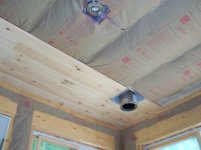
Spray Foam Question

   / Spray Foam Question #21  
I suggested in an earlier post to use Roxul, it is rock wool and much more dense than old school fiberglass so you get higher R value per inch of thickness. You can buy a 2 can spray foam kit with DVD for install directions and complete with hoses and do a bathroom or similar in no time. We just used Touch-n-foam system 600 on our bath remodel, and it worked great. Once and done. Touch 'n Foam - Energy Savings Tips - Save Energy with Spray Foam Insulation We foamed the exterior and interior walls and newly created cathedral ceiling area, AFTER creating a Rafter bay air chute, (like would normally be done with the thin styrofoam baffles), from 2" rigid foil faced foam board called Tuff-R. We then shot the touch-n-foam spray over those rafter bays underneath the Tuff-R to fill in the rest of the void. The foam makes for NO drafts, is CLOSED cell, dries quickly, provides for consistent R value, etc. In the wall cavities. We used Roxul to fill the remaining void, and as a means of sound deadening. ROXUL DIY | ROXUL COMFORTBATT Thermal Home Insulation

Here's the kind of nightmare to avoid, especially with know nothing open cell foam 'experts'!

We previously had a professionally built huge 30 x 30 plus 10 x 15' mudroom added onto our Cape here in VT the dining room and kitchen were cathedral ceiling with roof trusses. We used blueboard between the truss bays then sprayed foam under the blueboard to create what was supposed to be a complete sealed interior space with the attic space above closed off to any air passthrough: no soffit vents, no gable or ridge vents. Just dead air, so cold could not penetrate the interior from the 'attic' and no heated/conditioned air could escape to atmosphere.
Well, the end result was a climate all it's own above the T&G poly coated pine plank ceiling! We literally had rain coming down everywhere in our dining room! This went on for several years while I considered everything that might fix it. Water was running down the interior walls, dripping out of Bose in ceiling speakers, running down the Hubberton Forge chandelier into the electrical cluster for the lamp; it was one huge nightmare with differing opinions on cause/effect and how to solve without destroying the addition in the process.
Just this past spring I had a local carpenter start by cutting a ridge vent and gable end vents. He said he could smell the mildew when he climbed to the roof peak on the gable end to remove a 4" round vent we had previously installed to see if it would allow some air flow to see if that changed anything.
What was even weirder is I could hear little ice balls dropping from the underside of the roofdeck and rolling down the backside of the cathedral ceiling until they would hit cross bracing. We figured out after the ice would drop from the roof deck it then melted at the cross blocking and then would somehow leak through and drip onto the dining room/kitchen area or run down the walls. Freaking crazy stuff going on?!

We need to go through this winter and spring to know if we've completely solved the problem. People ask why I didn't spray directly to the underside of the roof deck. I had read about shingle companies back then claiming to void shingle warranties if the underside of the sheathing was foamed, so I came up with our design. It might have worked better if the spray foam had done a better job of stopping any heated air from escaping into the unheated dead air space above; according to the energy audit people I hired to perform an analysis of what might be happening in the attic space to allow rain in our living space. They told us the spray foam industry varies wildly in terms of skill level/experience of the installers, the products used, the proper application and the final results due to the chemicals mixing on site in the spray truck, the climate locally when the chemicals are sprayed, humidity, temp., etc.
We became concerned if mold/mildew might form between the foam and the backside of the pine planking, because it was dripping water at it's butt joints, that's another reason for the energy audit too.
 
   / Spray Foam Question #22  
Thanks everyone for reinforcing what I've researched over the last few days..My answer is --it ain't gonna happen...The roof with deck would cost probably 15-20k to replace if it got wrecked..Not worth the risk.

I asked the sales guy, the owner and left a message with the factory rep regarding the open cell sucking moisture and rotting the roof deck..The lack of response is telling beyond belief-- The sales guy had the nerve to say "I've been selling this for 5 1/2 years and never heard of this" --Yeah, that's a gnats life in the bigger scheme of things...

I'm going old school and using fiberglass for better or worse. My primary goal was my daughters comfort so I'll have to take my good old time insulating this...

Any suggestions for fiberglass on a cape with knee walls is more than welcome...

Thanks again everyone for helping me with this potentially expensive and wrong decision..:drink:

I think a cape is a perfect place to use CLOSED cell foam. If for nothing else at least the rafter bays. I think you would be very happy doing closed cell for the ceilings. The sun is killer on your a/c in a cape. Just an example i had to do fire damage repair in an attic of a home in the summer. If it wasn't for the closed cell foam no way in **** would you find me working up there. It really did prove to me that it is worth the money. By the way just to let you know the spray foam actually saved the house from fire doing more damage.
Good luck on your project.
 
   / Spray Foam Question #23  
Traditional cape-style homes are easy on the eye and economical to build for the space. Capes and cathedral ceilings do come with some built-in energy challenges though that didn't used to be an issue when heating oil was $1/gal and people had lower comfort expectations. Some attempts to work around that inherent design issue end up being worse, as in Coyote machine's example.

Bottom line, you need a lasting roof/ceiling system that will give you a minimum of R-50 insulation with very limited air infiltration--a goal that is in conflict with the design limitations. I wonder if someone manufactures special truss and roof systems for these cape-type problems? I would think there would be a market for that sort of approach.
 
   / Spray Foam Question #24  
Does the house have a heat recovery ventilation system? That will go a long way toward reducing the moisture load, regardless of what type of insullation you end up with.
 
   / Spray Foam Question #25  
In all of these insulation threads, I have sung the praises of rock wool. Easy to install. Great R value. The only downside is the cost.

If Roxul Comfortbat is available in your area, I suggest you check it out. As I go through my house, I'm removing fiberglass bat and replacing with Roxul.
 
   / Spray Foam Question #27  
Spray foam has its place but underside of the roof is not the place to use . It's causes premature failure of the roof. Shingles will blister and fail and when they fail the roof deck will be rotten before it is discovered. The manufacturers will deny the warranty if failure is due to inadequate ventilation. If you have to spray the deck install a flute between the rafters to allow air flow from soffet to ridge. If money is no object or you have a cathedral ceiling use a vented nail base on exterior deck and you will be good. While I benifit from these roofs failing in my business. I feel people should understand that the savings on heating and cooing
Will be spent on roof replacement or roof repair. If the attic is just an attic, spray the attic side of the ceiling
Save your money .
 
   / Spray Foam Question #28  
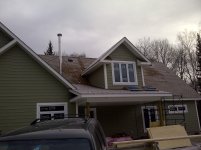
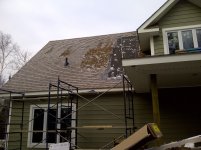
Here are a few pictures of a recent built (2012) cape cod insulated with fiberglass insulation. I had R 60 on the flat areas, R13 plus 3" of rigid foam on the verticals and R40 (2 x R20 batts on the angles) with 1.5" of venting between insulation and the roof deck.

Pictures taken late fall 2012(Builder said that this was normal):
IMG-20111224-00092.jpgIMG-20111224-00088.jpg

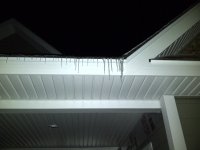
Picture taken early winter 2012(Builder maintains that this was normal):
IMG-20111209-00030.jpg

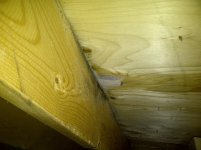
Picture taken of roof plywood removed and trusses 6 weeks after the home was insulated:
IMG-20111221-00086.jpgIMG-20120104-00128.jpg

We tried to seal up the vapour as best we could once the issues were discovered:
IMG00519-20120111-1033.jpg

After the builder tried to fix the problems for the 3rd attempt using conventional fiberglass insulation I insisted that the architect's recommendation to use spray foam be followed. During winter 2013 we could not see any frost/snow melting or any ice forming on the edge of the roof.

CT
 
   / Spray Foam Question #29  
CT-
Where is the venting for the attic of that gabled roof?

.
 
   / Spray Foam Question #30  
CT-
Where is the venting for the attic of that gabled roof?

.
I see a couple of turtle vents up there, if that's the only vents, there is going be a lot more problems
 
   / Spray Foam Question #31  
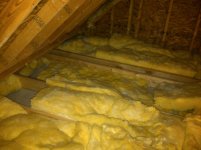
i have a modular built cape, and prior owner's finished the "attic" into 2 bedrooms and a bathroom.
there is a flat ceiling in the rooms, with unfinished cold space above.
differences here that i can point out is the modular came with the main level ceiling insulated and
plywood on top of the joists to create the 2nd floor. I have done some remodeling of that bathroom
and noticed it was insulated well. it's above this level the problems start. the roof system
of these modulars comes folded down for transport, and i believe they hinge the top portion up into place as they set
the sections together. this roof section seems to be made with 2x4's with a lot of extra cross bracing etc.
in comes somebody to build rooms, and knee walls are built 4-5' in from the eaves. sheetrock was put on
the bottom of the 2x4 rafters for the sloped portion of the ceiling . bat insulation on the top of the ceiling, in the roof rafters between the
sheet rock and plywood on the sloped ceiling, and then bat insulation in between the knee wall studs.
cold cold cold up there, as i'm sure it was very shoddy work to begin with, but by insulating the sloped ceiling
it cut off airflow from the soffit vents up to the attic ridge vent. so the soffits and behind the knee walls is cold air
with no place to go, and i'm sure it comes thru the wall. in the attic all insulation ends up above that ceiling,
of which i posted a picture. (first thing we did after closing was have all that insulation re-positioned as in
the picture it's quite scattered!)
i have pondered the same question. tear off the sheetrock, spray foam it all and close off the eaves,
or, build baffles and then spray foam, but with only a 2x4 to work with by the time we install a baffle
it doesn't leave much room for insulation. then i'm not 100% sure that those areas on the sloped
ceiling that are sheetrocked don't have a cross brace in like there are above the ceiling.
currently we have those rooms closed off, nobody lives with us, except for when we have visitors.
Chateauguay-20120206-00134.jpg
 
   / Spray Foam Question #32  
Good Afternoon Tim,
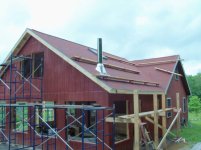
I used conventional fiberglass insulation when building the addition on my Vt home. I had the thread of this project posted in this forum, don't know if you saw the thread or not.http://www.tractorbynet.com/forums/projects/312830-familyroom-addition-our-cabin.html

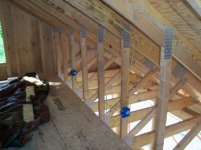
The addition was 18' by 28', and we used 8/12 trusses on 24" centers. Using these trusses gave us a 14' wide room upstairs with a 4' knee wall. I stapled Perma Vent to the roof sheathing in between the trusses giving ventilation from the eaves to the ridge vent. I used conventional faced fiberglass in between the trusses from the roof peak down to both of the knee walls. The family room ceiling was also insulated using conventional faced fiberglass R-38. We wanted a bit more insulation in that ceiling, so we blew in some cellulose insulation on top of that, and then insulated the knee walls.
We haven't really gotten into any severe cold weather yet, but so far I am thinking this room is going to be easy to keep warm. We used 2" by 6" wall construction, again using fiberglass faced there also.

I am not sure you can tell by the last picture, but the insulation hanging down from the ceiling, drooping down between the trusses, along with the added weight of the blown in cellulose, made for a real chore trying to put up that V groove pine ceiling, since I was working by myself ! :(

But we managed to get it done ! :)
 

Attachments

  • backroof.jpg
    backroof.jpg
    570.6 KB · Views: 133
  • 100_4671.jpg
    100_4671.jpg
    664.2 KB · Views: 140
  • fmrmwire.jpg
    fmrmwire.jpg
    619.2 KB · Views: 134
  • 100_4693.jpg
    100_4693.jpg
    537.5 KB · Views: 144
   / Spray Foam Question #33  
Very nice Scott!
i miss building stuff like this! makes me want to tear my 2nd floor off and build on
a whole full 2nd story!
but it is just the 2 of us, sort of hard to justify.......
 
   / Spray Foam Question #34  
I see a couple of turtle vents up there, if that's the only vents, there is going be a lot more problems


Could be. I was thinking those were possibly for kitchen/bath exhausts.

Nothing on the ridge. Nothing on the soffit. Maybe something on the gable end?

I dunno. Doesn't look good to me.
 
   / Spray Foam Question #35  
CT-
Where is the venting for the attic of that gabled roof?

.

You are correct, the initial design didn't provide enough venting. A ridge vent was added by the builder at the same time as the spray foam was installed. A ridge vent was also installed on top of the two dormers.

CT
 
   / Spray Foam Question #36  
Very nice Scott!
i miss building stuff like this! makes me want to tear my 2nd floor off and build on
a whole full 2nd story!
but it is just the 2 of us, sort of hard to justify.......

Good Evening Dutch,
Thanks, yep this was the last big project up here ! Did the barn in 2010, so this is it. We are in the same boat, just the two of us now with an occasional guest !:)

Hope Tim gets his problems straightened out !
 
   / Spray Foam Question
  • Thread Starter
#37  
Thanks guys...Mine is also a modular cape like Duch but the 2x's are 2x6 and up except for the 6' knee walls which are 2x4. There is no excess bracing as the original lumber from all appearances looks stick built beyond the hinging points which aren't very obvious unless you know what you're looking for...

Anyway, radio silence-still--from the foam contractor and supplier...Done with them. Going to put airflow baffles in every bay then follow with fiberglass..the Rock stuff suggested is only available as a sound deadener around here. Will go as high an R as possible for the spaces I'm working in. Should have the HVAC done this weekend, run some cable/phone/speaker wires and it's insulation time.

The primary reason for the spray foam was my daughters comfort, not resale or any other potential benefit. I'm going to do the best I can with what I have to work with.
 
   / Spray Foam Question #38  
You are correct, the initial design didn't provide enough venting. A ridge vent was added by the builder at the same time as the spray foam was installed. A ridge vent was also installed on top of the two dormers.

CT


Was a soffit vent installed?
 
   / Spray Foam Question #39  
i have a modular built cape, and prior owner's finished the "attic" into 2 bedrooms and a bathroom.
there is a flat ceiling in the rooms, with unfinished cold space above.
differences here that i can point out is the modular came with the main level ceiling insulated and
plywood on top of the joists to create the 2nd floor. I have done some remodeling of that bathroom
and noticed it was insulated well. it's above this level the problems start. the roof system
of these modulars comes folded down for transport, and i believe they hinge the top portion up into place as they set
the sections together. this roof section seems to be made with 2x4's with a lot of extra cross bracing etc.
in comes somebody to build rooms, and knee walls are built 4-5' in from the eaves. sheetrock was put on
the bottom of the 2x4 rafters for the sloped portion of the ceiling . bat insulation on the top of the ceiling, in the roof rafters between the
sheet rock and plywood on the sloped ceiling, and then bat insulation in between the knee wall studs.
cold cold cold up there, as i'm sure it was very shoddy work to begin with, but by insulating the sloped ceiling
it cut off airflow from the soffit vents up to the attic ridge vent. so the soffits and behind the knee walls is cold air
with no place to go, and i'm sure it comes thru the wall. in the attic all insulation ends up above that ceiling,
of which i posted a picture. (first thing we did after closing was have all that insulation re-positioned as in
the picture it's quite scattered!)
i have pondered the same question. tear off the sheetrock, spray foam it all and close off the eaves,
or, build baffles and then spray foam, but with only a 2x4 to work with by the time we install a baffle
it doesn't leave much room for insulation. then i'm not 100% sure that those areas on the sloped
ceiling that are sheetrocked don't have a cross brace in like there are above the ceiling.
currently we have those rooms closed off, nobody lives with us, except for when we have visitors.
View attachment 395685
We have the same problem, but our house was stick built and the room in question is the master bedroom...

Aaron Z
 

Tractor & Equipment Auctions

1453 (A57192)
1453 (A57192)
Towable Centrifugal Water Pump (A59228)
Towable...
INTERNATIONAL FLAT BED TRUCK (A52707)
INTERNATIONAL FLAT...
2019 MACK GRANITE (A58214)
2019 MACK GRANITE...
iDrive TDS-2010H ProJack M2 Electric Trailer Dolly (A59228)
iDrive TDS-2010H...
Lone Star dump trailer (A55973)
Lone Star dump...
 
Top