JD 24volt charging

   / JD 24volt charging #21  
So I talked with a John Deere service tech this morning. His words are that both the battery's are charged in parallel and the starter draws the current in series. That's what the wiring diagrams that I have show too. So you aren't going to charge a 12 volt battery with 24 volts, therefor the generator is 12 volts unless you want to add up the two outputs and say it's 24 volts.

All I know is that if you want to repair the system you need to understand it. The generator has two separate 12 volt charging circuits in it. Both are controlled by one voltage regulator. If you add a load to one battery like a radio, or a fan for the cab, or a monitor for a round baler sooner or later you are going to have one dead battery. It was definatly an ingenious engineer that developed the system. What he forgot about was that over time a burnt out light bulb, some extra resistance somewhere, or accessory's would change the way the battery's needed to be charged. That's why John Deere came up with a change over kit. I just buy the starter and do the rest myself as the John Deere kits are pricey. A 12 volt 3020 starter on eBay used to be around the $200 mark.

Tx Jim I don't really want to get into a big argument with you. If You want to stay with the idea that everything you say is fact go ahead. Maybe John Deere built tractors differently for the Texas market. There are lots of things I don't know, but i do have a basic understanding of how a John Deere 24 starting system works. Thanks to you I now understand it better that I did before.

txjim is 100% correct. as much we enjoy yanking each other's chain.
 
Last edited:
   / JD 24volt charging #22  
By now the bulk of the split system tractors have been converted to all 12v. Your biggest expense is a 12v starter, after that pretty minimal parts needs. There used to be a kit for 4010's, early 3020's etc but not aware of one ever for the 5020, probably because it already had an alternator. Can't really blame the local dealer for not stepping out every step that needs to be taken though in the greatest of detail, its how they make a living.

24V 5010 had a generator. The "side console" 5020 was 12V with a negative chassis system.
 
   / JD 24volt charging #23  
The tractor is under s/n 25000. Has a 24v starter, but the alternator says delco 12v negative on it. The alternator has 2 output terminals on the back that are both isolated from the frame. There are also 2 flat faston type terminals in the side of the alternator. For voltage to power the regulator and field? Do you have anything on how to connect the fastons or how to charge a pair of 12v batteries in series? I haven't opened the alternator up to confirm that the regulator is 12v. If it had been modified to 24v, that would make it all simple. The wiring diagrams I have show 3 terminals on the alternator, so this is probably not the original alternator. Still, the original alternator is listed as 12v, so there is that persistent problem of how did they charge 24v of batteries with a 12v alternator?

There were a few rare 24V alternator's that had pos and neg isolated from the chassis. If this is so, then it's just a matter of proper wiring.
 
   / JD 24volt charging #24  
These tractors charged with a 12 volt alternator because the alternator or generator has two separate 12 volt terminals. One for each battery. The battery's are isolated from each other so then it works. The battery's are connected in series for starting. I don't understand how it all works and they whole setup is an interesting bit of engineering that works as long as you don't pull too much power from one battery as there is only one voltage regulator.

As long as you keep all your light's working and don't add something to one battery like a monitor for a round baler for example then the load is pretty even on both battery's and one voltage regulator can do the job. The whole system is a bear to figure out and most people just switch to a 12 volt system as it's not hard to do and it's easier to understand.


Never seen an alternator with anything but one set of three phase windings on the stator. I suppose it could be done but why bother ? There would not be enough room to mount two sets of rectifiers in one alternator . A pair of external rectumfires would be required.
 
   / JD 24volt charging #25  
So at first I was going to hotly contest this as I was sure that I was right. Then you started me thinking and I went and pored through my books to see if I was right or not. The books I have (I&T manuals) didn't really give a whole lot of details but it did show me that one battery is charged on the + terminal and the other is charged on the - terminal suggesting two separate charging circuits of 12 volts each.

So I waited till my favourite electrical repair shop was open and I phoned him and asked whether the 3020,4020,5020 had a 24 volt generator on a 24 volt system. He told me the same thing I told you guys. It's a 12 volt generator with two separate charging circuits. One for each battery. I quote "The only thing on those tractors that is 24 volts is the starter and part of the dash depending on the serial number break".

Now as far as the John Deere conversion kit goes yes you would have to change both the starter and the generator if you are converting to 12 volts. The generator for a 24 volt system is different that one for a 12 volt system because of the two separate charging circuits in the 12 volt generator for a 24 volt system.

Now my buddy did look it up in his parts books and he told me that there were only two different generators available for John Deere 24 volt systems. I'm not 100% sure on this but if the tractor has a factory alternator then it should have a 12 volt starter. The only exception to this would be if someone has installed an alternator and a series/parallel switch so that they can still use a 24 volt starter. A series/parallel switch is a heavy duty solenoid which changes battery connections to serial for starting and leaves the connections parallel the rest of the time. John Deere's do not come from the factory with a series/parallel switch so if your tractor has one it's been added by a previous owner.

The only two Delco generators used back in the two cylinder days was a 10amp for ag tractors and a 20amp for industrial.
I'm away from my JD books at the moment to verify new generation amperage .
 
   / JD 24volt charging #27  
The Delco generator's that JD bought used a single 24V main winding and rotor. A commutator rotor is capable of only a single DC circuit.
I do own an AC three phase 240V generator with a stationary field and revolving stator which uses three slip rings to pickup the AC. It's a rare odd ball device. No neutral unless the centre tap of an external Wye transformer is used.
 
   / JD 24volt charging #28  
You are right Tx Jim on the alternator, but I was talking about a generator.

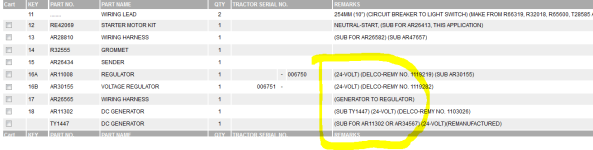
Generator JD utilized on 24 volt systems were also 24 volt not 12 volt. Supply this forum with a part number of this phantom 12 volt generator utilized on a JD 24 volt system
 
   / JD 24volt charging #30  
I see 24 volt but no mention of 12 volts on 24 volt system
 

Attachments

  • Capture.PNG
    Capture.PNG
    33.3 KB · Views: 173
   / JD 24volt charging #31  
Some wild tinkerer has removed the 24V generator which floats electrically isolated from the chassis and probably jammed on a 12V neg chassis alternator?
It maybe time to entertain a 12V conversion using the mighty Delco 44MT. It's a PM gear reduction starter that will wail an engine over like few starter can.
Lots of warm weather uses install a 4KW nipper but there is a 5Kw nipper that turns a 531 cu better .

That's what I say, convert it. But op does need to be careful that there is enough room for a gear reduction starter due to their taller nature. The fuel filter set up (depending on version op has) could also be in the way, but easily remedied. But I am not as familiar with potential room issues on the early 5020 as the 10's and early 20 series utilities. There is just to many aftermarket choices for decent $ out there to continue to diagnose an obviously tinkered with electrical system.
 
   / JD 24volt charging #32  
The 44MT is an inline design unlike the Denso with the offset motor . The Delco 44MT may fit in places the less powerful 4 or 5 KW Denso won't.
 
   / JD 24volt charging #33  
   / JD 24volt charging #35  
What you need is called a Series parallel switch.
Large construction equipment and 18 wheelers from the 1970's used them all the time.
Here is a link showing how they are connected and where to buy.
You charge at 12 volts and start at 24
12/24 Volt DC 1500 amp Series Parallel Solenoid Relay.
Dave M7040

Before I installed a parallel switch on a JD 24 volt system I'd advise to just change it over to straight 12 volts and be done with it.
 
   / JD 24volt charging #37  
I worked for a farmer in my younger days that had a 4010 with a series parallel switch in it. Most of the time it worked ok but when it didn't it was a pain.

A series parallel switch is about $120 -$150 on the internet and a rebuilt delco 12 volt starter is about $300. I would go with the starter.
 
   / JD 24volt charging #38  
A JD technician I know installs new Iskra starters when he converts 24 volts to 12 volts. New Iskra starter cost about $325
 
   / JD 24volt charging
  • Thread Starter
#39  
Wow, I've been too busy to check here for a few days. I didn't mean to start an argument. Thanks to all for the ideas and links to possible options to solve the problem. Between the I&T manual that I found, the parts guys at the local dealer and a lot of brain picking of the old timers around here, I have come to terms with the whole 24v thing. It's essentially the same as house wiring, where you get 110v between the hots and ground, and 220v between the hots. I've done enough wiring and working with electronics with bi-polar power supplies that I'm not too worried about putting it back on this tractor.

Provided the alternator works, I'm just going to keep the 24v setup. Why spend the money to fix what ain't broken? That leaves me with 2 questions:

The alternator has 2 terminals in the side to power the field and regulator. Does anyone know the polarity on them? If I can power that up, I can see if it's 12 or 24V, or working at all. The outputs are isolated from the frame as someone had said, and it apparently charged the batteries, so it may be 24V even though it's marked 12. Based on the serial No. of this tractor, it shouldn't even have a delco alternator. With all the hacking that was done on the electrics in this tractor, anything is possible.

TxJim, can you post a better picture of that fuse kit that was installed to prevent fires, or give me a part number that I can take to the dealer?
 
   / JD 24volt charging #40  
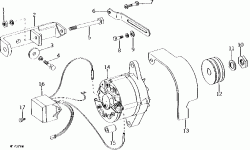
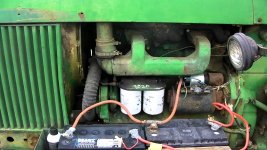
The breakers that were field installed have no illustrations(photos ) in JD parts catalogs. Part number for breakers is AR47660. Can you post a photo or part numbers for the alternator on your tractor? Here's is the parts photo of the Motorola 24 volt alt that the very few 4020's with AC cabs came with from the factory. I found a photo with the mounting bracket for a 3020 which should be very similar to 4020 BUT bracket & breakers are mounted to starter incorrectly but will give you the idea.
 

Attachments

  • R13766_________UN01JAN94.gif
    R13766_________UN01JAN94.gif
    10.9 KB · Views: 161
  • maxresdefault.jpg
    maxresdefault.jpg
    112.3 KB · Views: 183

Tractor & Equipment Auctions

2012 MACK Tender Truck w/ADAMS Rear Discharge Bed Auger (A56438)
2012 MACK Tender...
Dump Truck Body with Tarp System (A55851)
Dump Truck Body...
2021 KOMATSU WA200-8 WHEEL LOADER (A60429)
2021 KOMATSU...
Ratchet Straps (A59230)
Ratchet Straps...
1996 FORD F SERIES DUMP TRUCK (A60430)
1996 FORD F SERIES...
2011 Chevrolet Silverado 2500 Pickup Truck, 127808 Miles, Utility Rack - GREAT WORK TRUCK (A56438)
2011 Chevrolet...
 
Top