Splitter question

   / Splitter question #1  

handirifle

Veteran Member
Joined
Jul 2, 2010
Messages
1,727
Location
Central Coast of CA
Tractor
Massey Ferguson 1010
Before I order a tank for my splitter, I want to ask you guys to be sure. My tank will have to mount beneath the pump. Seems someone here before told me the pump WILL pull the fluid up, correct?

If I were to make it so the pump is below the tank, it will cost me a lot more $$$ than I really want to invest in this splitter.

Thanks in advance
 
   / Splitter question #2  
as long as there are no air leaks on the suction side and you squirt a little hydro fluid into the pump suction before you put the suction line on , it should prime just fine.
 
   / Splitter question
  • Thread Starter
#3  
OK great thanks. I suppose if I ever run into issues I will have to re-position it.
 
   / Splitter question #4  
don't think it will work, if pump doesn't have suction tube to pull the oil up
 
   / Splitter question
  • Thread Starter
#5  
Hmmm, already ordered it..... I MIGHT have a way in mind to mount it higher. Won't look as good, but function is more important than for at this point, for me.
 
   / Splitter question #6  
You have a gear pump and in proper working order they will lift just fine. Centrifugal pumps are the ones that you have to prime as with no fluid, they have nothing upon which to build a vacuum and move the fluid. Height depends upon the pump. Obviously to create a vacuum and "suck" you need to be able to create a vacuum.....aka no leaks as bladehauler mentioned.

One thing you can do that will surely help is to put a (sideways) P (trap)in your line preceeding the pump which will retain oil when the pump shuts off and upon restarting it will ensure a solid vacuum to get the fluid flowing.

Other thing is on feed line 1" for a ¾ pump discharge sort of thing.....don't want the pump to have to "beg" for fluid to move. That creates negative pressure (vacuum) and vacuums make bubbles and bubbles make for cavitating pumps which heat fluid and makes it run hot besides reduction in pumping volume. Don't over do it on the inlet size because on the other side, you look at the volume of air in the inlet hose and the smaller the diameter, the less trapped air and faster the pump will load up and pump.
 
   / Splitter question
  • Thread Starter
#7  
Would I use a 1" return line if the fitting threads are only 3/4" or smaller?

By a sideways ptrap, do you mean "partly" sideways? Otherwise I can't see how one level sideways would retain oil, would it not flow out as well?
 
   / Splitter question #8  
Would I use a 1" return line if the fitting threads are only 3/4" or smaller?
On the splitter I built:

1" suction line feeding the pump (which is above the reservoir)

1/2" pressure lines

Two 3/4" return lines, tee'd together just before the filter (I have two valves: one for the ram and another for the log lift, return line on each)

That's an 11 or 13 gpm Barnes splitter pump, pushing a 4" cylinder with a 24" stroke. Cycle times are very respectable, at around 10 or 11 seconds round trip. No problem with the pump picking up the fluid the 6" or so that it needs to from the reservoir.

You want the return lines larger than the pressure lines to reduce velocity/pressure.
 
   / Splitter question #9  
What whis was saying is where ever the suction line is pulling from, must be under the level of the oil. IE, bottom of the tank, or have a suction tube.

What's the rest of the details of the build? Motor and pump size? Cylinder size? Horizontal or vertical?

Get the biggest lump the motor will run. That's the speed.

I built mine with a 16.5hp motor and 22gpm pump. And IIRC 1-1/2 suction hose pulling through a strainer, 3/4 pressure lines, and either 1 or 1-1/4/return thru filter. Feeding a 4" cylinder. I like speed.
 
   / Splitter question
  • Thread Starter
#10  
This is pretty much pre built. It has a 5hp Honda, and I posted some data on here (somewhere) what pump it has. I will try to look it up. I think they said it works out to about 18-20 ton.

I might end up re-doing this whole set up. As it is, the exhaust from the motor aims pretty much right at me, but is deflected upwards. Still not ideal. The pump mount is welded on the top beam so that is the only thing that will be an obstacle to a remount. I am thinking this because as it sits, the weight forward is almost more than I can lift, to hook or unhook from a trailer hitch. If I remount everything, I can change the direction of the exhaust, put the fluid at pump level, and put more weight behind the axle to make it easier for me to hook up.

Still thinking the last part over, not sure I will commit to that yet.
 
   / Splitter question
  • Thread Starter
#11  
OK found my old post. It has a 4" dia cylinder, rod I still didn't measure but it's a 1.25 or 1.5 with a 21" stroke. Engine is 5hp Honda, pump is Northern Tool 1012 11gpm 2 stage.
 
   / Splitter question #12  
Pretty common combo. Gpm and smaller cylinder is where the speeds at. You won't really want anything smaller than a 4", and with your 5hp, more gpm isn't really an option either
 
   / Splitter question #13  
Would I use a 1" return line if the fitting threads are only 3/4" or smaller?

By a sideways ptrap, do you mean "partly" sideways? Otherwise I can't see how one level sideways would retain oil, would it not flow out as well?

I used the word P in that P traps are designed to hold liquids for a particular reason...like in sewer systems to seal off sewer gasses from sinks, tubs, and showers.

Yes on the positioning to ensure a supply of fluid at the pump inlet. Surely most of you have seen fluid movement in clear lines where on one occasion you have fluid left in the line at the pump with an airspace to the sump where in another situation you had the air space at the pump. Having the fluid gives the sump fluid movement some kinetic energy to keep moving once it gets started by the fluid at the pump inlet and seals off any bypass leaks that may exist at the pump gears, ensuring a better vacuum.
 
   / Splitter question
  • Thread Starter
#14  
I do have a Briggs 15hp engine that is in an old mower, that no longer mows. But for now the little splitter does what I need so no need to get crazy on size. I moved some lines around, removed the old tank and welded some brackets on for the new tank, so it is mounted beside the pump, so no concerns about feeding issues. Thanks for the good feedback. It made me more determined to set it higher.

Now I have some more questions.

It came with a 1 1/2" outlet port and 3/4" inlet port. The pump uses 3/4" threaded fittings, so is there Some advantage of running a larger line from the tank to a 3/4" fitting? If I did run, say a 1" or 1.25" line, how do I step that down to the 3/4" at the pump?

Also, with my 11 GPM pump and a 3/4" return feed line is there a particular size/style filter I should use?
 
   / Splitter question #15  
The suction and return is low pressure. Just plain pipe fittings will work. A bell reducer where you need to step down. There is still benefit to running larger line.
 
   / Splitter question #16  
I do have a Briggs 15hp engine that is in an old mower, that no longer mows. But for now the little splitter does what I need so no need to get crazy on size. I moved some lines around, removed the old tank and welded some brackets on for the new tank, so it is mounted beside the pump, so no concerns about feeding issues. Thanks for the good feedback. It made me more determined to set it higher.

Now I have some more questions.

It came with a 1 1/2" outlet port and 3/4" inlet port. The pump uses 3/4" threaded fittings, so is there Some advantage of running a larger line from the tank to a 3/4" fitting? If I did run, say a 1" or 1.25" line, how do I step that down to the 3/4" at the pump?

Also, with my 11 GPM pump and a 3/4" return feed line is there a particular size/style filter I should use?

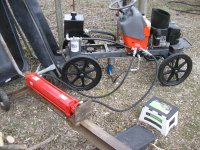
Northern tool has the filter for that application and the mounting bracket. Several years ago I took an old Scotts mower with a 15 hp Kohler and with parts bought primarily from NT, I stripped the frame, kept the engine and made a power unit for my splitter. In all the pre-reading literature that I was able to find, size and length of hose matter. The inlet to the pump always has to be larger than the outlet to ensure the pump has an uninterrupted supply of fluid to prevent cavitation. Mounting the tank above the pump worked out real neat for me...put the tank where the seat used to be but there are other ways to supply fluid to the pump.

A reduced sized fitting is not the same as a small line in terms of resistance to flow so even though you have small ports on the pump, keep the hoses short and large. NT also has the valve at a reasonable price that is made especially for the LS application.

This rig works for me. I used to use my tractor but gpms were too low so I bought a 2 stage 16 gpm pump (blue thing under mower frame) from NT that only needed 8 hp to operate as designed and pulled this old Scotts out of the trash pile. The 15 is plenty of power. Cycle time is less than 10 sec in both directions unloaded (no log).
 

Attachments

  • P1010131.JPG
    P1010131.JPG
    668.7 KB · Views: 182
   / Splitter question #17  
What is that above the pump and how far is the pump from the ground?
 
   / Splitter question #18  
What is that above the pump and how far is the pump from the ground?

I had to mount the pump under the carriage due to the direction of the engine shaft rotation and required direction for the pump....made things a little awkward. I originally wanted to have the tranny belt remain for mobility purposes (put the mower in the shop and cylinder/ram sits outside under the old cattle feeder you see next to it) and use the mower deck pulley to drive the pump but I was too close to the ground and had other issues with the frame getting in the way of the pulleys and belt. Didn't matter as with the wheel/solid tires I also got from NT (20" as I recall but may be 16), it is not only farther off the ground but very easy to roll as compared to the OEM tire/wheels that came on the mower.

Initially I was going to mount the pump to one side of a plate and with a hole in the plate, mount the pulley on the other side....direct connection all on top of the frame. However, in my readings and looking at machine drawings of the pumps, I learned that these little inexpensive pumps cannot tolerate lateral pressure for any length of time as the shaft has no lateral support bearings and as stated, I needed the correct rotation.

That complicated the design and required the tires/wheels as installed to get some ground clearance, currently about 3"....plenty for my place with rolling hills.

The interface of which you are asking is the adapter that NT also sells and inside are the Lovejoy brand connections which allow the pump to provide radial torque with no lateral stress....also from NT. Note that in the NT Lovejoy catalog excerpt, look closely at what you are buying. Unless specifically stated, you are only buying one half the required connection.....the drive and the driven shafts both need a connector.

A Lovejoy connector is a sexless 120 degree 3 pin/slot hootus with a thru hole and woodruff key for the shaft. When mounted in the Lovejoy frame mentioned, they don't actually touch until you turn a shaft.....thus no lateral pressure.

On the cycle time the cylinder is a 24x4 from ASC and the real time is 8 and 7 for full out to full retract.
 
Last edited:
   / Splitter question
  • Thread Starter
#19  
Boy I thought I was "rigging" mine together. Interesting setup you have there. I saw one at the Kubota dealer the other day that made me drool. I think it was rated 30ton but not sure. It was nice.
 
   / Splitter question #20  
Boy I thought I was "rigging" mine together. Interesting setup you have there. I saw one at the Kubota dealer the other day that made me drool. I think it was rated 30ton but not sure. It was nice.

It started with my trimming up trees around my house. I had the cylinder part with the ram and all that but the tractor was a PIA. So I started looking around my junk piles to see what I could "rig up" using available resources. Really everything was a no brainer except for the adaptation of the pump to the driving source. That put a monkey wrench in the works but I was far enough along in the "I'm going to do this" mentality that a little setback here and there wasn't going to rain on my parade.

Several things that allow mine to be different from storebought: 1. I don't go anywhere with it so it doesn't need to be all that transportable. 2. I don't want to do any lifting and I just roll the big guys onto this, and 3. I want to sit on my "duff" while I'm working. The way I have this laid out I can sit on that seat and run the loading and the ram activity. I set my tractor's FEL next to where I am and just chunk the splittings into that to haul off to the woodpile and dump, and to get the new logs while sitting on my throne, I use a little 4 prong rake about the size of a good hoe and reach out and roll in what's in reach before I have to get up and roll more into range. Last, aesthetics on something like this is not on the list.....functionality is.

On pressure, I think the pump puts out 2k psig on high range. Dia of piston is 4" pi x r (exp2) x 2k = 25k/2k= 12.5 ton. A 5" dia would up it to 20 ton but I have a 4, a 5 at 24 long is expensive and the increased fluid volume would slow my cycle time considerably.....not that it matters all that much being retired, but slow cycle time is what got me into this in the first place.
 

Tractor & Equipment Auctions

2016 John Deer 5075E (A60462)
2016 John Deer...
2013 KOMATSU HM400-3 OFF ROAD DUMP TRUCK (A60429)
2013 KOMATSU...
2013 TEXAS PRIDE LAY FLAT HOSE TUGGER TRAILER (A58214)
2013 TEXAS PRIDE...
20 LOWBOY BUMPER PULL TRAILER (A58214)
20 LOWBOY BUMPER...
2018 CATERPILLAR 12M3 MOTORGRADER (A52709)
2018 CATERPILLAR...
2012 FORD F450 XL SUPER DUTY TRUCK (A59823)
2012 FORD F450 XL...
 
Top