How do you take care of your traps?

   / How do you take care of your traps? #1  

brokenknee

Platinum Member
Joined
May 21, 2010
Messages
569
Location
South of Moose Lake MN
OK, some of you may have seen my post on squirrels in the attic. So far so good, although I have seen evidence they are trying to get back in. I have ordered a half a dozen 110 conibear traps and one 220. I have watched a good share of videos on U-tube on how to trap. Since I have not trapped before this will be a learning experience.

In my research I have seen many different methods on how to take care of your traps.

1. Boiling the trap to take the oil off, let rust then dye.
2. Waxing the trap after dye.
3. Waxing the trap without dying.
4. A process called speed dipping, involves white gas and some dye.
5. Another dying process that uses dye and water.
6. Painting with spray paint.
7. Powder coating.
8. Doing nothing and just let them rust.

Some say not to wax a conibear trap as it will make it unsafe as the trigger will be more likely to misfire.

Almost all said to remove oil that comes on the trap from the factory then let rust some before applying coating. (all except paint and powder coat)

My main focus will be the squirrels with maybe a coon or two that come around on occasion causing problems. We do have a lot of different predators around but those are the main ones causing problems.

Any advice is welcome, as always thanks for the advice.
 
   / How do you take care of your traps? #2  
OK, some of you may have seen my post on squirrels in the attic. So far so good, although I have seen evidence they are trying to get back in. I have ordered a half a dozen 110 conibear traps and one 220. I have watched a good share of videos on U-tube on how to trap. Since I have not trapped before this will be a learning experience.

In my research I have seen many different methods on how to take care of your traps.

1. Boiling the trap to take the oil off, let rust then dye.
2. Waxing the trap after dye.
3. Waxing the trap without dying.
4. A process called speed dipping, involves white gas and some dye.
5. Another dying process that uses dye and water.
6. Painting with spray paint.
7. Powder coating.
8. Doing nothing and just let them rust.

Some say not to wax a conibear trap as it will make it unsafe as the trigger will be more likely to misfire.

Almost all said to remove oil that comes on the trap from the factory then let rust some before applying coating. (all except paint and powder coat)

My main focus will be the squirrels with maybe a coon or two that come around on occasion causing problems. We do have a lot of different predators around but those are the main ones causing problems.

Any advice is welcome, as always thanks for the advice.
I wouldn't paint a trap, because that will leave an odor on it. That may or may not matter if you're going for squirrels.
Wax isn't a good idea as you've already said. It really isn't much fun when a trap snaps shut on your fingers. :laughing:

All of the traps I've owned I bought used. I've dyed them in the Speedi-dye mixed with gas, and have also boiled them in water and hemlock bark. I am not sure how much it really matters with squirrels in your attic, as they're inured to our strange habits.

Please be sure that you don't catch any household pets. Unlike a leghold, Conibears are't very forgiving.
 
   / How do you take care of your traps?
  • Thread Starter
#3  
I wouldn't paint a trap, because that will leave an odor on it. That may or may not matter if you're going for squirrels.
Wax isn't a good idea as you've already said. It really isn't much fun when a trap snaps shut on your fingers. :laughing:

All of the traps I've owned I bought used. I've dyed them in the Speedi-dye mixed with gas, and have also boiled them in water and hemlock bark. I am not sure how much it really matters with squirrels in your attic, as they're inured to our strange habits.

Please be sure that you don't catch any household pets. Unlike a leghold, Conibears are't very forgiving.

How often do you need to re-dye? I would think the gas would leave more of a smell than paint. Does the speed dipping last longer than the tree bark dye or is it just a faster process?
 
   / How do you take care of your traps?
  • Thread Starter
#4  
We only have one little yapper house dog, when outside he is on a lease. Oh and some chickens, not considered pets by me, but my wife may differ. ;-)

At this time I have no plans on using them in the water, but that may change as we do have a small pond on our property.
 
   / How do you take care of your traps? #5  
Most of those steps you're reading about are regarding foothold traps, not bodygrip traps. Some people do dye them, but I'd say the majority paint them. And very few people would suggest waxing a bodygrip trap unless you like sore fingers. A simple soak in a water/vinegar solution will get rid of the oil and will start a little surface rust. Rinse them off, and after they're dry, paint them. Most people use something like Rostoleum. That's really all you need to do. Don't worry about the odor, it'll be gone soon enough after drying. Plus, squirrels and coon aren't odor shy in the least.
 
   / How do you take care of your traps? #6  
No dye or treatment is needed. Other than walnut hulls or logwood dye, most of the other paint/dye/stains or waxes will make it difficult to set conibear style traps. I have treated mine some years, but most of the time I leave them rust. Animals will not avoid a rusted trap any more than they avoid going through a rusty fence.
 
   / How do you take care of your traps?
  • Thread Starter
#7  
No dye or treatment is needed. Other than walnut hulls or logwood dye, most of the other paint/dye/stains or waxes will make it difficult to set conibear style traps. I have treated mine some years, but most of the time I leave them rust. Animals will not avoid a rusted trap any more than they avoid going through a rusty fence.

Won't the rust make the trap more difficult to set? Does it effect how the trap is triggered (harder to trigger)?
 
   / How do you take care of your traps? #8  
They won’t rust so bad as to affect operation. It'll just be a little surface rust. And if you happened to leave them so long that the rust builds up, just knock it off with a wire brush.
 
   / How do you take care of your traps? #9  
Any of the paint/gas/wax/dip stuff will affect them more than a light layer of rust. The trigger area collects that gunk, and you'll probably have to scrape each one clean before using, or else the trigger slips and the trap snaps. I made that mistake a couple times and it was a pain to get them all cleaned up so they would stay set. I did use the trap dip with gas one time and thinned it way down, and that worked ok. As MMagis said above, Rustoleum is popular now for traps, but mainly footholds. Flat black (or mixed with brown) is the most popular. But it would have to be thinned way down for conibear traps. Otherwise the logwood dye or walnut hulls work ok too since there is no buildup. But some of my conibear traps that are decades old, and they work fine with the rust too (and look more natural in my opinion).
 
   / How do you take care of your traps? #10  
My grandfather was a trapper and when I was young he told me to just leave them outside until they surface rust and don't touch them again, use rubber gloves. Ed
 
   / How do you take care of your traps? #11  
We usually just pile up the new traps up outside and spray them with a degreaser let them sit and then hit then with the hose. With conni's done type of degreasing is a must otherwise you won't keep them set. Just a little bump and they will fire.

We have used the rustoleum paint dip on them but taped over the dog and trigger to prevent having to scrape it off. No need to wax the Connis either. That's usually just a foothold thing. And really if you're not going to have them in the field for entire seasons i wouldn't worry about dipping them either.

If you haven't used body grip traps before i highly suggest you start by playing with the 110. And really a 220 is probably too much for a squirrel. Especially if they are reed squirrels, probably ok for fox/gray/black squirrels but still large. We use those for raccoon.

I would also look into making boxes for them. Use an idea like a mink box or weasel box. Just google those and you'll see the idea.

Just a few tips, we run everything from 110s-330s.

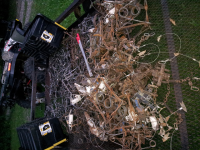
ForumRunner_20151110_182650.png

Pile of some of our iron on a 4x8 trailer for power washing.
 
   / How do you take care of your traps?
  • Thread Starter
#12  
We usually just pile up the new traps up outside and spray them with a degreaser let them sit and then hit then with the hose. With conni's done type of degreasing is a must otherwise you won't keep them set. Just a little bump and they will fire.

We have used the rustoleum paint dip on them but taped over the dog and trigger to prevent having to scrape it off. No need to wax the Connis either. That's usually just a foothold thing. And really if you're not going to have them in the field for entire seasons i wouldn't worry about dipping them either.

If you haven't used body grip traps before i highly suggest you start by playing with the 110. And really a 220 is probably too much for a squirrel. Especially if they are reed squirrels, probably ok for fox/gray/black squirrels but still large. We use those for raccoon.

I would also look into making boxes for them. Use an idea like a mink box or weasel box. Just google those and you'll see the idea.

Just a few tips, we run everything from 110s-330s.

View attachment 446885

Pile of some of our iron on a 4x8 trailer for power washing.

Thanks for all the replies, it appears the conciseness is just to degrease them and then let them rust. That seems the easiest thing and cheapest thing to do.

I also read the Duke traps need some tuning to make them work correctly. I saw that on a couple of sites but they did not say what or how to tune them.

Will definitively be starting with the 110's, just purchased the 220 to have around if the raccoon comes around again looking at my chickens.
 
   / How do you take care of your traps?
  • Thread Starter
#13  
What is the purpose of a box for setting your trap in? Just safety for dogs? Why are some tapered and others are not?
 
   / How do you take care of your traps? #14  
Dukes are your base model traps. They are some of the most common bought because they are usually the cheapest. They are ok traps for what you're looking at doing, and some guys swear by them, but after having my hands on alot of different steel they are considerably lighter made. That being said, their foot holds require tuning however the connis don't really have anything to tune other than making sure the dog and trigger hook up and cut loose how you want them. There are modifications you can do to those parts or even up grade them but i wouldn't worry about it for squirrels. You may want to look at getting trigger boards for them that you could bait the trigger bar itself. Or look at how the trigger bars can be bent to increase the chance they hit them rather than slipping by. You don't want both bars sticking straight down the middle because it will look like an obstruction to them and they'll try to slip by.

The boxes are primarily just a holding device that you can bait. And critters like investigating openings and such anyhow. As for the 220 we usually just do trail sets for the coons, but your situation i would look at a bucket set. Again just to be able to bait it and draw them.

Now keep in mind the boxes will not totally prevent other critters from getting in, especially the bucket set with the 220. And connis are indiscriminate killers!!! They don't care if it's a cat, coon, small dog, chicken, etc..

You may want to consider the live trap and a .22 for coons in the yard. Use marshmallows for bait put a few outside, a couple before the pan, and a couple in the back after the pan. We use cat food too, but not for around houses with strays because they tie up the sets too much.

If you get on trapperman.com there are endless hours of reading there on the topics. Just like here, lots and lots of experienced folks.
 
   / How do you take care of your traps? #15  
Another easy way to degrease them is a dishwasher.
 
   / How do you take care of your traps?
  • Thread Starter
#16  
Another easy way to degrease them is a dishwasher.

I would have to do it when the wife is not around, I don't think she would appreciate anything but dishes in the dishwasher. :)

@psebowhunter, thanks for all the information, will be checking out trapperman.com.
 

Tractor & Equipment Auctions

2018 CATERPILLAR 259D SKID STEER (A60429)
2018 CATERPILLAR...
40ft T/A Gooseneck Flatbed Equipment Trailer (A55851)
40ft T/A Gooseneck...
1999 TRANSCRAFT FLAT BED 48FT TRAILER (A59905)
1999 TRANSCRAFT...
2019 FREIGHTLINER CASCADIA TANDEM AXLE SLEEPER (A59905)
2019 FREIGHTLINER...
Caterpillar D5G LGP (A53317)
Caterpillar D5G...
CATERPILLAR 72" HANG-ON WHEEL LOADER FORKS (A60429)
CATERPILLAR 72"...
 
Top