Break-in Procedure 3616

/ Break-in Procedure 3616 #1  

rmacdon

New member
Joined
Mar 19, 2016
Messages
5
Location
Abbotsford, BC, Canada
Tractor
2014 Mahindra 3616
Hi all.

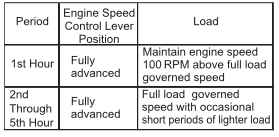
Just purchased my first tractor...which I chose to be a Mahindra 3616! I am trying to sort out the break-in procedure for it, but the manual isn't making much sense to me. It says to have the "engine speed control lever position fully advanced" and "maintain engine speed 100 rpm above full load governed speed".

Can anyone help me out with what this means? I am not sure what to run my new tractor at for RPM, and want to make sure I break it in properly.

Thanks everyone; I look really forward to being apart of this forum with my new purchase!
 

Attachments

  • Screen Shot 2016-03-18 at 9.05.34 PM.png
    Screen Shot 2016-03-18 at 9.05.34 PM.png
    27.6 KB · Views: 260
/ Break-in Procedure 3616 #2  
Same in my manual and confused me too, I'm interested too
 
/ Break-in Procedure 3616 #3  
Have you called your dealer? Did they not explain any of this upon pickup/delivery?

To me it reads like full load on pto at 100 rpm over the rated speed to get to 540 for one hour then required rpm to put you right at 540 pto with a fully loaded pto load with occasional lighter pto loads while maintaining the same engine speed for the next 4 hours.

My explanation is probably just as confusing as the write up in the manual.

Seems odd to fully load a brand new engine and bypass the rated pto speed for an hour uninterrupted.

I for one would not follow what that says the way I read it but to each his own.

Good luck and congrats on the new tractor.
 
/ Break-in Procedure 3616 #4  
i just drove mine the way i wanted to.
 
/ Break-in Procedure 3616 #6  
Anyone have more info on this topic? I'm taking delivery of a Max 26XL (TLB) tomorrow and want to break it in properly. My dealer said he hadn't read the new procedures on the smaller tractors, but that following the manual is the right thing to do, and that running at max RPM (or 100 rpm over max load) is "normal". My manual has the same table so I'd planned on running at 2,600 RPM (engine rate RPM of 2,500 plus the 100 RPM) for the initial hour, etc. But, there was not discussion about loading the PTO, and I don't have any implements that will use it anyway... Maybe I misunderstood the prior postings, but it sounded like there was some expectation that you'd put a load on the PTO for the break in. Ugh, everything is so clear... I hate being a noob on this stuff...
 
/ Break-in Procedure 3616 #7  
Use it as you want..... just don't push it to it's limit for a few hours. You can read thru thousands of threads here and you will not see one case of failure due to 'improper break in'.

The real 'break in' issue is proper oil/filter changes.

Do not worry about it. There are bigger things in life to worry about.
 
/ Break-in Procedure 3616 #8  
Yes, that makes sense to me...I always try to RTFM and follow factory recommendations, but that table was not clear. Think I'll treat their directions as guidelines and not rules...Thx for the feedback...
 
/ Break-in Procedure 3616 #9  
I was using mine last year (it only had 20 hrs on it), an Amish guy was watching me, he ask me how many hours o it, when i told him 20, he said that thing will never break in unless you work it, he said i wasn't running it fast enough. He said same as the owners manual, run it at governed speed for a while while bush hogging, warm it up, break it in. The guy has been around tractors a bunch, they drive them to work as well as farm with them.
So i ran mine for several hours at like 2400 rpm with the hog back there, it seems to run fine now.
 
/ Break-in Procedure 3616 #10  
When an engine is rebuilt and particularly when a new camshaft is installed it is required to start and run the engine at 1500 to 2500 rpm for 20 minutes to encourage proper camshaft and ring break-in. The higher speeds establish a hydrodynamic fluid film of lubrication that prevents metal to metal contact (this is the same principle as a tire hydroplaning on a wet road) and is particularly crucial with camshafts and lifters, the high speed also encourages lifter rotation.
Even gears to a much lesser extent appreciate a break-in of load/no load. Hydrostatic transmissions are perhaps the most precise component in the system aside from the fuel injection system and they too are happiest with higher speeds for proper lubrication as mentioned above.
Having said that don't panic just keep the engine speed up above 2K and use it to get the job done.
Diesels like/must be worked to be happy, light load especially when new is a no-no.
90cummins
 
/ Break-in Procedure 3616 #11  
Here is what I posted earlier to a member who was really worked up about what appears to be the same problem with the manual. Please read it and don't be offended as it was posted to someone else that I was not trying to offend, just put some common sense to the perceived problem he was having. Enjoy your new machine and keep reading these threads. They are packed with good information and entertainment.

Wow, you are making a mountain out of a mole hill. Vary the speed to all levels (idle to full throttle) don't operate at one speed for hours. Let it idle until warm (don't make fast temp changes) and idle it for a few minutes after working it hard (allow oil and water to carry away some of the heat). Utilize all the attachments including the PTO at all different speeds and loads. The 1.7 hours that were on it when you got it is nothing more than slow light use around the dealer before you took delivery. Change the oil at the first recommended interval (usually half the time of the normal interval after break in/run in). All that being said you must think about where these machines end up around the globe. Some are destined to a life of dead idle some are run at full throttle from the beginning and most will never see the quality of oil, fluids, greases and fuels we have available here in the states. If you are not making a living with it (8 plus hours of operation a day) it will last you a lifetime if you follow the manufacturers maintenance schedule and don't let buddy's and family borrow it unsupervised (the most detrimental thing to a tractor that you can do). I hope I spelled detrimental right. Don't get all worked up over nothing and enjoy your new machine.
 
/ Break-in Procedure 3616 #12  
Not too sure if this helps, but I've seen break-in for a lot of aviation engines. I worked at a shop that overhauls Allison V-1710 engines (1710 cubic inch V-12).

After a complete overhaul, we start them up and run them at idle for about as long as it takes to get to normal operating temperatures, perhaps going up very slowly to maybe 1000 rpm or so. Then we clean the screens (change the filter). Then we run them 10 minutes or so, first at idle and then at 1000 working slowly to 1500 rpm. Then we clean the screens. At no time do we increase rpm quickly. always slowly. Then, for the next 4 - 6 hours, we run near idle until warm and slowly work up to 1500 - 2500 rpm, run awhile, and slowly work back down and then back up again.

What we're looking for is for the valves and rings to seat. When the exhaust outlet has a light gray coating that isn't wet, the rings are seated. After than, run it like you want to run it. Of course, we are running straight pipes without a muffler in WWII aircraft. I'm not exactly sure how the exhaust on a muffled engine would look, but I follow that general procedures for 4-stroke engines for about 8 - 10 hours, just to be sure. Most times, it takes 4 - 8 hours for a WWII Allison V-12.

The instructions for the diesel SHOULD give you an idea of how long it takes to seat the valves and rings. As stated above, don't run it at one speed for extended periods during break-in. After break-in, it really doesn't matter.

Once the rings seat, oil usage should drop way off. If it doesn't, then the rings never seated.

Just as an aside, when I was racing cars, I separated the ignition from the starter. If you run a high horsepower engine, it's best to get oil pressure before starting. So it always sounded like my engine was hard to start, but that wasn't the case at all. I ran the starter until I saw oil pressure on the gauge and then closed the ignition, assuming it had been longer than about 20 minutes since I ran it last. My engines always looked brand new when we disassembled them later.

If I had a tractor, and I will, I'd do the same thing. Separate the ignition and starter, assuming you have an oil pressure gauge. If you don't, add one or not as you see fit. Might pay real dividends in cold climates. Most engine wear happens during startup without a good oil film on the parts, and cold makes it worse. I never rev a cold engine above idle, but that's just me. I wait for some temp before going above idle. Everyone has an opinion about that one, and many think otherwise.

Fortunately, I don't pay for their engines. I know a few people who do whatever they want to cold engines and never have a problem. I also know the other side of it. Those guys spend a LOT more on engine issues than I do. If you're racing, you MAY be spending someone else's money. If you are talking about your own tractor, you're probably spending your money.

Spend it wisely.
 
/ Break-in Procedure 3616 #13  
Not too sure if this helps, but I've seen break-in for a lot of aviation engines. I worked at a shop that overhauls Allison V-1710 engines (1710 cubic inch V-12).

After a complete overhaul, we start them up and run them at idle for about as long as it takes to get to normal operating temperatures, perhaps going up very slowly to maybe 1000 rpm or so. Then we clean the screens (change the filter). Then we run them 10 minutes or so, first at idle and then at 1000 working slowly to 1500 rpm. Then we clean the screens. At no time do we increase rpm quickly. always slowly. Then, for the next 4 - 6 hours, we run near idle until warm and slowly work up to 1500 - 2500 rpm, run awhile, and slowly work back down and then back up again.

What we're looking for is for the valves and rings to seat. When the exhaust outlet has a light gray coating that isn't wet, the rings are seated. After than, run it like you want to run it. Of course, we are running straight pipes without a muffler in WWII aircraft. I'm not exactly sure how the exhaust on a muffled engine would look, but I follow that general procedures for 4-stroke engines for about 8 - 10 hours, just to be sure. Most times, it takes 4 - 8 hours for a WWII Allison V-12.

The instructions for the diesel SHOULD give you an idea of how long it takes to seat the valves and rings. As stated above, don't run it at one speed for extended periods during break-in. After break-in, it really doesn't matter.

Once the rings seat, oil usage should drop way off. If it doesn't, then the rings never seated.

Just as an aside, when I was racing cars, I separated the ignition from the starter. If you run a high horsepower engine, it's best to get oil pressure before starting. So it always sounded like my engine was hard to start, but that wasn't the case at all. I ran the starter until I saw oil pressure on the gauge and then closed the ignition, assuming it had been longer than about 20 minutes since I ran it last. My engines always looked brand new when we disassembled them later.

If I had a tractor, and I will, I'd do the same thing. Separate the ignition and starter, assuming you have an oil pressure gauge. If you don't, add one or not as you see fit. Might pay real dividends in cold climates. Most engine wear happens during startup without a good oil film on the parts, and cold makes it worse. I never rev a cold engine above idle, but that's just me. I wait for some temp before going above idle. Everyone has an opinion about that one, and many think otherwise.

Fortunately, I don't pay for their engines. I know a few people who do whatever they want to cold engines and never have a problem. I also know the other side of it. Those guys spend a LOT more on engine issues than I do. If you're racing, you MAY be spending someone else's money. If you are talking about your own tractor, you're probably spending your money.

Spend it wisely.
V-12 Merlin engine???
 
/ Break-in Procedure 3616 #14  
V-12 Merlin engine???

He said Allison as in P40 etc.. Not the venerable Merlin or Packard built Merlin the P 51 had which had come originally with an anemic short winded Allison engine. The Brits put Rolls Royce Merlins in a lot of planes Spitfire, Lancaster, Mosquito etc then they tried it in the P51 and that made it into a truly fantastic aircraft. The P51D and on is still one of the most beautiful airplanes ever made IMHO. The P40 is nice looking but the P51 is beautiful.
 
/ Break-in Procedure 3616 #15  
The Allison is anything but anemic. Both early and late Allisons had about the same power as the Merlin.

But the US Army Air Corps owned the rights to the Allison and specified a single-stage supercharger with high-altitude boost to be supplied by a turbocharger. Then they went and deleted the turbocharger from all the US fighters except the P-38 Lightning. Of course in WWII, the turbocharger was not called a turbocharger. It was called a turbosupercharger, making for a lot of modern-day confusion.

With a single-stage, mechanical supercharger, the P-39 and P-40 were very good up to about 10,000 feet and started falling off above 15,000 - 17,000 feet depending on dash number, intake system, and impeller size and gearing. They could get to the low 30,000 foot level, but not really with fighter performance when they got there.

The P-38 was a different story and had no trouble at high altitudes after the initial issues were ironed out. It's biggest issue after solving the main initial problems was a low critical Mach number. That meant a relatively low diving speed unless the pilot was willing to risk being a lawn dart. But it WAS the mount of choice for our two top aces of the war. If nothing else, that says something about the P-38.

Sorry for the long, off-topic rant.

I answered only because we have broken in a LOT of piston engines for other people. The only thing specific to diesels is that they should not be accelerated quickly when cold since the main bearings will take a pounding when not up to temp, shortening bearing life. For best diesel life accelerate slowly up to your desired level when up to operating temp and slowly back down when desired. An occasional burst at less than max rpm for loader work is not what I'm taking about here. It's people who pump the throttle just to hear the engine blip. I've heard a lot of them.

They probably don't realize the damage they are causing. But we can see it when we disassemble one that has been run that way. The main bearings are pounded.

Everyone is free to run as they see fit without further comments from me. I was just passing on some suggestions for longer engine life should anyone want to try them out. If not, you'll probably still get years of life from any tractor you are running. I have yet to see a "delicate" tractor.

They're sort of like refrigerators, they mostly always seem to run for a long time ...

Cheers.
 
/ Break-in Procedure 3616 #16  
The Allison is anything but anemic. Both early and late Allisons had about the same power as the Merlin.

But the US Army Air Corps owned the rights to the Allison and specified a single-stage supercharger with high-altitude boost to be supplied by a turbocharger. Then they went and deleted the turbocharger from all the US fighters except the P-38 Lightning. Of course in WWII, the turbocharger was not called a turbocharger. It was called a turbosupercharger, making for a lot of modern-day confusion.

With a single-stage, mechanical supercharger, the P-39 and P-40 were very good up to about 10,000 feet and started falling off above 15,000 - 17,000 feet depending on dash number, intake system, and impeller size and gearing. They could get to the low 30,000 foot level, but not really with fighter performance when they got there.

The P-38 was a different story and had no trouble at high altitudes after the initial issues were ironed out. It's biggest issue after solving the main initial problems was a low critical Mach number. That meant a relatively low diving speed unless the pilot was willing to risk being a lawn dart. But it WAS the mount of choice for our two top aces of the war. If nothing else, that says something about the P-38.

Sorry for the long, off-topic rant.

I answered only because we have broken in a LOT of piston engines for other people. The only thing specific to diesels is that they should not be accelerated quickly when cold since the main bearings will take a pounding when not up to temp, shortening bearing life. For best diesel life accelerate slowly up to your desired level when up to operating temp and slowly back down when desired. An occasional burst at less than max rpm for loader work is not what I'm taking about here. It's people who pump the throttle just to hear the engine blip. I've heard a lot of them.

They probably don't realize the damage they are causing. But we can see it when we disassemble one that has been run that way. The main bearings are pounded.

Everyone is free to run as they see fit without further comments from me. I was just passing on some suggestions for longer engine life should anyone want to try them out. If not, you'll probably still get years of life from any tractor you are running. I have yet to see a "delicate" tractor.

They're sort of like refrigerators, they mostly always seem to run for a long time ...

Cheers.

For whatever reason the Allison was anemic at altitude in the P 51. Maybe it could have been corrected by adding sufficient forced induction but the Brits chose to correct it with an engine swap that worked out very well. The P38 was also a great airplane and fast but I think the Mosquito was faster. It's only protection was speed as it had no armor or guns. Some of the aces in the European theater flew a Thunderbolt with a big ole radial bolted to the front of it. The Thunderbolt was not a pretty plane, 8 tons of ugly to my eye but I guess it had power aplenty, lots of armor and many guns. For looks, I've always liked the F4U too but I think those were only used in the Pacific theater.
 
/ Break-in Procedure 3616 #17  
Still of topic guys. Didn't Allison build some Merlin engines ? What engine was used in PT boats? Is Mr Bong still alive?:confused3:
 
/ Break-in Procedure 3616 #18  
Still of topic guys. Didn't Allison build some Merlin engines ? What engine was used in PT boats? Is Mr Bong still alive?:confused3:

Packard did but I don't think Allison did. PTs used engines based on the Liberty aircraft engine the Packard 4M-2500. The rum runners used Liberty engines too as there were a lot avaliable from surplus after WWI. I guess they gave the revenuers a real run for the money. LOL
 
/ Break-in Procedure 3616 #19  
The Mosquito was faster than any tractor, but not faster than a P-38. Actually fairly close in speed with many Mosquitoes being some 40 mph slower than a P-38 if both were at full power, but with the Mosquito cruising faster most of the time. Both great airplanes used mostly for different purposes. The Mosquito also didn't have quite as many teething troubles as the P-38, but they were all ironed out in the end anyway.

I'm just hoping to pick up some actually-useful information on tractor brands in here. Seems like you can't find any honest data on tractor reliability ... or at least I haven't found it yet. I see posts with welds that were bad and others where all is great, all on the same brand. Doesn't seem like steady production quality to me. Seemingly the same with all brands. Seems like getting good reports of issues compared with numbers of units or age of unit wouldn't be all that hard to find, but that doesn't appear to be the case.

Makes it tough to choose a first tractor by reputation or reliability when they are all "good" or all "bad." As I get closer to it, maybe reading more will help narrow the field.

I've narrowed it to 35 - 40 hp, probably with a cab and FEL & box blade to start with. Will likely need some sort of mower at the same time. Beginning to look like a package deal might be best rather than getting attachment separately, at least money-wise. The after-market attachments seemingly offer better quality but, again, hard to find out for sure.

I know, unrelated to break-in. No more replies in here unless on subject. My fault.
 
/ Break-in Procedure 3616 #20  
The Mosquito was faster than any tractor, but not faster than a P-38. Actually fairly close in speed with many Mosquitoes being some 40 mph slower than a P-38 if both were at full power, but with the Mosquito cruising faster most of the time. Both great airplanes used mostly for different purposes. The Mosquito also didn't have quite as many teething troubles as the P-38, but they were all ironed out in the end anyway.

I'm just hoping to pick up some actually-useful information on tractor brands in here. Seems like you can't find any honest data on tractor reliability ... or at least I haven't found it yet. I see posts with welds that were bad and others where all is great, all on the same brand. Doesn't seem like steady production quality to me. Seemingly the same with all brands. Seems like getting good reports of issues compared with numbers of units or age of unit wouldn't be all that hard to find, but that doesn't appear to be the case.

Makes it tough to choose a first tractor by reputation or reliability when they are all "good" or all "bad." As I get closer to it, maybe reading more will help narrow the field.

I've narrowed it to 35 - 40 hp, probably with a cab and FEL & box blade to start with. Will likely need some sort of mower at the same time. Beginning to look like a package deal might be best rather than getting attachment separately, at least money-wise. The after-market attachments seemingly offer better quality but, again, hard to find out for sure.

I know, unrelated to break-in. No more replies in here unless on subject. My fault.

I think most of the brands are making basically good machines these days and many of the SCUTS and CUTS are made off shore in Japan and Korea anyway. For example Mahindras are made by Mitsubishi in Japan and KYM in Korea. They aren't made by Mahindra. I don't know about the KYM machines but I know my Misu built 1538 came with a loader and backhoe made by KMW out of Kansas. As far as buyer satisfaction I think it's more of an individual dealer issue more than it is a brand thing. A lousy dealer can make life with the best built tractor in the world just plain miserable. To get the best read on dealers, I'd say the best way to do that is to visit and see how you are treated. You'd be surprised how poorly many of them act even when they know you're there shopping for a new tractor. Body language can tell you a lot. Also maybe you can also pigeon hole any current customers you see around the place who are there buying parts or something.

When I was shopping I actually had one dealer that never got off of his lazy behind and out from behind his desk. Needless to say, he didn't sell me anything. I could just imagine what service would have been like there so I kept moving along to find greener pastures. Another dealer acted like he was doing me a big favor just letting me walk in the door and his prices reflected his nickle dime attitude. I didn't hang around there very long either.

I can imagine making one airplane out of two had its share of challenges.
 

Marketplace Items

UNUSED MINI EXCAVATOR QUICK COUPLER (A60432)
UNUSED MINI...
2015 Haulotte 5533A (A53316)
2015 Haulotte...
2015 KOMATSU D61PX-23 CRAWLER DOZER (A60429)
2015 KOMATSU...
AEREATOR (A58214)
AEREATOR (A58214)
UNUSED KJ - K1912 - 20' X 12' LIVESTOCK METAL SHED (A60432)
UNUSED KJ - K1912...
excavator trenching bucket- one bucket per lot (A61306)
excavator...
 
Top
