Cylinder for log splitter questions

   / Cylinder for log splitter questions #1  

polemidis

Gold Member
Joined
Oct 24, 2017
Messages
272
Location
Winthrop Maine
Tractor
LS XG3140
I am looking for a cylinder for my log splitting part of my firewood processor, and I see a huge variance in prices, and some differences in rod diameters.
A few questions plz:
a)If a cylinder is rated for 3000 or 3500psi will last longer when I operate it at 2500psi, that one that is rated right at 2500psi? With the same use/abuse?
b)How important is the rod diameter other than the difference is retracting speed? I am looking ar surpluscenter, at 4" bore cylinders there are options for 1.75",2" and 2.5" rod diameters. The price range is not analog to that
c) Whats the catch with this cylinder? Its only $140 (rated at 3000psi) where the other cylinders 4" bore, cost $250-$300? Is it just an overstocked item? Maybe there is an mistake on the price?
d) I am trying to figure out if going to 4.5" bore cylinder make sense for splitting 16" of red oak, white ash, and some yellow birch and blask ash. How much slower will be the 4.5" with a 22gpm/7gpm 2-stage pump? A requirement is a 4way wedge.
e)Is there a way to restrict the movement of the rod to move only 15" than 24"? I dont see any shorter cylinders than 24" long.
f) I-beam, "W", would the 8x28 suffice?

thank you!
 
   / Cylinder for log splitter questions #2  
The bigger bore will be slower as more hydraulics oil will be required.
Since you are basically pushing the shaft size is of no importance, just stronger. (On 2 way operation the larger shaft would make a difference in return speed)

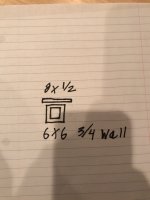
My DIY splitter uses a 4" old 'dozer cylinder (LOL. $25.00) mounted on a 6" X 6" H beam (3/8" flanges) and I drive it from my tractor hydraulics (a bit slow) but then I can cut 4" maple sideways in lengths. Mind U the H beam kinda groans and twists but cuts without hesitation.

As to price, it probably is simply that it is real 'surplus' and not a replaceable stock item.

As to travel distance if U use a valve that is mechanically linked to automatically return once the split is done you don't have to worry.
(I rigged a lever and a rod that actuates the return thus freeing my hands to retrieve a new log or heave the splits onto the pile.*)
Rather than a simple knife blade to split I welded a long 'VEE' from 0 to the 6" width of my H beam (V is about 7" long) so that my logs really split wide open real fast. In my case as luck had it my local shop has a leftover section of hardened knife edge that he had from installing a new edge on a bucket.

If that cylinder is rated at 2500 it will probably do U just fine, main criteria will be to keep debris away from the seals.

Mind U I have only made this one splitter but that after studying many commercial units out there.

*( valve had a spring loading which I removed to allow my lever return system)
While splitting I do need to hold the valve open while splitting.
 
   / Cylinder for log splitter questions #3  
I've got a 5" bore on both of my splitters. Splitting nice straight grain red oak that's a waste. Unfortunately it doesn't always pan out that way. And you say it's a processor. That implies a several way wedge. Sometimes I have to take my 4 way off to get a piece split with that. My homemade splitter has a 5" bore 22" stroke cylinder that I bought at a salvage yard for 25 cents a pound. How tall and how wide is your beam? I understood your other thread to be it's 28" wide. If you insist on using the 4" cylinder, use 2 of them. That's a little bit stronger than one 5".
 

Attachments

  • IMG_0732.JPG
    IMG_0732.JPG
    2.1 MB · Views: 230
   / Cylinder for log splitter questions
  • Thread Starter
#4  
I've got a 5" bore on both of my splitters. Splitting nice straight grain red oak that's a waste. Unfortunately it doesn't always pan out that way. And you say it's a processor. That implies a several way wedge. Sometimes I have to take my 4 way off to get a piece split with that. My homemade splitter has a 5" bore 22" stroke cylinder that I bought at a salvage yard for 25 cents a pound. How tall and how wide is your beam? I understood your other thread to be it's 28" wide. If you insist on using the 4" cylinder, use 2 of them. That's a little bit stronger than one 5".

no the "28" means 28pounds per foot. See the link, it has the specs. Curently I have not any beam. I am going to purchase it. I will make the CAD intending to buy everything new, but if I can find something at some scrap yard I will make any changes. I just want to have a plan with something that works first.
 
   / Cylinder for log splitter questions #5  
Go big or quit now on the beam. That's another lesson you can learn at my expense.
 
   / Cylinder for log splitter questions #6  
c) Whats the catch with this cylinder? Its only $140 (rated at 3000psi) where the other cylinders 4" bore, cost $250-$300? Is it just an overstocked item? Maybe there is an mistake on the price?

That is a "trunnion mount" cylinder, the mount on the larger part of the cylinder is with a pair of pins at the top instead of a clevis or through pin tube at the bottom. Should be fine for a splitter since you can make whatever kind of mounts you need but for someone looking for a regular cylinder mount to match an existing use then it is less valuable.

This cylinder shows you what a trunnion mount looks like (the trunnions can be mounted anywhere along the length, this one and your link both have them up near the top)
2.5x1x1.5 Double Acting Hydraulic Cylinder Trunnion | Double Acting Hydraulic Cylinders | Hydraulic Cylinders | Hydraulics | www.surpluscenter.com
 
   / Cylinder for log splitter questions #7  
I am looking for a cylinder for my log splitting part of my firewood processor, and I see a huge variance in prices, and some differences in rod diameters.
A few questions plz:
a)If a cylinder is rated for 3000 or 3500psi will last longer when I operate it at 2500psi, that one that is rated right at 2500psi? With the same use/abuse?
b)How important is the rod diameter other than the difference is retracting speed? I am looking ar surpluscenter, at 4" bore cylinders there are options for 1.75",2" and 2.5" rod diameters. The price range is not analog to that
c) Whats the catch with this cylinder? Its only $140 (rated at 3000psi) where the other cylinders 4" bore, cost $250-$300? Is it just an overstocked item? Maybe there is an mistake on the price?
d) I am trying to figure out if going to 4.5" bore cylinder make sense for splitting 16" of red oak, white ash, and some yellow birch and blask ash. How much slower will be the 4.5" with a 22gpm/7gpm 2-stage pump? A requirement is a 4way wedge.
e)Is there a way to restrict the movement of the rod to move only 15" than 24"? I dont see any shorter cylinders than 24" long.
f) I-beam, "W", would the 8x28 suffice?

thank you!
A. Probably not. Higher pressure rating is typically thicker metal, but seals are what wear and are usually the same.
B. Bigger rod is MUCH better for a fast retract speed. But keep in mind that even with a 22gpm pump.....you are gonna want a ~40GPM valve to handle full flow.
D. For a multi-way wedge you want the 4.5 or 5" cylinder for sure
E. Look harder. You can get a cylinder in whatever diameter and length you want
F. Maybe. Depends on what size cylinder you ultimately end up with, and how you plan on attaching the wedge and cylinder. So cannot answer that question just yet
 
   / Cylinder for log splitter questions #8  
Plating the top and bottom flange of a beam will strenghten the beam more than plating the web. To prevent the beam from twisting, it needs to be boxed.
The cyl needs to be rated for the maximum pressure you plan on running. I have seen little 2000psi rated cyl swell like a balloon when subject to regular 3000psi use. Once they balloon, there is no rebuilding or replacing seals, the metal has stretched over size and it simply wont seal anymore. Going with a higher pressure rated cyl than your machine can make is just a waste of money. A lot of things will work as far as valves and such are concerned. Some things just work better than others. Using a 25gpm rated valve with a pump rated for 25gpm will work, even tho the return stroke is pushing a lot more than 25gpm on return, but if your returning 40 gpm with your 25gpm pump, a 40gpm valve will just work better. Larger rods will return faster than a cyl with a smaller rod, and also push more gpm on the return stroke.

With limited use, it probably isnt going to hurt anything to use the 25gpm valve with a return flow of 40gpm because the 40gpm is going to be low pressure, but it is going to increase the velocity of the oil and can cause aeration of the oil and also create extra heat. This means you would really need a larger oil tank to allow the aerated oil to release the trapped air bubbles and maybe even a oil cooler to prevent over heating. Another option is to use a dump valve on the oil return to allow the returning oil to bypass the control valve. All of this is mute if your cyl has little ports. 1/2in ports on the cyl negates any other plumbing you can do. The oil has to exit the cyl before it can pass thru a dump valve or control valve. When you start hitting 40gpm flows, even 3/4 in ports are marginal. For maximum cyl speed, use a cyl with the largest rod dia and biggest ports as well as a valve that will handle your expected oil flow.
 
   / Cylinder for log splitter questions #9  
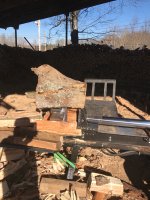
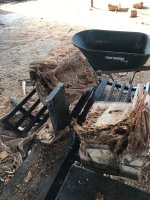
Here's a nasty piece of sweet gum that was all my 5" cylinder wanted. Here's another nasty piece of oak through the 4 way. I later had to remove the 4 way because I couldn't push a nasty piece of hickory through it. IMG_0783.JPGIMG_0784.JPG Unless you don't actually plan on splitting anything or plan on running 4500 psi hydraulics, give up on the 4" cylinder idea.
 
   / Cylinder for log splitter questions
  • Thread Starter
#10  
Thank you all. Muddstoper, no intend to use anything out of specs man!
Ok, I abandon the idea of 4". probably going to 5" I
I understand the bending forces on the beam. I think that by keeping the cylinder as close to the beam as possible will limit that stress. But what about twisting? Is it a big stress? I do not get how the twist force is generated. maybe from weird knotty logs?
I believe the trunnion mount will cause less bending forces since the distance between the rods is only 3.5" right?
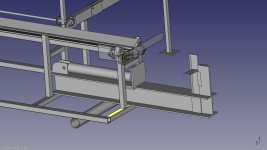
Thats a rough CAD of the splitter part, no much detail yet though. :)Screenshot from 2017-12-11 00-08-28.png
 
   / Cylinder for log splitter questions #11  
If you were only using a single way knife the beam probably wouldn't twist. It's hitting a tough place on 1 side of the horizontal part of the 4 way that makes it twist.
 
   / Cylinder for log splitter questions #12  
Dad's huskee 27 ton splitter twisted the beam when still under warranty.

The wedge tried to follow the twisted grain of a knarly piece of wood....and took the beam with it.

Was replaced under warranty. Hasn't happened again
 
   / Cylinder for log splitter questions #13  
Go big or quit now on the beam. That's another lesson you can learn at my expense.
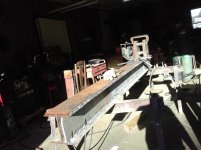
The first pic is a 8x8 by 32lb beam. You can see how I plated the top and boxed one side of the beam. I also boxed the other side.
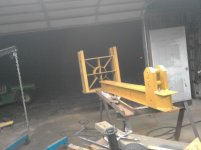
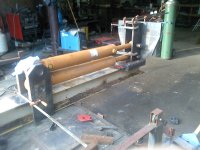
The second pic is of the boxed wedge just hung on the beam. It will be reinforced a lot more before it over with, but the box is setting on a 36in widex 3/4in thick plated that extends about 2ft under the bean and is also fully welded to the beam. I dont know if you can tell in the pick how I gusset welded the cyl base supports into the beam. Those supports are 2in thick.
 

Attachments

  • splitter beam.jpg
    splitter beam.jpg
    908 KB · Views: 180
  • beam and wedge.jpg
    beam and wedge.jpg
    797.9 KB · Views: 189
   / Cylinder for log splitter questions #14  
Here was my original plan for a beam. It would've been nearly indestructible. And I had the materials to do it. I abandoned that idea when I found an already built wood splitter for 25 dollars. It had a 3.5 cylinder and a single way wedge. I removed both of those and "upgraded"IMG_0794.JPG
 
   / Cylinder for log splitter questions
  • Thread Starter
#15  
The first pic is a 8x8 by 32lb beam. You can see how I plated the top and boxed one side of the beam. I also boxed the other side.
The second pic is of the boxed wedge just hung on the beam. It will be reinforced a lot more before it over with, but the box is setting on a 36in widex 3/4in thick plated that extends about 2ft under the bean and is also fully welded to the beam. I dont know if you can tell in the pick how I gusset welded the cyl base supports into the beam. Those supports are 2in thick.

That plating you did on the top surface gave me an idea: Do the whole length but the very end were the horizontal 4way wedge is. So I will lower the four way down and out of way if I split small stuff that need to be splitted only in half.

But where is the limit guys? What is the point that "overbuilding" something just adds unnecessary weight? It looks like I will have to learn the FEM module to analyze the stress on the metal.
Actually the real question here is about the frame of the firewood processor, which in the design is just 2"ラ2"ラ⅛" square tubing. I am just wondering if that to weak... Anyway. thank you all. The plan is looks good, I will start soon to do the math for the hydraulic system. Btw, the "Industrial Hydraulics Manual is AWESOME book!"
 
   / Cylinder for log splitter questions #16  
I'm not sure how to determine you overbuilt a wood splitter without overbuilding it. There's no engineering handbook to deal with the forces involved.
 
   / Cylinder for log splitter questions #17  
That plating you did on the top surface gave me an idea: Do the whole length but the very end were the horizontal 4way wedge is. So I will lower the four way down and out of way if I split small stuff that need to be splitted only in half.

But where is the limit guys? What is the point that "overbuilding" something just adds unnecessary weight? It looks like I will have to learn the FEM module to analyze the stress on the metal.
Actually the real question here is about the frame of the firewood processor, which in the design is just 2"ï¾—2"ï¾—⅛" square tubing. I am just wondering if that to weak... Anyway. thank you all. The plan is looks good, I will start soon to do the math for the hydraulic system. Btw, the "Industrial Hydraulics Manual is AWESOME book!"

I had to put my box wedge ahead of of the hbeam to be able to raise and lower it, hence top plating all the way to the end of beam. My other splitter, I just plated to the adjustable wedge so that when the wedge is lowered, the 4way is below the top of the beam the same as you are suggesting. Of course my wedge is a 6way so even lowered all the way, I am still splitting 4 ways.

I look at over building as insurance against breakage. On a normal splitter, over building leads to a heavy machine and makes it hard to move around by hand. With a processor, it doesnt matter how over built or under built it is, you still aint going to move it by hand. My truck wont care if the machine is a few hundred lbs over weight because of being over built, but my back will care if I have to rebuilt the machine if something breaks because it wasnt strong enough. Reason for over building my processor beam, twin 4.5 in dia cyl's pushing 50 tons.
 

Attachments

  • 0822151909.jpg
    0822151909.jpg
    768 KB · Views: 159
   / Cylinder for log splitter questions #18  
Eastonmade has the best design for an adjustable height wedge IMO. Instead of an I beam they use 2 heavy plates running side by side. Another heavy plate welded in between running perpendicular to those two for a cylinder mount. At the other end they have 2 plates welded in the middle with a gap that makes a nice track for the adjustable wedge.
 
   / Cylinder for log splitter questions #19  
Thank you all. Muddstoper, no intend to use anything out of specs man!
Ok, I abandon the idea of 4". probably going to 5" I
I understand the bending forces on the beam. I think that by keeping the cylinder as close to the beam as possible will limit that stress. But what about twisting? Is it a big stress? I do not get how the twist force is generated. maybe from weird knotty logs?
I believe the trunnion mount will cause less bending forces since the distance between the rods is only 3.5" right?
Thats a rough CAD of the splitter part, no much detail yet though. :)View attachment 531551
One way to reduce twisting force is to allow the blunt end to pivot. Take a look at the Canadian built "SplitFire" for an excellent explanation.

I've used pivot blocks on a lot of splitters that would twist and spring out the pieces of wood.

Another thing is how much bearing area and leverage the slide has on the beam.
 

Marketplace Items

2006 CATERPILLAR 304C (A58214)
2006 CATERPILLAR...
2007 FORD F750 XLT SUPER DUTY SERVICE TRUCK (A58375)
2007 FORD F750 XLT...
UNKNOWN TANK MANIFOLD (A58216)
UNKNOWN TANK...
Zero Turn Mower (A59231)
Zero Turn Mower...
Case Titan 3530 (A61307)
Case Titan 3530...
404 (A52706)
404 (A52706)
 
Top