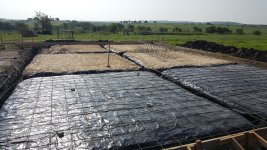
concrete slab question

   / concrete slab question #1  

joeu235

Platinum Member
Joined
Mar 27, 2014
Messages
724
Location
Little River, TX
Tractor
John Deere 4020 / 6403 / 317 Ford 5600
I'm about to have a 20 x 25 slab put in to use as a parking spot and patio. soil type is black land clay. I got two quotes. One contractor wants to to pour a 4 inch thick slab with #5 reinforced exterior beams and #3 12" spaced rebar in the field. The other contract wants to just pour a 5" slab with #3 12" spaced rebar. The first quote is x2 the second.

Any educated opinions on whether the beams are needed for my soil type?
 
   / concrete slab question #2  
Howdy neighbor,

I am over near Manor and Elgin.

You want the first guy, unless you want cracks in our black land clay soil.

I have had 4 engineered slabs done. I am the only one of my neighbors who has NOT had any foundation issues in any of my slabs. All of my slabs were closer to design of the first than the second.

Good luck
 
   / concrete slab question #3  
Here is a picture of the rebar and perimeter beam they spec'd for a covered porch on my house-30 x 17

foundation 3.jpg
 
   / concrete slab question #4  
I would go with design,#2.
Thicker concrete will help more than edge beam
 
   / concrete slab question #5  
The thickened edge is far less important than the imported material beneath the slab and other prep. Another factor is the quality for the concrete. Another is the finish and joints.

My only question would be in relation to the frost level and slope- those are two reasons to thicken the slab around the edge. From your post it doesn’t sound like anything you are putting on the slab would require the thickened edge.

It sounds like both want to do a good job and it’s the details that may reveal if the one person is worth twice as much.
 
   / concrete slab question
  • Thread Starter
#6  
My only question would be in relation to the frost level and slope- those are two reasons to thicken the slab around the edge. From your post it doesn稚 sound like anything you are putting on the slab would require the thickened edge.

It sounds like both want to do a good job and itç—´ the details that may reveal if the one person is worth twice as much.

Luckily the frost level is 0" here, and maybe slopes 2 inches where I want the slab to go.

Below is a picture of the slab under my shop. This slab will be right next to it. The shop slab has 3' deep beams with #5 rebar. Just don't think a parking slab needs to be this beefy, but definitely want it to last.

20160903_100731.jpg
 
   / concrete slab question #7  
If you're not building a living space on it, does it really matter?

My driveway is 2" blacktop, no rebar or foundation.

.
 
   / concrete slab question #8  
Luckily the frost level is 0" here, and maybe slopes 2 inches where I want the slab to go.

Below is a picture of the slab under my shop. This slab will be right next to it. The shop slab has 3' deep beams with #5 rebar. Just don't think a parking slab needs to be this beefy, but definitely want it to last.

View attachment 602621

With no slope, no frost and no need for footings (heavy point load on the slab) I don’t see a need to spend twice as much for a thickened edge. If you have good prep, the specified rebar, decent concrete and proper control joints a 4-5” slab should work just fine.
 
   / concrete slab question #9  
For a slab on grade; what is under it is more important than what's in it. I am not famaliar with your type subgrade material. A 6" layer of 3/4 minus crusher run gravel base will always help stabilize. If an unstable sub-grade is not economical to correct then you need the structural slab with re-bar. Slab thickness and re-bar design are matched to the static and dynamic loading downward. For admin type vehicle parking quote #2 appears more than adequate unless building on mud. For size of the slab it will need to be divided in four sections with control joints sawed in right after slab is finished (not the next day). I have done saw cutting in the dark many times.

Ron

Ron
 
   / concrete slab question #10  
In Texas, we have very expansive clays with severe linear expansion between dry and wet.
These clays when saturated are very muddy and sticky, but when they dry out become rock hard.
In addition, when they dry out they shrink and crack open - 1/2 to 3/4 inches.
That's why most engineered slabs have reinforced beams every so often.
Without proper reinforcements the shrinking and expanding clay will destroy a simple slab on grade.
 
   / concrete slab question #11  
The best thing anyone can do when pouring a slab is add FIBERS. Your choice of fibers either stainless if fiberglass.

Reinforcement throughout the entire concrete section: By adding millions of fibers to the concrete mix, the concrete achieves three-dimensional reinforcement.
Increased construction speed: By adding reinforcement to the concrete mix, construction is faster and labor costs are reduced.
No special equipment required: By adding fiber reinforcement in commonly used concrete mix designs and conventional concrete pumps, no additional equipment expenses are needed.
Fiber reinforcement also inhibits plastic shrinkage crack formation, reduces plastic settlement cracking, increases green strength, and improves the cohesion of the mix, all of which give you durable, low maintenance concrete.
Fibers enhance both the fresh and hardened properties of concrete. In fresh concrete, fibers help reduce bleeding, settlement and the cracking associated with settlement. Fibers also help minimize the development of plastic shrinkage cracks that have a tendency to form during adverse weather such as hot, dry, and windy conditions.
In hardened concrete, the primary advantage of fibers is their ability to improve the post-crack load capacity or flexural toughness of the concrete.

Carbon & Steel Fiber Reinforced Concrete - CEMEX USA - CEMEX


I poured 4" on beach sand 10 years ago and not a crack while drining heavt tractors and fork lifts on it.
 
   / concrete slab question #12  
Are these slabs to be poured directly on the soil? How much to get the second guy to dig down 6 inches and and lay down a 6 inch pad of base course and compact it to minimum of 95%? That would be my preferred route.
 
   / concrete slab question #13  
For a slab on grade; what is under it is more important than what's in it. I am not famaliar with your type subgrade material. A 6" layer of 3/4 minus crusher run gravel base will always help stabilize. If an unstable sub-grade is not economical to correct then you need the structural slab with re-bar. Slab thickness and re-bar design are matched to the static and dynamic loading downward. For admin type vehicle parking quote #2 appears more than adequate unless building on mud. For size of the slab it will need to be divided in four sections with control joints sawed in right after slab is finished (not the next day). I have done saw cutting in the dark many times.

Ron

Ron

This dude concretes.
 
   / concrete slab question #14  
When I lived over there in the Blackland soil area, the concrete slabs all had 1' wide x 2' deep beams. The barn i built was 60 x 80 clear span and had beams every 20'. As you know, the clay really causes problems with getting a good foundation but, since you're doing "just" a parking spot I don't see that much really needs to be done. If you were going to put heavy equipment on it, or put a building on it in the future, I'd go with the beams.
 
   / concrete slab question #15  
Is your black clay the type that has cracks in it several inches wide in summer? With that amount of movement, you either have to have beams to hold it all together, or it needs to float on the surface so it's not pulled apart. This is a highly localized issue that you will have to rely on your local experts.

What I really wanted to comment on is that the most common reason for cracks in concrete is because of too much water in the mix. A lazy crew, or one that's in a hurry will add as much water as they can get away with to the mix when the truck is pouring it so it flows easier. Water adds volume to the concrete mix, and when that water evaporates, you are left with less volume covering the same amount of area. This forces the concrete to crack. Rebar helps hold it together to it's less obvious, unless it was a lot of water, then you will have huge cracks no matter how much rebar is in there. You will know if too much water was used in less then a week. 95% of the time when I'm looking at cracks in concrete, it's because of water.

Cracking from the soil not being compacted is very rare. Most of the time, the concrete will span the void and nobody ever knows about it. This takes decades to happen. In the few cases where it was from poor soil prep, the most obvious issues is drainage that undercuts the foundation and the weight of the building collapses the concrete.

Rebar on 12 inch centers is going to be hard to walk through. 16 inches will allow you to use chairs and give everyone enough space to walk through the rebar. The second biggest lie told by concrete contractors is that they will lift it as they work. This is impossible and in most cases, they only do it for the first few minutes for pictures, and then abandon that lie completely to get the mud spread and screed. Number one lie is that they will use as little water as possible. You absolutely have to have chairs under rebar. If they do not have chairs, do not let them pour the concrete.
 
   / concrete slab question #16  
Is your black clay the type that has cracks in it several inches wide in summer? With that amount of movement, you either have to have beams to hold it all together, or it needs to float on the surface so it's not pulled apart. This is a highly localized issue that you will have to rely on your local experts.

What I really wanted to comment on is that the most common reason for cracks in concrete is because of too much water in the mix. A lazy crew, or one that's in a hurry will add as much water as they can get away with to the mix when the truck is pouring it so it flows easier. Water adds volume to the concrete mix, and when that water evaporates, you are left with less volume covering the same amount of area. This forces the concrete to crack. Rebar helps hold it together to it's less obvious, unless it was a lot of water, then you will have huge cracks no matter how much rebar is in there. You will know if too much water was used in less then a week. 95% of the time when I'm looking at cracks in concrete, it's because of water.

Cracking from the soil not being compacted is very rare. Most of the time, the concrete will span the void and nobody ever knows about it. This takes decades to happen. In the few cases where it was from poor soil prep, the most obvious issues is drainage that undercuts the foundation and the weight of the building collapses the concrete.

Rebar on 12 inch centers is going to be hard to walk through. 16 inches will allow you to use chairs and give everyone enough space to walk through the rebar. The second biggest lie told by concrete contractors is that they will lift it as they work. This is impossible and in most cases, they only do it for the first few minutes for pictures, and then abandon that lie completely to get the mud spread and screed. Number one lie is that they will use as little water as possible. You absolutely have to have chairs under rebar. If they do not have chairs, do not let them pour the concrete.

Good post Eddie, I agree especially with the excess water. When I have concrete poured, I bring them a five gallon bucket of water and turn off the water to the house. That then adds another issue, where they start over using vibrators. Those will screw up concrete almost as fast as too much water. You have to keep on top of them, no doubt!
David from jax
 
   / concrete slab question
  • Thread Starter
#17  
Thanks for the input everyone.
 
   / concrete slab question #18  
There are only 2 kinds of concrete. There is cracked concrete and concrete that isn't cracked yet.
 
   / concrete slab question #19  
There are only 2 kinds of concrete. There is cracked concrete and concrete that isn't cracked yet.

All concrete cracks; control joints in slabs put cracks where you want them, not where they want to go. I have built many slabs that after many years show no cracks outside the control joints. Use of fiber as previously mentioned reduces stress and shrinkage cracks. Low slump concrete (finishers will hate you) and water reducing additives also are key to minimize cracks. I never allow water to be added at the site unless the delivery can prove the water to be added is part of the mix design (only needed when haul time is close to maximum). Concrete batch plants will accurately apportion the ingredients as you order it. The finisher(s) are your enemy on water addition.

There are concrete guys and then there are concrete guys. A lot of science, engineering, and experimentation go into mix designs. C-94 "ready mix concrete" is a very standard product.

Prior to placing concrete everybody needs "The Contractor's Guide to Quality Concrete Construction" fourth edition. Available on Amazon. Well worth the $100.

Ron
 
   / concrete slab question #20  
Diggin It: post#7:
Is your experience with concrete in Florida?
Is it in Alaska?
Since you refuse to provide a reference for where you live,..... your generic response about concrete is useless to the OP.
Perhaps you are not aware, but there are major concrete mix/placement differences/requirements across the US.
 
Last edited:

Tractor & Equipment Auctions

2016 FORD F-350 XL SUPER DUTY EXT CAB TRUCK (A59823)
2016 FORD F-350 XL...
4ft Mini Skid Quick Attach Rotary Cutter (A56438)
4ft Mini Skid...
2019 DRAGON ESP 150BBL ALUMINUM (A58214)
2019 DRAGON ESP...
Bobcat T590 (A60462)
2019 KOMATSU D61PXI-24 CRAWLER DOZER (A60429)
2019 KOMATSU...
2018 Ford Escape 4WD SUV (A59231)
2018 Ford Escape...
 
Top