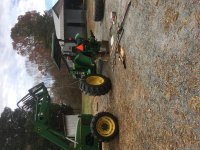
Switching side to side

   / Switching side to side #1  

Reg

Elite Member
Joined
Nov 10, 2005
Messages
3,345
We want them farther out, a LOT farther out.

It happens to be a Kubota and our ASSUMPTION is that the wheels are set to minimum spacing for reasons of shipping.

OK, so we could have the dealer do it, but that would be expensive.
We could get it there, but once the tires are OUT it would be too wide to fit between the fenders of the only trailer we have that is big enough (not a bed over).

The tractor in question does NOT have a back hoe, or we would use that to hold it up.
If we are to maintain tread direction we will have to swap side to side and of course that means having both rear wheels off at the same time.
16.9 x 28 - filled with about 650 lbs of liquid ballast (each).

The biggest problem we foresee if we do this ourselves is lining up the wheel studs.
One possibility for moving them around is an engine crane, another is pallet forks on a second tractor, we have both.

So, we are looking for ideas on how to get the wheels lined up clock/counter-clock wise.
If only our pallet forks had rollers in place of tines<grin>
 
   / Switching side to side #2  
Those are AG wheels right? Usually they give several options for width - reversing the hub on the rim, and/or bolting the rim with its lugs inside or outside the hub plate. You shouldnt have to exchange sides and so you can do 1 side at a time.
 
   / Switching side to side #3  
Park it alongside a wall. A guy can shuffle the tires to the wall while the hubs are reversed. Then move the tire/wheel assembly back to the hub. I've done it without a problem. Don't let the wheel get to an angle greater than a few degrees off of perpendicular.
 
   / Switching side to side
  • Thread Starter
#4  
Yes and no.
They are narrower than R4s, but not as skinny as R1s
No matter the tires, the center dishes are "öut" and the rims are mounted with the "tunnels" that the rim/dish bolts go through also "öut"
so to gain a LOT more width we have to get the majority of the rim "öut" while maintaining tread direction we need to swap the outer rims side to side while leaving the inner dishes the way they are.

The manual say we can gain more than15 inches and we WANT that.

Since I posted I have realized that ONE way to align the studs is to rotate the opposite wheel the opposite direction - the differential
will then give us the needed rotation.
 
   / Switching side to side #5  
In the past I have used my shop crane to move a wheel and tire to the other side.

P1200016 640.JPG
 
   / Switching side to side #6  
Yes and no.
They are narrower than R4s, but not as skinny as R1s
No matter the tires, the center dishes are "öut" and the rims are mounted with the "tunnels" that the rim/dish bolts go through also "öut"
so to gain a LOT more width we have to get the majority of the rim "öut" while maintaining tread direction we need to swap the outer rims side to side while leaving the inner dishes the way they are.

The manual say we can gain more than15 inches and we WANT that.

Since I posted I have realized that ONE way to align the studs is to rotate the opposite wheel the opposite direction - the differential
will then give us the needed rotation.

That is one of the ways or if you are comfortable with your blocking I have seen tractors started and power turned the hubs.
I just swapped mine around a while ago;
https://www.tractorbynet.com/forums/century-branson/419054-adjusting-wheel-spacing-8050-a.html
 
   / Switching side to side #7  
I just did this. Swapped liquid loaded tires side to side. 700 pounds of liquid in each tire. Break loose wheel bolts on both sides first. I needed a 6 foot cheater on the wrench. Then jack onto Wood blocking. No 2x4s or concrete blocks... 6x6 or better. You want as wide and stable as possible. Block the tractor till you see daylight between the tire and ground. You'll need clearance to remount the tire. A strap and another FEL to handle the wheels. To rotate the wheel to match the hub, simply rest the wheel on the ground, and push the strap opposite the rotation you want. When you lift, the wheel will rotate a degree or so. It takes a few tries, but works well enough to do single handled. There was too much drag to turn the axles through the diff.

IMG_0429.JPGIMG_0430.JPG
 
Last edited:
   / Switching side to side #8  
My Kubota M6040 has each rear tire loaded with 775# of rim guard. The rears are 16.9 x 28 - R1's. Thank goodness - the dealer mounted the rears at their widest setting when I purchased the tractor. I know from experience with my first tractor - Ford 1700 - and much smaller CaCl loaded rear tires - - working with my rear tires on my Kubota is not a job I would want to tackle. With the 775# of rim guard, each rear tire easily weighs over 1K#.

With Ag tires you have either six or eight adjustable width settings.

Be MOST careful. A loaded tire, tipping & falling on you, could easily ruin more that just that day.
 
   / Switching side to side
  • Thread Starter
#9  
I have the general tire handling routine OK, I HAD been swapping loaded R4 17.5 x 24 (50 gallons each, about 1/2 ton each) for 18 inch turfs each season and doing them one at a time usually with the hoe on.
That was easy/simple since I could get every thing lined up and lifted with that tractor, swap, then use that tractor to get the next one.

It was just the rotation thing that I had a mental block for.

AGREED ! On edge these can be very dangerous, I have always worked with enough space to hop out of the way if one starts to get away from my control.

PS this happens to be a M7060 'bota
 
   / Switching side to side #10  
I did 16.9 x 28 R1s. I bought the correct size bolt, but much longer, cut the head off, then ground the shank to a point for a line up pin. I also cut a cross slot on the end so I could us a screw driver to remove.

Install at 12 o'clock. Then work the wheel tire in place. Have the axle flange a little low so the wheel tire leans in as it goes on. Slowly jack the axle up and as wheel tire be comes straight up/down start the bolts. Get a few in and remove the line up bolt.


Be sure to retorque after a few hours use.
 
   / Switching side to side #11  
......................................
Since I posted I have realized that ONE way to align the studs is to rotate the opposite wheel the opposite direction - the differential
will then give us the needed rotation.

Yep, that works great.

Just got around to reading this thread. Between yesterday and today, been busy widening the rears (loaded 14.9 x 26) on my L5060. That method to align the studs and my new H.F. shop crane similar to the one in Xfaxman's picture worked great.
 
   / Switching side to side #12  
I've changed the same sized tire, 50 gallons of fluid in each alone with nothing but the nut removing device, a 2x4 block of wood and a crow (wrecking) bar....about 3' long, popular at any construction supplier...Lowes, Home Depot, HF.

The key is keep the tires vertical, meaning no more than a few degrees of leaning. I figure where I am going to roll them (concrete floor) and prop up before I remove them.

I made a stand out of 2x2 square tubing that I put under the drawbar where it attaches at the front end. I made it so that I would need a couple of 2x4 blocks to barely get the tires off the floor...like less than an inch. Now we are at the point where the tires are off the floor and pretty much balanced.

Next off come the nuts with an impact tool. The wheel is usually rusted to the axle so I beat on the rim with a 4# short handle sledge moving from side to side, paying attention to be ready to support the tire (with my unused hand) when it breaks loose.

Next comes the prybar and the 2x4....2x4 about 2-3" away from the side of the tire and with one hand holding the top of the tire (to keep it from falling over) the other hand (in short up and down movements), walks the wheel off the notched axle. Now the tire is on the ground adjacent to the axle...like 1-2" sort of thing.

I then grasp both sides of the tire, at about the 2 and 10 O'clock positions and walk the tire back from the wheel, by rolling a couple of inches, turning and rolling back the other way, back and forth till the VERTICAL wheel/tire assy is away from the tractor and can be rolled away.

Once you remove one wheel, the tractor tilts over on to the other side...amount depends on how much the support member holding the tractor off the ground allows the tractor to tilt.

Repeat the removal process and immediately roll the tire to the other side, always keeping it vertical.

You walk the tire over to the axle the same way you removed them just in reverse order, use the pry bar as you did to line up/elevate the tire and push it onto the studs and get a couple of nuts on it. Finish replacing the nuts and impact them in place with an X criss cross pattern.

Get the other tire and repeat the process. Done deal! Takes half an hour or so.
 
   / Switching side to side #13  
I've changed the same sized tire, 50 gallons of fluid in each alone with nothing but the nut removing device, a 2x4 block of wood and a crow (wrecking) bar....about 3' long, popular at any construction supplier...Lowes, Home Depot, HF.

The key is keep the tires vertical, meaning no more than a few degrees of leaning. I figure where I am going to roll them (concrete floor) and prop up before I remove them.

I made a stand out of 2x2 square tubing that I put under the drawbar where it attaches at the front end. I made it so that I would need a couple of 2x4 blocks to barely get the tires off the floor...like less than an inch. Now we are at the point where the tires are off the floor and pretty much balanced.

Next off come the nuts with an impact tool. The wheel is usually rusted to the axle so I beat on the rim with a 4# short handle sledge moving from side to side, paying attention to be ready to support the tire (with my unused hand) when it breaks loose.

Next comes the prybar and the 2x4....2x4 about 2-3" away from the side of the tire and with one hand holding the top of the tire (to keep it from falling over) the other hand (in short up and down movements), walks the wheel off the notched axle. Now the tire is on the ground adjacent to the axle...like 1-2" sort of thing.

I then grasp both sides of the tire, at about the 2 and 10 O'clock positions and walk the tire back from the wheel, by rolling a couple of inches, turning and rolling back the other way, back and forth till the VERTICAL wheel/tire assy is away from the tractor and can be rolled away.

Once you remove one wheel, the tractor tilts over on to the other side...amount depends on how much the support member holding the tractor off the ground allows the tractor to tilt.

Repeat the removal process and immediately roll the tire to the other side, always keeping it vertical.

You walk the tire over to the axle the same way you removed them just in reverse order, use the pry bar as you did to line up/elevate the tire and push it onto the studs and get a couple of nuts on it. Finish replacing the nuts and impact them in place with an X criss cross pattern.

Get the other tire and repeat the process. Done deal! Takes half an hour or so.
Very good description! - Ive done it that way. The only difference is that I try to get the blocking height just to the point that the tire is supporting its weight only. - - A guess but usually good enough to let you ease it back onto the studs, or into the rim bolt positions, w/o the pry bar.
 
   / Switching side to side #14  
I've changed the same sized tire, 50 gallons of fluid in each alone with nothing but the nut removing device, a 2x4 block of wood and a crow (wrecking) bar....about 3' long, popular at any construction supplier...Lowes, Home Depot, HF.

The key is keep the tires vertical, meaning no more than a few degrees of leaning. I figure where I am going to roll them (concrete floor) and prop up before I remove them.

I made a stand out of 2x2 square tubing that I put under the drawbar where it attaches at the front end. I made it so that I would need a couple of 2x4 blocks to barely get the tires off the floor...like less than an inch. Now we are at the point where the tires are off the floor and pretty much balanced.

Next off come the nuts with an impact tool. The wheel is usually rusted to the axle so I beat on the rim with a 4# short handle sledge moving from side to side, paying attention to be ready to support the tire (with my unused hand) when it breaks loose.

Next comes the prybar and the 2x4....2x4 about 2-3" away from the side of the tire and with one hand holding the top of the tire (to keep it from falling over) the other hand (in short up and down movements), walks the wheel off the notched axle. Now the tire is on the ground adjacent to the axle...like 1-2" sort of thing.

I then grasp both sides of the tire, at about the 2 and 10 O'clock positions and walk the tire back from the wheel, by rolling a couple of inches, turning and rolling back the other way, back and forth till the VERTICAL wheel/tire assy is away from the tractor and can be rolled away.

Once you remove one wheel, the tractor tilts over on to the other side...amount depends on how much the support member holding the tractor off the ground allows the tractor to tilt.

Repeat the removal process and immediately roll the tire to the other side, always keeping it vertical.

You walk the tire over to the axle the same way you removed them just in reverse order, use the pry bar as you did to line up/elevate the tire and push it onto the studs and get a couple of nuts on it. Finish replacing the nuts and impact them in place with an X criss cross pattern.

Get the other tire and repeat the process. Done deal! Takes half an hour or so.

Maybe in my younger days, not today. Older and wiser, 'nough said. ;)
 
   / Switching side to side #15  
Maybe in my younger days, not today. Older and wiser, 'nough said. ;)
I was 76 or so the last time I did it....a couple or three years ago.
 
   / Switching side to side #16  
Very good description! - Ive done it that way. The only difference is that I try to get the blocking height just to the point that the tire is supporting its weight only. - - A guess but usually good enough to let you ease it back onto the studs, or into the rim bolt positions, w/o the pry bar.

The pry bar lets me move the tire around when up against the studs ready for remounting. A lot easier than trying to back the wheel away from the studs to get clearance, then wiggle back and forth and get the clocking and all right. I keep my drive train locked so rolling the axle isn't an option. To each his own.
 
   / Switching side to side #17  
This is what I use on the 140 pound, 14-17.5, V417 tire and wheel:

Wheel Lifter.jpg

P6250006 140 LR Ply sep s-wall.JPG


P6260001 tubed.JPG
 
   / Switching side to side
  • Thread Starter
#18  
This is a NEW tractor, just turned 50 hours.
Dealer kinda/sorta pressured us into having them do the 50 hour "service" so they will be coming to the
tractor for that (an oil change and little else).

Here is the "complexity" ;

This tractor is owned by a CLUB !
Of course we have differing opinions as to what we/others could/should do - could/should be allowed to do.
Protective of our investment, warranty terms, etc.
Different interests, skills, eagerness to save the club some bux, etc.
Quite a mix, but we try to respect each others' opinions/positions, etc.
Just saying that while I appreciate the input of all who have posted - the decision(s) won't be solely mine,
although I will make input to them.

The 50 hour "service" is going to co$t us quite a bit, but since they will be coming to the tractor for that ANYWAY the question is "why don't we have them switch the wheels while they're here ?"
My mere OPINION is that the dealer should have considered our application at the time of sale,
recommended max width on all wheels and done it as part of dealer prep.
 

Marketplace Items

2018 FORD F-450 XL SINGLE CAB FLATBED SERVICE TRK (A59823)
2018 FORD F-450 XL...
2017 PETERBILT PB337 HYDRA-TAIL FLATBED TRUCK (A59823)
2017 PETERBILT...
2012 Ford E-350 Enclosed Service Van (A59230)
2012 Ford E-350...
2017 Dodge Ram SLT (A55314)
2017 Dodge Ram SLT...
2016 LEEBOY 8510D ASPHALT PAVER (A60429)
2016 LEEBOY 8510D...
2013 CATERPILLAR 336E L (A58214)
2013 CATERPILLAR...
 
Top