New Yard Hydrant

   / New Yard Hydrant #1  

Dennisfly

Gold Member
Joined
Nov 9, 2003
Messages
277
Location
Lake Anna, Virginia and Alleghany County, VA
Tractor
John Deere 4410
I want to install a new yard hydrant about 100 yards west of my house. Presently, my well with submerged pump is about 30 yards west of my house and runs to the house where the pressure tank, pressure and sensing switch are located. I have two hose bibs at the house and they take water after it has run through the filter and conditioner.

My question: Can I tap into the line that runs from the well to the house or do I have to go all the way back to the house and tap into the line after the pressure tank and switch, a much longer run>?
 
   / New Yard Hydrant #2  
I have a frost free hydrant inside a barn 100 yards from the house. There is a another frost free hydrant and Nelson waterer tapped into the same line between the house and the barn. The hydrants and frost free hydrants don't care where my well pump is.
 
   / New Yard Hydrant #4  
When you tap into the well line, I recommend installing street valves so you can isolate the house and/or the new hydrant as necessary. That way if the new line gets a stone bruise and starts leaking, you can shut it off without digging anything up.
 
   / New Yard Hydrant #5  
You can tap at the well. However, it won’t be isolated from the house line- meaning if something happens to the line or frost free you won’t have water to the house or anything else.
But don’t try to isolate the two by adding a valve between the house and well......that would be a well and pump disaster!
I would dig up next to the well and verify pipe type and size. If it’s PVC the tap is fairly straight forward. if it’s HDPE I’d try to get push on o ring style fittings over the barbed fitting with hose clamps. This is assuming you aren’t going to socket or butt fuse.
 
   / New Yard Hydrant #6  
We have a separate line running from the house to the barn that has the two frost free hydrants and the Nelson waterer. We can shut this barn line off in our basement. Although we don't have a lot of problems with the barn line, outside hydrants and waterers require more maintenance than the house lines. Being able to isolate the barn water line from the house water allows more time to for maintenance to the barn line. In other words I don't have to stay up all night because the house water had to be shut off to fix a barn water problem.
 
   / New Yard Hydrant
  • Thread Starter
#7  
Wow! Quick replies. Thanks guys. As I remember, the line is black semi-flexible plastic. I don't know if that is PVC or HDPE. I do like the idea of putting a valve in the new line just down stream of where it intersects the line to the house so I could isolate the new line. Rneumann is this what you are saying would be a disaster?
 
   / New Yard Hydrant #8  
Is there a check valve in the line coming from the well going in to the pressure tank ? If there is, then the check valve would need moved from the pressure tank and put in the line before the splice where your going to tee in for the hydrant.
 
   / New Yard Hydrant #9  
Wow! Quick replies. Thanks guys. As I remember, the line is black semi-flexible plastic. I don't know if that is PVC or HDPE. I do like the idea of putting a valve in the new line just down stream of where it intersects the line to the house so I could isolate the new line. Rneumann is this what you are saying would be a disaster?

If you put a valve between the pump and pressure switch the pump will come on and not stop pumping. It will likely blow the pump off the down pipe!

Black is typically HDPE. It’s not PVC.

You can put a valve between the yard hydrant and the well. How deep is your water line? You can pull the top off the well and see where the pitless is. It will be 12” or below frost depth- whichever is more. That will dictate what’s type of valve you can put in.
 
   / New Yard Hydrant #11  
Is there a check valve in the line coming from the well going in to the pressure tank ? If there is, then the check valve would need moved from the pressure tank and put in the line before the splice where your going to tee in for the hydrant.

^This.
Check valve may be just before ballast tank. Water would only come out hydrant directly from pump when pump is running, otherwise you get no water. Turning on hydrant wouldn’t automatically start pump because the check valve prevents pressure dropping in the ballast tank pressure and at the pressure switch.
 
   / New Yard Hydrant #12  
I agree with the idea that you can connect to the line from the well however I wouldn't do it. For 30 yards of extra digging you can run a totally separate line. If you ever have any problems with the hydrant all you need to do is shut off the isolation valve in the house. You don't need to shut down the whole pressure system to fix any problems with the hydrant.
 
   / New Yard Hydrant #13  
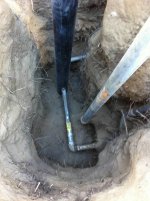
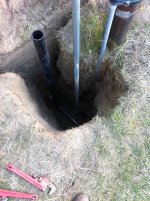
IMG_3124.jpg

IMG_3125.jpg

Yes, it’s fine to connect at the well end. I was fortunate to find an unused end of a T fitting to tap my shop line to. It was 3 ft deep. The thicker black pvc pipe on the left was notched at the bottom and fitted over a street valve. The top end of the pipe was glued to a female fitting with a screwed cap. The bottom & sides at the base is all gravel. This setup allows me to unscrew the cap and lower the shutoff tool should I need to cut off the shop line.
 
   / New Yard Hydrant #14  
One more consideration to installing a freeze proof hydrant.
If you have heavy soil that doesn’t perk well be sure to provide plenty of opportunity for the back wash to drain away when the hydrant is opened and closed in freezing weather. I usually drop a 10’ long piece of perforated drain tile capped on the outboard end and covered with a foot or so of pea stone as a sump to absorb the water running back down the stand pipe when the valve is closed.
For the what’s it’s department, the Michigan plumbing code requires anti syphon valves to prevent cross contamination on all exterior hose connections which of course negates the purpose of a freeze proof hydrant.
To stay mostly compliant, I have a handful of those anti siphon dohickeys that go on the hose Bibb in the spring and come off in the fall.
I just love being protected from my self.......
B. John
 
   / New Yard Hydrant #15  
My well is about 80 yards from the hose and 50 yards from the hydrant in the yard,
the check valve is on the top of the pump drop from the pitless adapter.
The piping 1 1/4" leaves the well runs about 30 ft and has a Y in it which is the split
for the house and hydrant. The pressure switch is at the house on the tank.
One issue is that my pressure switch is the type that drops out and shuts the pump
off on low pressure (15 psi) if the hydrant is turned on rapidly the system pressure
(40-60 psi) can drop below the 15 psi before the flow from the pump reaches the hose
and maintains the pressure resulting in the low pressure safety shutting the pump down.
If the hydrant is opened slowly or if the hydrant is on and the flow controlled by a spray nozzle,
no problem but that 1" hydrant wide open quickly will shut it down which means a trip to the basement
and lifting the shutoff lever on the pump to the run position and holding it for 5-10 seconds.
I have contemplated removing the low pressure safety switch as it has as of yet never functioned
in an as needed situation (broken line, low pressure, pump running continuously) just as an aggravation
during power outages and hydrant use.
 
   / New Yard Hydrant #16  
Not a plumbing/well expert but...cutting into the line after it leaves the well but before the house means that unless the pump is running with yard hydrant open, the water is feeding back from your pressure tank through the filter and conditioner. I don't know if that is a bad, good or mox nix thing.
 
   / New Yard Hydrant #17  
Not a plumbing/well expert but...cutting into the line after it leaves the well but before the house means that unless the pump is running with yard hydrant open, the water is feeding back from your pressure tank through the filter and conditioner. I don't know if that is a bad, good or mox nix thing.

That is exactly how mine has been working for the past 40 years.
The yard hydrant did rust out after 30 years, so I shut the valves off at the tank and the pump, while I replaced the hydrant.
I do not have any filter or conditioner.

Who said backflow preventer?
I grew up drinking from the hose, riding in cars that did not have any seat belts, and riding my bike without a helmet.
I never did smoke though!
 
   / New Yard Hydrant #18  
That is exactly how mine has been working for the past 40 years.
The yard hydrant did rust out after 30 years, so I shut the valves off at the tank and the pump, while I replaced the hydrant.
I do not have any filter or conditioner.

Who said backflow preventer?
I grew up drinking from the hose, riding in cars that did not have any seat belts, and riding my bike without a helmet.
I never did smoke though!
Mine too. House built in 1978 although I've only owned it 8 years. The line from the well Teed off to the hydrant in the barn before the internal house plumbing. My pressure tank is before my filter. Got a lot of sand & sediment out of the tank a couple years ago when I drained & flushed it. I've thought about re-plumbing it for the filter before the tank, but have seen some recomendations to leave it plumbed tank before the filter. So I haven't messed with it. I have added a few more frost free hydrants between the well & house though.
 

Tractor & Equipment Auctions

DEUTZ MARATHON 60KW GENERATOR (A55745)
DEUTZ MARATHON...
2015 CASE SV280 SKID STEER (A60429)
2015 CASE SV280...
S/A Utility Trailer (A59231)
S/A Utility...
2010 Case 580N (A60462)
2010 Case 580N...
2017 Ram 5500 Bucket Truck (A56438)
2017 Ram 5500...
Agri-X 5' 3pt Mower (A53317)
Agri-X 5' 3pt...
 
Top