Loader Loader lift pressure gauge

   / Loader lift pressure gauge #1  

Smokeydog

Elite Member
Joined
Jan 20, 2019
Messages
3,213
Location
Knoxville, Tennessee
Tractor
Kubota B26, M59, M5030DT
Recently retrofitted a Kubota Soft Ride (KSR) system to fit a M59 loader. Nice upgrade and would highly recommend this option if available. Greatly reduces stress while carrying loads.
IMG_1643.JPG
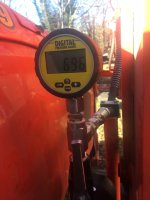
Added a permanent pressure gauge at the same time. Anyone else monitoring their loader lift pressure during use? Advice?


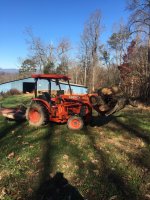
Not only did I want another way to evaluate the KSR system but learn more about the dynamics of the hydraulic system. See if I could use it to roughly measure the weight of what I’m picking up. Large loaders at quarries use similar system.
IMG_1645.JPG

Only on for a few days so trying some experiments to evaluate if this is something that is practical.

Grapple empty 630psi.
Grapple I think is 850#
Need to measure with the grapple off.
How the weight is measured relative bucket pin.

Dead head lift into brush pile, 2600psi. Slightly lower than the 2750-2950 spec. 1400+hours.

Could curl while at max lift 3700psi. Showing how trapped fluid in a circuit can exceed pump relief valve pressure by external force. Curl, grapple, push/pull driving, and bouncing.

Curl effects lift circuit psi. How high you lift. Some loaders have graphs showing lifting capacities along their lifting range. Sitting with engine off, grapple empty but not on ground after using has 1800psi I guess due to thermo expansion. Lot to consider and respect when seeing how much pressure is in the system.

Don’t have many known 500#-ton weights sittings around to calibrate.
 
   / Loader lift pressure gauge #2  
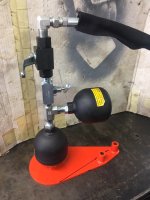
i've got the fitting to plumb a gauge into the lift circuit to have some data to help me size an accumulator in the lift circuit for a home made ride control system. the plan was to mount the gauge temporarily but your system has me thinking I should maybe mount it permanently.

interested in seeing more data. that M59 looks a little funny without the backhoe mounted.

I was thinking i would test pressure with empty bucket and full bucket so I can decide how much pressure to put in the accumulator.
 
   / Loader lift pressure gauge #3  
funny that the curl circuit affects the lift circuit pressure.
 
   / Loader lift pressure gauge #4  
do you have any pics of the actual soft ride system. where did they mount the accumulator. are they piston or bladder type. one or two?

the wr long system has two bladder type but I'm thinking of using two piston type but i'm having trouble figuring out the size required.
 
   / Loader lift pressure gauge
  • Thread Starter
#5  
I bought a KSR NOS kit on eBay for $200 for LA-1953-2253 loaders. A little bigger capacity than my TL-1350. Only used accumulators and one bracket. The rest custom to fit my tractor. IMG_1589.JPG
About $150 in valves, fittings, hose and gauge. Unit sits well protected on top the 3rd function cover between the loader tower and engine, attached with three bolts. 5’ hydraulic line tee to lift cylinder bottom.

The accumulators are Bosch brand, bladder, precharged to 280psi on one and 580psi on the other. One is sealed and the other has a bolt in the bladder side so I don’t think they can easily change the pressure or recharge on these.

When you curl or lift a load you are changing the load center of gravity in relation to the loader bucket pivot pin. Same weight but changing force (psi) on the loader circuit.

To make a loader a weight scale is an interesting math problem. Picking reference point, aligning CG, and lifting calibrated weights is my theory. Hoping smarter brains can figure an easier way.

That’s a static load. Start moving and momentum becomes a dynamic load.
 
   / Loader lift pressure gauge #6  
Water weighs 8.3lbs per gallon. Which you can pivot into a somewhat accurate known weight. 55 gallon drum is about 460lbs plus the weight of the empty drum which you can get with a bathroom scale. 275 or 330 gallon IBC totes will be over a ton fully filled.

How you lift will affect things a lot. My 1,700lbs flail mower on a pallet can't really be lifted with forks. Lift it with a chain to the back of the bucket or forks & it lifts okish, albeit getting close to taking out my grill guard.
 
   / Loader lift pressure gauge
  • Thread Starter
#7  
Test 2.

Grubbed out storm damaged trees, stumps and debris along the spring and creek. Transporting 1/4 mile to brush pile. The KSR worked flawlessly. One of the best modifications I’ve ever done. Carrying loads is so smooth. The gauge confirms cushioning of pressure spikes.

Weight scale.
Working, stacking, grubbing etc. If you install a real-time gauge needs to be a least a 5,000#. I’m using a 10,000#.
The M59 engine strains a little when lowering a load. This feature helps control heavy lifts. It also can give high lift pressures when the grapple is empty. Raise a little and goes to normal. Noticed after dumping load, dropping the grapple to travel would have as high as 2000psi.

Made a 3pt concrete and steel counter weight back in 1981 to help the MF135 with a trip bucket loader. Used a weigh scale to weigh it 980#.
IMG_1648.JPG

Chained to the back of grapple, scale to counter weight. Lifted till chain lined up with lower loader bucket pivot pins. 1232psi.

1232 - 630 Grapple tare = 602psi
980#/602psi = 1.63#/psi
Or maybe rule of thumb 1000# for every ~600psi? Seems a little high so got to due some more thinking.

I understand the max lift at max pressure for a specification. Did they both start at zero? Loader would have to be at some pressure to start?
 
Last edited:
   / Loader lift pressure gauge #8  
The weight vs pressure curve isn't going to be linear. At the start of the lift, cylinders are pushing forward & up with the load levered way out in front. At nearly max height the cylinders are pointing almost straight up with the load directly above them. It will be closer to applying hydraulic pressure * piston diameter force to lifting. When the load is out front the leverage will dramatically decrease the effective lift capacity of piston size * pressure.

If you want to try & calibrate pressure gage readings vs load, you'll have to do it at one specific height, or do a chart for various heights. If you are more patient than me & better at math you might be able to come up with a formula that takes in height & pressure to get you weight, but it won't be a super simple one.
 
   / Loader lift pressure gauge #9  
Don’t have many known 500#-ton weights sittings around to calibrate.
Well Mr. Smokeydog....

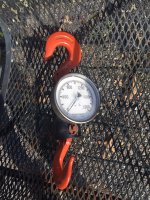
First: I happen to have two "nose weights" that go under my loader backhoe. If I recall, I think they are combined right at 500 lbs. There IS a weight (in Kg) stamped on them. I don't recall what it is but it's a known quantity.

Second: I live in Greenback so I'm not terribly far from you


If you want to know and have the means to either bring your tractor here or come here and carry them back (and of course, return them! HA!) You're more than welcome to borrow them.

I'm in process of bolting them back to the underside of the backhoe however, the "washers" that keep them held up were machined for me and are slightly too large so they need some more fabricating before they'll fit into their spot so these can be bolted back on.

Meanwhile, they're just sitting here as dead weight.

Let me know if interested. If you DO have interest and ability to transport your tractor, there is plenty of room here to load/unload and move it around.
 
   / Loader lift pressure gauge #10  
I would think that if you lift to the same point all the time the calibrating should give consistent results. For me the same point would be something like when the crossbar on the loader is inline with my eyes and the hood of the tractor.
 
   / Loader lift pressure gauge
  • Thread Starter
#11  
Well Mr. Smokeydog....

First: I happen to have two "nose weights" that go under my loader backhoe. If I recall, I think they are combined right at 500 lbs. There IS a weight (in Kg) stamped on them. I don't recall what it is but it's a known quantity.

Second: I live in Greenback so I'm not terribly far from you


If you want to know and have the means to either bring your tractor here or come here and carry them back (and of course, return them! HA!) You're more than welcome to borrow them.

I'm in process of bolting them back to the underside of the backhoe however, the "washers" that keep them held up were machined for me and are slightly too large so they need some more fabricating before they'll fit into their spot so these can be bolted back on.

Meanwhile, they're just sitting here as dead weight.

Let me know if interested. If you DO have interest and ability to transport your tractor, there is plenty of room here to load/unload and move it around.

Thank you for your generous offer. Always good to have fellow TBN members near. I’ll pass for now. I was able to use the crane scale to measure the counterweight, grapple and land plane. The land plane weight confirmed by EA website.

After lifting the various know weights using the torque tube of the QA to center the center of gravity over bucket pivot and similar height. The gauge is consistent. Figuring a formula for weight not so much.

Agree the relationship is some sort of mathematical curve. Published specs shows higher lifting capacities at lower position not higher. Been my experience with other loaders being able to lift something but not load a truck. There is geometric travel component and changing moment arms that influence too.

Without a front implement attached 340psi.
I can push down and lift the tractor front end off the ground and the gauge goes to zero. Gauge capable of reading a vacuum.
Stored overnight, morning reading 500-600psi. Can relive pressure using joystick before starting and get zero. Backlight is nice.

The Means of using a loader pressure gauge as a weight scale is elusive so far. Several variables have to be considered and controlled. It is interesting seeing how this function does work. Never know till you try.
 
   / Loader lift pressure gauge
  • Thread Starter
#12  
I would think that if you lift to the same point all the time the calibrating should give consistent results. For me the same point would be something like when the crossbar on the loader is inline with my eyes and the hood of the tractor.

What little I have lifted known weights from the same point the gauge is consistent.
Given enough objects like hay bales, weighing with crane scale, lifting consistently, recording pressures, develop a chart might be fairly accurate. But would be different for logs or buckets of gravel.
The lift pressure gauge is an interesting puzzle piece and trying to see how it fits in the big picture the challenge.
 
   / Loader lift pressure gauge #13  
But would be different for logs or buckets of gravel.

I would think that the bucket would need to be curled to the same position every time in order for the results to be consistent. Therefor you would need different charts for say a set of pallet forks etc.

I don't think that different materials would change the charts too much. If a load of logs was completely within the bucket I think the gauge would be as accurate as a bucket with gravel. I would think that if the logs were sticking over the sides the accuracy would still be ok. If the logs were sticking out a fair ways over the lip of the bucket though that might change the accuracy. It's an interesting question.
 
   / Loader lift pressure gauge #14  
If you ever watch the loaders at most quarries, they have a weight scale built into them, you'll see them take a scoop then bring the loader to arms to a set height. Because of the geometry of the loader its easier to calibrate it to one set height.

Typically loader arms horrizontal and bucket curled all the way back from the ones at my quarries.
 
   / Loader lift pressure gauge #15  
If you ever watch the loaders at most quarries, they have a weight scale built into them, you'll see them take a scoop then bring the loader to arms to a set height. Because of the geometry of the loader its easier to calibrate it to one set height.

Typically loader arms horrizontal and bucket curled all the way back from the ones at my quarries.

They only work with the bucket all the way back and the arms at a predetermined height. Using hydraulic pressure to weigh varying size and position objects with any degree of accuracy is about impossible.
 
   / Loader lift pressure gauge #16  
They only work with the bucket all the way back and the arms at a predetermined height. Using hydraulic pressure to weigh varying size and position objects with any degree of accuracy is about impossible.
Yup, like I said.

They are surprisingly accurate though, most loads are within 20lbs on a 10k load of gravel when I'm picking up material.
 
   / Loader lift pressure gauge
  • Thread Starter
#17  
The pressure gauge accuracy is without question. Interpreting the results is the question.

Quarry end loaders not only weigh with the bucket curled back but more importantly when curling forward dispensing their product. I’m sure they use a more elaborate mechanism and expensive gauge setup.

I was hoping with such a large knowledge and experience base others might have tried this with better success. Not given up just not as simple as I first thought. I have some logs I can weigh individually and lift in groups and see if I can find a meaningful curve.

Part of the variable component influencing pressure is wide variety of attachments and materials being lifted.

There maybe other useful information gleaned from monitoring the loader pressure during operation also.
 
   / Loader lift pressure gauge #18  
Thanks for the pics. so your bladder PSI settings are probably a little on the high side since they are designed for a larger loader. but they are lower than I would have expected.

I think the geometry of the load will have a larger effect than we think.
 
   / Loader lift pressure gauge #19  
They only work with the bucket all the way back and the arms at a predetermined height. Using hydraulic pressure to weigh varying size and position objects with any degree of accuracy is about impossible.


Yes - - Change the height, bucket curl or load position in bucket and weight will be way off. Somewhat accurate when used strictly as described above using materials that lay in the bucket nicely.
 

Marketplace Items

CAT CB34 (A60462)
CAT CB34 (A60462)
2444 (A60432)
2444 (A60432)
2021 Billy Goat F902H Walk-Behind Debris Blower (A59228)
2021 Billy Goat...
1990 Bayliner 19ft Trophy Center Console Boat w/ S/A 20ft Boat Trailer (A59231)
1990 Bayliner 19ft...
PALLET OF (20) BOXES OF ARMSTRONG TILE FLOORING (A60432)
PALLET OF (20)...
(14) WOOD PALLETS (A60432)
(14) WOOD PALLETS...
 
Top