Log winching safety questions

   / Log winching safety questions
  • Thread Starter
#21  
Update:

I cut 3 sections from the small part of the limb, about 8-10 ft long each. Diameter up to 10". Very small stuff compared to other pictures here. Pulled them one at a time, no problem. Not much sideways roll.

Now, I am hooked up to the "small end" of a 20' section. 10" diameter at the small end, 18" at the large end. My winch won't pull it. When I engage the winch, the line tightens, then the clutch slips. Limb doesn't move.

Not sure what is going on. The Farmi manual says there is a clutch adjustment possible, but this *is* a brand new winch?

Since it is a fallen limb, maybe when it came down, a side limb burrowed into the ground and is acting like an anchor?

My cable is routed through the top pulley, then the bottom pulley, then through a snatch block at about 90 degree turn, then hooked onto the limb. Any ideas?

 
   / Log winching safety questions #22  
If your clutch is working right with full pressure on it your tractor engine should bog way down, maybe even stall, or the tractor should get dragged backwards before the clutch slips. The key word is full pressure on the clutch which you must supply thru the control rope.
It is possible a new clutch needs adjusting but not that likely. These are the reasons I can think of If your clutch is slipping before that log moves or before the tractor lurches backward or bogs down: You are not pulling hard enough, there is oil on the clutch face, the clutch face is glazed over from over heating, the clutch needs adjustment, or there is something impeding the clutch arm lever from realizing full travel.


Check the easy things first. Make sure the lever arm can swing fully w/o hitting or binding on something. Pull harder on the rope. On my Farmi I have to wrap the rope around my hand a couple times and then lean back hard on the rope putting all my weight into it on a hard pull. I can't pull anywhere near hard enough on a hard pull standing flat footed and pulling on the rope but I only weigh 150. Clutch adjustment would be next but I wouldn't do that until I used it a while to make sure it really needs it. Might be a little surface rust or something that will wear off. To check for oil or glaze you need to take it apart so that is a last resort. I would call the dealer before I adjusted the clutch or took a brand new winch apart.

Keep us posted.

gg
 
Last edited:
   / Log winching safety questions #23  
As a side note independent of the clutch question often a log gets stuck or frozen to the ground if it lays a while. Also braches stab into the ground as you mentioned. It can be real tough to get these started. It helps a lot if you give it a small sideways pull first at the choker end to break it loose. Or you can wrap the long end of your choker chain around the log and hook the slider at the very end so when you start your pull the wrapped chain makes the log roll to free it. Not good on a side hill maybe. Sometimes you can roll it out from behind a stump this way.

gg
 
   / Log winching safety questions
  • Thread Starter
#24  
That is good information and I suspect it is not enough tension on the pull rope.

Not being experienced, I presumed the clutch was "on / off", i.e. fully engaged-- or not. I was only pulling hard enough for the cable to begin to move.

I did find an "anchor limb" underneath the 20ft log, although I think it should have pulled through that. It wasn't bogging the engine nor pulling the tractor. I cut the anchor limb off, cut the 20ft limb in half, and it easily pulled each 10 ft section. The next limb starts at 18in diameter and gets bigger. So tomorrow I will pull hard on the rope.

Question: suppose you pulled a log in. Clutch is released but PTO still spinning. You want to disconnect the cable, pull it back out, and go hook onto a second log. Before handling the cable, do you disengage the PTO? Or is the clutch reliable enough so as not to create an undue hazard while you're handling the cable?
 
   / Log winching safety questions #25  
To each their own when it comes to risks and safety, but I consider the clutch reliable enough to keep PTO running when pulling cable out for the next hitch.
Worst case scenarios would be it pulls the cable out of your hand. That is, never be in a situation where a sudden cable retraction could do anything worse.
It’s always good practice to have a few feet of slack and never,ever put your arms, hands, fingers, legs or feet anywhere that could be pinched, jammed, sliced, etc.. by a cable that goes from slack to taut.
 
   / Log winching safety questions #27  
If you fix your block to the log. Take your winch cable through the block and fix the end to another tree higher than the log. In effect this gives you twice the pull. Just make sure your block can take twice the pull of the winch.
 
   / Log winching safety questions #28  
(removed)'s right.

Snatch blocks are your friend. I gotta say this.. People doing this kind of stuff first think "can I do this?, yeah I can do it" sure you can but the idea is to Minimize Risk. That is why professional arborists in town will often put a line on something even though they think they can free fall it, and wedge it right. Minimize Risk. The further you are from the point of possible impact(s) the safer and better off you will be. Messing around with blocks and angles is fun, too. You might surprise yourself how crafty, safe and smart you will be.
 
   / Log winching safety questions #29  
You know, a simple post of your concerns without insults would go a lot further. As of now your just a bad case of the mouth runs. With idiotic verbiage to boot.
 
   / Log winching safety questions #30  
You know, a simple post of your concerns without insults would go a lot further. As of now your just a bad case of the mouth runs. With idiotic verbiage to boot.

Amen. (and thanks for saying it)

Someone new to this is asking for suggestions. They are getting some good ones. Seems as though there is always someone who thinks their way is the only way and everyone else is doing it wrong.

This as been a productive, friendly discussion. I certainly hope that someone tossing insults and getting obnoxious doesn't get it closed down.
 
   / Log winching safety questions
  • Thread Starter
#31  
Update: I've now winched in about 10 limbs. With and without a snatch block. No problems except when I didn't pull the rope hard enough.

Largest limb is about 22" diameter. I'm cutting limbs into 10-20 foot sections.

No issues with log rolling. The topsoil here is rich. When I drag a limb, it creates a furrow, keeping it stable.

I appreciate all the help and input.
 
   / Log winching safety questions #32  
Update: I've now winched in about 10 limbs. With and without a snatch block. No problems except when I didn't pull the rope hard enough.

Largest limb is about 22" diameter. I'm cutting limbs into 10-20 foot sections.

No issues with log rolling. The topsoil here is rich. When I drag a limb, it creates a furrow, keeping it stable.

I appreciate all the help and input.

Glad it's working out for you. It's always best to play it safe and take extra precautions until you become more familiar with the equipment, and how the logs react under different situations. Remember, there are plenty of internet experts out there. When you are new to a subject, it's sometimes hard to sort out who knows what they are talking about, and who just talks a good show and has been lucky (so far). There is also no substitute for being there in person and seeing the situation with your own eyes.

One of the most important things you can learn as you go through this is your own limitations. Learn what you can handle and what your equipment can handle. If you make an effort to keep learning - both from things that went well and from things that didn't go as planned - you'll expand your limits and find new (and safe) ways to use your equipment. Never be afraid to just stop and say "this one is beyond me" and find someone more experienced to help or advise.
 
   / Log winching safety questions #33  
Update:

I cut 3 sections from the small part of the limb, about 8-10 ft long each. Diameter up to 10". Very small stuff compared to other pictures here. Pulled them one at a time, no problem. Not much sideways roll.

Now, I am hooked up to the "small end" of a 20' section. 10" diameter at the small end, 18" at the large end. My winch won't pull it. When I engage the winch, the line tightens, then the clutch slips. Limb doesn't move.

Not sure what is going on. The Farmi manual says there is a clutch adjustment possible, but this *is* a brand new winch?

Since it is a fallen limb, maybe when it came down, a side limb burrowed into the ground and is acting like an anchor?

My cable is routed through the top pulley, then the bottom pulley, then through a snatch block at about 90 degree turn, then hooked onto the limb. Any ideas?

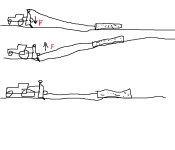
PlowHog I noticed this statement but didn't say anything because of your more important clutch issue but now that you have put that to bed I would like to make another comment. Your winch is designed with a high top pulley for a reason. When you are winching in a log, ideally you want the winch to take all the pulling force and the tractor to just sit there acting as a counter weight. To make this happen you need to drive the winch dozer blade into the ground so that the ground is holding the winch back and not the tractor. There are two things that drive the blade into the ground. The weight of the winch, 400 lbs or so for a 351 I think ??, and more important the tension on the cable. You want the cable tension to drive the winch into the ground. If the cable leaves the top pulley at a downward angle the cable tension will pull the winch down into the ground. That is good. And as a side benefit it will tend to lift the front end of the log making an easier pull. Conversely, if you winch from the bottom pulley and your cable runs uphill to the log so that the cable makes an upward angle leaving the pulley the cable tension will actually try to lift your winch off the ground. That is
bad. If the cable runs out straight at 90* you gain no benefit from the cable tension. The only time I use the lower pulley to winch is when I have to much side angle on the cable. Remember always to winch straight back only from the top pulley. Winching at an angle you loose the counter weight effect of the tractor and you can pull it over very easily. You can also mess up your 3ph very badly with side forces.

Just be aware of these principles. Nothing is absolute as there are way to many variables and you just have pick the setup that seems best and make trade offs.

Here is an older Farmi doc on the 351 which mentions the pulley uses and a crude drawing of the cable forces that might help make sense of what I was trying to say- but maybe not.

View attachment 680542

CableAngle.jpg

gg
 
   / Log winching safety questions
  • Thread Starter
#34  
Your winch is designed with a high top pulley for a reason.

Thank you for that. The Farmi manual, and a pin on the lower pulley, were somewhat misleading. The manual does say: "usually the logs are winched through the upper pulley.;" However, in a prior section, the manual discusses tip-over danger, writing: "the falling danger can be reduced by winching through the lower diverting pulley." I formed an impression that using the lower pulley was safer.

The winch was shipped with the cable routed through the lower pulley. On my first "tensioning" pull, I wanted to re-route to the upper pulley. But a pin was preventing the cable from being removed from the lower pulley. It could not be removed without using a tool, which seemed odd. (Tapered pin, pounded into place.) I will replace that pin with something that is easy to remove and replace.
 
   / Log winching safety questions #36  
I'm thinking of getting a logging winch. This thread has been very useful. One question I have that has not been discussed is how far one should stand from the winch when pulling the cord. The reason I ask is that I think a lot of my pulls would come from a road that cuts across a steep hillside. Both banks are steep which would make it hard to get more than a foot or two away from the winch. Also a related question- for winches that have a compound pulley system for the clutch cord (like a Uniforest 35m) do you have to operate it from the tractor's left side?
 
   / Log winching safety questions #37  
How far away to stand? : Depends.
If there’s a chance the blade hasn’t dug in when you’ve lowered winch (blade on ice, a root, rock, pavement, etc..) and there’s a chance blade and tractor may slide instead of the log, I make sure I’m not standing with my back turned behind the tractor tire.
Or if there’s a situation where log may exceed pull limit of my winch or get hung up on something, (I.e clutch may slip), it seems standing farther away, and more perpendicular to the cable , it’s easier to watch that the cable is actually moving INTO THE WINCH.
I find that watching the cable at the winch is sometimes more useful, and a quicker indication, than watching the log end.
It’s hard to see what’s going on 50’-100’ away, or if log is getting snagged, but the cable next to you tells you clearly.
....but in a easy pull, I sometimes only stand just outside the width of the tractor.
 
   / Log winching safety questions #38  
Regarding using bottom pulley vs top pulley only on winch:
I think using only top pulley can help a little lifting log and not digging as big of a rut, or giving a tiny advantage in getting log over a root, or rock, etc..
...but I always thought there may be situations where using only the top pulley puts a lot of the torque on the top link vs. using lower pulley. Is there any real danger? Maybe not.
I always thought that when using the lower pulley, much of the torque is between the blade (digging in) and the lower (stronger) lift arms. For this reason, I use the bottom pulley more for bigger log pulls, and skip it for smaller logs.
Also, any leftover torque to the the top link when using bottom pulley puts top link in compression rather than in tension when only using the top pulley (if that makes any difference?).

I tend to use the bottom pulley more for towing reasons. It gets the log tighter to the winch.
Towing from the top pulley can let a log swing around the side of the winch and do all sorts of mayhem. You wouldn’t think it’s possible, but on uneven ground and making a tight turn, I’ve had a log bend the guard on the tractor side of the winch. I had a log try to take out my chainsaw hanging on the side of the winch.
 
Last edited:
   / Log winching safety questions #39  
I need ideas

The lands I wish to pull about 100 hardwood logs off is all up hill.

I would barely like to drive the tractor up to them, and hauling 30 foot hardwoods down would scare the bejesus out of me.

Winching down is my thought, With a 6 K pull Fransgaard and several 150 foot lengths of 10K static Kern Mantle rope, I believe I can make a job of it. I'm thinking pull with the winch wire rope to a pulley hitched to a tree to avoid runaways from striking the tractor (or me)

It seems like a lot of work hitching onto a length of rope, winching in, pulling out, re-hitching, pulling in, etc.

But what can a fella do on up slope land and no skidder?
 
   / Log winching safety questions #40  
I need ideas

The lands I wish to pull about 100 hardwood logs off is all up hill.

I would barely like to drive the tractor up to them, and hauling 30 foot hardwoods down would scare the bejesus out of me.

Winching down is my thought, With a 6 K pull Fransgaard and several 150 foot lengths of 10K static Kern Mantle rope, I believe I can make a job of it. I'm thinking pull with the winch wire rope to a pulley hitched to a tree to avoid runaways from striking the tractor (or me)

It seems like a lot of work hitching onto a length of rope, winching in, pulling out, re-hitching, pulling in, etc.

But what can a fella do on up slope land and no skidder?

How long of a pull are you talking about? I have 230 feet of cable on my winch. For the vast majority of my pulls, 100 or 150' would be plenty. There have been times when I've used the whole length plus a couple of 20' chains on the end. I'd pull in enough to remove the two 20' chains, then pull my cable back out and re attach for the rest of the pull. It was a bit of a hassle but do-able. I did quickly find out that pulling at that distance was not something I wanted to do alone. Since my winch is rope operated (no remote control), that kept me at the tractor. It was just too hard to tell what was going on at the log. especially if I was using one of my self-releasing snatch blocks to redirect the pull. I needed one person at the winch, and another near the log as a spotter, and we needed to be in communication with each other (shouting, walkie talkies, or if I could see the person, hand signals).

Even with a static line, you need to be quite aware of the possibility of the rope recoiling if something lets go (like a knot fails or a hook slips off). You and anyone else in the area need to be cognizant of where the "safe" areas are and where it's not so safe to stand while pulling.


Tractor & Equipment Auctions

2017 Har-Tru CourtPac Tennis Court Roller (A59228)
2017 Har-Tru...
2011 Ford F-550 Bucket Truck - Power Stroke Diesel, Altec AT40G Boom, 45 ft Working Height (A56438)
2011 Ford F-550...
2024 CATERPILLAR 259D3 SKID STEER (A60429)
2024 CATERPILLAR...
2014 FORREST RIVER SALEM TRAVEL TRAILER (A55745)
2014 FORREST RIVER...
2020 PETERBILT 567 (A58214)
2020 PETERBILT 567...
2008 New Holland T2420 (A60462)
2008 New Holland...
 
Top