Home-Built Hydraulic Post Pounder; Speeding up the freefall

/ Home-Built Hydraulic Post Pounder; Speeding up the freefall #1  
Joined
Jan 7, 2021
Messages
31
Location
Bitterroot Valley, Montana
Tractor
Kubota T1400, B7300, L35
.
.
I've got a ton of fencing to do this spring that will involve setting several hundred wooden fence posts.

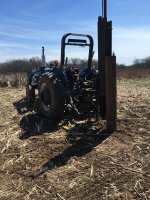
I have a compact Kubota tractor ...

A1KubotaB7300.jpg

that I have rear remote "hydraulic-enabled" by tapping into the PowerBeyond port on the FrontEndLoader spool valve:
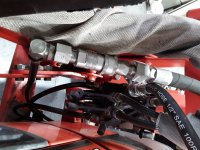
C1PowerBeyondTap.jpg
The specs say that the tractor hydraulic pump will produce three gallons per minute. Yeah that pretty low but it should be more than adequate for what I what to do, which is, lift a 300-400 pound weight then drop it letting it freefall. Yeah i know the setup looks fragile but I'm just doing proof of concept right now.

I was driving around in the Root the other day and saw a lonely contraption along the fence line in somebody's yard. Here in the Root, we don't use ForSale signs. If it's on the front lawn, that means it's for sale. I went up to the house and knocked on the door. The rest is history.

Anyway, I picked up a gem. It was probably in a previous life a 3pt-mounted, PTO-driven DanUser post pounder now mounted on a trailer. It was powered by a small gas engine that thru a rube goldsberg (sp?) set of chains and sprockets drove the DanUser friction wheel. The engine was shot. Instead of fixing the engine I removed it and all the friction-wheel/brake stuff. I installed a hydraulic cylinder, spool valve and hoses.

Here's the whole rig:
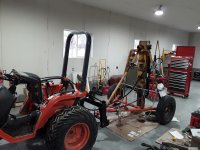
B1KubotaNTrailer.jpg

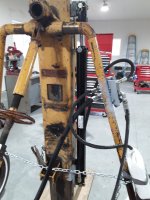
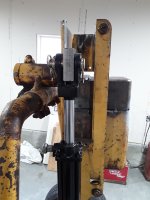
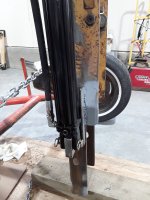
Shots of the fabricated hydraulic post pounder. Hey! Don't make fun of my welds. I did it with my eyes closed, well kind of, I have cataracts really bad.
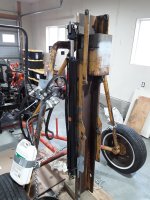
D1HydraulicPostPounderFrontView.jpg E1HydraulicPostPounderRearView.jpg F1HydraulicCylinderTopView.jpg G1HydraulicCylinderBaseView.jpg

The setup of the hydraulic spool valve:
o Port bottom left: From pump (actually the PowerBeyond port on the FEL spool valve)
o Port top right: Return to tank. (actually the one gallon jug for now)
o Port bottom right: Return to tractor. (The other end of the PowerBeyond from the FEL spool valve that goes on to power the 3pt)
o Port top center: B port that goes to the base of the hydraulic cylinder.
o Port bottom center: A port capped. This would ordinarily go to the rod end of the hydraulic cylinder.
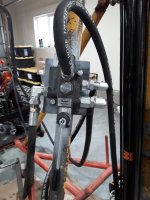
H1SpoolValveCloseup.jpg

So what I've done here is taken a 4-way single bank spool valve and double-action hydraulic cylinder and converted to a 3-way single bank spool valve and single-action hydraulic cylinder. I have a hydraulic line only to the base of the cylinder and nothing but an air vent in the top port of the cylinder. ie I'm depending on the weight of the ram to retract (drop).

For anyone interested, here are the specs on the spool valve:

This monoblock valve is a hydraulic directional control valve. These valves are used to start and stop fluid flow into hydraulic cylinders or hydraulic motors.

Common Uses:

Operate hydraulic cylinders (Double-Acting or Single-Acting)
Operate hydraulic motors ("D" Spool Required)
Install rear remotes on a tractor

Benefits:

1 Spool valve with compact design allows for installations in tight areas
All spools are standard double acting with spring return to neutral position which are ideal for double acting cylinders
Used for open center systems (Pump to Tank Flow) - closed center option available
Anti-drop load checks on each spool
Precision ground and hard chrome-plated spools assure a long life
High-tensile strength cast iron monoblock construction
SAE O-Ring ports ensure solid seal and prevent blockages
Capable of closed center or Power Beyond (conversion plug required)
Vertical or horizontal handle mount
Adjustable Relief Valve Range: 1500 to 3625 PSI
Used as motor or single-acting spool possible (#8 SAE port plug required)

Features:

Max Operating Pressure: P = 3625 PSI, T = 725 PSI, A & B = 4350 PSI
Flow Rating: 11 GPM (40 l/min)
A & B Work Ports: #8 SAE O-Ring (3/4?16) Thread
Inlet Port: #10 SAE O-Ring (7/8?14) Thread
Outlet Port: #10 SAE O-Ring (7/8?14) Thread
2 5/16 Mounting Holes

Here are the specs on the hydraulic cylinder.
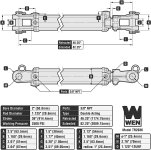
I1HydraulicCylinderSpecs.jpg


So, I put this all together and fired it up.

It works!

Well mostly. The cylinder extends fully. It's not really fast but it is acceptable.

The problem comes in when I retract the cylinder. The cylinder comes down at the same rate that it goes up. It comes down leaving a love-tap ... of course unacceptable for a post pounder.

I'm reaching out to the hydraulics brain trust here. Any suggestions on how to make this freefall?
 
/ Home-Built Hydraulic Post Pounder; Speeding up the freefall #2  
the pounderI built years ago only used the cylinder to lift, there is no use having the system double acting because you want the pounder to free fall and no restrictions
 
/ Home-Built Hydraulic Post Pounder; Speeding up the freefall
  • Thread Starter
#3  
the pounderI built years ago only used the cylinder to lift, there is no use having the system double acting because you want the pounder to free fall and no restrictions

So you used a single-acting cylinder? They are pretty hard to find and for some reason really expensive.
 
/ Home-Built Hydraulic Post Pounder; Speeding up the freefall
  • Thread Starter
#4  
A friend stopped by today and suggested flipping the cylinder over and try powering the cylinder from the rod-end; the rationale being that since the rod-end of the cylinder holds a smaller amount of fluid, maybe it would purge faster.

The hoses are long enough so I tried it. It didn't work in that it wouldn't lift the weight. Powering the cylinder from the rod-end won't lift the weight.

With the cylinder still inverted, I moved the hydraulic line to the non-rod end of the cylinder, so in effect it would be pushing the whole cylinder assembly and weight up.
I tried that. It worked going up and noticeably faster down. But still not fast enough. An advantage to this setup is that the cylinder port is now physically higher than the spool valve so that should give a slight advantage in draining.

The bottleneck still seems to be the rate that the fluid purges the cylinder -- it's being restricted.

Question to hydraulics pros, can these cylinder ports be safely enlarged? The cylinder port is 3/8", the hose is 1/2" and the spool valve port is 3/4". So technically I could go up to 3/4" on the cylinder port and hose before encountering another bottleneck.
 
/ Home-Built Hydraulic Post Pounder; Speeding up the freefall #5  
/ Home-Built Hydraulic Post Pounder; Speeding up the freefall #6  
The return port should be 3/4 and dump back to the tractors hyd fill cap..
 
/ Home-Built Hydraulic Post Pounder; Speeding up the freefall #7  
Yes, the ports can be enlarged easily.
The commercial units I’ve worked on have a big single acting ram (think big plow ram) and use pulleys under the cylinder and on the top. IIRC the multiple pulleys has cable wrapped around giving it a ratio of cable lift vs ram travel (think block and tackle hoist with a cylinder inside), then a high pressure ball valve with tee used to release the single acting ram and dump directly to tank (return oil not going thru the regular control valve).
If the cable moves at a 4:1 ratio, then the cylinder would need to be 4 times more powerful to lift the hammer.
 
/ Home-Built Hydraulic Post Pounder; Speeding up the freefall #8  
So you used a single-acting cylinder? They are pretty hard to find and for some reason really expensive.

Any double acting cylinder can be converted to single acting by having only 1 hose installed in cylinder & a breather installed in other port. IIRC return oil from post driver control valve needs to go directly to tank(reservoir)
 
/ Home-Built Hydraulic Post Pounder; Speeding up the freefall #9  
You still have move air in and out of the open port. It will act as a damper. The only way to reduce that drag is to make the port the same size as the bore of the cylinder.

I think I would have made some type of clicker latch so the weight is falling free. Have the cylinder lift the weight up to point where it's then disengaged from the lift cradle/cylinder. Power return the cylinder to latch the weight in the cradle and the cycle repeats.
 
/ Home-Built Hydraulic Post Pounder; Speeding up the freefall #10  
The return port should be 3/4 and dump back to the tractors hyd fill cap..

This is the answer to your problem. If you are running the return through your remote valve on your tractor that is your restriction. The return has to freely dump back into the reservoir of your tractor with NO RESTRICTION and the only way to do it is to unscrew your hydraulic fill cap, stick the open ended return hose in there and then operate your driver.

NOTE #2: Do not test your post driver in your garage on your concrete floor. It will drop so fast it will surprise you and it will bust your floor in a manner that will make a jackhammer jealous.
 
/ Home-Built Hydraulic Post Pounder; Speeding up the freefall
  • Thread Starter
#11  
I am truly humbled by the patient and thoughtful responses. Thank you all for sharing your thoughts, experiences and ideas. I really appreciate you!

I'm going to followup shortly with perhaps a few "plumbing" diagrams to illustrate the current setup and some of the ideas proposed. It will definitely be edifying for me but maybe it will also help the next person that comes along trying to do something similar.

Thanks again!
 
/ Home-Built Hydraulic Post Pounder; Speeding up the freefall #12  
Bitterroot Valley- ahhhhhh. Love that area, especially the steak house (Dicks?) on the road to Lolo hot springs. :thumbsup:
 
/ Home-Built Hydraulic Post Pounder; Speeding up the freefall #13  
The return port should be 3/4 and dump back to the tractors hyd fill cap..

This, and Tinhack’s comment on the breather size.
....but oil still has to flow back through the spool valve (with anti-drop load checks??) on the unit. How fast it can do that might also be key. Or like wdchyd and OldAndTired refer to, bypass spool valve for return flow with something else.
 
/ Home-Built Hydraulic Post Pounder; Speeding up the freefall
  • Thread Starter
#14  
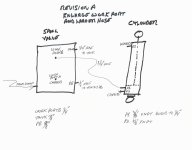
Okay. I thought I'd do a few drawing to show how this thing is currently plumbed. Also throwing in a couple of revisions.

I know I'll need to acquire a few more pieces and parts so drawing it out helps in detailing what I need. I love living in "fly-over" country but getting parts can be a challenge. Sometimes I feel like that guy in the movie "O'Brother" whose told that it will take two weeks to get a new transmission belt for his Model T - "This place is a gol-dang geographic oddity, two weeks from anywhere!".

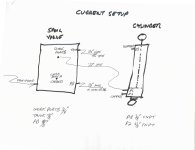
Here's a simplified picture of the current plumbing. It works, kindof. The weight goes up, somewhat slowly. The weight comes down WAY TOO SLOW:
CurrentSetup.jpg

Several contributors have suggested that the problem is that the hydraulic fluid flow is being unduly restricted. The spool valve has a 3/4" work port. I'm currently reducing that down to 1/2" hose, then finally the port on the cylinder is only 3/8".

So let's first look at enlarging the cylinder work port to at least 3/4" and then increasing the working hose to that size:
RevisionA.jpg
Pros:
o I can control up/down with the single spool valve
o Only need to change one hose
Cons:
o I'm constrained by the internal porting of the spool valve, whatever that may be
o May introduce excessive heat to the spool valve


I noticed that the cylinder actually has two 3/8" work ports on the non-rod end. Here's a scenario where we enlarge that second work port to 3/4" and add a 3/4" ball valve, leaving the plumbing for the first work port intact:
RevisionB.jpg
Pros:
o The first work port plumbing isn't being changed, so the "up" speed will remain predicable
o The ball valve allows for a quick dump of the hydraulic fluid back to tank. In theory this should make the weight drop twice as fast
o Bypassing the spool valve for the down stroke should extend the life of the valve as well as avoiding any internal restrictions
o The spool valve can still be used for a slow controlled up and down. This would is useful for positioning and locking the pounder for road travel
Cons:
o Driving posts requires the coordination of manipulation too separate valves
o Cost of ball valve and extra hoses


And then finally an option that again involves increasing the work port and hoses to 3/4" but adding a tee inline:
RevisionC.jpg
Pros:
o The first work port plumbing IS being changed, so the "up" speed MIGHT be faster
o The ball valve allows for a quick dump of the hydraulic fluid back to tank. In theory this should make the weight drop twice as fast
o Bypassing the spool valve for the down stroke should extend the life of the valve as well as avoiding any internal restrictions
o The spool valve can still be used for a slow controlled up and down. This would be useful for positioning and locking the pounder for road travel
Cons:
o The first work port plumbing IS being changed, so the "up" speed MIGHT be slower
o Driving posts requires the coordination of manipulation too separate valves
o Cost of ball valve, tee and extra hoses

I have a new found respect for the folks that design these systems. There's a lot to think about.

Thoughts on the revisions?
 
/ Home-Built Hydraulic Post Pounder; Speeding up the freefall #15  
You are making this very much harder than it needs to be. To make it simple you need a constant supply to a log splitter valve on the driver than has an open center that fluid will pass through when not directing fluid to or receiving from the cylinder that raises your driver up. The return hose from that has to go to the tank on your tractor, the easiest place is to the same hole in the transmission you pour hydraulic oil into. The log splitter valve needs 1 hose going to the cylinder that makes the driver go up... it will send fluid to it when you move the valve control one way and it will come back through the same hose and out the return when you move it the other way.

One handle up/down.

On my Shaver HD8 when I pull the handle towards me it raises, when I slam it forward it drops. Its very simple and easy, 1 valve and a total of 3 hoses (1 from the tractor, 1 to the cylinder, one to the tractor. Technically two valves, I will be using the remote spool valve on the tractor with a bungee cord holding it to full constant flow, one hose will be coming from that remote on the back of the tractor to the driver, the flow will be returning to the sump of the tractor.
 
/ Home-Built Hydraulic Post Pounder; Speeding up the freefall
  • Thread Starter
#16  
You are making this very much harder than it needs to be. To make it simple you need a constant supply to a log splitter valve on the driver than has an open center that fluid will pass through when not directing fluid to or receiving from the cylinder that raises your driver up. The return hose from that has to go to the tank on your tractor, the easiest place is to the same hole in the transmission you pour hydraulic oil into. The log splitter valve needs 1 hose going to the cylinder that makes the driver go up... it will send fluid to it when you move the valve control one way and it will come back through the same hose and out the return when you move it the other way.

One handle up/down.

On my Shaver HD8 when I pull the handle towards me it raises, when I slam it forward it drops. Its very simple and easy, 1 valve and a total of 3 hoses (1 from the tractor, 1 to the cylinder, one to the tractor. Technically two valves, I will be using the remote spool valve on the tractor with a bungee cord holding it to full constant flow, one hose will be coming from that remote on the back of the tractor to the driver, the flow will be returning to the sump of the tractor.

You are so right my friend. In concept it is SO simple.

In practice the devil is in the details. :)
 
/ Home-Built Hydraulic Post Pounder; Speeding up the freefall
  • Thread Starter
#18  
I made a video on a dry erase board with a very crude drawing, (DISCLAIMER) I don't intend to sound rude or liking I'm talking down to you just the way I normally talk, I have been told that often but I'm a nice guy really, most of the time.
January 9, 221 - YouTube

Rick,

No, gosh no. I saw no offence intended nor take any offence. I think you are a really nice guy especially what with you taking the time to film and layout your thoughts. Yep I get what you are saying.

I've looked at those Shaver PPs. Wish I had one. I notice that they use hydraulics exactly as you stated but they don't use a conventional hydraulic cylinder. The "cylinder" is actually a triangular tube sized just so, with plate/plunger. The hoses are right sized for the job as is the valve, weights, springs, etc. The "cylinder" is designed to use a minimum of fluid. The valve is designed to fast fast evacuate. The point is, somebody sat down and engineered the whole thing.

If you look at my drawings, I'm "plumbing" mine essentially the same way Shaver plumbs theirs. Difference of course is I'm winging it. I'm limited to off-the-shelf parts. Only after trial and error discovered that I under-sized ports, hoses, etc.

So am just trying to get thoughts on plumbing pieces and parts at this point.

Thanks again for your help!
Ed
 
Last edited:
/ Home-Built Hydraulic Post Pounder; Speeding up the freefall #19  
My previous tractor, Ford 3910 and a 10" power pole I drove in the dirt. The drivers work best in moist soil, a rule of thumb I always went by was if I could drive the tractor on it without getting stuck then I could drive a post solid. Later of course I proved beyond that and laid a corduroy path of old timbers down to get a few posts in and they were solid to.

A post the size of the one in this photo took me less than 5 minutes to get in the dirt 3' deep from the time of getting off the tractor to the time I got back on it. No boring of a pilot hole (though that helps with big posts) and I can't remember if I cut a wedge on that one or not.

IMG_1956.jpg
 
/ Home-Built Hydraulic Post Pounder; Speeding up the freefall #20  
I've seen an accumulator setup on a Shaver that a guy who used to be a distributor marketed and sold which would allow you to use the remotes and not have to pipe directly back to the sump. That guy and Shaver had a falling out of some sorts and I have not the accumulator on any Shaver information. Maybe the guy who was the distributor built it himself and it wasn't a Shaver item, either way it was a slick looking setup and appeared to be alot more user friendly.

I did scratch that video first video I made and then did a new one, it might follow better than the first. The point it that if you are returning through a remote it is too much of a restriction, I still haven't figured out what the 4th hose in your photos does but I'm betting if you eliminate it and pipe to the sump your troubles will go away.

**** And get that thing out of your garage to test it. If it drops correctly it will bust your floor and send a crack every direction. My dad was working on this one in his garage back in 1975 (before i was born) and the cracks are still there..... brand new slick floor at the time and BAM!
 

Marketplace Items

2022 Brush Wolf 4800X Severe - Duty Excavator / Backhoe Brush Cutter (A57024)
2022 Brush Wolf...
2020 PETERBILT 567 (A58214)
2020 PETERBILT 567...
500 Gallon Fuel Tank with Pump (A55853)
500 Gallon Fuel...
2016 FORD TRANSIT T250 CARGO VAN (A59905)
2016 FORD TRANSIT...
2020 CATERPILLAR 302.7DCR EXCAVATOR (A60429)
2020 CATERPILLAR...
(1) 48"X15' ADS DRAINAGE PIPE (A60432)
(1) 48"X15' ADS...
 
Top