Rebar supports in a slab

/ Rebar supports in a slab #41  
It is impossible to reach out far enough to pull mesh up while you are standing on it effectively. Maybe with a long tool. But then, if you reach out 6-8 feet from where you are standing to lift the steel can you effectively lift it? I doubt it. To prove this, unroll some mesh and then stand on it. See how far away you have to reach and lift to get the wire to even make a small attempt at staying elevated.....

Any pour that's too large to do without standing in it should not use mesh.

Obviously you've not been exposed to many professionally prepped and poured slabs using wire mesh...on slabs where standard sized aggregate* is used it is not difficult to pull the wire up to the proper place within the pour and it will stay there...engineers have been designing slabs using this technique for a long long time...quality concrete come-a-longs have a hook on the opposite side of the blade for to hook on and pull up the mesh... FWIW...there is a big difference between rolled wire mesh and welded reinforcing panels...

simple test...take a scrap of standard wire mesh (5x5 etc.)....cover it with a couple inches of gravel...then pull the mesh up through the gravel ...stand on the mesh and see how far it sinks back into the gravel...the gravel is no different than the course aggregate in the concrete...

* some pump mixes use very small course aggregate...
 
/ Rebar supports in a slab #42  
From what I've seen, they will pretend to pull it up in the first few minutes of the pour for pictures. But as soon as the mud gets flowing, they are too busy to pretend anymore.
 
/ Rebar supports in a slab #43  
From what I've seen, they will pretend to pull it up in the first few minutes of the pour for pictures. But as soon as the mud gets flowing, they are too busy to pretend anymore.

Below is what I said in a prior post in the thread..

...I think the bigger problem with wire mesh is not that it gets walked on and pushed down...it's that it does not get pulled up in the first place...it just gets forgotten in what can be a hectic job for the time it takes to make a pour...
 
/ Rebar supports in a slab #44  
Obviously you've not been exposed to many professionally prepped and poured slabs using wire mesh...on slabs where standard sized aggregate* is used it is not difficult to pull the wire up to the proper place within the pour and it will stay there...engineers have been designing slabs using this technique for a long long time...quality concrete come-a-longs have a hook on the opposite side of the blade for to hook on and pull up the mesh... FWIW...there is a big difference between rolled wire mesh and welded reinforcing panels...

simple test...take a scrap of standard wire mesh (5x5 etc.)....cover it with a couple inches of gravel...then pull the mesh up through the gravel ...stand on the mesh and see how far it sinks back into the gravel...the gravel is no different than the course aggregate in the concrete...

* some pump mixes use very small course aggregate...

Yup...... that is exactly the way it should be done!
 
/ Rebar supports in a slab #45  
Obviously you've not been exposed to many professionally prepped and poured slabs using wire mesh...on slabs where standard sized aggregate* is used it is not difficult to pull the wire up to the proper place within the pour and it will stay there...engineers have been designing slabs using this technique for a long long time...quality concrete come-a-longs have a hook on the opposite side of the blade for to hook on and pull up the mesh... FWIW...there is a big difference between rolled wire mesh and welded reinforcing panels...

simple test...take a scrap of standard wire mesh (5x5 etc.)....cover it with a couple inches of gravel...then pull the mesh up through the gravel ...stand on the mesh and see how far it sinks back into the gravel...the gravel is no different than the course aggregate in the concrete...

* some pump mixes use very small course aggregate...

I think that where you live they must used a different type of aggregate in their concrete. They use river rock here. I've only worked in Texas and California, and I've only seen river rock used in concrete off of a truck. What is course aggregate? Do you ask for that when you order the truck? Is it only used when you use wire mesh?

Where I've worked with concrete, it doesn't matter how dry the mix is, when you step in it, you go to the bottom. There is no such thing as wire mesh that will remain on top of the aggregate when you step on it with river rock as the aggregate. Obviously, we must be discussing two completely different types of aggregate!!!
 
/ Rebar supports in a slab #46  
I think that where you live they must used a different type of aggregate in their concrete. They use river rock here. I've only worked in Texas and California, and I've only seen river rock used in concrete off of a truck. What is course aggregate? Do you ask for that when you order the truck? Is it only used when you use wire mesh?

Where I've worked with concrete, it doesn't matter how dry the mix is, when you step in it, you go to the bottom. There is no such thing as wire mesh that will remain on top of the aggregate when you step on it with river rock as the aggregate. Obviously, we must be discussing two completely different types of aggregate!!!

Coarse aggregate, is rock that has been run through a crusher, and a relatively coarse screen.
It is quite difficult to push wire mesh completely down through it.
I would be very surprised, if your commercial buildings concrete is made with "river rock",.... and particularly in highway construction, or airports.
 
/ Rebar supports in a slab
  • Thread Starter
#47  
In different parts of the country aggregate comes in different forms. There is the river rock which is rounded like marbles and crushed stone. The river rock will not support anything, it just moves to the side and lets whatever is on it settle down. The crushed stone however, interlocks and does not allow an object to settle. In my area, the small rounded pebbles are used most of the time. I've seen crushed stone used over in the Waco and Lufkin areas. Wish I could get some of that.

I do not have a date for the concrete pour yet, but I intend to insist on a pumper truck and rebar chairs. The weather here this week has not been conducive to pouring concrete or even being outside for that matter.

on edit: The concrete plant here is not certified for DOT concrete. They just don't have material that meets DOTs specs.
 
/ Rebar supports in a slab #48  
I think that where you live they must used a different type of aggregate in their concrete. They use river rock here. I've only worked in Texas and California, and I've only seen river rock used in concrete off of a truck. What is course aggregate? Do you ask for that when you order the truck? Is it only used when you use wire mesh?

Where I've worked with concrete, it doesn't matter how dry the mix is, when you step in it, you go to the bottom. There is no such thing as wire mesh that will remain on top of the aggregate when you step on it with river rock as the aggregate. Obviously, we must be discussing two completely different types of aggregate!!!

In FL the course aggregate (aka gravel) was generally crushed limestone...and in most residential and a lot of commercial flat work rebar was rarely used except under where there was going to be heavy truck traffic...and or under load bearing points (for columns etc)...
Slabs were prepped with a plastic (visqueen) no gravel under...the earth was generally pretreated for termites before the plastic...wire mesh on the plastic...The large aggregate was up to about 1.5"...here in the GA mountains everything is crushed granite the course size is about the same 1.5"...

Again I have to go back to what I have seen untold times...even with the smaller aggregate take a couple of bags of ready mix concrete and spread them out so it's a couple inches thick...place a piece of wire mesh on top of it and see if you can push it down through the mix...I have never seen river rock used by commercial ready mix outfits...

FWIW depending on the contracts /building specifications all the products in the concrete may be required to meet certain specs...especially for gov. or municipal contracts...
 
/ Rebar supports in a slab #49  
Coarse aggregate, is rock that has been run through a crusher, and a relatively coarse screen.
It is quite difficult to push wire mesh completely down through it.
I would be very surprised, if your commercial buildings concrete is made with "river rock",.... and particularly in highway construction, or airports.
Many areas use natural gravel for concrete. Using crushed gravel is rare in my area. Also very few engineered plans use mesh here
 
/ Rebar supports in a slab #50  
In my area of western Ohio it is almost exclusively crushed limestone aggregate. River stone is rarely used.
 
/ Rebar supports in a slab #51  
River rock was common here back in the 60's and earlier. It was used as a low PSI for sidewalks. But it had a tendency for rust spots and blowouts after a few seasons. Since then, it has given way for 4000 psi crushed limestone.
 
/ Rebar supports in a slab #53  
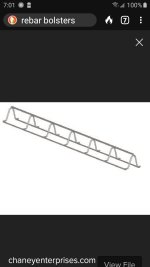
I like this style reber support. Available in multiple heights at "real" contractor supply houses that specializes in the needs of concrete contractors. (I am not)
Screenshot_20210219-070141_DuckDuckGo.jpg
 
/ Rebar supports in a slab #54  
It sounds like...to do it the "rightest":

- welded rebar grid on 18 inch centers
- chairs/supports to hold rebar at 1/3 of the total concrete depth from the bottom
- welded wire mesh on top of rebar for added strength
- low slump test results to prevent excessive use of water in mix
- effort throughout the pour to maintain/pull up to the 1/3 height for rebar and mesh
- add expansion joints/cuts as soon as possible (cuts made within 12-18 hours)


Accurate summary so far?

Any changes or additions?
 
/ Rebar supports in a slab #55  
It sounds like...to do it the "rightest":

- welded rebar grid on 18 inch centers
- chairs/supports to hold rebar at 1/3 of the total concrete depth from the bottom
- welded wire mesh on top of rebar for added strength
- low slump test results to prevent excessive use of water in mix
- effort throughout the pour to maintain/pull up to the 1/3 height for rebar and mesh
- add expansion joints/cuts as soon as possible (cuts made within 12-18 hours)


Accurate summary so far?

Any changes or additions?

Yup......you got the subject completely covered.
 
/ Rebar supports in a slab #56  
Obviously you've not been exposed to many professionally prepped and poured slabs using wire mesh...on slabs where standard sized aggregate* is used it is not difficult to pull the wire up to the proper place within the pour and it will stay there...engineers have been designing slabs using this technique for a long long time...quality concrete come-a-longs have a hook on the opposite side of the blade for to hook on and pull up the mesh... FWIW...there is a big difference between rolled wire mesh and welded reinforcing panels...

simple test...take a scrap of standard wire mesh (5x5 etc.)....cover it with a couple inches of gravel...then pull the mesh up through the gravel ...stand on the mesh and see how far it sinks back into the gravel...the gravel is no different than the course aggregate in the concrete...

* some pump mixes use very small course aggregate...

Maybe not as many as you. I'll stick with my contention. The mesh will end up in the bottom of the pour. And for clarity, I am referring to roll mesh. Panel mesh might react differently? If it is harder to push down thru the aggregate then it is also harder to pull up into the aggregate?

If there's a multi-man crew working, there will be very few square feet of pour that someone doesn't step on at one time or another during the pour.
 
/ Rebar supports in a slab #57  
In different parts of the country aggregate comes in different forms. There is the river rock which is rounded like marbles and crushed stone. The river rock will not support anything, it just moves to the side and lets whatever is on it settle down. The crushed stone however, interlocks and does not allow an object to settle. In my area, the small rounded pebbles are used most of the time. I've seen crushed stone used over in the Waco and Lufkin areas. Wish I could get some of that.

I do not have a date for the concrete pour yet, but I intend to insist on a pumper truck and rebar chairs. The weather here this week has not been conducive to pouring concrete or even being outside for that matter.

on edit: The concrete plant here is not certified for DOT concrete. They just don't have material that meets DOTs specs.

That would be my plan as well.
 
/ Rebar supports in a slab #58  
Commenting on my previous posts, I'll add that what I've said is based on what I've done, where I've worked. In every part of building, there is the ideal, best possible way of doing things, then there is what actually happens. The goal is to do everything possible to do it the best way possible, but knowing that things are going to happen that you have to deal with.

Rebar on chairs keeps it where it needs to be during a pour. Wire mesh has the potential to be better then rebar, but in my opinion and decades of experience, it always ends up at the bottom of the concrete when used on houses and large pads. This is 100% true in every case that I've ever come across, and in every picture that people have posted on here of their houses and barns being built.

As a contractor, I relocate toilets and drain lines all the the time. If they have rebar, it's usually in the middle of the concrete. I've only found it laying at the bottom a few times, and the amount of cracking was significant. On jobs like that, I refuse to install tile. Only a floating floor will last. In every house that I've found wire mesh, it's at the bottom and the cracking is also significant.

Welded wire on a house or barn slab is a waste of money and effort. Size of rebar and how far apart it has to be will vary by your location. After Katrina, they changed the Code for rebar, and then after houses where being built, they changed it again and some homes that had done it according to the first change had to tear it all out and do it again to meet Code. Spacing and size of rebar where the big changes that they where dealing with for those extreme conditions. I also heard that Florida keeps changing code for their rebar in slabs due to Hurricanes. Back in CA, where I'm from, it changes every year, and in every change, the size and amount of rebar required keeps increasing.

In my previous comments about a slump test, I'm not saying that your concrete has to remain standing after it comes out of the pail, I'm just trying to point out that it's where concrete needs to be for the best possible results. I doubt that anybody's house will ever pass the same tests used on sky scrapers, but it does give you an idea of where you are when the concrete is being poured. If the concrete comes out of your pail like soup, then there is way too much water. If it holds some sort of shape, even if it's more of a round hill, then you should be fine.

Most importantly, read up on what Code is for where you live. Weather and soil conditions will decide what you have to do.

The footings are what holds up your building. The slab is just for what goes on top of it, and secondary to the integrity of the structure.

In my entire life I've only seen a few houses with true foundation issues. The vast majority of issues that clients have claimed to be foundation problems are either structural issues in the attic, or lack of maintenance to their bricks that allowed water into the bricks and water to freeze. Since nobody is paying attention to their bricks when it freezes, and they usually notice the cracking when it's warm out, they tend to think it's a foundation problem. Sealing the windows and doors around the bricks, replacing the mortar will stop this from getting worse, or from ever happening. Attic issues are from using lumber that is too small for the span, storing stuff in the attic that is too heavy for the joists and somebody cutting away parts of the roof to get a pipe or duct through that area of the attic. AC units in attics cause a ton of issues too!!!

Soil compaction is probably the biggest reason for a true foundation failure, but it's extremely rare. It takes years for this to happen, and when it does, you can see where the concrete has cracked and sunk deeper into the ground.

Cracking the week or month after concrete is poured is always, 100%, from too much water in the mix.
 
/ Rebar supports in a slab #59  
It sounds like...to do it the "rightest":

- welded rebar grid on 18 inch centers
- chairs/supports to hold rebar at 1/3 of the total concrete depth from the bottom
- welded wire mesh on top of rebar for added strength
- low slump test results to prevent excessive use of water in mix
- effort throughout the pour to maintain/pull up to the 1/3 height for rebar and mesh
- add expansion joints/cuts as soon as possible (cuts made within 12-18 hours)


Accurate summary so far?

Any changes or additions?
Use rebar at 12" and skip mesh
Concrete with proper amount of water to complete set will have almost no slump.
Slump makes it easier to finish
 
/ Rebar supports in a slab #60  
No inspection on a garage floor here so I was on my own. I installed foam over the compacted base, then plastic before installing the rebar. Rather than 12"x12" squares, I used 10"x14" because it would be easier for my big feet. My concrete contractor warned me that plastic rebar chairs would sink into the foam, destroying all my hard work so I made my own out of concrete. They were a pyramid with a 2"x3" base,1 1/2" high, spaced evenly, using about 400 of them in an area of 1360 square feet. I installed the pex above the bar because it was too difficult to put it below. It was easy to walk around before the concrete was poured because of the size of the squares and then when the workers couldn't see the bar anymore, they would occasionally stumble but it didn't damage anything while they walked on top of the bar. This did require using a pump.
 

Marketplace Items

TOPCAT HCRC 72" HYD BRUSH CUTTER (A52706)
TOPCAT HCRC 72"...
3650 (A47477)
3650 (A47477)
2000 Bobcat 763 (A60462)
2000 Bobcat 763...
2025 Polaris Ranger Premium (A60462)
2025 Polaris...
2015 KOMATSU WA270-7 WHEEL LOADER (A60429)
2015 KOMATSU...
2015 VOLVO VNL760 SLEEPER (A59905)
2015 VOLVO VNL760...
 
Top