Live Edge Pine from a Sawmill question

   / Live Edge Pine from a Sawmill question #1  

EddieWalker

Epic Contributor
Joined
May 26, 2003
Messages
27,586
Location
Tyler, Texas
Tractor
Several, all used and abused.
I'm in the early stage of converting my shop into a Great Room. It's 24x30 with 12 foot walls. The way things get done around here, it's probably a 2 year project, so I'm not in a rush for this, but I want to finish the interior walls with flat, live edge pine logs from my land and chink between them so you can still see some of the edge of the log.

I plan on hiring a sawmill to come out to my place and cut them here. Then I will store them in my haybarn, which I'm going to build when I'm done with my equipment shed. The slabs will be 16 feet long and 2 inches thick.

How long do you think that they will need to dry before they can be installed? What would happen if they where installed before they where dry? What issues or concerns should I have about doing something like this? Is 2 inches a realistic thickness?

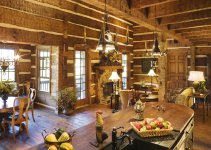
I really like the look in this picture from the Permachink website and want my home to look like this.
 

Attachments

  • int4.jpg
    int4.jpg
    887.6 KB · Views: 320
   / Live Edge Pine from a Sawmill question #2  
I think that will look great. I think 2" is overkill as it's strictly cosmetic. 1" or 1.5" would suffice and you'd get more planks from the trees.
 
   / Live Edge Pine from a Sawmill question #3  
I still own a small house in FL where the interior of the living room is finished that way...Bald cypress slabs with plaster chinking...it has a cathedral ceiling with full round logs for cross ties... it's a great effect...

To prevent the possibility of any insect larvae etc. within the logs/bark etc (may enter after sawing)...the slabs should be heated to an internal temp of 140*...
You can get a moisture content meter for $20 +/- once the MC is down to 15% it should be stable...
 
   / Live Edge Pine from a Sawmill question #4  
I still own a small house in FL where the interior of the living room is finished that way...Bald cypress slabs with plaster chinking...it has a cathedral ceiling with full round logs for cross ties... it's a great effect...

To prevent the possibility of any insect larvae etc. within the logs/bark etc (may enter after sawing)...the slabs should be heated to an internal temp of 140*...
You can get a moisture content meter for $20 +/- once the MC is down to 15% it should be stable...
You won't get that hand hewn look in the picture from a sawmill cut, but it certainly will still look beautiful.
Would be best if you can get it cut with a circular blade, rather than a band saw mill.
 
   / Live Edge Pine from a Sawmill question #5  
We built our cabin in Alaska with two sided spruce trees. They were only two weeks from standing in the forrest when we installed them on the cabin. So ..... they were soaking wet. A year later they were as dry as they ever got.

Two inch rough cut will dry faster than that.

If you install the planks before they are completely dry. They will shrink away from the calking material and you will need to fill the cracks that will form. Not a major problem - just a PITA.
 
Last edited:
   / Live Edge Pine from a Sawmill question #6  
Sounds gorgeous. If you want the rough cut look, I would use a chainsaw mill, or a circular saw mill, and then take an adze to it for character.

Look for tips on using green lumber. As @oosik pointed out, green timber shrinks, so you want to make sure that you angle the nails in so that as the board shrinks, it will cinch the nail in, rather than loosening it. Most green timber construction methods have overlapping boards, so that as the boards shrink, the walls are still covered. If you use green timber, and don't go for overlap, I wouldn't chink it for a year or two, it will dry faster, and you only have to do it once.

There is also old school splitting of the timber lengthwise. (Half, quarter, eighth, sixteenth, etc. depending on how big your tree is and how thick you want the boards.) You get tapered boards, but you get all of the irregularity of the grain.

Have fun! And please take lots of pictures!

All the best,

Peter
 
   / Live Edge Pine from a Sawmill question #7  
I'm in the early stage of converting my shop into a Great Room. It's 24x30 with 12 foot walls. The way things get done around here, it's probably a 2 year project, so I'm not in a rush for this, but I want to finish the interior walls with flat, live edge pine logs from my land and chink between them so you can still see some of the edge of the log.

I plan on hiring a sawmill to come out to my place and cut them here. Then I will store them in my haybarn, which I'm going to build when I'm done with my equipment shed. The slabs will be 16 feet long and 2 inches thick.

How long do you think that they will need to dry before they can be installed? What would happen if they where installed before they where dry? What issues or concerns should I have about doing something like this? Is 2 inches a realistic thickness?

I really like the look in this picture from the Permachink website and want my home to look like this.
Live edge or rough hewn?

The picture (which looks beautiful) appears to be rough hewn, not live edge. I may be mistaken, but I think that's the terminology. Live edge hasn't been touched by tooling, while rough hewn has. Anyhow...

I have very rough wood paneling in portions of my home from a previous owner. I have to say, that while I like the looks, you cannot dust rough wood worth a hoot. The duster gets caught in the splinters (as does your skin if you fall against it). It collects dust extremely well, especially with our cats and wood burner. So I'd take that into consideration.
 
   / Live Edge Pine from a Sawmill question #8  
Look up shrinkage on the internet. It may be a little more than you are expecting.
 
   / Live Edge Pine from a Sawmill question #9  
It does not cost that much to get rough lumber kiln dried...usually transporting is the biggest logistical issue...

We pay about $400 /1000 BF
This dries the material to a stable state and also kills any insects or their eggs etc...
 
   / Live Edge Pine from a Sawmill question #10  
I have looked into producing slabs, and read a recommendation to dry 1 year for every inch of thickness. Not sure if that is accurate-- seemed like a long time to me.

I can vouch that wood moves a lot as it is drying. I created a 10' long 8x8 pine cant about 4 months ago. I figured I would use it either for a post or a beam. I didn't cinch it down well enough-- and I noticed last week its starting to looked more like a turned post instead of straight lumber.
 
   / Live Edge Pine from a Sawmill question #11  
For a couple years prior to building our log cabin I read everything I could get my hands on. I two sided the logs because I wanted a tight fit & didn't want to have to calk between logs. I allowed a three inch gap over all the windows and doors for shrinkage.

After a year the gap was about half an inch. I stuffed the gaps with fiberglass insulation and called it good. Covered the gap/insulation with 1x6 chainsaw sawn boards.
 
   / Live Edge Pine from a Sawmill question #12  
I let all of my lumber for my house dry for 6 months. I stacked it on edge with 1 x 1 stickers and covered it with roofing metal with cross ties on top of that for weight. It was the perfect moisture when we started nailing it up.
 
   / Live Edge Pine from a Sawmill question #13  
I used an alaskan mill and did 2"x7' planks and used the 1/4 log bottom for a bench. I let dry for about a year and it did split a bit on the ends. Now varnished and sitting outside and seems to be dry. I second getting a moisture meter.
The Kiln dry sounds like a great idea if these will be indoors.
What kind of finish are you going to use , oil ?
 
   / Live Edge Pine from a Sawmill question
  • Thread Starter
#14  
I've been watching some Youtube videos on Alaska Mills and might give that a try. Seems like the hardest part is the first cut. I'm don't want to make lumber, I just want slabs for the wall.

I haven't put any thought into how I will finish the boards. I want a smooth, easy to clean finish. But an oil finish would be faster and easier.
 
   / Live Edge Pine from a Sawmill question #15  
Too wet and when they dry they will shrink and you will have to go back and re do a lot of work. Best bet make a simple solar kiln. It will save you a ton of work down the road. I have done a lot of green wood projects but for sheathing I would make sure its dry and stable. Amazon has simple wood moisture meters too.
 
   / Live Edge Pine from a Sawmill question #16  
I've been watching some Youtube videos on Alaska Mills and might give that a try. Seems like the hardest part is the first cut. I'm don't want to make lumber, I just want slabs for the wall.

I haven't put any thought into how I will finish the boards. I want a smooth, easy to clean finish. But an oil finish would be faster and easier.
Smooth, easy to clean to me implies planed or sanded and sealed, as roughness tends to harbor dust.

There may be folks in your area that will saw the logs for you for a few or a share of the lumber. A downside to Alaskan mills is that the kerf is thicker and you have a slightly lower yield on lumber. As your goal is basically paneling, you could go pretty thin on your boards, which would be lots of cuts and more waste with an Alaskan mill. Just a thought.

All the best,

Peter
 
   / Live Edge Pine from a Sawmill question
  • Thread Starter
#17  
Thank you. My ultimate goal is to be able to have my taxidermy mounts on the wall. I want the slabs to be thick enough to be able to hold the weight of my heaviest mounts. Another concern is being able to adjust them on the wall if I ever get any more. My big dream is to one day have an Alaskan Moose on the wall, which would mean that whatever is up there would have to be moved to accommodate the size of a moose. This is why I was thinking 2 inches. I could probably get away with an inch and a half, but I don't think anything less would work.

I have a lot of pine trees that I want to remove. If I get four slabs out of each length of tree, that would be ideal. I'm thinking that I'll cut each tree into 16 foot lengths and then get four slabs from the center part of the log. I want to see part of the edge of the long when it's on the wall, but fill in the gaps with chinking of some kind. Maybe an inch of the live edge exposed and the chinking would be an inch thick?
I'm torn on what I want the finished slab to look like. Chainsaw marks might add a lot of character to it. A smooth, cabinet finish might look nice too. But in my mind, I'm thinking that a combination of both some distressed, cutting marks and some smooth finished areas would look the nicest.

I still have plenty of time and lots of pictures to look at. There is a point where it needs to get done and if I over complicate it too much, it will never get done.

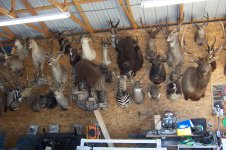
This is part of my collection. I forget how many I have, I'm guessing it's somewhere close to 40 mounts. This is inside my shop, which is the room that I will be converting into my new living room. The walls are 12 feet tall, and what I want to cover in the live edge slabs to look like an Old Kentucky Log Home, or something you might find in the Rocky Mountains.
 

Attachments

  • 1622.jpg
    1622.jpg
    2.8 MB · Views: 129
   / Live Edge Pine from a Sawmill question #18  
Since you know what you want the walls for, have you thought about reinforcing a section of the actual wall for your eventual prize moose? It might simplify things when the time comes. (2x6, or 4x4 running along at the height(s) you want your trophies mounted at?)

A friend took an axe and an adze to otherwise finished boards to give a hand hewn look. If you didn't look too closely, it looked as if the boards were hand hewn.

It sounds like you are having fun!

All the best,

Peter
 
   / Live Edge Pine from a Sawmill question #19  
Eddie I did this exactly as your OP. I had a bunch of pine stabbed @ 2", I'm not exactly sure of the drying time but you've been around enough to estimate this. I basically picked up an end and if it was similar to an equivalent piece of framing lumber, go with it.
I nailed up osb and for the "chinking", nailed on some wire mesh and just used joint compound. I feel that 2" gives the "proper" depth to simulate the real thing. I would peel the bark and hire the guy with a bandmill. It's a nice finish that you can lightly sand so that you can at least broom off the dust. Cobwebs and dust can be miserable on rough sawn lumber. Put on any finishing you want on your logs before chinking. They have real chinking that is somewhat elastic for the real thing but it's pricey and when I did this, it was way before the internet and the simplicity that provides searching for odd ball construction materials.
It may be not that expensive today with the competitive pricing that the net has created. 👍
 
   / Live Edge Pine from a Sawmill question
  • Thread Starter
#20  
Do you have any pictures? I never thought about joint compound and wire. Did you have any cracking?
 

Tractor & Equipment Auctions

2007 MACK GRANITE CV713 DUMP TRUCK (A60430)
2007 MACK GRANITE...
golf cart (A56859)
golf cart (A56859)
Sakai SV505 (A60462)
2016 Bobcat E85 Midi Excavator (A59228)
2016 Bobcat E85...
Husqvarna Riding mower (A56857)
Husqvarna Riding...
2008 INTERNATIONAL WORKSTAR 7400 SBA 6X4 DUMP TRK (A57192)
2008 INTERNATIONAL...
 
Top