How long should I let new ground settle before putting in posts on piers?

   / How long should I let new ground settle before putting in posts on piers? #41  
Helical piers are an excellent option for the post bases. I would forgo the slab for a few years to see what happens.
If you have a geotechnical engineer nearby, have them come and take a proctor and do a few penetrometer tests or nuclear density tests.
 
   / How long should I let new ground settle before putting in posts on piers? #42  
Also most dozers have low ground pressures, ie they don’t do a good job of compacting. A Cat D6 has ground pressure of about 8psi.
 
   / How long should I let new ground settle before putting in posts on piers? #43  
Maybe not for buildings, and I am sure MF231 knows better than any of us, but I will wager dozers have done more soil compacting than any other machine in our lifetime -- taking into acct roads, berms, rights of way, mining reclamation, etc. I realize that is tangntial and not a building foundation though so the point is well taken. We ARE talking "an old pole barn" here I repeat from a few posts back.
 
   / How long should I let new ground settle before putting in posts on piers? #44  
Maybe not for buildings, and I am sure MF231 knows better than any of us, but I will wager dozers have done more soil compacting than any other machine in our lifetime -- taking into acct roads, berms, rights of way, mining reclamation, etc. I realize that is tangntial and not a building foundation though so the point is well taken. We ARE talking "an old pole barn" here I repeat from a few posts back.
You would lose that wager. Nothing is worse at compacting soil then a dozen. Mine weighs 40,000 pounds. My small tractor weighs 4,000 pounds. It's tires will sink into the ground where the tracks have gone over new dirt. When building up a pad for myself, I put a full yard in the bucket of my backhoe and I drive over every inch of soil repeatedly. I do 2 inch lifts and compact each layer this way.
 
   / How long should I let new ground settle before putting in posts on piers? #45  
You would lose that wager. Nothing is worse at compacting soil then a dozen. Mine weighs 40,000 pounds. My small tractor weighs 4,000 pounds. It's tires will sink into the ground where the tracks have gone over new dirt. When building up a pad for myself, I put a full yard in the bucket of my backhoe and I drive over every inch of soil repeatedly. I do 2 inch lifts and compact each layer this way.
Nope. I disagree. I wager dozers have done more soil compacting than any other machine in our lifetime. I stand by that.

Dozers are THE primary tool for soil spreading and compacting world-wide for essentially all roads, mine reclamation projects, berms, rights of way, earthen dams, major highway construction, etc. That's universally known, undeniable and it does not matter what your's weighs. We got into this discussion about a pole barn site. I said I was talking aside from that in this added discussion (post 43 plus) which I said was just comment NOT to do with buildings or foundations. Buildings and foundations are significant but make a smaller fraction of earth moving and soil compacting compared to highways, roads, and industrial sites of all sorts -- most of which is done by dozers. They are sometimes supplemented by "sheeps hoof " rollers for very loose problem areas.

Since you say I lose that wager, what were you thinking did most of the soil smoothing and compacting in our lifetime?
 
   / How long should I let new ground settle before putting in posts on piers? #46  
I can’t understand why/how anyone thinks they’re going to actually compact 5-10’ of soil at once.
You’d be lucky to get the top 1 foot compacted. If you must compact the fill, push it back into a pile and compact it with a vibe compactor in proper lifts.

Better yet, just do it right from the start and move the building onto virgin or dig below the fill into virgin soil you'll curse the day when your building begins to sink.
Why do all that work and expense and take chances
 
   / How long should I let new ground settle before putting in posts on piers? #47  
Nope. I disagree. I wager dozers have done more soil compacting than any other machine in our lifetime. I stand by that.

Dozers are THE primary tool for soil spreading and compacting world-wide for essentially all roads, mine reclamation projects, berms, rights of way, earthen dams, major highway construction, etc. That's universally known, undeniable and it does not matter what your's weighs. We got into this discussion about a pole barn site. I said I was talking aside from that in this added discussion (post 43 plus) which I said was just comment NOT to do with buildings or foundations. Buildings and foundations are significant but make a smaller fraction of earth moving and soil compacting compared to highways, roads, and industrial sites of all sorts -- most of which is done by dozers. They are sometimes supplemented by "sheeps hoof " rollers for very loose problem areas.

Since you say I lose that wager, what were you thinking did most of the soil smoothing and compacting in our lifetime?
If you want to say that dirt was spread with a dozer and then people drove over that dirt, or built on it more then properly compacted soil, then I'll give you that. If you are trying to argue that a machine with it's weight spread out over a pair of tracks is capable of compacting the soil so it doesn't settle afterwards, then you are wrong.

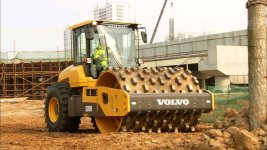
To get maximum compaction, you have to use a vibratory roller. Sheepsfoot rollers work the best for soil, but smooth drum are used all the time for road too. You also have to have the proper amount of moisture in the soil so it will bond with itself. This is done every time you need proper compaction in order to build anything on top of it.

A dozer is a very good tool at spreading soil, and moving it short distances. It's a horrible took at compacting soil. In our lifetime, the machine that has done most of the spreading of soil is probably a dozer, but a Grader might actually have done more miles of smoothing soil if the math was ever done. I honestly don't know which has smoothed more dirt. I do know that a vibratory roller has compacted more dirt then both of those combined since neither a dozer or a grader is capable of compacting soil.

Did you build something and compact the soil with a dozer? Your disagreeing with common knowledge makes me think you did it wrong and you are trying to defend what you did.

sheepsfoot.jpg
 
   / How long should I let new ground settle before putting in posts on piers? #48  
Yeah, Eddie is correct. If you have driven by or been around a construction site it might look like bulldozers are spreading soil and compacting but they are not doing the compacting part. I spent 37 years as a land surveyor on all sorts of construction sites, I also did nuclear machine density testing. The pic Eddie posted of a vibratory sheep’s foot roller is the most common tool.
 
   / How long should I let new ground settle before putting in posts on piers? #49  
Nope. I disagree. I wager dozers have done more soil compacting than any other machine in our lifetime. I stand by that.

Dozers are THE primary tool for soil spreading and compacting world-wide for essentially all roads, mine reclamation projects, berms, rights of way, earthen dams, major highway construction, etc. That's universally known, undeniable and it does not matter what your's weighs. We got into this discussion about a pole barn site. I said I was talking aside from that in this added discussion (post 43 plus) which I said was just comment NOT to do with buildings or foundations. Buildings and foundations are significant but make a smaller fraction of earth moving and soil compacting compared to highways, roads, and industrial sites of all sorts -- most of which is done by dozers. They are sometimes supplemented by "sheeps hoof " rollers for very loose problem areas.

Since you say I lose that wager, what were you thinking did most of the soil smoothing and compacting in our lifetime?
Think back many years when tractors were the primary tool for farming. The problem was that when soils were soft the tires sunk in and when the moisture was right the soil became compacted which is bad for planting. Then Holt née Caterpillar came out with tracked tractors. Sinking and compaction problems greatly reduced because the ground pressure exerted by tracked equipment is a fraction of tired tractors.

The weight per SF on a tracted tractor in many applications is less than a person standing!
 
   / How long should I let new ground settle before putting in posts on piers? #50  
Several folks have suggested the most cost effective idea assuming you have some flexibility with the building site. Shift it into the hill to put all of it on undisturbed ground or at least enough to put the downhill post bases within reach of whatever you've got for an auger.

While you're shifting it, and even if you're not, leave enough room for some drainage on that uphill side, both for roof spill and overland flow. Ditch it deeper if you need to cut off subsurface flow.

Regarding compaction - compacting just with a dozer is a dream. Several posters have accurately noted the low ground pressure from a dozer, and ground pressure with or without vibration (along with proper moisture content) is what it takes to get compaction. You'll see dozers spreading material in lifts on lots of job sites but if they're building anything of consequence that dozer is going to be towing a sheepsfoot roller or being followed by a self propelled roller.
 
   / How long should I let new ground settle before putting in posts on piers? #51  
And, if you like facts regarding ground pressure and compactive effort here are some:

D6 Cat Dozer, standard tracks, 50,733 lb. Ground pressure 7.9 psi

Ford F250 5700 lb. LT285 tires ground contact patch approx 46 sq in. per tire or 184 sq. in. total for all four. 5700 / 184 = 32 psi.

Towed sheepsfoot rollers 200 psi and up. Way up.
 
   / How long should I let new ground settle before putting in posts on piers? #52  
And, if you like facts regarding ground pressure and compactive effort here are some:

D6 Cat Dozer, standard tracks, 50,733 lb. Ground pressure 7.9 psi

Ford F250 5700 lb. LT285 tires ground contact patch approx 46 sq in. per tire or 184 sq. in. total for all four. 5700 / 184 = 32 psi.

Towed sheepsfoot rollers 200 psi and up. Way up.

You really need a vibratory roller to do a good job compacting.
 
   / How long should I let new ground settle before putting in posts on piers? #53  
Your poles need to be set on virgin soil, not compacted soil, so dig down to that level for each post. I just finished a 30x40 pole barn. My plans called for a 4" thick 16" round concrete cookie at the bottom of each pole to prevent the pole from sinking into the ground. We had to raise the rear elevation 3' to match the front elevation. We did it in 4" layers and a vibrating plate compactor plus all of the tractor traffic moving the soil. Then we flooded each layer with water and once up to final grade it sat out in the weather for 6 months before the roof went on.
 
   / How long should I let new ground settle before putting in posts on piers? #54  
The best option as mentioned above, is to cut back into the hill and make sure the footprint of the building is all on native soil, then compact the native soil before building your pole barn. Having half the building on native and the other on poorly compacted fill will result in differential settlement between native and fill. Either retain the cut slope or knock it back to 2:1 (H:V) if you can.

Tracked equipment is NOT suitable for proper compaction of the soil because of low ground pressure. Use a smooth drum vibratory roller for compaction if the soil is granular (sand and gravel), or a sheepsfoot if it is cohesive (silt and clay). Keep your lifts thin 6-8 inches and avoid clasts larger than 6 inches in diameter (we usually recommend <3 inches). You can test the compaction using a tile probe and pushing it into the soil with your body weight. It should go in less than an inch for properly compacted soil.

If you can, get a single-shingle geotech or engineering geologist out to give you some pointers.

/engineering geologist
 
   / How long should I let new ground settle before putting in posts on piers? #55  
For pole barns on hills where fill is needed, I like to drill the post holes first, install the footings and posts, and frame/square up the structure (minimum posts and girts, and one skirt board) before backfilling the post holes. Then you can think about backfilling and leveling the site with a self-compacting material (any screened gravel 3/4" or below in size -- I prefer #8, which is a pea size). Heck, you can build the entire barn before backfilling and leveling the site if you want, as long as you can get a machine with a loader inside to bring in the gravel later.

This is the fastest/cheapest method to move forward with the pole barn method. When you have to start worrying about compacting a base and pouring a slab, then you begin to lose many of the benefits off the pole barn method. People still do it, which is fine, but you lose some of the time and cost benefit.

Too many times I have seen someone prep the site too much and then have to deal with compaction issues, or footing issues, or have to drill post holes through the gravel base they just put down (which is more work).
 
   / How long should I let new ground settle before putting in posts on piers? #56  
Yeah, Eddie is correct. If you have driven by or been around a construction site it might look like bulldozers are spreading soil and compacting but they are not doing the compacting part. I spent 37 years as a land surveyor on all sorts of construction sites, I also did nuclear machine density testing. The pic Eddie posted of a vibratory sheep’s foot roller is the most common tool.
This horse is long since dead and I will make no further comments after today. Nothing wrong with opinions.

No, Eddie is not correct in the context of getting ground compacted suffieciently to get on with most projects. I hear all he & others have said about the low per square inch soil pressure of the dozer, etc, etc.
Now, in this current context, NOT about buildings or foundations: Sure sheeps foot rollers and all sorts of equipment do some serious packing of soil on relatively flat or gentle slope places. Nationwide you have huge acreage of VERY steep road edges, berms, embankments, earthen dams, pond sides, farming soil movement, etc. where no roller can or ever will set foot. Where a sheepsfoot packer could not get to, much less operate. Guess what is used? The dozer my friends. Adequate compaction for the needs at hand are not always foundations nor high soil pressure requirements. The world uses bulldozers.

Dozers have done more soil compacting than any other machine in our lifetime and nothing said here refutes that. The next nearest competitor has never been mentioned or put forth.
 
   / How long should I let new ground settle before putting in posts on piers? #57  
OP- if you don’t care and money doesn’t matter, roll the dice and go ahead and build/pour as-is. Maybe it will suit your needs and budget.

If you want it to last, and be of use in the future; remove the fill, clean the fill, place and compact the fill along with using grading and gravity to get rid of any standing water near your structure.
If you ever want to enclose the structure, go ahead and add a vapor barrier prior to pouring.

Good luck!
 
   / How long should I let new ground settle before putting in posts on piers? #58  
One other note, a compaction test or proofroll is only a snapshot of that particular time. Meaning that you can have a perfectly placed and compacted product, then weather hits and it turns to crap(or vice versa). We have had several parking lots on jobs(25 acres plus) where conditions were not optimal, but we stayed off the subgrade and allow winter to pass and kept checking until the site improved enough to place aggregate and paving.
 
   / How long should I let new ground settle before putting in posts on piers? #59  
This horse is long since dead and I will make no further comments after today. Nothing wrong with opinions.

No, Eddie is not correct in the context of getting ground compacted suffieciently to get on with most projects. I hear all he & others have said about the low per square inch soil pressure of the dozer, etc, etc.
Now, in this current context, NOT about buildings or foundations: Sure sheeps foot rollers and all sorts of equipment do some serious packing of soil on relatively flat or gentle slope places. Nationwide you have huge acreage of VERY steep road edges, berms, embankments, earthen dams, pond sides, farming soil movement, etc. where no roller can or ever will set foot. Where a sheepsfoot packer could not get to, much less operate. Guess what is used? The dozer my friends. Adequate compaction for the needs at hand are not always foundations nor high soil pressure requirements. The world uses bulldozers.

Dozers have done more soil compacting than any other machine in our lifetime and nothing said here refutes that. The next nearest competitor has never been mentioned or put forth.
You are probably correct in playing a word game of saying that dozers have compacted more soil then any other machine. But you should also add that it compacts the soil poorly and that no building should ever be built on soil compacted by a dozer. You also might want to add that soil compacted by a dozer is much more likely to wash out and erode ten times faster then a road that is properly compacted. But maybe that's just a small detail in the grand scheme of being right.
 
Last edited:
   / How long should I let new ground settle before putting in posts on piers? #60  
You are probably correct in playing a word game of staying that dozers have compacted more soil then any other machine. But you should also add that it compacts the soil poorly and that no building should ever be built on soil compacted by a dozer. You also might want to add that soil compacted by a dozer is much more likely to wash out and erode ten times faster then a road that is properly compacted. But maybe that's just a small detail in the grand scheme of being right.

If you did it in lifts and tracked in each lift the dozer would compact it good enough for a barn. If you just shoved the dirt out the dozer isn’t going to compact it very much.
 

Marketplace Items

Preliminary Listing / Full Catalog Coming Soon! (A53317)
Preliminary...
UNUSED FUTURE MINI EXCAVATOR GRAPPLE (A60432)
UNUSED FUTURE MINI...
SKID STEER MOUNTING PLATE (A60432)
SKID STEER...
2012 FORD F-350 XL SUPER DUTY CREW CAB SERVICE TRK (A60430)
2012 FORD F-350 XL...
500 BBL FRAC TANK (A58214)
500 BBL FRAC TANK...
Used Landpride GR1525 Stump Grinder
Used Landpride...
 
Top