Working rail roads and their tracks.

   / Working rail roads and their tracks. #1,421  
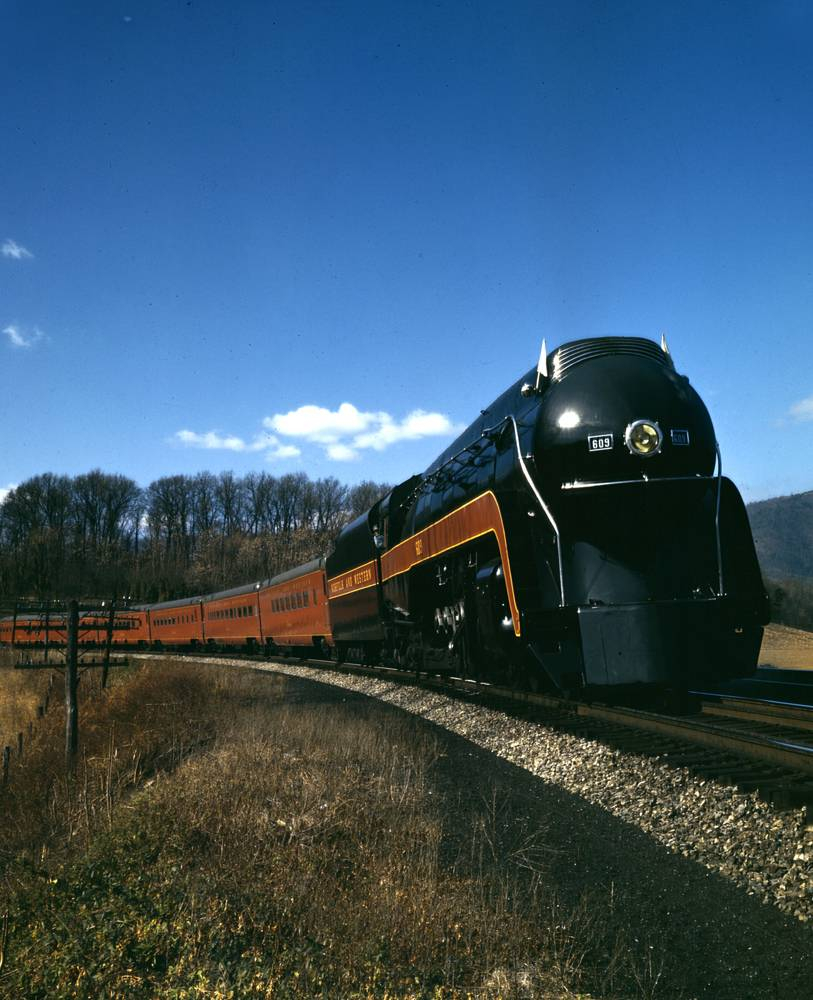
As a kid my parents took me to NYC on one of these N&W steam trains, we had a Pullman sleeper car. I remember asking Dad at one point "what's the picket fence for?"..."those are telephone poles" he said.
The service, dining car, everything was excellent.
48930385uj477862949483.jpg
 
   / Working rail roads and their tracks. #1,422  
I was reading that engine and tender weighed almost a million pounds! 880k, something like that.
Steam power still to me is amazing.
 
   / Working rail roads and their tracks.
  • Thread Starter
#1,423  
I was reading that engine and tender weighed almost a million pounds! 880k, something like that.
Steam power still to me is amazing.
The Big Boy locomotive with its tender weighed about 604 tons and measured more than 132 feet in length. I believe this was the heaviest setup ever used in North America. It had a maximum power capacity of more than 6,000 horsepower and could haul a 3,600-ton train unassisted up the Wasatch Mountain grade.
 
   / Working rail roads and their tracks. #1,424  

It is the strongest-pulling extant steam locomotive in the world​

Historic significance[edit]​

Norfolk & Western 2156 is the sole survivor of the railroad's Y5, Y6, Y6a and Y6b classes (in final form referred to as the "Improved Y5/Y6 class"). These locomotives developed 152,206 lbs of tractive effort when built, with later modifications bringing them closer to 170,000 lbs. By comparison, the Union Pacific Big Boy locomotives developed 135,375 pounds-force (602.2 kN) of tractive effort. The only successful steam locomotives that developed somewhat more tractive effort, the Virginian AE class 2-10-10-2s, pulled trains at about 8 mph (13 km/h), while the N&W Y6's regularly pulled trains 50 mph (80 km/h), and some anecdotal evidence exists that they pulled trains up to 63 mph
 
   / Working rail roads and their tracks. #1,426  
While I am not at all a fan of Greta, and enjoyed watching Sky News respond to her little tantrum, I am sure glad freight is moved by somewhat cleaner locomotives now. Coal and later fuel oil, were cheap and readily available 70 years ago and made sense then, but I can't imagine what the air would look like along a major rail artery with the number of trains and the amount of freight that is hauled today.
greta.jpg
 
Last edited:
   / Working rail roads and their tracks. #1,427  
There was more freight hauled years ago that there is now
The railways were relevant back then and basically the only form of transportation.. not anymore there's more rails to trails than rails
 
   / Working rail roads and their tracks. #1,428  
There was more freight hauled years ago that there is now
The railways were relevant back then and basically the only form of transportation.. not anymore there's more rails to trails than rails
That might be true where you are but on the BNSF near where I lived there are more and longer trains than there were before. Oil trains, coal trains, container trains, mixed freight all more often and longer. It's hard to believe that a population that was half of what it is now, and a population that was way less materialistic required more freight trains than are operating now despite the exponential growth in trucking.
 
Last edited:
   / Working rail roads and their tracks.
  • Thread Starter
#1,429  
There was more freight hauled years ago that there is now
The railways were relevant back then and basically the only form of transportation.. not anymore there's more rails to trails than rails
There is less mileage of rails but more tonnage on heavier lines. I resided in a little town that had a full train* every 20 minutes. No cycling on that grade.....

* double main line. Full trian is 1 and a 1/4 miles long.
 
   / Working rail roads and their tracks. #1,430  
Continued expansion of the interstate system has allowed more competition from trucking. Consolidation of large industry still uses rail service for high-volume, high-efficiency transport. Fewer smaller businessies (buzineseese?) are easily served on public roads vs tracks that must be maintained.

This has been evolution vs revolution and btw coincidental to the end of the steam era. Coal trains are fewer and that was once a prime cargo that natural gas, solar and wind power have replaced.
 
   / Working rail roads and their tracks. #1,431  
Don't forget Billions to High Speed Rail...
 
   / Working rail roads and their tracks. #1,432  
not anymore there's more rails to trails than rails
Actually as I thought about it, it is true of where I lived too at least in miles of track, but all the rails that are now trails were spur lines built for freight and passenger service into the river valleys of the Cascades. They hauled lumber, limestone, coal, cement, logs which in some cases are hauled by truck but in many cases the mills and mines have shut down and the need just isn't there. Others were lines abandoned because of redundancy after rail mergers. The main lines are busier than ever and I would not want to live along a modern east-west rail corridor if all trains were powered by coal like in the above coal train video.
 
   / Working rail roads and their tracks. #1,434  
Well I worked on the RR for 36 yrs and the difference from when I hired on until I retired was very real. Spur lines, sidings industry all have disappeared and while trains are longer there are fewer of them. Hump yards no longer needed, flat switching taking over main line Locos used in yards where yrs ago 1200-1700 hp engines were everywhere. Mainlines were removed where trains ran daily. Towns bypassed, the railroads became a money maker for shareholders while shutting down the little guy 100 cars or you dont get service. So much rail has been torn up that the RR's couldn't really handle any new business. Wait until CP starts removing KCS rail etc. There are thousands of locomotives sitting idle everywhere right now that 15 yrs ago were in service and now they're not. Its busy in some spots but yrs ago it was busy everywhere. Just a thought
 
   / Working rail roads and their tracks. #1,435  
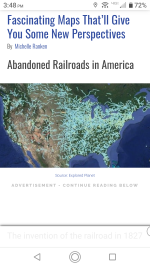
Neat map of abandoned railroads in North America the blue lines. Most are probably reporpused and or torn up. Apologize for clarity.
 

Attachments

  • Screenshot_20211103-154825.png
    Screenshot_20211103-154825.png
    1.1 MB · Views: 154
   / Working rail roads and their tracks. #1,437  
Looking at the map MossRoad linked to and looking at abandoned lines that I am familiar with, I can understand why they were abandoned. They were industry driven dead end lines that became surplus when the factories shut down or the project was completed. Where I lived in Skagit County WA, there were two lines running up the river valley, one went as far as Concrete, about 30 miles east of the freeway, the second line ended at Rockport but was extended to Newhalem by Seattle City Light for their dam projects. The big lumber mills are gone, the cement plants shut down, the dams were completed.

Some of the lines in Whatcom county were also industry driven or were closed down with railroad mergers and railroads with drawing service, The Northern Pacific and Milwaukee Road each shipped one short train a day out of Bellingham. Between the two of them they made up about 20% of the rail traffic through town.

In many ways decrying the demise of the small railroads and their many spur lines is like mourning the loss of Sears or K-Mart. Their bad management and shortsightedness caused their demise and the competition filled the gap, and then some. With Sears and K-Mart, it's Amazon, Walmart and Costco, with the railroads it's trucking and the mega merger railroads, BNSF, CSX, Union Pacific and so on.

Railroads never could have put down enough steel to service all the store and shops trucks do. The result is we have better service, more choices, and lowered costs.
 
   / Working rail roads and their tracks. #1,438  
It really boils down to simple $ & ¢. Modern railroads are most cost effective when transporting large amounts of goods over long distances. Trucks fill the gaps at either end of those long distances and for shorter transport routes.
 
   / Working rail roads and their tracks. #1,439  
Around here, most of the abandoned lines are between small grain elevator towns. All of the larger towns and cities are still connected by freight rail.
 

Tractor & Equipment Auctions

2018 NEW HOLLAND C232 SKID STEER (A60429)
2018 NEW HOLLAND...
2015 TEXAS PRIDE TRAILER  30 FLATBED GOOSENECK TRAILER (A58214)
2015 TEXAS PRIDE...
2012 Vermeer V500LEHD Vacuum T/A Towable Trailer (A55973)
2012 Vermeer...
2012 FREIGHTLINER CASCADIA SLEEPER (A59905)
2012 FREIGHTLINER...
2021 MULTIQUIP 25 WHISPERWATT DIESEL GENERATOR (A59823)
2021 MULTIQUIP 25...
XCMG CV83PD (A53317)
 
Top