
How to find a suction leak

   / How to find a suction leak #41  
Beez,
In reviewing schematic again and thinking about this further I am still puzzled on where the external pressure is coming from to extend the cage cylinder.

While manually extending with ratchet strap you could potentially pressurize the rod of both cylinders if the over centervalve is opened. This would then allow a slightly larger volume of oil to pressurized since the knuckle cylinder is in the fully extend position while you were doing this. Pressurizing the rod ends should keep the cage from extending but crazy thought if the seals on the knuckle cylinder are leaking slightly could you have also induced some pressure into the cap end of the knuckle cylinder? If yes then this pressure would extend the cage cylinder since would have free flow through the PO check and if high enough to over come the over center valve setting. Any trapped air would also act like an accumulator to increase potential flow.

Problem is this really doesn't work when you tried retracting the cage cylinder with the ratchet strap.

A bad seal on the cage cylinder and I would think you could extend the cylinder fully with the ratchet strap.

Back to thinking we need gauges in the system. Since closed system be nice to have one in both the rod and cap end lines so can observe what is happening. Problem how to do this with introducing more air or in a location where the air cab be purged easily or easier.

Can you safely operate the cage tilt cylinder fully with the mast fully raised? I.e. knuckle cylinder fully retracted. Just curious is this would help remove any potential trapped air in cap end since it should be forced out to the cage cylinder.
 
   / How to find a suction leak
  • Thread Starter
#42  
Beez,
In reviewing schematic again and thinking about this further I am still puzzled on where the external pressure is coming from to extend the cage cylinder.

While manually extending with ratchet strap you could potentially pressurize the rod of both cylinders if the over centervalve is opened. This would then allow a slightly larger volume of oil to pressurized since the knuckle cylinder is in the fully extend position while you were doing this. Pressurizing the rod ends should keep the cage from extending but crazy thought if the seals on the knuckle cylinder are leaking slightly could you have also induced some pressure into the cap end of the knuckle cylinder? If yes then this pressure would extend the cage cylinder since would have free flow through the PO check and if high enough to over come the over center valve setting. Any trapped air would also act like an accumulator to increase potential flow.

Problem is this really doesn't work when you tried retracting the cage cylinder with the ratchet strap.

A bad seal on the cage cylinder and I would think you could extend the cylinder fully with the ratchet strap.

Back to thinking we need gauges in the system. Since closed system be nice to have one in both the rod and cap end lines so can observe what is happening. Problem how to do this with introducing more air or in a location where the air cab be purged easily or easier.
I'm going to watch a few videos on how over center valves work. It's been awhile since I had a hydraulics class and the only thing I remember is how basic PO check valves work. I also have to keep looking for the 145 bar reliefs.

Can you safely operate the cage tilt cylinder fully with the mast fully raised? I.e. knuckle cylinder fully retracted. Just curious is this would help remove any potential trapped air in cap end since it should be forced out to the cage cylinder.
I can't do it with the mast raised but that's what I do to purge it on the ground. Here's the air purge instructions from the manual. The green button they refer to turns on the hydraulic pump- it's a safety thing so you can't operate the lift without keeping this spring loaded button depressed.

1640024580799.png
 
   / How to find a suction leak
  • Thread Starter
#43  
Beez,
Couple of more questions:
...
3 ) same with two relief valves set at 145 Bar. Are they separate line bodies or in a common valve body. Not sure if these are in play but trying to gain a fuller picture of how this is plumbed.
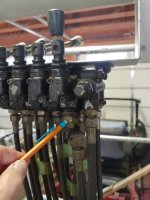
I found the 145 bar reliefs, they are both attached to the valve body that manually operates the leveling cylinder. My pencil is pointing to one of them, the other one is on the opposite side of the valve:
145 bar relief valve.jpg

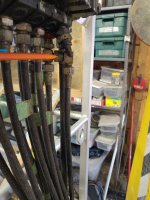
I also discovered that the knuckle cylinder and cage cylinder are T'd together in front of the manual valve. So that means when I manually apply pressure to the cage cylinder, it's also applying the same pressure to the knuckle cylinder. Of course it has no effect because the knuckle cylinder is too small and poorly positioned to have any effect on the lift mast. My pencil is pointing to the T that connects the lines from the cage cylinder and knuckle cylinder:
Knuckle T.jpg
 
   / How to find a suction leak #44  
Excellent job tracing the lines and finding the work port reliefs. You are learning more about this machine day by day.
 
   / How to find a suction leak #45  
Forget air in the system. The hydraulic oil pump blasts the oil through the system so fast that any air is pushed back to the reservoir before it has chance to rise and settle anywhere. I note that cylinders 1 and 2 both have pilot operated check valves, so any oil to and from these cylinders has to go via the PO check valves. These PO check valves are there to lock the cylinders in the desired position, so if the cage is tilting these valves are allowing oil to pass when they shouldn't. PO check valves are cheap to replace so this would be my first port of call. The valve/s may have a weak spring or a worn seat and no longer work as they should.
 
   / How to find a suction leak
  • Thread Starter
#46  
For everyone still keeping score, I called tech support at Nifty Lift, surprised to get a guy who really seems to know his stuff. The guy said a bad load valve on the cage cylinder fits all my symptoms. He said if the system were sucking so much air that the problem returns after a few hours, I would be seeing problems with some or all of the cylinders on the lift being spongy or jerky. I asked him why the bleed process makes the problem go away for a few hours, he said he didn't know but it's possible that forcing that cylinder to the far ends of it's stroke in both directions is causing the short term fix rather than it actually purging any air. Normally that cylinder spends much of its life between fully and halfway retracted. It seldom moves into the extended position because that only happens if the lift is at it's full height straight up.

A replacement load valve is $115 and the local dealer has it in stock. I'm talking with oldnslo about any testing I can do to confirm it's bad before I replace it. But that's a modest enough amount of money I'm willing to see if it solves the problem.
 
   / How to find a suction leak
  • Thread Starter
#47  
Forget air in the system. The hydraulic oil pump blasts the oil through the system so fast that any air is pushed back to the reservoir before it has chance to rise and settle anywhere. I note that cylinders 1 and 2 both have pilot operated check valves, so any oil to and from these cylinders has to go via the PO check valves. These PO check valves are there to lock the cylinders in the desired position, so if the cage is tilting these valves are allowing oil to pass when they shouldn't. PO check valves are cheap to replace so this would be my first port of call. The valve/s may have a weak spring or a worn seat and no longer work as they should.
Thanks for the input, do you have any reason to suspect the check valve rather than the over center valve (also called a load valve in the parts list)?
 
   / How to find a suction leak #48  
Once the hydraulic cylinder is in the desired position the PO valve circuit de-energises allowing the PO valve to close, which locks the hydraulic oil inside the cylinder thereby locking the hydraulic cylinder in place. This is a safety feature used on countless hydraulic circuits, so unless you've literally got oil dripping on the floor the hydraulic cylinder cannot move until the PO valve is re-energised to release the oil in the cylinder.
 
   / How to find a suction leak #49  
You mention the load valve could be a possible problem, but I don't know the age of the machine or the condition of the oil and filtration system. The spools in your load valves are machine lapped to a tolerance of several micron and should give good service for many years, however, the debris in dirty oil will cause wear on these lapped tolerances and you could get slight weeping past the spools, but this is only remotely possible. I've seen 40 year old valves still in pristine condition, so I doubt if this is your problem. Your oil filtration will be somewhere between 5 and 15 micron and for longevity of the system it's essential that you have the correct oil filter/s and that you change regularly.
 
   / How to find a suction leak #50  
Beware of the difference of terminology between the USA and Europe. I think in the USA the load valve and PO check valve may be the same thing. In Europe we use the terms PO check for the cylinder valve and directional control valve for the spool valve. The information I've given you is correct but beware of terminology.
 
   / How to find a suction leak
  • Thread Starter
#51  
@Jofang I agree terminology can be a problem, I've cutout the cage leveling circuit so we can focus on it and agree on terminology:

1640095392066.png

In the above schematic, #20 is called an over center valve on the drawing, but it's called a load valve in the parts list. On our side of the pond it's also called a counter balance valve or a motion control valve. Let's agree to call #20 an over center valve. #19 is consistently called a pilot operated check valve, so let's use that term. The directional control valve is out of view, but it's the thing that has a lever that I move with my hand to manually operate the cage cylinder, and it's the thing that has a finely machined spool inside of it.

See if you agree with my description of how this circuit works when it's not being manually operated, so only the motion of the knuckle is causing motion of the cage cylinder.

Cage tilting away from machine: When the knuckle retracts, oil flows freely through #19 and forces extension of the cage cylinder. The cage cylinder can only extend as fast as #20 will allow it. #20 is piloted by the inlet side of #19, so right now that pressure is high and #20 will open slowly and it's own internal pilot will modulate how quickly it allows the cage cylinder to extend.

Cage tilting toward machine: When the knuckle extends, oil flows freely through #20 and forces the cage cylinder to retract. Note that the weight of the cage and operator are always acting to retract the cage cylinder. #19 would normally stop flow in this direction but the pilot pressure is supplied by the inlet to #20, which is high right now, so the PO check valve opens and allows flow so the cage cylinder retracts. I would have thought they would use an over center valve here instead of a PO check valve because you want to control the speed the cage cylinder retracts. Maybe overcenter valves work in both directions but I don't think so.

Assuming you agree with the above operation, let's talk about the 3 problems one by one.

1. The cage leveling cylinder shudders when the lift is being lowered, but not when it's raised. This problem has been going on for a long time and has very slowly gotten worse.
2. The cage gets out of level when the lift is being raised and lowered. This has not been going on as long as problem 1.
3. The cage rolls slightly away from the machine (the cage cylinder extends) right after the machine stops moving and the pump is off. This is a very slow motion, it takes about 30 seconds for the cage to roll about 5 degrees and then it stops. Once it stops it doesn't continue to roll and will hold this position indefinitely. This is a very new problem, just started in the last month or so.

Problem 1 is a symptom of an overcenter valve whose internal pilot is not controlling it properly, so the valve oscillates open and closed too far and too rapidly. I'm not sure if PO check valves can exhibit this behavior. I can stop this shuddering by manually slightly moving the cage cylinder with the directional control valve. I only have to move it a very slight amount and that causes the shuddering to completely stop temporarily.

Problem 2: When the cage gets out of level it's not because the cage cylinder isn't moving at all, it's just moving too slowly. So it's like the knuckle is undersized and isn't sending enough fluid to the cage.

Problem 3: After I've finished raising, lowering or rotating the lift, sometimes the cage will slowly roll forward about 5 degrees. This happens after the hydraulic pump is off, so there is nothing but residual pressure in the system. This is a very recent development and is confusing because it would appear the only way this can happen is if there is pressure being applied to extend the cage cylinder. I can't think of a way to understand where that pressure would come from. Recall that my weight and the cage weight are trying to make the cage cylinder retract, so it takes a fair bit of force to make it extend.

Thanks for taking the time if you got this far.

Problem 2
 
   / How to find a suction leak #52  
Ok, give me a little time to digest this info. You don't say how old this machine is or how many hours it's done so please advise. Will get back to you today. It's early evening in France and I need to shower & change.
 
   / How to find a suction leak #53  
Ok, your description is very concise and well worded. For me your problems are definitely pointing towards there being a problem with either the PO check valve or the over centre valve. It seems as if one is fighting the other and they could both be worn. Again, this could be reflected by the hours or the age of the system. As you correctly identify, the shuddering could be a symptom of a worn over centre valve #20 that is being piloted but is unable to control itself under pilot operation and is snapping open and closed repeatedly. Unfortunately, like electronic components, you cannot see what's happening inside an hydraulic valve in operation. The sag after switching off could also be symptomatic of the valve not seating correctly allowing a small flow from the cage cylinder into the knuckle cylinder.

You also mention a sag after the machine is switched off and whilst maybe this is not a connected problem, you say this also occurs when the machine is warm, so my other thoughts were that the chrome piston rod/s may be binding in the seals causing the juddering. When manufactured the piston rods are usually flash chromed and ground to give an Ra of 4, which is a surface roughness sufficient to carry a film of oil in the grinding marks. Over time the grinding marks wear away to leave a mirror finish to the rod, which cannot carry an oil film. The rod then becomes hot as it moves in an out of the seals with no lubrication and is why many older machines run hot. I've seen rods turn blue with the heat. Worn rods such as this with no lubrication would stick in the seals and be prone to juddering.

If this was my machine I'd replace the over centre valve #20 first and if no success I'd replace the PO check valve #19 next, but hey, it's not my money I'm spending so over to you for a decision forward. I'm here to help if I can.
 
   / How to find a suction leak
  • Thread Starter
#54  
Thanks @Jofang, the machine was made in 2005, doesn't have an hour meter. It was a rental for the first 8 years of its life, then I bought it. So it probably had a lot of use the first 8 years and now it only gets used probably 40-50 hours a year. I think I'm ready to try replacing those valves. The over center valve is $115, which I though was pretty cheap. I didn't get a price on the PO check valve, but I'm guessing it's less. Is there any special procedure to replace these valves? I'll lose a little fluid and end up with some air in the lines. But that circuit should be able to quickly purge the air.
 
   / How to find a suction leak #55  
No problem replacing these valves or anything else in the circuit. Just fit & forget, the hydraulic pressure and flow will quickly displace any air. Good luck & keep me posted.
John & Yufang = Jofang
 
   / How to find a suction leak
  • Thread Starter
#56  
No problem replacing these valves or anything else in the circuit. Just fit & forget, the hydraulic pressure and flow will quickly displace any air. Good luck & keep me posted.
John & Yufang = Jofang
But isn't there always pressure in that circuit? The only path back to tank is through those 145 bar reliefs. If I actuate the manual valve I guess that would relieve the pressure through the directional valve and back to tank.
 
   / How to find a suction leak #57  
When you're ready to replace the valve/s just park your machine, switch off and operate all levers until there is no load in the system. I don't know the machine you have but you may need to either support the weight of the cage somehow to eliminate it from tilting when you remove the valve/s or run one of the cylinders to its limit so there's no more travel left in the cylinder. Yes, you'll lose some hydraulic oil but if you've released all pressure and prevented the cage from tilting you should hopefully be able to catch the oil in a bucket. Discard this oil and preferably change the oil & filter/s if you haven't done so recently.

Again, I don't know your machine, but when we do an oil change we remove the end covers from the reservoir, remove & clean the suction strainer and clean the inside of the reservoir with clean rags. If it's feasible to do so we also crack the fittings on the hydraulic cylinders and drain the oil from them also. You'll be surprised how much crap will be in the reservoir. If you remove the end cover/s be sure to have new gasket/s available, as the old ones will likely rip. If the hydraulic oil pump is inside the reservoir it will likely be a vane pump or at least a gear pump and will not need priming. When you fire up the system after you've done all this work there will be lots of air in the system but don't worry, as all the air will be blasted back to the reservoir after you've activated the cylinders a few times.
 
   / How to find a suction leak
  • Thread Starter
#58  
@Jofang OK thanks. I do plan to change the fluid and filter once I'm sure this problem is fixed. The machine has 2 pumps, the electric pump lives in the reservoir, the gas engine pump lives outside. I've never opened the reservoir, it's a real pain. So I suck it out with an oil vacuum.

I picked up the valve, it was $115. I'll probably put it in this Friday because it's supposed to be warm here and I need to have the lift outside to test it. Hopefully my Christmas present will be the problem solved.
 
   / How to find a suction leak
  • Thread Starter
#59  
Success.

I replaced the over center valve and that solved 2 of the 3 problems. The shuddering stopped and it no longer drifted. However it still did not remain level when descending. So I replaced the check valve and that fixed that problem.

Both of the old valves looked like brand new when I took them out. When I get time I'll take them apart and look inside to see if there's anything obvious. The small amount of fluid that came out with them also looked like new.

I thought of one other thing that could have been an issue in diagnosing this issue. The valve block that the two valves screw into has passages connecting one valve to the other for the pilot pressure. If those passages were obstructed it could cause a problem.

Thanks for all the help and Merry Christmas.
 

Tractor & Equipment Auctions

Commercial Lawn Mower 652R (A56859)
Commercial Lawn...
2022 John Deere 5055E (A60462)
2022 John Deere...
2016 FREIGHTLINER CASCADIA SLEEPER (A59905)
2016 FREIGHTLINER...
48ft all aluminum feather light wedge trailer (A56438)
48ft all aluminum...
Kubota M4700 4WD 51HP Utility Loader Tractor (A56857)
Kubota M4700 4WD...
CAT D6T LGP DOZER (A58214)
CAT D6T LGP DOZER...
 
Top
