
Torvy
Super Member
Quite a few likes and responses for spam-vertising. Check this guy has two posts basically the same. Smh



Check my post #2, Moss. I built mine using a spare fitting I already had in a drawer, but even if I had to buy a fitting, it'd have cost me less than $20 to build that tool. The BOM is pretty simple:I could do about 5-6 implements for the price of the tool.
I've never heard about connecting the male/female lines together on detached implements as a soultion


I bet the Harbor Freight clamp doesn't have those adapters that you see on the end of that ratcheting clamp that he bought though, that's the difference, I have never had any difficulty with tractor hydraulic couplings but the flat faced couplings on my skid steer were aggravating until I got one of these clamps with the adapters for 1/2" and 3/4" couplers.Cheaper at Harbor Freight...lol
I've never had the connectors lock up after they were hooked together in 21 years. Just to be clear, these are on hydraulic motors, not cylinders, if that makes a difference.Now I like the idea of having M-F on the implements in order to prevent debris from entering the connectors or system, but I can also envision the connectors either locking up due to the pressure build-up or violently separating and smacking the hell out of something (likely me!).
Also, in order to change out the connectors on the tractor I have to consider the arrangement. I have the 3rd function, continuous flow, and the return line so I'd probably need to make the 3rd function and continuous flow the same ***, and the return line the opposite. Maybe M, M & F?
I mentioned earlier I was going to start a post about this just to throw out that this was available in large part because so many variations on the theme are either expensive, unavailable or have long lead times. But this thread was already started and a new one didn't make sense. I bought this due to the convenience factor - delivered the next day.
This time I'll know better than to leave the tool in my tractors toolbox so service techs with sticky fingers don't liberate it.
My post was not directed at you. I quoted it to the previous poster, since it seems you have found that worked for you, same as me. I have not run into a situation where the implement's lines, connected together, allowed hydraulic pressure build-up that would prevent me from normal connector coupling.Not sure if that was directed at me, as you quoted my post and then asked if I read my own post. I've found that connecting the lines to each other helps reduce, but not entirely eliminate, this type of hydraulic lock-up. Moreover, some of my equipment has M/M for plugging into my factory rear 3rd channel (which is F/F on tractor), so I'd need to make up a F/F coupling for each one for storage.
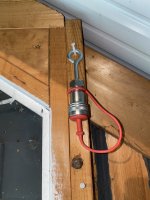
This pressure relief tool is cheaper, easier, and more quickly at-hand than all of that. I keep it hanging from a nail on the door jamb of my shed, where I keep all of my equipment. If you don't ever need one, consider yourself lucky, but it's very handy for those of us who do.
This is exactly what I did after having the problem, when I first bought my grapple. Easy fix, and has never been a problem since.I have same *** couplers on my small hydraulic lines on my machine. If it was a problem that surfaced that often, I'd change the connectors on the machine and my implements to one of each *** and connect the implement hoses together when not in use. The first one is free, as there are two males on the machine and two females on the snowplow. Just swap one of each. For anything else, I can get female quick connects for about $15-$25. That would resolve the issue permanently and I could do about 5-6 implements for the price of the tool.
This is correct. There is nearly zero stored energy in an incompressible fluid, like hydraulic fluid. You can build 1000 PSI or more, and still have very little stored energy.I don't think they'd have enough force to smack apart and whack me in the head.
Yes, if you have a cylinder that can move to change the system volume, such as a hydraulic top link, this will usually prevent hydraulic lock-up. The two places where I need to use this tool are both cases where there is no cylinder or motor that can relieve the pressure:I know that the fluid within the implement and lines would still expand, even when lines form a closed loop, but for me, it has never prevented me from snapping them on the tractor fittings. I think the expanding fluid may be moving the hydraulic cylinder piston enough to not be overwhelming when connecting.

Agreed.. I do the 'joystick wiggle' and connect both ends together as well, and it doesn't always work. Like this year when I had to loosen a connector on my grapple to relieve enough pressure to connect it up even after having both ends connected all winter.Not sure if that was directed at me, as you quoted my post and then asked if I read my own post. I've found that connecting the lines to each other helps reduce, but not entirely eliminate, this type of hydraulic lock-up. Moreover, some of my equipment has M/M for plugging into my factory rear 3rd channel (which is F/F on tractor), so I'd need to make up a F/F coupling for each one for storage.
This pressure relief tool is cheaper, easier, and more quickly at-hand than all of that. I keep it hanging from a nail on the door jamb of my shed, where I keep all of my equipment. If you don't ever need one, consider yourself lucky, but it's very handy for those of us who do.

I agree. The stored energy is not coming from the hydraulic oil it's coming from the stress built up on the lines as the heat causes the fluid to expand.There is nearly zero stored energy in an incompressible fluid, like hydraulic fluid. You can build 1000 PSI or more, and still have very little stored energy.
It comes from change in volume. When the pressure is released by a hose failure, the fluid will immediately expand back to its volume at atmospheric pressure. With oil, this change in volume is extremely small, but with air it can be many times its compressed volume.I agree. The stored energy is not coming from the hydraulic oil it's coming from the stress built up on the lines as the heat causes the fluid to expand.
Never happens, Pressure cannot build up, as the piston in the grapple cylinder would move as fluid expands, and never be high enough to matter.Unless your connectors are the kind that connect and disconnect under pressure, the pressure build up as the implement warm will lock the two connectors together.
For a grapple, sure. Other than the weight of the thumb itself, there's nothing causing pressure.Never happens, Pressure cannot build up, as the piston in the grapple cylinder would move as fluid expands, and never be high enough to matter.
Are those single acting cylinders on the plow? One extending forces the other back? I think that's what I recall on my old truck snow plow.For a grapple, sure. Other than the weight of the thumb itself, there's nothing causing pressure.
But you're ignoring other cases, such as dead-ended lines, or snowplows with opposing cylinders for tilt.
You know, I didn't plumb that one up myself, it came pre-assembled from dealership. It's still new enough that it hasn't needed any hydraulics repairs yet, so I've honestly never taken notice. I'm going to have to check next time I'm out in the shed where it's stored, and report back here.Are those single acting cylinders on the plow? One extending forces the other back? I think that's what I recall on my old truck snow plow.


