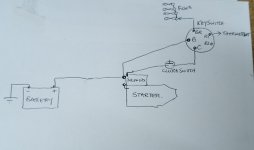
TM1820 Starter circuit

   / TM1820 Starter circuit #1  

pycoed

Silver Member
Joined
Mar 28, 2007
Messages
178
Location
West Wales UK
Tractor
Zetor 7045; Yanmar YM1820;Wheelhorses C121, C101, A8;Cushman Turf truckster
Yanmar YM 1820 - does not start via ignition key. Previous owner had disabled connection to the starter solenoid & added jumper wires from solenoid battery & start terminals, now I think I know why.
He had also, wisely in my opinion, added a 25 amp blade fuse link in the white/red ignition switch feed from the starter solenoid. I have now proven all circuits on the tractor. Everything works except the starter connection from the ignition switch. I have proved the cable from the ignition switch via the clutch switch, which works fine, to the vacant wire next to the starter solenoid i.e the original one.
Battery connections are clean & have dielectric grease, ditto earth to chassis removed cleaned greased, replaced - neither looked corroded at all. I've done the same on the solenoid too.
Every single time, with the original tractor wiring connected, when you turn the ignition key to start, this fuse will blow. If I connect a jumper cable from the battery connection on the solenoid to the start connection the engine starts instantly and the 25 amp fuse stays intact. For some reason, which at the moment escapes me, it seems as if with the original wiring the starter tries to draw its start current via the ignition switch rather than the battery cable. At present I am stumped as to why.
I've come back to the house for a coffee & I'm taking the dogs out for a run & clear the brambles away from the transit box that is pencilled to sit behind the Yanmar, then I'm going to try an additional earth strap from a starter mounting bolt to the chassis. I'm half minded to try inserting a starter relay in circuit, but I wanted a simple little tractor & I've already got a thermostart timer I didn't want!!
Opinions gratefully received!
 
   / TM1820 Starter circuit #2  
Is there a reason to think that this particular starter solenoid would draw less than 25A? i.e. Have you measured the draw? A a rule, at least in my experience, starter solenoids aren't particularly frugal devices.

All the best,

Peter
 
   / TM1820 Starter circuit
  • Thread Starter
#3  
None at all, except that 25amp was the fuse I found in it. Looking at the conductor size, I'd be surprised if more than 10 amps though.
I've no direct way of measuring the current (multimeter max of 10amp), I'll check the ohms & work back from there, but I wonder if just a slow-blow fuse would do it.
I did try with a 30amp, but that blew too. I don't know what ordinary automotive blade fuses are rated, I'd guess not slow-blow
 
   / TM1820 Starter circuit #4  
Any guesstimate on the wire gauge? Have a neighbor with a clamp on multimeter that you could borrow?

From memory my solenoid connection on my current, non-Yanmar, tractor is either 10 or 12ga, but then again the wire only has current on it for a few seconds.

All the best,

Peter
 
   / TM1820 Starter circuit #5  
Are you sure you don't have a short in the original wire between the key switch and the solenoid start?
 
   / TM1820 Starter circuit
  • Thread Starter
#6  
I get 12v at the original solenoid wire when clutch depressed & key to start. 0v when clutch up. I've checked continuity from ignision switch to clutch switch & from clutch switch on to solenoid. All seem OK.
It starts easily by jumping 12v to the solenoid start with no indication that the temporary wire heating. I even ran the starter for 10 seconds by keeping the stop cable pulled & temp wire didn't warm at all. Yet there IS a problem somewhere?????
 
   / TM1820 Starter circuit #7  
Bad Key Switch?
 
   / TM1820 Starter circuit #8  
Strange for sure, turn the key +12V energize the solenoid through the clutch (switch) once energized solenoid contacts made 12VDC to the starter!!
What could possibly go wrong? For some reason it is never that simple.

You said you verified the wiring through the clutch switch to the solenoid and you jump around the solenoid and it starts OK so my guess is the solenoid itself or the key switch.

On edit I guess I was typing this as you were posting

I agree key switch.
 
   / TM1820 Starter circuit
  • Thread Starter
#9  
Any guesstimate on the wire gauge? Have a neighbor with a clamp on multimeter that you could borrow?

From memory my solenoid connection on my current, non-Yanmar, tractor is either 10 or 12ga, but then again the wire only has current on it for a few seconds.

All the best,

Peter
My fully equipped neighbour departed yesterday to Germany for a fortnight to visit relations. I'm opening & closing their chickens for the duration!
Our wire guages are different from the AWG but even keeping the stop cable pulled & running the starter on the small guage temporary cables for 10 seconds or so results in no discernible heat build up at all in the wire, yet the tractor wiring immediately blows even a 30A fuse. This is so simple... yet just not working. AAArgh.
I'll try putting various 55W bulbs at the end of the start wire to see what happens & I think I have some MAXI slow blow fuses somewhere to try as well.
 
   / TM1820 Starter circuit #10  
   / TM1820 Starter circuit #11  
I'm only half way/sort of following this, but in the original post I thought I saw where someone "added a fuse to the ignition switch feed from the starter solenoid". Am I reading this correctly? There is a fuse between battery and ignition switch that's not factory? IF that's the case, my first thought is to change that. If you want a fuse in there, it should be AFTER the switch but before the ignition/accessory circuits. NOT involved in the start circuit. The start circuit can easily blow most any standard fuse in a heartbeat.
 
Last edited:
   / TM1820 Starter circuit
  • Thread Starter
#12  
But it's in the ignition feed, not the actual heavy starter circuit. i.e the wire that feeds the ignition switch & subsequently all accessory circuits. It has to handle supplying the solenoid switch current (about 10A apparently)until the engine starts & supplying accessory current thereafter. In theory a fuse here shouldn't blow unless something is wrong, which is the case here. I assume the previous owner fitted it because something WAS wrong & disconnected the start circuit, requiring two small wires to be touched to start it. I want to get the switch working again & to date have found the switch, the clutch switch AND the solenoid all to work individually but not together, which is EXASPERATING.
 
   / TM1820 Starter circuit #13  
If it's in the feed circuit, it's still in the start circuit. Any power coming OUT of the switch (no matter where it goes) has to come INTO the switch first.

That's the wrong place for the fuse. And it's NOT just 10 amps to supply the solenoid. It's a great deal more. It only takes a second to blow the fuse, right?
 
   / TM1820 Starter circuit #14  
A normal key switch will have 4 terminals:
1. Batt+ (in from battery)
2. Run ( goes to ignition/accessories/fuse panel)
3. Start (to starter solenoid)
4. Glow (to glow plug relay)

The wire connected to batt+ will be heavier gauge than the others (10 or 12 awg vs 14 or 16 for run & depending on draw glow & start could be same 10/12, but usually 14/16 since only activating a relay -- same for big fuse panel ). The batt+ wire should come straight from the battery or run through the main fuse (100 amp). Did the previous owner change out the key switch to non-oem part? Did they wire it right if they had to take apart connectors?

Like Harry said, other than high amp main fuse, I've never seen a fuse in any part of the start circuit. Wires are upsized to handle the current. Shade tree stuff rigged wrong? Yeah throw fuses in to prevent a fire, but not in properly wired/designed oem wiring.
 
   / TM1820 Starter circuit #15  
But it's in the ignition feed, not the actual heavy starter circuit. i.e the wire that feeds the ignition switch & subsequently all accessory circuits. It has to handle supplying the solenoid switch current (about 10A apparently)until the engine starts & supplying accessory current thereafter. In theory a fuse here shouldn't blow unless something is wrong, which is the case here. I assume the previous owner fitted it because something WAS wrong & disconnected the start circuit, requiring two small wires to be touched to start it. I want to get the switch working again & to date have found the switch, the clutch switch AND the solenoid all to work individually but not together, which is EXASPERATING.
Given what you have reported, I would focus on two things;
1) the fuse to the ignition switch works in every position, except "Start", and
2) Applying +12V to the solenoid directly works.

I would suggest trying a new (even temporary) wire from the start wire at the ignition switch to the starter. If that works, then the problem is in the ignition switch to solenoid wire. If that doesn't work, then you need to either clean the switch out, and perhaps disassembly it to clean, or repair, the contacts, or just buy a new start switch.

I would be in favor of disconnecting the battery and perhaps giving the top of the solenoid a good cleaning. File it under the "it can't hurt" category. Perhaps I'm being overly sensitive to the damp and humidity in west Wales, but it comes of experience in similar climes.

All the best,

Peter
 
   / TM1820 Starter circuit #16  
Given what you have reported, I would focus on two things;
1) the fuse to the ignition switch works in every position, except "Start", and
2) Applying +12V to the solenoid directly works.

I would suggest trying a new (even temporary) wire from the start wire at the ignition switch to the starter. If that works, then the problem is in the ignition switch to solenoid wire. If that doesn't work, then you need to either clean the switch out, and perhaps disassembly it to clean, or repair, the contacts, or just buy a new start switch.

I would be in favor of disconnecting the battery and perhaps giving the top of the solenoid a good cleaning. File it under the "it can't hurt" category. Perhaps I'm being overly sensitive to the damp and humidity in west Wales, but it comes of experience in similar climes.

All the best,

Peter
I believe we're seeing this differently. My impression is the fuse and ignition switch work as expected UNTIL the switch goes to "start". That's when the fuse blows. The solenoid and starter work fine as long as it's NOT supplied through the fuse. Maybe I got it wrong.
 
   / TM1820 Starter circuit #17  
I believe we're seeing this differently. My impression is the fuse and ignition switch work as expected UNTIL the switch goes to "start". That's when the fuse blows. The solenoid and starter work fine as long as it's NOT supplied through the fuse. Maybe I got it wrong.
Actually, I think we are on the same page, I think that I may have just explained it poorly.

The previous bypass of the ignition switch was from the battery to the solenoid directly, at least as I understood it. To my way of thinking, that leaves both the wire from the switch to the starter (or the connector/terminals) and the switch as potential issues.

If @pycoed were to run a temporary wire from the switch to the solenoid that could test whether the existing wire is the issue, and if the temporary wire fries the fuse, then the issue is at or in the ignition switch. I leave open the possibility that the start wire is shorting at the switch.

BTW: @pycoed a 10ga wire is 5.2mm2, FWIW...

Sorry for not explaining it well the first time.

All the best,

Peter
 
Last edited:
   / TM1820 Starter circuit #18  
No, we're not. Bypassing the switch to solenoid wire still relies on the feed wire with the fuse. Bypassing everything and going from battery to solenoid does NOT blow the fuse because it's not using the fuse.
 
   / TM1820 Starter circuit
  • Thread Starter
#19  
Actually, I think we are on the same page, I think that I may have just explained it poorly.

The previous bypass of the ignition switch was from the battery to the solenoid directly, at least as I understood it. To my way of thinking, that leaves both the wire from the switch to the starter (or the connector/terminals) and the switch as potential issues.

If @pycoed were to run a temporary wire from the switch to the solenoid that could test whether the existing wire is the issue, and if the temporary wire fries the fuse, then the issue is at or in the ignition switch. I leave open the possibility thatthe t the start wire is shorting at the switch.

BTW: @pycoed a 10ga wire is 5.2mm2, FWIW...

Sorry for not explaining it well the first time.

All the best,

Peter
Yeah - I agree with all that. I'll try a new wire from terminal C to the solenoid & see if the fuse blows. Just to avoid misunderstanding, I attach the following sketches showing (Start1) what should be in place
Start1.jpg
& (Start2) what was in place when bought.
Start2.jpg
I'll be quite happy to ditch the extra fuse once I knew the problem that must have led to the PO fitting it has been fixed. Until then it might will save loom damage.
 
   / TM1820 Starter circuit
  • Thread Starter
#20  
If it's in the feed circuit, it's still in the start circuit. Any power coming OUT of the switch (no matter where it goes) has to come INTO the switch first.

That's the wrong place for the fuse. And it's NOT just 10 amps to supply the solenoid. It's a great deal more. It only takes a second to blow the fuse, right?
I'm thinking that the pull-in coil in the solenoid is drawing too much current & blowing the extra fuse before the reduced hold-in current is applied. What troubles me is WHY they put in the fuse in the first place. Solenoid & starter work perfectly with jury rigged wires, just not with the factory setup
 

Tractor & Equipment Auctions

2008 GMC C7500 CREW CAB FLATBED DUMP TRUCK (A57192)
2008 GMC C7500...
2785 (A60432)
2785 (A60432)
iDrive TDS-2010H ProJack M2 Electric Trailer Dolly (A59230)
iDrive TDS-2010H...
2019 BOBCAT T450 SKID STEER (A60429)
2019 BOBCAT T450...
1992 AM General M998 HMMWV 4x4 Humvee Truck (A59230)
1992 AM General...
2021 CATERPILLAR 259D3 SKID STEER (A60429)
2021 CATERPILLAR...
 
Top