*citedwell thank you for looking into this for me . I would hate to see the OP do all that gutter work & then get sited for doing what he thought was ok to do . Gutters up .
animal12
You are using an out of date browser. It may not display this or other websites correctly.
You should upgrade or use an alternative browser.
You should upgrade or use an alternative browser.
More options
Who Replied?
/ Offered another unusual project
#41

hunt4570
Super Member
- Joined
- Feb 10, 2015
- Messages
- 5,984
- Location
- South Carolina
- Tractor
- Grand L3540 ,724 loader, bucket, grapple and now forks also! And just for OP.. a pool!
Question for you about the other ponds on the property, where do they drain off at? Where’s the overflow? Is there any? Maybe you could cause them to overflow towards that pond?
OP

Hay Dude
Epic Contributor
- Joined
- Aug 28, 2012
- Messages
- 25,572
- Location
- A Hay Field along the PA/DE border
- Tractor
- Challenger MT655E, Massey Ferguson 7495, Challenger MT555D, Challenger MT535B Krone 4x4 XC baler, 2-Kubota ZD1211’s, 2020 Ram 5500 Cummins 4x4, IH 7500 4x4 dump truck, Kaufman 35’ tandem 19 ton trailer, Deere CX-15, Pottinger Hay mower, NH wheel rak
They are located quite a distance away, so I am not able to utilize them. Both of them seem to be holding their water levels just fine.Question for you about the other ponds on the property, where do they drain off at? Where’s the overflow? Is there any? Maybe you could cause them to overflow towards that pond?
Sometimes the easiest way to preserve your reputation is to tell the customer that you’re unqualified to assess the project and maybe refer them to a knowledgeable engineer.Don't want to install something that won't work or lessen my reputation with customer.
Cfhenrickson
New member
I would get your County Extension Agent's view. Our's was most helpful. The most salient advice, do not ruin the clay liner materialHave a long time customer. It's a large acreage HOA with several fields to be hayed and large grass areas to be mowed.
They also have 3 small ponds.
1 pond is spring fed. The spring has unexpectedly dried up. I dont know a lot about the life cycle of springs, so I don't know if they can also come back to life, but it's been on the decline for about a year.
The pond is down to 10-20% (best guess). Water is evaporating, so diminishing with each passing day. There is no other natural water source to replace it nearby. The property owners would like to keep the pond, but are not of unlimited wealth.
Here is the only 2 ways I can think of to replenish the pond:
1. Drill a well. But how much the well gives in GPH is anyone's guess. Very rough estimated cost is about $10,000.
2. The current building the owners live in is uphill from the pond, about 300-500' away in a PUD building of 6 condominium units. Only a small part of the building currently has gutters and downspouts. I was contemplating installing hundreds of feet of 5" gutter, with 3x4 down spouts on the building and running all the down spouts into a continuous rain water retention system. Rather than running the underground pipe into a typical large stone pit, instead run the water directly into the pond.
Realize there's no guarantee it'll rain enough to keep the pond full, but other than that, that's the only reasonable sources of water I can come up with. The roofs areas are pretty large. I suppose there's a roof water runoff calculator that can help calculate.
Another noteworthy point is the other ponds, about 1/4 mile away each, are also spring fed, but not low on water. So that tells me it's probably not a drought issue?
This is all in the "talking/ideas" phase. I have installed several rainwater retention systems, so this is nothing new for me from an installation perspective.
I just don't know if it's enough water?
Pond is triangular about 150' on each leg and averages about 4-5' deep.
Don't want to install something that won't work or lessen my reputation with customer. Another thing definitely worth mentioning is the customer also has some desire to have gutters and downspouts installed to get roof runoff away from the building, so there could be a 2-fer type of benefit in helping to keep water from damaging building foundations
View attachment 3361235
kenhar
Silver Member
- Joined
- Feb 7, 2014
- Messages
- 158
- Location
- romance, ar
- Tractor
- 6640 ford, 1135 massey, 1610d yanmar, 1957 350 international utility
Leakage isn't the problem if the pond is 50 years old. I have had luck in the past, some good, some not so good, cleaning or digging the spring out with a shovel by hand. A machine is too aggressive. Of course the water level has to be low enough to show the springs location. Something as simple as a well being drilled or an excavation project somewhere in the area may be the culprit. The fresh water table is lowering nationwide. The source may be gone. The gutters and any other run off may be the answer. A well would be like an expensive crap shoot. lol
Gord Baker
Platinum Member
Wait for Spring rains. Not worth feeding it. Looks like they could afford to hire a Geologist.
HammerGrips
New member
- Joined
- Mar 29, 2021
- Messages
- 15
- Tractor
- Kubota L4240
You might want to ask a local geologist, well driller, and/or conservationist. They would know your area best, and probably can give better advice than a bunch of tractor enthusiasts or wannabe farmers on the internet.
I think you have two problems. 1. The supply from the spring 2. You definitely have a leak.
You have plenty of runoff to keep it full over the winter. I can see it getting lower in August, but this is early spring and there has been no evaporation. That pond should have collected water all winter and be full. I would drain it and buy a liner for a pond that size.
walnutman
Gold Member
Here in East Texas the summers can be brutal on ponds.
Two years ago we had two months of 100+ temps and not a drop of rain.
We live on a 6 acre pond... shared with a neighbor. Runoff when it rains is plentiful as there's 100's of acres all around us in the local watershed but when it doesn't rain, wind and heat do a number on the level.
We see drops in water level of up to three feet sometimes.
We moved here four years ago and it had been a really rainy spring when we got here. The front yard was a swimming pool with 2" of standing water.
I was told that there was a spring but apparently it's not doing enough.
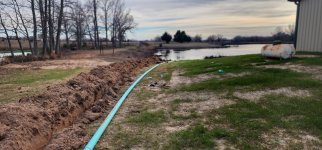
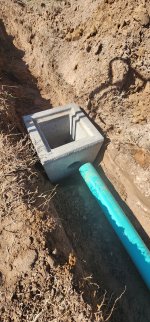
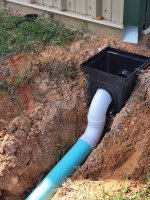
Long story short, bought a backhoe and installed catch basins under every downspout (12) and installed 3 12" concrete drain boxes out front.
It's all done... grass has come in and I notice that when it does rain, the pond fills quicker.
Front yard can get overwhelmed during hard rains but as soon as the rain stops it instantly drains out to the pond.
Two years ago we had two months of 100+ temps and not a drop of rain.
We live on a 6 acre pond... shared with a neighbor. Runoff when it rains is plentiful as there's 100's of acres all around us in the local watershed but when it doesn't rain, wind and heat do a number on the level.
We see drops in water level of up to three feet sometimes.
We moved here four years ago and it had been a really rainy spring when we got here. The front yard was a swimming pool with 2" of standing water.
I was told that there was a spring but apparently it's not doing enough.
Long story short, bought a backhoe and installed catch basins under every downspout (12) and installed 3 12" concrete drain boxes out front.
It's all done... grass has come in and I notice that when it does rain, the pond fills quicker.
Front yard can get overwhelmed during hard rains but as soon as the rain stops it instantly drains out to the pond.
Attachments

Murphys Law Farmer
New member
- Joined
- Oct 29, 2010
- Messages
- 19
- Tractor
- JD4100, NHTN75
Have a long time customer. It's a large acreage HOA with several fields to be hayed and large grass areas to be mowed.
They also have 3 small ponds.
1 pond is spring fed. The spring has unexpectedly dried up. I dont know a lot about the life cycle of springs, so I don't know if they can also come back to life, but it's been on the decline for about a year.
The pond is down to 10-20% (best guess). Water is evaporating, so diminishing with each passing day. There is no other natural water source to replace it nearby. The property owners would like to keep the pond, but are not of unlimited wealth.
Here is the only 2 ways I can think of to replenish the pond:
1. Drill a well. But how much the well gives in GPH is anyone's guess. Very rough estimated cost is about $10,000.
2. The current building the owners live in is uphill from the pond, about 300-500' away in a PUD building of 6 condominium units. Only a small part of the building currently has gutters and downspouts. I was contemplating installing hundreds of feet of 5" gutter, with 3x4 down spouts on the building and running all the down spouts into a continuous rain water retention system. Rather than running the underground pipe into a typical large stone pit, instead run the water directly into the pond.
Realize there's no guarantee it'll rain enough to keep the pond full, but other than that, that's the only reasonable sources of water I can come up with. The roofs areas are pretty large. I suppose there's a roof water runoff calculator that can help calculate.
Another noteworthy point is the other ponds, about 1/4 mile away each, are also spring fed, but not low on water. So that tells me it's probably not a drought issue?
This is all in the "talking/ideas" phase. I have installed several rainwater retention systems, so this is nothing new for me from an installation perspective.
I just don't know if it's enough water?
Pond is triangular about 150' on each leg and averages about 4-5' deep.
Don't want to install something that won't work or lessen my reputation with customer. Another thing definitely worth mentioning is the customer also has some desire to have gutters and downspouts installed to get roof runoff away from the building, so there could be a 2-fer type of benefit in helping to keep water from damaging building foundations
View attachment 3361235
If the square footage of roof foot print is equal to the square footage of the pond, then assuming it had vertical sides like a pool, in theory you could potentially add 43” (PA’s annual rainfall) to its height—over 1 year’s time. Those banks look pretty shallow, so I expect the actual water height increase would be much less.Have a long time customer. It's a large acreage HOA with several fields to be hayed and large grass areas to be mowed.
They also have 3 small ponds.
1 pond is spring fed. The spring has unexpectedly dried up. I dont know a lot about the life cycle of springs, so I don't know if they can also come back to life, but it's been on the decline for about a year.
The pond is down to 10-20% (best guess). Water is evaporating, so diminishing with each passing day. There is no other natural water source to replace it nearby. The property owners would like to keep the pond, but are not of unlimited wealth.
Here is the only 2 ways I can think of to replenish the pond:
1. Drill a well. But how much the well gives in GPH is anyone's guess. Very rough estimated cost is about $10,000.
2. The current building the owners live in is uphill from the pond, about 300-500' away in a PUD building of 6 condominium units. Only a small part of the building currently has gutters and downspouts. I was contemplating installing hundreds of feet of 5" gutter, with 3x4 down spouts on the building and running all the down spouts into a continuous rain water retention system. Rather than running the underground pipe into a typical large stone pit, instead run the water directly into the pond.
Realize there's no guarantee it'll rain enough to keep the pond full, but other than that, that's the only reasonable sources of water I can come up with. The roofs areas are pretty large. I suppose there's a roof water runoff calculator that can help calculate.
Another noteworthy point is the other ponds, about 1/4 mile away each, are also spring fed, but not low on water. So that tells me it's probably not a drought issue?
This is all in the "talking/ideas" phase. I have installed several rainwater retention systems, so this is nothing new for me from an installation perspective.
I just don't know if it's enough water?
Pond is triangular about 150' on each leg and averages about 4-5' deep.
Don't want to install something that won't work or lessen my reputation with customer. Another thing definitely worth mentioning is the customer also has some desire to have gutters and downspouts installed to get roof runoff away from the building, so there could be a 2-fer type of benefit in helping to keep water from damaging building foundations
View attachment 3361235
Does the spring originate in the pond or above the pond? If in the pond you may be limited by hydraulic pressure and won’t see any improvement. Likewise, if there is a leak/drain somewhere.
You’ll have to play with the math based on roof area and slope of the pond.
From the house foundation point of view, 100 sq’ of roof foot print will collect 62.3 gallons of water per inch of rain—when it’s not coming down so fast it runs over the gutters. You need to move that somewhere else anyway.
2manyrocks
Super Member
- Joined
- Jul 28, 2007
- Messages
- 9,516
IMO, the HOA should consider removing the sycamore tree while it is still relatively manageable and less costly to remove whether or not the root system is interfering with water retention or the course of the spring. In my experience, sycamores grow to become very large trees. They seed more sycamores. The limbs are brittle and drop off. I've picked up so many sycamore limbs over the years. From a maintenance perspective, I'd cut it.
You can independently research sycamore trees so you have more than just my personal opinion to work with.
You can independently research sycamore trees so you have more than just my personal opinion to work with.
Striker70
New member
As crazy as this will sound, and not seeing where you live, before you install gutters and downspouts check to see if the rainfall is "public property" and not "private". Some states will not allow run off from the roof to be collected or diverted. Could be an issue or might not be. Once had a neighbor that had pond drainage issues that he was trying to figure out. He went out and threw a handful of light bulbs in the water and watched where they collected to see if a pattern for leakage was seen. 20% loss and not being summer yet seems like excessive loss for evaporation ?
It doesn't look to me like the rooftop water will make a dent. You seem to have a nice size natural drainage area. I suspect a leak. My suggestion; 1. drain the pond and see what you have. (preferably with a syphon.) 2. Look for a leaking area and the possibility of opening up the spring.
If you do route the rooftop water, consider using an open ditch (maybe with a liner or just a concrete bottom) to get the stormwater there quickly before evaporation or absorption.
If you do route the rooftop water, consider using an open ditch (maybe with a liner or just a concrete bottom) to get the stormwater there quickly before evaporation or absorption.

charlessenf
Gold Member
How have you determined that the spring has failed? You do not mention locating the spring source.
As to "Sometimes people ask me about my avatar and what it means. It’s representative of a heavy handed government seizing power from the common man, just trying to make a living."
Rambo was a myth as is the idea of government (in America) "seizing power from the common man."
After all "Governments are instituted among Men, deriving their just powers from the consent of the governed" in our republic.
As to "Sometimes people ask me about my avatar and what it means. It’s representative of a heavy handed government seizing power from the common man, just trying to make a living."
Rambo was a myth as is the idea of government (in America) "seizing power from the common man."
After all "Governments are instituted among Men, deriving their just powers from the consent of the governed" in our republic.
IT'S A ***** BEING A CITIZEN IN A REPRESENTATIVE DEMOCRACY
ULTIMATELY, THE BUCK STOPS WITH US!
ULTIMATELY, THE BUCK STOPS WITH US!
charlessenf
Gold Member
I think you can download the historic rainfall data for free to National Climatic Data Center (NCDC)
I thought Musk fired those guys.
Bob Gibson
Member
A third option would be to line the pond. It would probably cost less than a well.

showcattle
Gold Member
I'd go up above where the spring surfaces and dig perpendicular to the hill and dig a ditch 20 to 40 feet long. I'd put schedule 35 or 40 four inch perforated pipe on plastic and gravel. I'd tee off the perforated pipe with solid wall schedule 35 or 40 four inch pipe.and trench it to the pond. Also pour a concrete headwall at the perforated pipe/solid pipe junction.

Engineer42
Veteran Member
I was thinking the same thing. Dunno about cheaper tho. There used to be a Bentonite type powder you could fan across the pond to settle on the bottom to prevent it from leaching out. Both methods would mean you have to know at what elevation the pond is fed from to avoid corking off your water supply.A third option would be to line the pond. It would probably cost less than a well.
JLinOK
Member
Springs are based on water tables, water tables are based on primarily rain. Check and see what the water table has been doing the last 1, 5 10 years. It may be you are in a slight drought that will probably improve. (My spring operates that way), Well drillers, county and state agents should have an idea.Have a long time customer. It's a large acreage HOA with several fields to be hayed and large grass areas to be mowed.
They also have 3 small ponds.
1 pond is spring fed. The spring has unexpectedly dried up. I dont know a lot about the life cycle of springs, so I don't know if they can also come back to life, but it's been on the decline for about a year.
The pond is down to 10-20% (best guess). Water is evaporating, so diminishing with each passing day. There is no other natural water source to replace it nearby. The property owners would like to keep the pond, but are not of unlimited wealth.
Here is the only 2 ways I can think of to replenish the pond:
1. Drill a well. But how much the well gives in GPH is anyone's guess. Very rough estimated cost is about $10,000.
2. The current building the owners live in is uphill from the pond, about 300-500' away in a PUD building of 6 condominium units. Only a small part of the building currently has gutters and downspouts. I was contemplating installing hundreds of feet of 5" gutter, with 3x4 down spouts on the building and running all the down spouts into a continuous rain water retention system. Rather than running the underground pipe into a typical large stone pit, instead run the water directly into the pond.
Realize there's no guarantee it'll rain enough to keep the pond full, but other than that, that's the only reasonable sources of water I can come up with. The roofs areas are pretty large. I suppose there's a roof water runoff calculator that can help calculate.
Another noteworthy point is the other ponds, about 1/4 mile away each, are also spring fed, but not low on water. So that tells me it's probably not a drought issue?
This is all in the "talking/ideas" phase. I have installed several rainwater retention systems, so this is nothing new for me from an installation perspective.
I just don't know if it's enough water?
Pond is triangular about 150' on each leg and averages about 4-5' deep.
Don't want to install something that won't work or lessen my reputation with customer. Another thing definitely worth mentioning is the customer also has some desire to have gutters and downspouts installed to get roof runoff away from the building, so there could be a 2-fer type of benefit in helping to keep water from damaging building foundations
View attachment 3361235
Catching and rerouting run off may not be legal or alterations my require state or federal approval. That is probably much easier to get under Trump than it was under Bidden/Obama. Do you have vegetation growth (like cedars) that may be affection the water table/runoff?



